

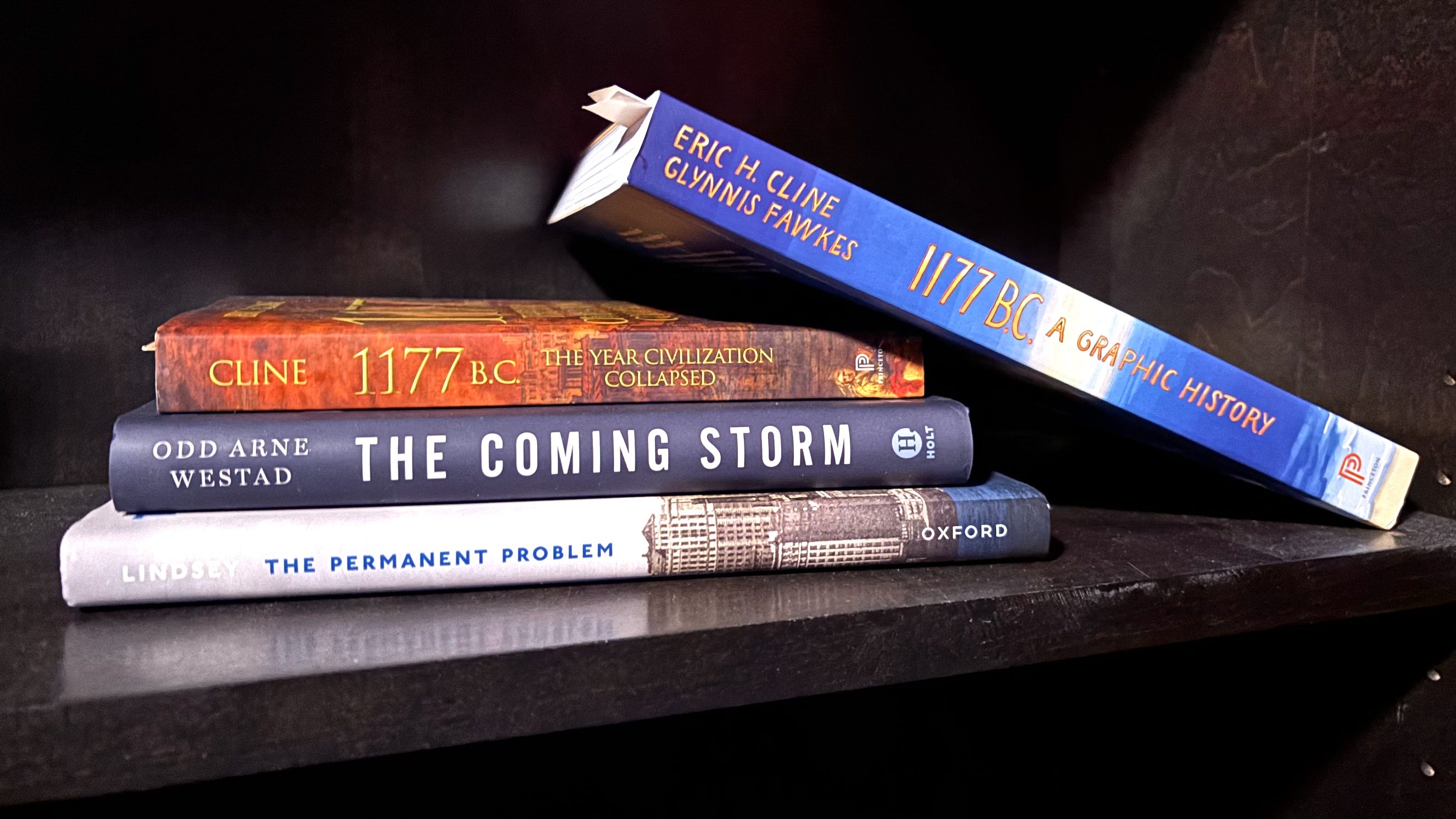
Books on civilizational collapse (or at least the problems of contemporary civilization) are kind of my beat. As such I would normally write in-depth reviews of each of these books. (See previous examples of such reviews here, here, here, here, here, and here(x2)) And I would like to do the same with these books, but writing those long reviews in the past means that this is territory I’ve already mostly covered. Plus for a variety of reasons (*cough* Slay the Spire 2 *cough*) I’ve fallen behind on my reviews and I need to catch up. That said, I think I can still do justice to all five books. In fact maybe the tighter format will help me cut out the normal weird rambling I do. Probably not, but one can hope.
1177 B.C.: The Year Civilization Collapsed by: Eric H. Cline
The Coming Storm: Power, Conflict, and Warnings from History by: Odd Arne Westad
1177 B.C.: The Year Civilization Collapsed
By: Eric H. Cline
Published: 2014 (revised and updated: 2021)
264 Pages
And for those more visually inclined
1177 B.C.: A Graphic History of the Year Civilization Collapsed
By: Eric H. Cline and Glynnis Fawkes
Published: 2024
256 Pages
Briefly, what are these books about?
The seemingly sudden and simultaneous collapse of the major states of the Late Bronze Age: Mycenaean Greece, the Hittites, Egypt, Canaan, Cyprus, Ugarit, and related powers. (Okay Egypt survived, but it wasn’t pretty.) This collapse has been known about for a while, and the previously dominant explanation was that the “Sea Peoples” did it. Cline discusses that view, but he eventually puts forth the idea that it was more of a perfect storm of problems: drought, famine, earthquakes, migrations, internal rebellions, disrupted trade, weakened states, and systems collapse. At the end he offers up some comparisons to our own day.
What authorial biases should I be aware of?
Cline is basically a cyclicalist (I assume that’s a word). He believes there is an inevitable rise-fall-rise again-fall again cycle to civilization. Or at least there has been. He does display some hope that we might be able to avoid this cycle, so he’s not precisely a doomer, but he’s definitely not an optimist.
Who should read this book?
I haven’t talked much about the differences between the two editions. They do largely cover the same territory. So I probably wouldn’t read both of them, and of the two I would definitely read the graphic novel. It’s easier to follow. The whole thing is one big visual aid. But before reading either of them, if you’re really curious about the period, I would probably read the ACOUP overview first.
That covers the what to read, but not the who should read. I would suggest that if you like non-fiction, historical graphic novels, and you’re intrigued by the great collapse, then you should read that version. Otherwise I would skip it (or read ACOUP). The book is not as juicy as the title suggests.
What does the book have to say about the future?
Cline mostly follows the model laid out by Tainter: civilizations naturally get more complex, and eventually the returns on that complexity turn negative. This leads to civilizational progress slowing, reversing, and then collapsing under the weight. He predicts that the same thing will happen to us, and that the signs of this decline are already apparent.
Specific thoughts: How bad was the collapse?
From the vantage point of over three millennia it can be difficult to visualize the Late Bronze Age Collapse. We are familiar with famine, destruction, and earthquakes, and while they are always tragic, they seem sort of normal. We also imagine that the various states were pretty primitive in any case, and how far could they fall anyway? Going from massively primitive to fantastically primitive doesn’t really summon any concrete picture for us.
But there were a few facts that were really arresting: the Late Bronze Age civilizations had a trade network that stretched from Afghanistan all the way to Crete. These days it’s hard to imagine Afghanistan as one of the lynchpins of the global economy. Of course that ended with the collapse. The book spends the most time describing how much diplomacy there was. (Since a lot of it was recorded.) These weren’t isolated settlements. It was a vast network of relationships.
But most amazing of all to me, the cities of mainland Greece collapsed so hard that they lost literacy. The writing system they had before the collapse (Linear B) completely disappeared during the collapse, and it was only centuries later that writing re-emerged using a completely different alphabet (the Phoenician alphabet). As bad as the fall of the Roman Empire was, Europe didn’t lose the ability to write. We didn’t emerge with a different alphabet. Of course literacy was more widespread, and you shouldn’t ignore the huge role Christianity played in that, but for me it put the depths of the collapse in an entirely different light.
The Permanent Problem: The Uncertain Transition from Mass Plenty to Mass Flourishing
By: Brink Lindsey
Published: 2026
234 Pages
Briefly, what is this book about?
The book may seem to be anti-capitalist, but it’s not. In Lindsey’s opinion, capitalism is great. It has solved the “economic problem” of want and scarcity. Most people figured that once that problem was solved, we could use the abundance thus created to easily solve the problem of meaning. Unfortunately, this has not turned out to be the case. Capitalism has created mass plenty, but it has struggled to create mass flourishing. Lindsey frames this as a transition point. (Yes, at this point I realize I’ve mostly just rewritten the subtitle, but sometimes that’s how it goes.) Capitalism has worked, perhaps too well, and we need to refocus it on what it does best (innovation, productivity, etc.) while disentangling it from those areas where its influence is more pernicious (family, human attention, etc.)
What authorial biases should I be aware of?
Lindsey formerly worked at the Cato Institute. In the summer of 2017, he left and joined the Niskanen Center, another think tank. His departure appears to be tied to the election of Trump, which convinced him that the problems of the country were much deeper than he realized, which pushed him in a more institutional direction.
The Niskanen Center was composed of a lot of former Cato people, so still fairly libertarian in places, but they’re a lot more open to government intervention. As a general matter, this places Lindsey in the general “technocratically led abundance” camp, though with more lingering libertarianism than someone like Ezra Klein.
Who should read this book?
I only found out after finishing the book that it was assembled out of a series of Substack posts. Thinking back, that makes sense, and leads me to wonder if it might be a better use of one’s time to just read a couple of posts rather than the whole book.
I will say that it’s nicely positioned between the “capitalism made us rich, so everything is great, and people just need to realize that” camp and the “capitalism is a monster eating the world, kill it with pitchforks and fire” camp. So if you find yourself in a similar space, you’ll probably enjoy the book.
What does the book have to say about the future?
Lindsey believes we’re at a crisis point, but that crises have the potential to resolve in either direction. On the one hand, there are a lot of problems: political dysfunction, creeping authoritarianism, and epistemic chaos, just to start. He’s also part of a growing number who recognize the danger of fertility collapse. He’s very pro-market, but now the logic of the market is everywhere. It has infiltrated our relationships, reshaped our communities, and beyond that, started hijacking our souls. In Lindsey’s telling, we need to unwind that, but does Moloch ever retreat?
Specific thoughts: The problem of leisure
The title comes from something John Maynard Keynes said. To quote from the book:
“The economic problem, the struggle for subsistence,” Keynes wrote, “always has been hitherto the primary, most pressing problem of the human race—not only of the human race, but of the whole of the biological kingdom from the beginnings of life.” But in light of the remarkable progress of modern economic growth, the prospect of continued progress “means that the economic problem is not—if we look into the future—the permanent problem of the human race.” If growth could just persist for another century, Keynes claimed, “for the first time since his creation man will be faced with his real, his permanent problem—how to use his freedom from pressing economic cares, how to occupy the leisure, which science and compound interest will have won for him, to live wisely and agreeably and well.”
This would appear to belong in the same bucket as his prediction that we would only be working fifteen hours a week by now. It’s fair to say that prediction didn’t come to pass, so why should we be any more deferential to his prediction about the permanent problem of leisure?
Clearly, he was wrong about the quantity of leisure, but I think his instincts were right that once most people had time and money above and beyond what was necessary to survive, using that surplus was going to create new and different problems.
Let’s call this surplus of time and money “leisure”. How many people use it wisely and well? Most people decided to turn “leisure” into status, services, spectacle, stuff, and superior selfies. This isn’t solving the problem of leisure. If anything, it makes it more acute, creating a counterfeit leisure with the appearance of flourishing, while actually taking us farther away from true mental, societal, and civilizational health.
Like many people in this space, he recognizes the value of religion while not personally being a believer, but isn’t the facade of belief very similar to the facade of meaning we’re already grappling with?
Perhaps Keynes’ true insight was that humanity would eventually have to pivot from finding meaning in scarcity, to needing to find it in abundance. And frankly, it’s a lot easier to find meaning in scarcity. But scarcity is not something people willingly adopt. We can try to get people to play-act scarcity in the same way Lindsey suggests we play-act religion, and it sort of works on an individual level. But we need it to work on a societal level. And in the final analysis, we live in a rich society where most people act as if God is dead (see my next review) and finding meaning in that sort of society is always going to be a problem, the permanent problem.
The Coming Storm: Power, Conflict, and Warnings from History
By: Odd Arne Westad
Published: 2026
256 Pages
Briefly, what is this book about?
Westad thinks that conditions today are very similar to the conditions before WWI: a long period of relative peace, globalization, rising powers, declining hegemons, nationalism, arms races, alliance malfunctions, and mutual suspicion. He’s not claiming that things are identical, but that they’re close enough to be scary.
What authorial biases should I be aware of?
Westad paints the history well, particularly the horrors of the Battle of the Somme, which opens the book. But by making an explicit comparison with 1914 and the period immediately before WWI, he runs a real risk of overfitting the data.
Who should read this book?
People who think we need to learn from history lest we repeat it are precisely the target audience, and many of the parallels between now and the pre-WWI era are striking and scary.
What does the book have to say about the future?
The thing I found most interesting was how the people of 1914 thought that war couldn’t happen for basically the same reasons we think it can’t happen now. The war would be too horrible. The world is too interconnected. Which is to say our assessment of the future is much the same as the assessment made by people in the lead-up to WWI. That assessment was wrong and maybe ours is as well.
Specific thoughts: Ten things that make our situation as bad as, if not actually worse, than the situation in 1914
1- Westad claims that current suspicion between countries is actually higher than in the pre-WWI period.
2- We imagine that the 100 years before WWI were relatively bloody. While we take comfort in the fact that the 80 years since WWII have been unusually peaceful. In actuality the 100 years before WWI were also relatively peaceful, enough so that the casualties from that entire period were less than the casualties from the Battle of the Somme during the summer of 1916.
3- Speaking of mass casualties, he thinks nukes work to deter things in a bipolar world but that deterrence in a multipolar world will eventually break down.
4- …and he thinks a multipolar world is inevitable.
5- Germany might have won WWI, and China’s manufacturing is twice what Germany’s was as a percentage of global output.
6- Much like Bismarckian Germany, China has already engaged in several wars from national self interest. We just don’t view things like Korea and Vietnam in that way.
7- Russia may end up playing the role of Austria-Hungary. The crumbling empire that’s so paranoid that it drags everyone else into war.
8- Part of the reason the French were less prepared than they might have been is that they were fixated on internal drama rather than external threats. But we would never make that mistake.
9- The leaders in 1914 suffered from information overload, which led to poor decision making. Whatever the deluge of information they were wading through, it’s a trickle compared to the amount of information available now.
10- The only way we’re going to get through things is by cold-blooded diplomacy, not moral grandstanding.
—-----------------------------------------------------
Yes, I resorted to using a list. The ease of the listicle was too much to resist. Hopefully this doesn’t represent the camel’s nose in the tent. I think having additional subscribers will keep me from descending into slop. Which is to say a subscription is a vote for quality—a vote for change.
"I will say that it’s nicely positioned between the “capitalism made us rich, so everything is great, and people just need to realize that” camp and the “capitalism is a monster eating the world, kill it with pitchforks and fire” camp. So if you find yourself in a similar space, you’ll probably enjoy the book."
This is a wide enough space I suspect two people can wander in it and not meet, nonetheless I've added Lindsey to my feed to peruse. Thanks for that, and the other reviews.
If the Bronze Age could collapse was caused in large part by earthquakes and environmental factors, how does that align with the civilizational complexity theory? Did the complexity just cause the collapse to spread?