

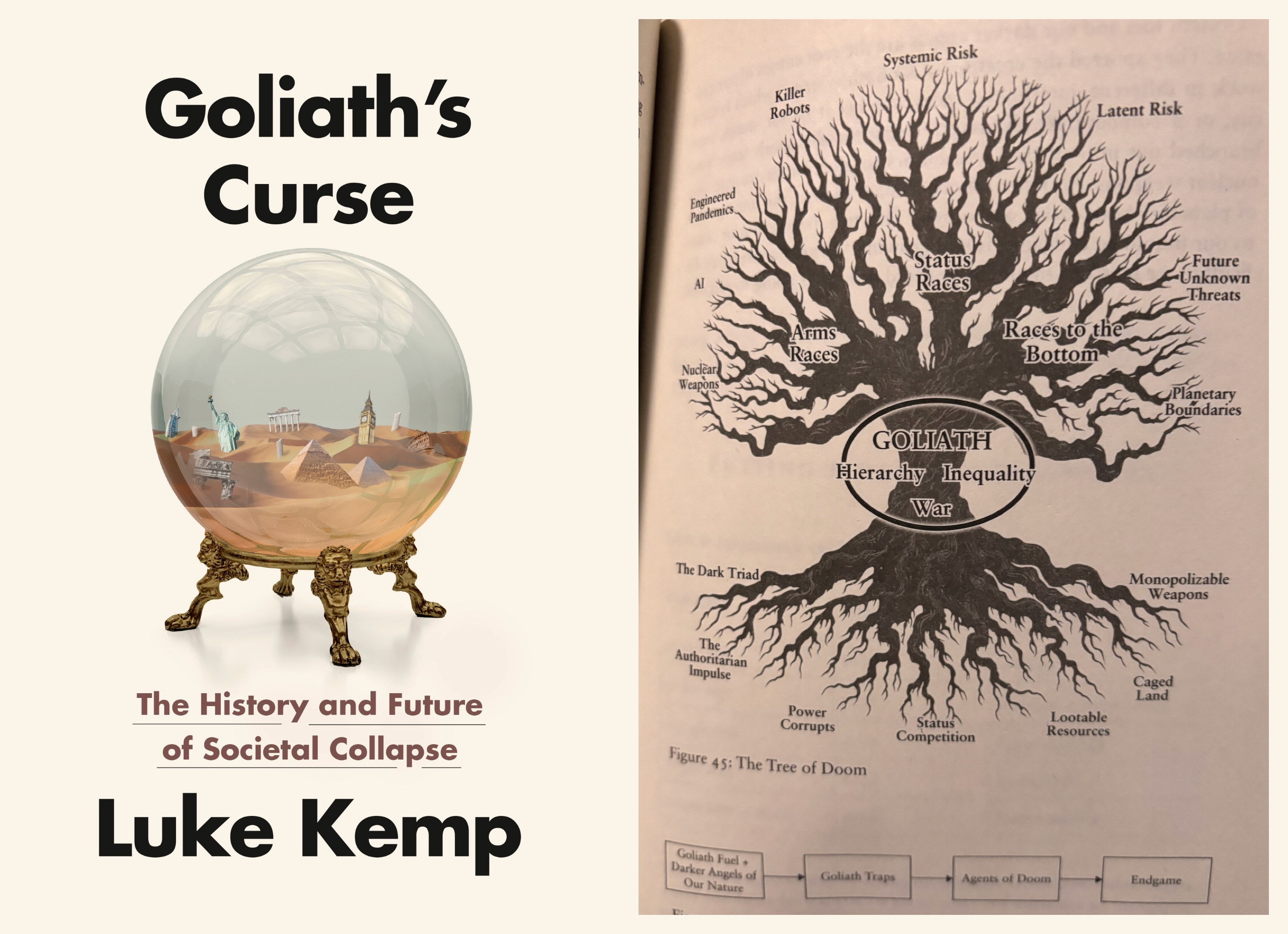
Goliath’s Curse: The History and Future of Societal Collapse
By: Luke Kemp
Published: 2025
592 Pages
Briefly, what is this book about?
By most accounts, civilization, which is to say the large Hobbesian state, is a good thing. Kemp doesn’t necessarily agree. In his account, states are lumbering, tyrannical, extractive Goliaths, cursed to grow bigger, more oppressive and more brittle until they are eventually brought down by a “stone” that hits in just the right place.
Civilization forms out of dominance hierarchies, and these hierarchies generally only move in one direction, towards greater inequality, greater extraction, and more self-interested decisions. This leads to ever increasing fragility and eventual collapse. Collapse might actually be a better place for the masses of people, though it’s often quite bloody to get there.
Though if that’s how it played out in the past, Kemp doesn’t think it will necessarily play out that way going forward. If (when?) civilization collapses this time, it will be far more apocalyptic.
What authorial biases should I be aware of?
Kemp is associated with the Centre for the Study of Existential Risk at Cambridge. I was recommended this book by the sagacious Florian U. Jehn of the excellent Existential Crunch blog. Jehn knows his stuff which gives me the confidence to safely locate Kemp as an important scholar in the genre of collapse research, with an interesting, albeit populist/anti-elite take on the subject.
Who should read this book?
Kemp draws heavily on the ideas of James C. Scott (Seeing Like a State and Against the Grain) and writes in opposition to the ideas of Steven Pinker (in particular The Better Angels of Our Nature). If you find yourself similarly situated, you’ll enjoy this book.
It’s also a great book for anyone who can’t get enough discussion of existential risk. And really given the stakes we should be considering as many viewpoints as possible.
What does the book have to say about the future?
As you might imagine, Kemp’s vision of the future is pretty bleak. He is not a techno-optimist, rather he sees in technology the emergence of a new Goliath, a new arena of dominance and extraction. He has a certain amount of hope, but it all revolves around using democracy to disrupt the ratcheting up of inequality and elite power, which seems like a tall order.
Specific thoughts: Past, present, and future collapse
The book is divided up into three parts:
“Dawns and Ends”: “from the dawn of our species to the emergence of the first states.”
“Imperial March and Fall”: “the rise and fall of empires over the past five millennia.”
“Endgame”: “the future and the prospect of a modern global societal collapse.”
I was mostly interested in his thoughts on the future, but he had some very provocative things to say about the other bits as well.
Dawns and Ends
Much of Kemp’s perspective relies on recent, revisionist scholarship about collapse, conditions, and carnage. Right out of the gate Kemp takes aim at Pinker in a chapter titled “Hobbes’s Delusion”. In Pinker’s Better Angels he made the strong claim that violence was much worse among our earliest ancestors and that the rise of the state (Hobbes’ Leviathan, Kemp’s Goliath) has steadily acted to decrease violence. Kemp takes the opposite stance, arguing that the state is the primary source of violence.
This is not a new argument, I’ve encountered screeds against civilization and the state in several books (off the top of my head I’m thinking of: Against the Grain, Civilized to Death, and Don’t Sleep There Are Snakes — links go to my reviews). The biggest counterargument to those wishing to wind back civilization has always been child and maternal mortality, which is something that only modernity has managed to get down to levels we now find acceptable. This argument doesn’t work if you’re talking about the difference between hunter-gatherers and Hittites, but it does carry a lot of weight if you’re talking about any abandonment of our current “tech level”.
As a general matter the revisionist take makes some very interesting points, and Kemp has some valid points. As far as who’s right on the question of violence, I lean towards Kemp, but I can also see Pinker’s point. When you’re looking at tribal societies that a raiding death here and there doesn’t seem like much, but when you actually crunch the numbers the actual mortality rate is through the roof.
Probably the most important bits for our purposes are his emphasis on anti-dominance and democracy. For the vast majority of our history humans lived in egalitarian, proto-democratic tribes, where dominance was rare, and easily discouraged by the introduction of simple weapons (as opposed to our primate ancestors.) Anti-dominance continues to show up in our loathing of inequality and Kemp leans heavily on our innate democratic instincts as a potential solution to Goliaths later in the book, so it’s important that he lays the groundwork for both here.
Imperial March and Fall
This is the post-Agricultural Revolution period of things—the period people are most familiar with. The collapse of Rome looms very large in these discussions. So let’s talk about Rome for a bit.
I just did a book review of The Children of Mars by Jeremy Armstrong. One of the things the book made clear is that for hundreds of years Rome was not a Goliath at all, it was a gathering place for a handful of families/tribes. But at some point it ended up in what Kemp calls a “dominance spiral”.
In constructing his theory of the spiral Kemp leans heavily on Scott and his observations about “lootable resources”.1 Another phrase that I’ve heard used is “storable resources”. In some respects that’s the central feature. Once you can accumulate resources, you have the potential for inequality, because one person can have more resources stored than another. Kemp argues that this creates the potential for dominance hierarchies, as greater resources translates into greater power, which allows you to get more resources, and even more power, and so on, spiraling upward.
You might think that this spiral takes hold pretty easily, that once someone gets a little bit of a resource advantage that the advantage compounds until they’ve absorbed all of the nearby, easily lootable resources. But the early history of Rome shows that this was not the case. For several centuries the Italian peninsula seemed to be in something of an equilibrium with no community dominating. And it wasn’t an advantage in the amount of resources that eventually made Rome stand out, it was an advantage in waging war—in the looting part of lootable resources. They didn’t produce more, they took more.
And here we see the violence inherent in the system. The dominance spiral starts with bloodshed and coercion, and needs to be maintained in the same way. And the spiral can only end in one of three different ways:
One possibility is that someone comes along with a better system for looting (i.e. they’re better at waging war) and they overthrow your system and replace it with their own. The system is destroyed from the outside
Another possibility is that people don’t like the violence and inequality and they successfully rebel against the system. The system is ended from the inside.
Finally, as the scale of the system increases, so does its complexity. This brings a host of problems: factionalism, corruption, rent-seeking, and beyond this, eventually all of the easily lootable resources have already been seized. At the same time that problems are mounting, those inheriting the system are generally not as talented as those that start it, so the whole thing becomes fragile, and it eventually collapses. This is the system bringing about its own ending.
The question has always been, how pertinent are the previous examples of collapse to our own situation? And which of the three do we need to be the most worried about?
Endgame
Quite a bit has changed since the time of Rome. To begin with back then it was all about taking other people’s resources, there wasn’t much movement on producing your own resources more effectively.2 In the modern era we have many examples of people just making more resources, rather than looting them from other people. This is a big deal, and much of the pro-modernity arguments revolve around our greater productive capacity.
It has also given rise to the hope that we can eliminate war. That there will be so much abundance, so much benefit from free trade, that we will be able to move past great power war. The Ukrainian invasion somewhat belies this, but I nevertheless think that “the system” is unlikely to end because of war. Russia is not going to conquer Europe, and China is not going to occupy the US, at least not anytime in the foreseeable future. Abundance is not the only factor here. Many people argue that the real reason for the Long Peace is that war has become so terrible, no one wants to engage in it. Once again the situation in Ukraine undermines this argument, but it is true that modern technology has created a very different landscape from the one described by Kemp in the previous sections of his book.
Despite this different landscape, inequality has not gone away, and as Kemp repeatedly points out, it still makes people very upset, perhaps upset enough to bring the whole thing down. So even if I have my doubts about the US collapsing from the first method, the second method of ending the system, destruction from within, is still in play. Certainly there are compelling arguments that inequality is not something we should get worked up over, but absent a massive change in human psychology, it’s going to continue to generate dissatisfaction and rage. It’s just the way we’re built, and much of modern populism can be traced back to these impulses. Are the masses going to burn down the system? Maybe, but the modern world has made everything weird, and burning down the system is going to look very different this time around. (Should that be the way things go.)
Things are going to look so different that it makes me question some of the conclusions Kemp draws. Kemp talks a lot about extraction, it’s a big part of the dominance spiral. When extraction/looting is easy, that’s the “golden age”: post Punic Wars Rome, the Mongol Horde, and even “westward expansion”. But as it becomes more difficult factions emerge, corruption proliferates, and complexities arise. This is when the extractive elites become the most troublesome. And I think Kemp is right that we’re dealing with these elites right now.3 But we’ve also got an extractive public. France is a useful example, since they’re farther down the road than we are. The public’s demand for benefits is entirely unsustainable, but despite the awareness that everyone is on the same bus and it’s headed towards a cliff they are unable to apply even the mildest braking. (See the massive protests which erupted when they tried to raise the retirement age from 62-64.)
Talking about the extractive elite without talking about the entitled elderly seems like a significant oversight. And yes, picking on Boomers is unfair, because we all feel entitled, and that’s the problem. And it’s particularly a problem for Kemp because he puts a large amount of faith in democracy to solve the problems of the Goliath, and I think that faith might be misplaced. To the extent that the $38 trillion dollar debt is a problem, and represents a growing potential for collapse—obviously some people argue it’s no big deal—democracy has not slowed the growth down. Arguably the exercise of democracy has always pushed in the direction of more entitlement spending.
This brings us to the fragility of the system itself. This is where most of the discussion and most of the uncertainty lies. Many people argue that the modern world is uniquely fragile. Others argue that it’s exceptionally robust. Kemp kind of tries to have it both ways:
The world appears to be growing both increasingly robust and more fragile. I call this the ‘Death-Star Syndrome’, after the space-weapon in the film Star Wars: A New Hope that can annihilate entire planets but can itself be destroyed by a single well-placed blow. Our world is incredibly powerful and robust, yet surprisingly fragile if hit hard enough in the right place.
I would argue that anything which can be destroyed by a single hit in the right place is fragile, full stop, regardless of how robust it’s individual parts might be. I agree that modern society definitely looks formidable, but I’m with Kemp in suspecting that a well placed hit down a certain exhaust port could blow the whole thing up.
Of course that’s what you want to know, when you’re reading a book like this, is everything going to blow up? I think there are a lot of reasons why things might blow up, but Kemp’s particular thesis is that unless we reduce inequality, and level things out, things are going to blow up.
This is an interesting thesis and it reminds me of a book I read several years ago: The Great Leveler: Violence and the History of Inequality… by Walter Scheidel. (See my review here.) His contention was that the only way inequality has ever been reduced is by blowing things up. Quote from Scheidel:
Through recorded history, the most powerful leveling invariably resulted from the most powerful shocks. Four different kinds of violent ruptures have flattened inequality: mass mobilization warfare, transformative revolution, state failure and lethal pandemics. I call these the Four Horsemen of Leveling.
Now it’s always possible that Kemp is right about inequality and Scheidel is wrong, that it can be done without any of the violent ruptures he mentions. And perhaps it’s possible to mobilize on the scale of World War II in such a way that inequality is reduced, but without needing an existential threat. But that’s not the way to bet. To continue with Scheidel:
State collapse served as a more reliable means of leveling, destroying disparities as hierarchies of wealth and power were swept away. Just as with mass mobilization wars and transformative revolutions, equalization was accompanied by great human misery and devastation, and the same applies to the most catastrophic epidemics: although the biggest pandemics leveled mightily, it is hard to think of a remedy to inequality that was dramatically worse than the disease. To a great extent, the scale of leveling used to be a function of the scale of violence: the more force was expended, the more leveling occured. Even though this is not an iron law—not all communist revolutions were particularly violent, for example, and not all mass warfare leveled—it may be as close as we can hope to get to a general premise. This is without any doubt an exceedingly bleak conclusion. (emphasis mine)
On the one hand Scheidel agrees with Kemp: state collapse does reduce inequality. Where they diverge is thinking that people might be better off post-collapse. And to be fair to Kemp, he mostly makes this assertion with respect to older and less advanced societies. A point he brings up several times is that when Somalia collapsed the Somali people were better off. He does note that it will be very different for the Danish should Denmark collapse. And unfortunately the US and the rest of the western nations are a lot closer to Denmark than Somalia.
In the end I finished this book in much the same place I finished most books in this genre. Sooner or later collapse is coming, and there’s not much we can do about it. Or as the prophet said:
The harvest is past, the summer is ended, and we are not saved.
—-------------------------------------------------------
When reading a book of this size there’s a lot that doesn’t make it into my review. I’m going to experiment with putting some random thoughts into a comment on the post. They will be more quick bullet points, and not exhaustive by any means. Just things that seemed interesting and would be a shame to leave out. I’m curious to know if you think that’s where they belong. Or if I should create another section “Interesting Bits” or something like that for my reviews. Or if they should be a footnote or something else.
If you haven’t figured it out already Kemp loves James C. Scott.
Certainly there were improvements to production, but they didn’t come along very often.
He calls them “Agents of Doom” and he singles out Big Tech, Military/Industrial complex, and fossil fuel and plastics companies.
Faith in mass democracy has little basis in history. The term "ship of state" is well know; the origin is not. It's Plato's criticism of mass democracy.
Paraphrasing: "Democracy is like the crew of a ship, who having mutinied and locked the Captain in his cabin, is now fighting over who has control of the tiller, despite none of them having the slightest navigational training."
The founders of the country were equally disdainful of mass democracy, opting to enfranchise only white, male, landowners. That's an oligarchy.
"I’m going to experiment with putting some random thoughts into a comment on the post.... I’m curious to know if you think that’s where they belong. Or if I should create another section “Interesting Bits” or something like that for my reviews. Or if they should be a footnote or something else."
From an exposure point of view, they belong in a note that links to the main post. That seems to be a good way to get exposure here.
Actually, you can make a comment also share to notes; there's your ticket.