

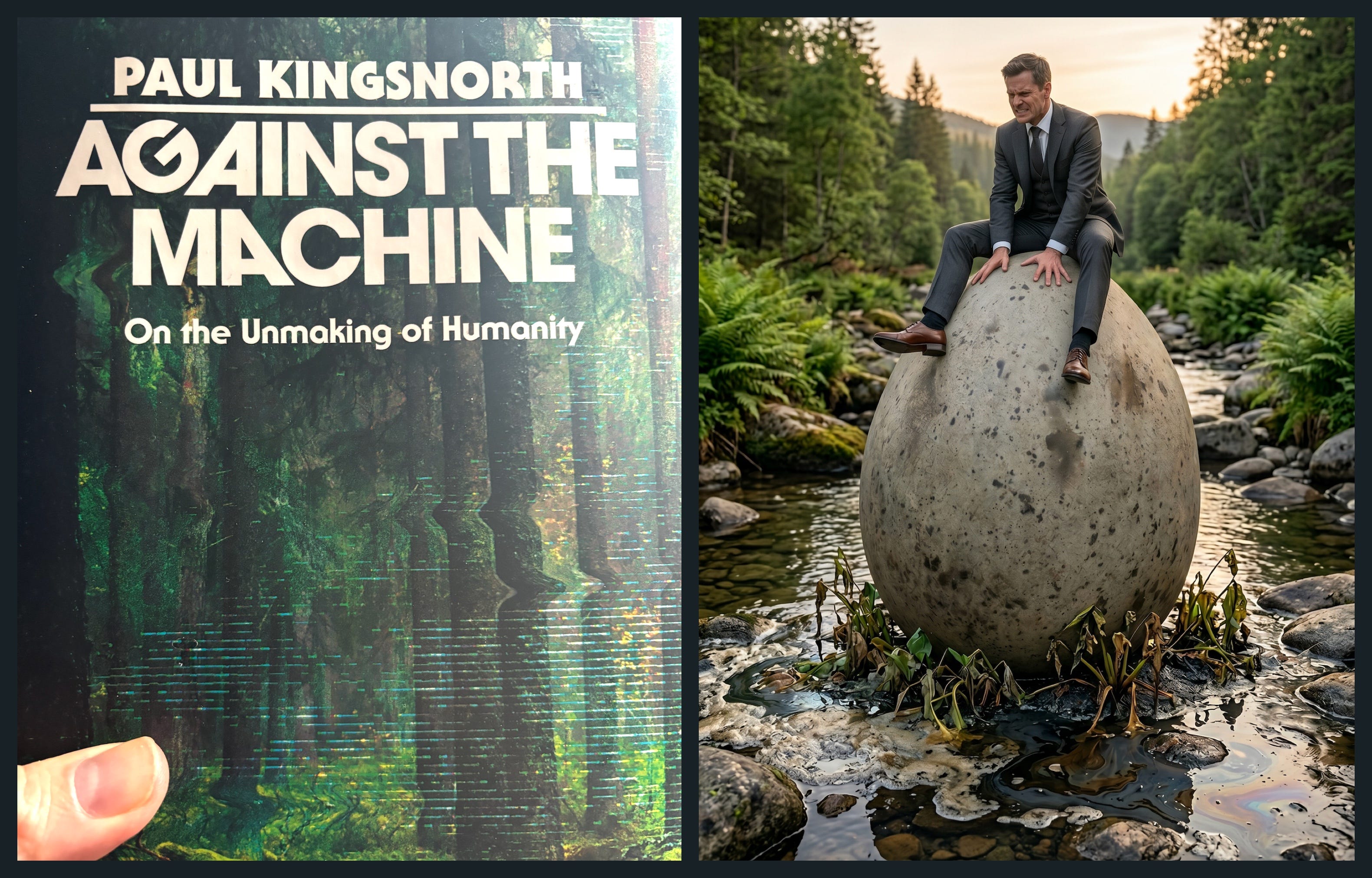
Against the Machine: On the Unmaking of Humanity
By: Paul Kingsnorth
Published: 2025
368 Pages
Briefly, what is this book about?
Before Kingsnorth can tell you how to be against the Machine, he first sets out to define it. The Machine is multi-faceted, but Kingsnorth distills it down into four S’s: Science, The Self, Sex, and the Screen. To take a position “against the Machine” he urges a return to the four P’s: People, Place, Prayer, and the Past. But before you grasp this simple heuristic too firmly, it turns out that not all P’s are good, and not all S’s are bad. He is opposed to progress, particularly as it reduces everything to the parameterized, portable, plannable, and ultimately purchasable. On the other side, he is attempting to carve out a path to salvation, through a return to Christian values, a settledness that comes from having a place and community, and a sacredness that comes from connecting with the natural world.
What authorial biases should I be aware of?
Kingsnorth has huge biases. He’s an ex-environmental activist who converted to Orthodox Christianity. He’s spent decades opposing globalization, technocratic progress, and materialism. It’s not true to say that he opposes all progress, but he certainly thinks that progress has gone from something we do, to something that is done to us—the Machine of the title, which turns everything (nature, people, culture, pleasure) into raw material that needs to serve ever more productive ends.
As such he makes no pretense at being balanced. And that’s part of the book’s value. This is a steelman of the anti-progress argument and a powerful rhetorical broadside against the technological miasma we’re currently wading through.
Who should read this book?
I think those who would benefit most from this book probably won’t read it. And those who will read it, might end up being too radicalized. I personally think that Kingsnorth is pointing in the correct direction, but as a practical matter we can’t all duplicate Kingsnorth’s life in rural Ireland, growing our own food and fuel, while making a living as a writer. To be fair that’s not how he sees things playing out, but he still has a tendency to lump all of progress into one negative whole, without much effort to identify things that might have been useful.
What does the book have to say about the future?
He doesn’t think we’re going to overthrow the Machine, or even deflect it very much. He’s urging people to outlast it in the same way that Irish monasteries kept the light of knowledge alive during the Dark Ages.
Specific thoughts: What exactly is the “Machine”?
I read this book in November, but I kept procrastinating my review because I really wanted to do justice to it. It’s the kind of meaty book that deserves a really meaty review.
This is not that review.
I eventually decided, after nearly six months, that I just needed to get something out. Which is not to say I don’t have an interesting take, only that if I do it’s more by serendipity than design. Oftentimes writing under pressure is when true genius emerges. (Whether “true genius” has ever emerged from these pages is a question I’ll leave to the reader.)
Over that six-month period, my goal was always to redefine the Machine in a more grounded way, to add an air of science to the whole undertaking. It’s easy to dismiss Kingsnorth’s opposition to the Machine as a class of reactionary “well back in my day” grumbling that has been present since Socrates was railing against writing, and probably long before then. But I think that’s a mistake. I think there’s something important here. What if the Machine really was anti-adaptive? What if there really is something exploiting a vulnerability in human psychology and physiology?
Long-time readers of this blog have probably already guessed where I’m going. There is such a vulnerability. They are called supernormal stimuli, and Kingsnorth is not wrong to identify processes that run on discovering these stimuli and consuming them as fuel. These processes are at least a part of the Machine.
For those who haven’t read my previous post(s) on the subject, I’ll provide a brief explanation. The concept of supernormal stimuli arose when Nikolaas Tinbergen was studying the behavior of birds. Birds frequently have very simple heuristics for deciding which eggs to incubate if they end up having to choose. Some birds go by size: the bigger the egg the more they’ll prioritize, while other birds might prefer spotted eggs to unspotted ones. Naturally Tinbergen wanted to measure this preference so he started making artificial eggs. In part, he was wondering how far this size preference would extend, at what size would the birds cease to prefer the larger eggs. To his amazement, it turned out that the eggs had to be almost as large as the birds themselves before they stopped trying to incubate them in preference to smaller, but natural eggs.
From an evolutionary standpoint this is obviously bad. Incubating artificial eggs in preference to real eggs does not do anything to help pass on your genes. But also it’s something that never happens naturally so there is no built-in protection against it. But once technology comes around, we can create not just giant eggs, but all manner of supernormal stimuli. We have created lots of “egg” markets, and they’re all incentivized to make them “big”.
I don’t think I’m engaged in much of a stretch to identify this process as a machine, and to imagine that a similar machine might form part of Kingsnorth’s Machine. Let’s apply this idea to Kingsnorth’s four S’s: Science, The Self, Sex, and the Screen, and see where it gets us. I’d like to go in reverse order.
The Screen: Tinbergen distilled out one factor and then turned it up as high as it would go. This is precisely what’s going on with screens. The one factor is engagement and attention, and content platforms (TikTok, Instagram, YouTube, etc.) are turning that up as high as they will go. Engagement is not quite as easy to quantify as size, but with modern technology that has not proven to be an impediment.
Sex: I have long railed against pornography, but I think it goes beyond that. We used to have long courtships that resulted in marriage and children (though not without frequent complications). Now we have dating apps that are all about instant assessments based on appearance, resulting in purely sexual relationships, without marriage or kids. I quickly descend into raging curmudgeonhood on this topic, so it’s probably best to move on.
The Self: We obviously are very interested in ourselves, and always have been, but historically we had to belong to a community and get along with them. If we didn’t we wouldn’t eat. Now we live lives of such abundance that we can focus ever more on ourselves, and the Machine knows this and has summoned forth vast industries to cater to the smallest degree of narcissism. We don’t all want large eggs, but whatever sort of eggs we want the Machine makes sure to provide them.
Science: I’m a fan of science. I think it has done enormous good. I also think this is the area where Kingsnorth could use far more caveats in his work. Nevertheless, particularly when we consider it in a broad sense, science, engineering, and markets are what allow us to distill out these one things, whether it’s engagement, titillation, narcissism, or giant eggs, and then flood the world with them.
I’m hoping that by coming at it from a different angle—one more based on some actual scientific findings and evolutionary data—that even those very much in favor of progress might concede that Kingsnorth is talking about something real. The question that obviously follows is what should we do about it?
Kingsnorth recommends technological askesis, essentially a monastic avoidance of tech. Certainly some caution around tech is completely justified, but deciding where exactly to draw the line is obviously the hard part. Kingsnorth definitely draws the line in a different, more extreme place than I would, but I agree that there’s a problem and that lines need to be drawn. I’m just overall doubtful that individuals drawing lines will ever be enough. The Machine doesn’t just operate at the level of individuals, it also operates at the level of civilizations. Though Kingsnorth doesn’t go into this, the book very much reminded me of Joseph Tainter’s work on complexity (see my review of his book The Collapse of Complex Societies). In a sense we’re also dealing with civilizational supernormal stimuli. There’s no evolutionary limit on the amount of wealth, energy, or comfort we desire, or the level of complexity we’ll introduce if it helps us get those things. But at some point we’re going to end up getting crushed by giant eggs of our own creation.
—-------------------------------------------------
The pivot to the civilizational scale there at the end was somewhat abrupt. I wanted to go even farther and bring in Florian U. Jehn’s piece on Anthropocene traps, because it dovetails really well, but that would have made it even more abrupt (or longer). But perhaps the real mistake is thinking that I achieved a level of smoothness sufficient to suffer from being disrupted. If you could detect smoothness, no matter how slight, consider subscribing.
Good review and very solid analogy to the birds eggs and supernormal stimuli.
I was one of the founding members of Paul's stack when he first stared it here and have tremendous respect for him. However he plays fast and loose with what a world that followed his anti-technology proposals would actually be like.
Paul believes humans are, for many reasons, on a path to wide-scale, possibly near extinction-level destruction. He's inherited a special dislike of "fossilized sunlight" (his term, which I absolutely love and use to this day) from his environmentalist days. That colors his antipathy toward progress. Similarly, his fatalism regarding the human race colors his recommendations.
The reality is this: Without fossilized sunlight, the carrying capacity of the Earth is about 4-5B people. Oil is both the energy source and chemical precursor for nitrate fertilizers. For all practical purposes, the world eats dead dinosaurs. A couple of years ago, I brought this up with Paul on his own stack several times, but he's always reluctant to engage with the problem of which half of humanity he's willing to consign to starvation.
I agree with Paul about many things. I truly believe he has a deep desire to see people flourish. But as you said, we can't all live in rural Ireland with a composting toilet and a stand of timber. And if we tried to, half of us would starve. I find it ironic that just as Paul has found the faith that grounds the value of human life in the divine, his own recommendations have taken a distinctly anti-human turn. One he remains unwilling to confront.
Thanks, I remember a fair bit of chatter about this book a couple months ago, good to see your take.
I would assume so based on the title and framing, but does Kingsnorth talk about the interplay between those S components? It seems to me that the synthesis of sex, screens, self, and science (or at least engineering) will be the sex-bot, which will effectively sterilize our society.