

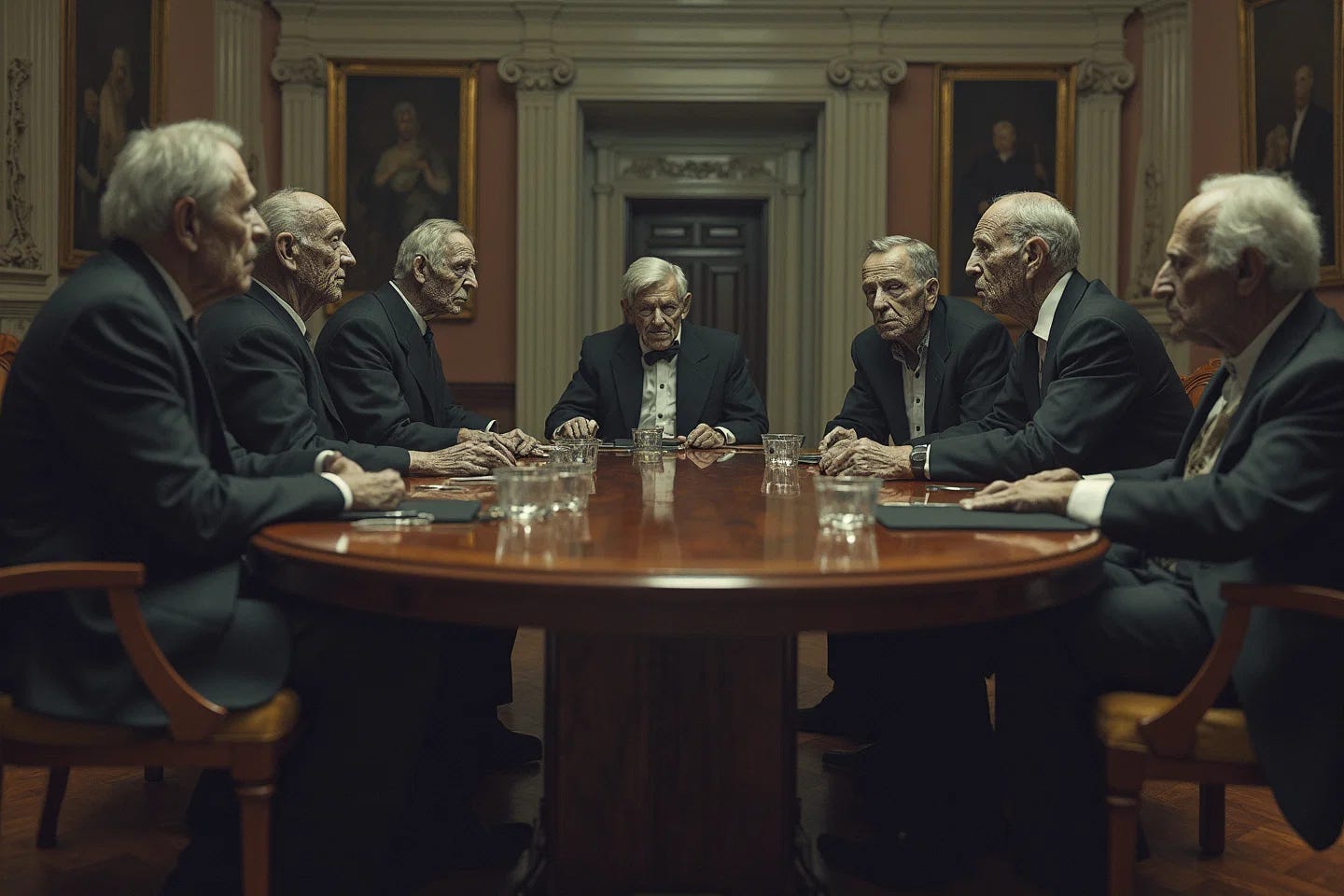
Over the last couple of weeks or so there’s been a lot of buzz about Trump’s health, specifically his ill health. As you might imagine these signs of Trump’s infirmities have led to frenzied speculation by those on the left.1 Last weekend it went so far that there was a rumor going around on the internet that Trump had, in fact, died. I’m certainly open to the idea that Trump is having health problems. Though, at this point, I have no insight into how serious they might be or whether he’s suffering at all from cognitive decline. I’m mostly interested in a different question: How did we get to this point?2
The point where the last two presidents were successively the oldest ever at their inaugurations. Both of whom are suffering from obvious age-related decline with Biden ending up too far gone to effectively act as executive, and the possibility that Trump is headed in that direction. It’s not just the presidency. The average age of the Senate is currently 64.7, the average age of most of the “upper houses” across the western democracies is increasing as well. Finally you may have heard the story of Kay Granger, a Republican from Texas, who spent the final days of her term in an assisted living facility for what her son described as “dementia”. (At least she had the good grace to stop casting votes…)
Why is all this happening? I contend it’s because gerontocracy is a supernormal stimulus. What’s that? For those unfamiliar with this term I would direct you to my previous post on the subject:

The short version is that evolution has primed us to desire certain things. A classic example is sugar and fat. Because they were scarce in the ancestral environment, we have a drive to eat as much as we can whenever we can. Additionally this scarcity meant that there was no danger of eating too much of them, consequently we didn’t evolve any protections in that direction. Lots of encoded behavior to make sure we got enough, none to prevent us from getting too much. On top of all this, we also never developed a protection against the combination of sugar and fat in the same food. A combination which has been dubbed “hyperpalatable”. (The classic example of a hyperpalatable supernormal stimulus is a twinkie.)
It turns out the modern world has created lots of supernormal stimuli. Technology has allowed things which were rare in the ancestral environment to become commonplace. Candidates for supernormal stimuli include gambling, pornography, social media and video games. So why do I think gerontocracies should be added to that list?
Our genes want to survive, so they encode desires that assist in that survival. But oftentimes the encoded desire is a proxy for the things which truly allow genes to propagate. So for example, taste is a proxy for calories, which itself is a proxy for getting the food necessary to survive. Sex is a proxy for having offspring to pass on genes. In the case of gerontocracy, age is a proxy for wisdom and wisdom presumably improves all of the outcomes. (It should be noted that this is more in the realm of cultural evolution than normal evolution, but it’s evolution all the same.)
On top of that the longer someone lives the more power they’re able to accumulate. What this means is that we have two forces pushing us towards having and keeping old people in power. This hasn’t been a problem in the past because there weren’t so many of them, and most of the time they declined physically before they declined mentally. To put it in more concrete terms, modern medicine has given us an abundance of old people, and it’s only because of this abundance that we’re able to end up with a Granger, a Grassley, a Pelosi, a Trump, and most especially a Biden all at the same time. This is bad. Or as my grandfather might have said, having one rabbit in your garden is charming, having thirty is a disaster.3
Perhaps calling it a disaster goes too far. I mean clearly the end of Biden’s term was a disaster, but it might be unfair to lay that all at the feet of a trend towards gerontocracy. This particular failure, contrary to the old saying, had many fathers. Gerontocracy to the extent it even played a role, may have played only a small one. Given this, I can entirely understand people wondering why I would even bother bringing it up. Allow me to draw your attention to a two things:
First, in Francis Fukuyama’s massive two volume history of political order (see my reviews here and here) he spends an enormous amount of time talking about different systems for preventing nepotism. We don’t worry nearly as much about that sort of thing these days. Democracy mostly solved that problem.4 But perhaps gerontocracy is to our day what nepotism was historically. Something we’re going to have to make a special effort to solve. Chinese Emperors solved the nepotism problem with eunuchs. The Ottoman Sultans solved it with the Devşirme (dev-sheer-MEH) levy. Perhaps in time we’ll have to come up with similarly exotic tactics to solve our problem with gerontocracy. Mandatory retirement comes to mind, but perhaps there are others. And of course the problem, as always, is that only those with power have the ability to limit that power, which requires them to act against their own interest. Something they are unlikely to do.
The second point I want to offer for your consideration: It’s easy to focus on the big changes which have been wrought by technology. But in the midst of all the conversation about AI (which I’ve participated in), social media, and a potential war with China it’s worth talking about smaller changes as well. Changes that are more subtle (AI is anything but subtle) but which are nevertheless problems wrought by technology. I think we’ve ended up narrowing this down to the idea that Biden shouldn’t have sought a second term (or should have picked a VP other than Harris.) But the subject is broader than that. Potentially broader even than what I’ve said here. Not only do we have a lot of old people running the country we have a lot of old people voting as well. I’m sure the percentage of voters over the age of 65 has never been higher, and it’s going to continue to increase.
Many people acknowledge that we’re living through a polycrisis, but I think even those people overlook how multitudinous and widespread the changes wrought by technology really are. Lots of things have changed, and the danger of a supernormal stimulus is that it means we can’t rely on following our instincts to save us. Rather our instincts will urge us to continually elect the old guy until his infirmity can no longer be denied (say in a televised debate) or eat twinkies until we’re fat and diabetic. We’ve long recognized the danger of junk food, it’s time to recognize that gerontocracy may be similarly bad for the health of the republic.
Obviously at this moment in time lots of things are proving to be bad for the health of the republic. And I think part of the problem is an incandescent focus on putting everything in terms of a great battle between the forces of good on the one hand and the forces of evil on the other. (With great disagreement on which side is the good one and which side is the evil one.) But life is complicated, there are numerous strange niches, and numerous shades of gray. If you’re interested in such niches I hope you’ll join me here next week for the exploration of more slightly skewed topics.
These are probably the same people who vigorously denied Biden’s decline. And conversely those who were adamant that Biden was too infirm to be president are probably now defenders of Trump’s heartiness. Such are the times we live in.
This post was written before Charlie Kirk’s assassination. Which makes this question far bigger than what I’m actually going to cover.
My grandfather might have said this, but he didn’t, still it remains true in spite of that.
Or perhaps I’m speaking too soon. There are a lot of Trumps in the Trump administration. And people have pinned a lot of the blame for the Biden disaster on his son Hunter.
Interesting thesis. On the other hand, there is, hate to say it, a sort of visceral repugnance for the signs of physical aging. Kennedy beat Nixon because the debates were televised, and the younger candidate usually has more charisma.
Have you checked for a correlation between life expectancy and average age of an elected official?
In comparing health states, I'm less concerned about a president with bruises on his hand than a president with cognitive decline. I'll bet if Biden could trade he'd rather have had the bruises than the brain fog during his fateful debate.