

I recently finished (and reviewed) The Rise and Fall of the Third Reich by William Shirer. I expected the book to give me insight into our current situation. And certainly there are some parallels between Germany in the 1920s and America in the 2020s, but as a general matter it was less helpful than I thought.
America in its 250th year is very different from the Weimar Republic in its first decade. Weimar was untested, messy, tenuous, and fatally undermined by the terms of Versailles. The same cannot be said for the U.S. Institutions are a lot stronger, norms are more entrenched. Rules are strongly enforced. If something is going to happen here, it’s unlikely to happen through an outright rejection of the rules. It’s far more likely to happen by finding the weaknesses of those rules and exploiting them. The failure of Weimar was an early stage failure. Should the U.S. fail it will be a late-stage failure. In this way it reminds me of the fall of the Roman Republic, but also flopping in soccer.
Let’s start with soccer.
I. Soccer
Flopping, for those unfamiliar with the term, refers to the practice of players exaggerating (or, less commonly, fabricating) contact with another player in an attempt to induce an official to award a foul or penalty, or issue a yellow or red card. I like to start here because it illustrates the various elements of my concerns in a fashion that’s easy to understand. If you imagine soccer in its platonic form (where it is obviously referred to as football) it involves players winning through skill and athleticism. Should fouls exist in the platonic form they would be accidental, caused by an excess of enthusiasm. The platonic player, should they commit a foul, would admit the excess and acknowledge the appropriateness of the penalty assessed.
Of course this is not the world we live in. We would like soccer players to be incentivized by the purity of the game, but instead they’re incentivized to win, and if there is a way to win outside of skill and athleticism they’ll take it. Getting a penalty kick can easily mean the difference between losing and tying, or tying and winning. Accordingly there is a lot of incentive to do whatever it takes to be granted one should the opportunity arise.
This is where finding the weaknesses in the rules and exploiting them comes into play. And this is where we see the key elements of the meta-competition. Ideally the enforcement of the rule would perfectly reflect the intent of the rule, but it can’t, and this opens up a gap which can be exploited. The referee is fallible; they can only call what they see in the moment. They don’t have all the angles, and they especially can’t see into the mind of the players. This opens an opportunity for a player to gain an advantage by manipulating the referee’s perception rather than gaining an advantage by being better at the game as it was intended to be played. They’re playing the game at a higher, but also worse level. This is the meta-game.
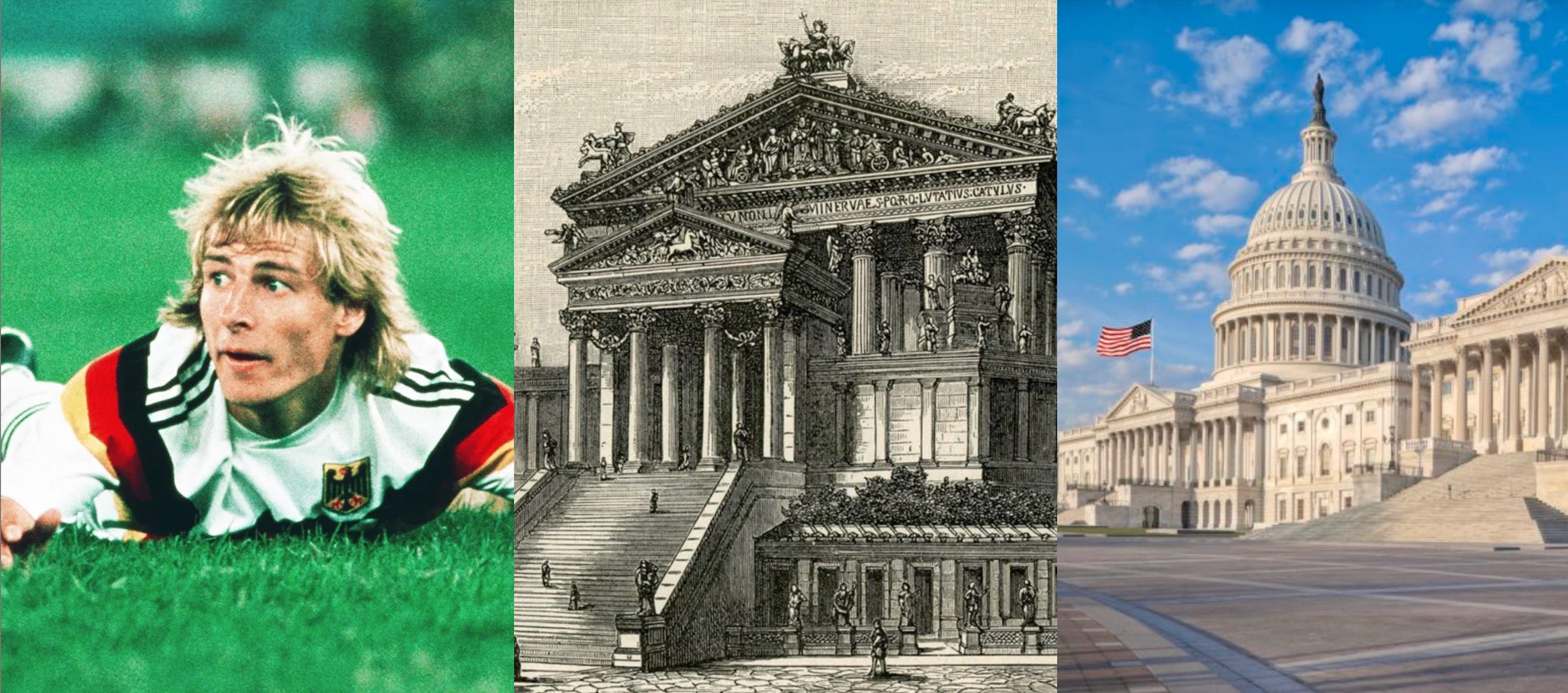
I’m discussing “late stage failure”, as such it might be good to discuss the stages which preceded this one. It would be useful if I could say that flopping is exclusively a recent phenomenon, but that’s not entirely true, what is true is that the flopping arms race is relatively recent. Flopping has been around for a long time, but the meta-competition around flopping is more recent. If one were to select a starting point, a moment when the problem of flopping erupted into the public consciousness, a moment when people realized something had to be done, you could do a lot worse than selecting Jürgen Klinsmann’s theatricality in the 1990 World Cup Final, which ended with a red card for the Argentinian defender.
Klinsmann’s dive! Italy World Cup 1990
At first people tried to use morality, purity, and even shame to stop flopping. “This is not how the game should be played. Players who flop are less admirable than those that don’t. Flopping is wrong and players shouldn’t do it.” It’s hard to say how well this worked. I’d be surprised if it had no effect, but it also obviously didn’t stop it. Then in The International Football Association Board Laws for the 1998/1999 season we see the first explicit rule against flopping (or as the rules call it “simulation”). By the mid-2000s it was apparent that this rule wasn’t having much of an impact. Flopping drew the occasional yellow card, but didn’t materially affect the actual rate of flopping. Many officials and administrators argued that they would need to introduce the possibility of post-match penalties. Still there was a lot of resistance about post-match video review.
In 2011 a paper was published which analyzed flopping from the perspective of incentives. It wasn’t just bad sportsmanship, players were flopping more when the stakes were higher. I know this is a useful perspective, but it also lets players off too easily. Most people behave badly because of various incentives, but bad behavior is still bad. So perhaps it’s unsurprising that it was also in 2011 that leagues started seriously considering post-match penalties and disciplinary reviews. But the problem continued and by 2018 Video Assistant Referee (VAR) was introduced at the World Cup. To be clear VAR wasn’t just about flopping, it was a way of getting clarity on multiple important moments in a soccer game. Specifically VAR was triggered to determine:
Goal / no goal
Penalty / no penalty
Direct red card incidents (not second yellow)
Mistaken identity (wrong player shown a card)
Flopping would mostly fall into the second category. Since there are definitely moments where flopping is advantageous but doesn’t fall into these four buckets it still happens, and even when it does, players have developed new strategies. They will drag a leg or fling out an arm so that contact did take place, and it shows up on the video review. Determining whether any contact happened is easier than determining how severe that contact was, leading to yet another level of gamesmanship between players trying to draw a foul and referees trying to keep the game fair.
II. Defining Meta-competition
Soccer is not the only sport where this sort of meta-competition takes place. Freddie deBoer recently had a piece about tanking in the NBA in order to improve draft prospects. Clock management is also a big thing in the NFL (as in don’t score a touchdown too soon). The AIs have also informed me that there are similar discussions around Mankading in cricket, and strategic grid penalties in F1. But I think we’ve covered the sports side of things well enough. It’s time to distill out some principles for what meta-competition looks like.
First there’s weaponizing the arbiter. The parties engaged in meta-competition don’t defeat their opponents, they trick, or maneuver the referee into a position where he will do it for them. Can the flopper draw an undeserved penalty and change the course of the game.
Second there’s the perversion of the rules. Rules that are designed to promote fair play are used in an unfair manner. Rules designed to prevent injury are used instead to turn fake injuries into real points.
Third there’s the death of the “spirit” of the game, and an embrace of pure, mechanical optimization. What can we do to win, regardless of whether it has anything to do with the game as envisioned (by its inventors, fans, etc.)
Finally there’s the arms race that develops in the meta-competitive space. Video is implemented to give referees better visibility, and to combat this players throw their arms out or drag their feet in an attempt to make the image more confusing and to make sure contact can be viewed even if it might be inconsequential.
As I said above, we can’t pinpoint the first flop. It’s been around for a while. But soccer took its modern form in 1863, and even if we imagine that flopping was recognized as a problem for a while before Klinsmann’s theatrical flop, we’re still probably looking at more than a century where meta-competition was not really a concern. One could speculate on why the change happened, but it seems to be a natural progression that comes from the accumulation of minor defections until eventually the defections become so large that they break out into a different level of competition.
III. Example from the Roman Republic
While the subject of flopping in soccer is interesting, it’s when we expand this idea into the domain of politics that things become truly consequential. One of my big worries when it comes to the continued survival of the U.S. is that we have drifted more and more into the arena of meta-competition. Why is this worrisome? Soccer seems to be getting along just fine despite the struggles over flopping. Why would meta-competition be so dangerous for our polity?
To answer this question, I’d like to take you back to what many historians believe was the beginning of the end for the Roman Republic. The year was 133 BC and the office of Tribune of the Plebs was held by Tiberius Gracchus. Gracchus wanted to pass a land reform bill to give public land to poor citizens. The usual suspects opposed it (wealthy citizens, many of whom were in the Roman Senate) and they convinced the other Tribune, Marcus Octavius, to veto Tiberius’ bill.
In response to this, Tiberius used his own veto to shut down the entire state. He locked the public treasury and promised to veto all business no matter the subject until his bill was passed.
You may have to squint a little bit, but you can see all of the elements listed in the previous section.
Weaponization of the veto
Perversion of the point of the veto (it was never meant to shut down the entire government)
The spirit of how the Roman government was supposed to work was forever perverted by this fight.
It was part of an arms race. Gracchus’ veto was extreme, but Octavius’ original veto was also a perversion of how the veto power of the Tribune was supposed to work. It was supposed to be a tool to protect the weak from the powerful and Octavius used it in exactly the opposite fashion, on behalf of the rich senate.
Connecting all this to the actual end of the republic: Tiberius was assassinated shortly after these events, and later his brother suffered basically the same fate. These acts opened the door into violence, and soon there were private armies and open warfare. This culminated in a fight between two ambitious generals: Marius and Sulla. Sulla ended up triumphing in that war. Having triumphed, he attempted to put things back together by making what had previously been unwritten norms into unbreakable laws. Among other changes, the veto power of the Tribunes was neutered, to prevent a repeat of what the Gracchi brothers had done. Sulla believed that he had fixed the problem, and closed all the exploits, but by using military force (the ultimate meta-competition) he had actually provided dramatic lessons to the next generation of “players” (i.e. Julius Caesar, Pompey, etc.) that the rules don’t matter if you have the most swords.
IV. What’s happening now?
You may already be thinking of ways in which the U.S. has descended into meta-competition, but it’s still probably worth spelling it out. The most obvious example is the role the Supreme Court has come to play in all major decisions, and the dramatic power of being in a position to select the justices. Let’s once again review the criteria:
Weaponizing the arbiter: The Supreme Court has been weaponized. The list of big decisions they’ve made reads like a who’s who of the biggest issues of our time: abortion, student loan forgiveness, campaign finance, Chevron deference, affirmative action, same-sex marriage, etc. A similar list for Congress contains statutes not one American in a hundred could give you the details of: the American Rescue Plan, CHIPS, the Inflation Reduction Act. To the extent that Congress does make the news it’s through precisely the meta-competition I’ve been talking about: government shutdowns over the budget, the filibuster, the fights over Merrick Garland, and Brett Kavanaugh.
Perversion of the rules: I am sympathetic to the idea that judicial rulemaking is downstream of a broken legislative process (namely, the near-impossibility of passing constitutional amendments). Nevertheless, relying on the courts to functionally draft legislation or ‘discover’ new rights within the Constitution is a perversion of the system’s original intent.
Death of the “spirit” of the “game”: The rulemaking system has clearly been perverted from the original intent of the founders. They imagined that the legislature would be the most powerful branch, that it would pass laws that reflected the will and wisdom of the people—this was how good governance would be achieved. Instead governance is largely the province of the executive and the legislature is a performative stage.
Arms race: This one is perhaps most obvious of all, as Supreme Court appointments become more and more powerful. Leading to the situation we have now where the biggest reason to vote for a presidential candidate comes down to whether you think they’ll appoint justices you agree with.
While the Supreme Court is the most obvious example there are others. I won’t spend a lot of time on them. Hopefully you can detect the pattern by now.
Speech: Cancel culture was arguably a meta-competition about speech. Rather than debate an issue people declared it to be so far beyond the pale that it was impermissible to even utter it. They then got various institutions to back them up in this censorship.
NIMBYism: People who didn’t want new construction to take place, for whatever reason, used laws intended for other purposes (zoning reviews, environmental regulations, historical preservation rules) to halt construction, and preserve the exclusivity.
Gerrymandering: Rather than win elections by persuading voters, much of the competition has come down to redrawing the maps in advantageous ways. And then to the extent that there is pushback it once again ends up in the courts.
Science: This is the area that alarms me the most, and something which became apparent only in the last few years when fights over COVID restrictions and youth gender medicine were reduced to a simple command to “trust the science” or an assurance that debate was over because the “science was settled”. This is weaponizing the arbiter at the most fundamental level.
I would say that the arms race is uglier in these areas than it was with soccer. Soccer is simpler, everyone basically knows what the platonic ideal is, and it’s easy to get agreement on what the goal is (pun intended) even if it’s difficult to come up with a perfect system to accomplish that goal. Politics is far messier, and no one seems able or willing to act in ways that might help bring it under control. There have been many different proposals for making Supreme Court nominations more fair. I personally like the proposal where Supreme Court Justices serve 18-year terms, meaning that each president gets to nominate two justices during their four-year term. But so far, proposals like this have gotten nowhere. Perhaps as the crisis deepens people will get more serious about solutions, but solutions require level-headed compromise. If anything the worse the crisis gets the less level-headed and more combative people become.
V. Where do we go from here?
The outlook going forward is not great. I’m not aware of any good examples of meta-competition ending, scaling back, or even pausing once it’s begun. Arguably there are examples of people making the effort to “turn down the temperature” as it were, but paradoxically this is often the place where meta-competition can be seen most clearly.
A useful arc begins with Obama’s nomination of Merrick Garland in 2016. Garland was widely viewed as a moderate, and viewed as a compromise pick in deference to the fact that the Republicans controlled the Senate. And yet despite this effort we ended up with one of the clearest examples of meta-competition when the Senate refused to even hold a hearing, because we were already past normal competition (win the presidency, fill supreme court vacancies) into a competition over process (do we have to hold a hearing? Apparently not.) In response to this the Democrats tried to filibuster Gorsuch, the candidate Trump put forward, and in response the Senate eliminated the filibuster for Supreme Court nominees which was easy to do because the Senate had already eliminated it for all lower court appointments by using the “Nuclear Option” in 2013.
It’s pretty easy to craft a narrative of continued escalation, where any attempts at moderation look more like a misunderstanding of the game rather than an actual opportunity to return to the “old way of playing”. And as we saw in our examples, escalation continues, and gets worse, and without some off-ramp (which seems very unlikely) it eventually results in violence. (I could definitely insert something about January 6th in here, but I’m not interested in going down that rabbit hole).
As near as I can tell the only reliable way to end a meta-competition is to reset the competition itself. This requires something big, wars, revolutions, plagues, etc. (In a similar fashion to the criteria for reversing inequality which I mentioned in a recent review of another book on civilizational collapse.) To put it bluntly, the only way out of this spiral may end up being very bloody.
When we consider the example of Rome this is precisely what we see. The Gracchi brothers were stopped through violence, and in Sulla’s estimation, the Republic had been saved. But once violence started it couldn’t be stopped and eventually the Republic perished in a series of bloody civil wars.
Looking at the current situation I don’t know if the “violence has started”, certainly things have yet to get as bad as they were in the late ‘60s/early ‘70s. And we did pull back from the brink then, but I think that for all the violence on the ground, the true meta-competition had yet to begin. (Recall that the Republicans turned on Nixon.) And fortunately, when comparing ourselves to the Romans, there are some huge differences. For one, the U.S. military appears to be far harder to subvert than the legions of Rome. So it may be premature to worry about violence on that level.
In the near term, I expect an election to happen in 2028, I expect it to be fair and I expect a peaceful transition of power. All that said I would be surprised if there wasn’t some drama, some grand pronouncements of injustice, some theatrical display of harm, some politician rolling around on the turf trying to draw a foul…
—--------------------------------------
This year is the World Cup, and it’s being held in North America. Obviously it’s acceptable to cheer for your home country (assuming they qualified) but may I also put in a pitch for the Netherlands. That’s where I served my LDS mission. Dutch soccer has a reputation for being clever, elegant, tactically ambitious, and forever punching above its weight. Much like this blog. (Too much?) So consider supporting the Netherlands and subscribing to this blog. 6
I love the flopping analogy. It complements Tainter’s complexity theory. He argued that society gains administrative complexity as new problems arise. But I do think there was a bit of a gap in the analysis. Solving more and more problems doesn’t seem like it will become a problem itself unless there is something else going on.
That something else could be that when people are exposed to the same rules for a long time they learn to exploit those rules.
So flopping = rules + cultural evolution, and then you need more rules to prevent flopping.
It’s like bacteria evolving resistance to antibiotics.
The recent article on ACX about SEIU is another good example. People have learned to fully exploit the ballot initiatives.
Thinking of the meta-game is a powerful way to think about the mis-alignment that happens over time in any game. This happens even in evolution - our technology allows us to game our basic desires - we now produce copious amounts of sugar with ease instead of spending a lot of calories and effort and risk harvesting a beehive.
Paul Portesi's x.com feed is a great little insight into this big phenomenon. Also the recent book "The Score" is quite fascinating on this topic.
Great post.