

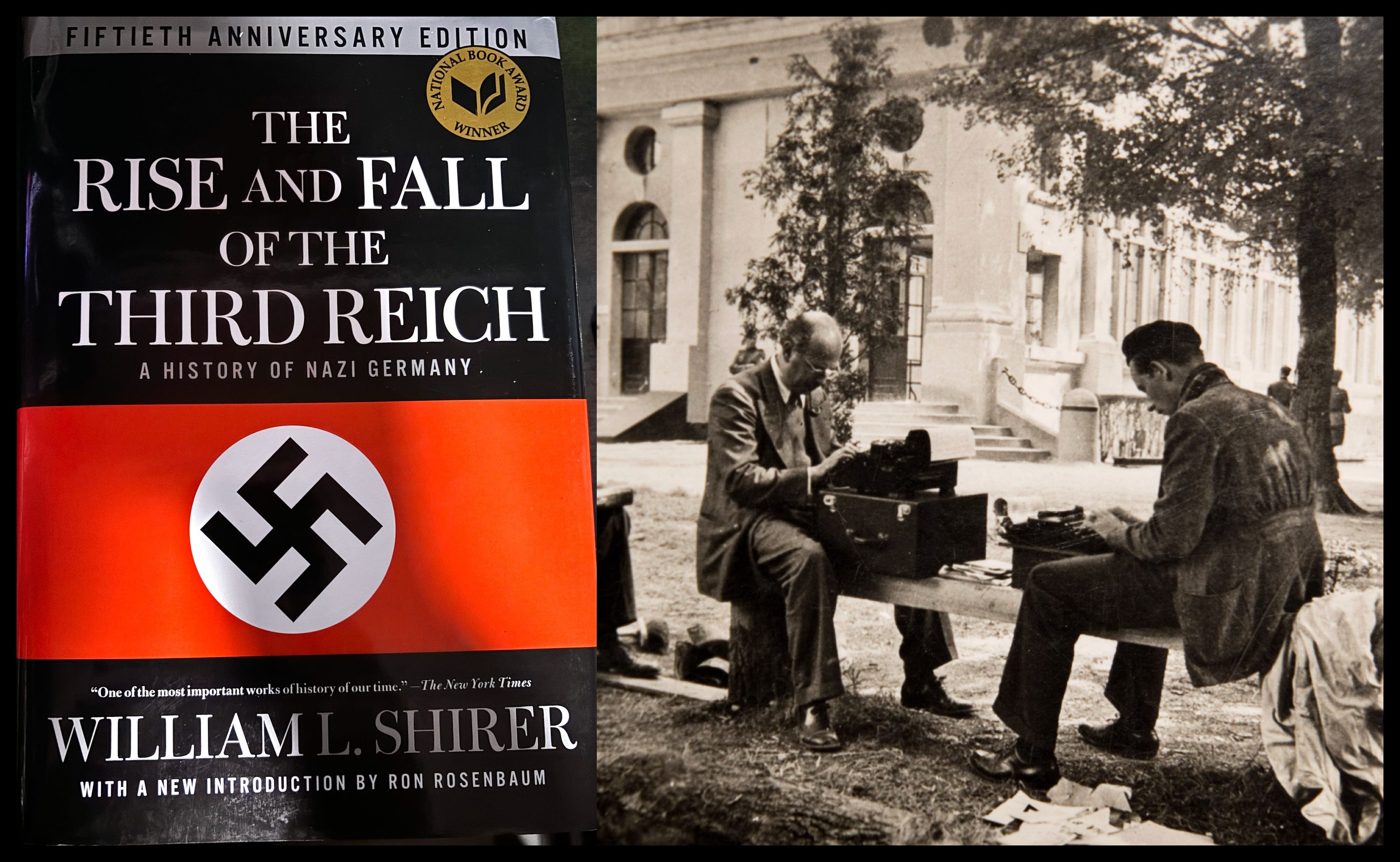

The Rise and Fall of the Third Reich: A History of Nazi Germany
Published: 1960
1250 Pages
Briefly, what is this book about?
A comprehensive history of Nazi Germany, from Hitler’s birth to the Nuremberg trials. Written by someone who was there for a great deal of the most important period.
What authorial biases should I be aware of?
Shirer is a journalist, not a historian, but he did have access to the German state and party archives, plus some diaries, etc. that were captured at the end of the war. Plus he witnessed the rise of Hitler in the 30’s. I love passages like this:
No wonder that Hitler was in a confident mood when the Nazi Party Congress assembled in Nuremberg on September 4 [1934]. I watched him on the morning of the next day stride like a conquering emperor down the center aisle of the great flag-bedecked Luitpold Hall while the band blared forth “The Badenweiler March” and thirty thousand hands were raised in the Nazi salute.
Who should read this book?
It’s clear that this isn’t the most accurate book about this subject. Scholarship is always advancing and this was written more than 60 years ago. But it may be the most readable book on the subject. It flows very well. 1250 pages fly by. (Or rather the minutes fly by, I listened to it, but with a physical copy for reference and anchoring.) If you’re at all interested in this period I think you’ll really enjoy this book.
What does the book have to say about the future?
I think a lot of people are trying to draw comparisons between the rise of Hitler and the Trump phenomenon. Other people see echoes of fascism in the ubiquity of woke-ism. I don’t think history is going to repeat. And I’m not even sure it’s going to rhyme this time around. People are still too aware of the dangers of populist demagoguery for someone to come to power in the same way Hitler did. Which is not to say there’s nothing to be gleaned from this book, but I suspect that by the time things start lining up, in some bizarre fashion, it will be too late.
Specific thoughts: Pivot points
I enjoyed this book a lot. It really dug in deep to the time period and Shirer had numerous interesting observations. The element I found the most interesting were the many pivot points he identified. Points where a different decision could have made a huge difference in how history progressed. Many of these decisions, had they been made differently, had the potential to avoid the war entirely, or at least make it far shorter. A few would have been beneficial to Germany, and extended the war. Though it seems unlikely that any of these changes would have been enough to give Germany eventual victory, if we assume that the US would have still eventually entered the war.
In any case I’d like to cover seven of these pivot points. If I had more time I could easily do double that many. Most of them will be covered briefly, but I’ll spend a little more time on the first point, the one I found the most remarkable, and the last one, the one Shirer feels was the most militarily consequential. I know it would be more convenient if these were in chronological order. They’re not, but I will put the timeframe in parentheses.
Pivot Point One (Summer 1939): I had long thought that the Molotov-Ribbentrop Pact involved the two dictatorships cynically arranging a non-aggression pact, which also involved secretly splitting up Eastern Europe. It was that, but for some reason, in my head, “cynicism” translated into a two party process that took place without much pressure. I had not realized that the Russian negotiations were critical for all the parties, and it was the last major hurdle before WW II could begin. As such everyone was courting Russia, and Britain and France just turned out to be really blasé about it.
Whereas the Nazis pulled out all the stops with their negotiations, sending high-level officials, and making numerous concessions to the Soviets, the British and French did the exact opposite. They sent low-ranking officials on a “slow boat”. The British diplomat didn’t even have the necessary credentials, and had been specifically instructed to “go very slowly with the conversations.” Now understand that this was at the beginning of August, and it was pretty clear that Hitler was going to invade Poland, though not if he thought he’d have to deal with the Russians. But the British and French, rather than doing everything they could to get the Russians on their side, seemed rather to be doing everything possible to sabotage their own efforts.
Pivot Point Two (January 1933): Hindenburg appoints Hitler as Chancellor. I don’t want to draw too many parallels here between then and now, but one of the reasons Hindenburg and von Papen appointed Hitler was they wanted to “own the left” as we might say today. Had they not done that, it’s entirely possible that the Nazi’s would have been revealed as a spent force. They were nearly bankrupt and losing votes.
Pivot Point Three (September 1938): The Munich Agreement, betrayal of Czechoslovakia and the surrender of the Sudetenland. I feel like I’ve come across some stuff recently that tried to rehabilitate Chamberlain. And I understand that it’s hard for us to understand the aversion to war people must have had in the decades after WWI. So I want to be somewhat charitable to Chamberlain, but when you read about Chamberlain’s negotiating strategy—how it starts from the premise of “what can we give Hitler” and from there proceeds from weakness to weakness—it really does come across as a colossal mistake.
Pivot Point Four (September 1938): The “Halder Putsch” Plot. What Chamberlain couldn’t have known—Shirer stresses this—was that elements of the German military were preparing to seize Hitler the moment he issued the final order to attack Czechoslovakia. Chamberlain removed the need to attack Czechoslovakia, and granted Hitler quite a bit of prestige on top of that.
Pivot Point Five (July 1944): Operation Valkyrie, and the attempted assassination of Hitler. Obviously by 1944 the war was basically over, and it’s not clear how much would have actually changed, but two things stand out with this incident. First Hitler’s enormous good luck: the briefcase with the bomb was moved, the building was changed, the second bomb wasn’t used, etc. And second how much actual planning the conspirators had done. I had just kind of assumed that the plan was:
1- Assassinate Hitler
2- ????
3- Germany is saved
But the conspiracy involved seizing key points in Berlin, open channels with the allies, a force of conspirators who would take over in France, and much more. It was a well planned, but unfortunately unsuccessful coup. These days, to the extent that such things still happen they mostly seem very amateurish. I mean what exactly was supposed to happen on January 6th, even if they had managed to seize Pence? Alternatively if Trump had been assassinated you just get crazy civil unrest and Vance as president…
Pivot Point Six (March 1936): Remilitarization of the Rhineland. This is definitely a big one, and one of the best places you can point to for stopping things early. And once again you can point to the weariness that still lingered from WWI, but France really missed an opportunity here. And it wasn’t just that this was the best spot to have pushed back on Hitler, it’s the enormous prestige Hitler acquired when he successfully pulled it off. Over and over again Shirer makes it clear that there were significant elements opposed to Hitler in Germany, but the prestige he was granted by the future allies made it very difficult to act against him.
Pivot Point Seven (Spring 1941): The delay in the Balkans. Shirer seems to think that this was the most consequential military pivot point. Hitler ended up in the Balkans because he had to bail out Mussolini in the Balkans. This was bad enough (and illustrates what a bad ally the Italians were) but then there was a coup in Belgrade, which pissed off Hitler so much that he delayed Barbarossa in order to teach a lesson to the Yugoslavs. As Shirer puts it:
This postponement of the attack on Russia in order that the Nazi warlord might vent his personal spite against a small Balkan country which had dared to defy him was probably the most catastrophic single decision in Hitler’s career. It is hardly too much to say that by making it that March afternoon in the Chancellery in Berlin during a moment of convulsive rage he tossed away his last golden opportunity to win the war and to make of the Third Reich, which he had created with such stunning if barbarous genius, the greatest empire in German history and himself the master of Europe. Field Marshal von Brauchitsch, the Commander in Chief of the German Army, and General Halder, the gifted Chief of the General Staff, were to recall it with deep bitterness but also with more understanding of its consequences than they showed at the moment of its making, when later the deep snow and subzero temperatures of Russia hit them three or four weeks short of what they thought they needed for final victory. For ever afterward they and their fellow generals would blame that hasty, ill-advised decision of a vain and infuriated man for all the disasters that ensued.
As you might gather from the quote, this decision delayed the invasion of Russia by around five weeks. And the difference between ending up in the suburbs of Moscow in Early December vs. Late October is gigantic.
To these points I could add:
The Enabling Act
Basically everything von Papen did.
British and French diplomatic spinelessness preceding the Austrian Anschluss.
The halt order outside of Dunkirk.
Switching target prioritization during the Battle of Britain
“No retreat!” orders from Hitler
Excluding the Soviets from Munich
Set aside for the moment how you feel about Trump and his presidency (good or bad) and try to identify similar pivot points in his ascendency. I’m not seeing anywhere near as many. Is this because we’re still too close to things? Were governmental actions just more volatile back then? Or was it the world itself that was more volatile? Regardless, I hope that when our own pivot point arrives and the fate of the world hangs on a single decision, that we are blessed to make the right one.
—----------------------------------------------------
I find it easier to see parallels between our own day and the end of the Roman Republic than between our own day and the rise of Nazi Germany. I’m not sure what that means. Perhaps it’s because the first is genuinely more similar? Perhaps it’s something like the narcissism of small differences? Perhaps it’s because I’m too soft on Trump? Or perhaps I just need to read more books. I’m going to go with the last one, and if you’re interested in reviews of those books consider subscribing.
Another thing this book highlighted for me was the fragility of Germany's brand new democracy. They did not have 250 years of democratic traditions plus a robust federal system to check the rise of their populist demagogue. Also, this book made it clear that the state of Germany post-WWI was far worse than anywhere in the modern US (even if Trump and his ilk try to pretend otherwise).