

I.
I attended the Faith Matters conference a few weekends ago. For those unfamiliar with the organization (most of you, I suspect) Faith Matters is an independent, privately run LDS nonprofit that defines itself as a “space in which an expansive, radiant approach to the restored gospel can be considered.“
I attended a handful of sessions, and in several of them this “radiance” was on full display. But for the purposes of this post I’d like to focus on one in particular.1 This presentation started in an unradiant manner. The speaker opened by listing all of the problems faced by the modern world. I don’t recall everything he listed, but I know that climate change and political unrest were in there, and possibly decreasing fertility. In any case, this list of problems culminated in the term polycrisis. A term I myself have used from time to time. That was the first half of his talk. The second half was his solution to the polycrisis.
Obviously a solution to all of our most pressing problems would be the biggest thing ever. In fact, if he could solve even one of the problems he had listed that would be a huge accomplishment! So, how did he propose solving the polycrisis?
Meditation…
This seems unequal to the task. Though maybe it was super special meditation? His meditative technique does have a greater focus on connection with others and opening oneself up to a “universal orchestra of meaning”.2 So it’s got that going for it, which is nice. Full disclosure, once the presentation took a turn towards maximum “woo” I kind of checked out.
When I say, “checked out”, I actually had my laptop open and I was getting a little bit of work done while I listened, but I don’t think I missed anything important. I’m pretty familiar with the many crises affecting the world, and I’ll wager I could come up with a few this guy had never heard of. And yes, I tuned out even more as he started talking about meditation, but I’m positive I’ve heard that pitch as well. In fact it’s the entire point of my post, but I’m getting ahead of myself.
I should recount one humorous anecdote. As I said, I was on my laptop. I had a small software deployment that needed to be taken care of. About the same time I started my deploy, the speaker started his guided meditation section, asking everyone to close their eyes and open their souls to God. (Or something along those lines, I was doing a deploy, not taking notes.) This went on for a while, and eventually he asked them to open their eyes, and expand their senses and feel the love they had for the person sitting next to them. I did feel something from the woman sitting next to me, but it definitely wasn’t love… Fortunately, I was on the end of the aisle, so I was only getting barely concealed annoyance from one direction, not both.
One of the people I told this story to said that she felt that the woman’s annoyance was justified. To which I replied, “Of course it was justified! What kind of jerk works on his laptop through a guided meditation exercise! The point of the story is to shake your head at me, not her.”
II.
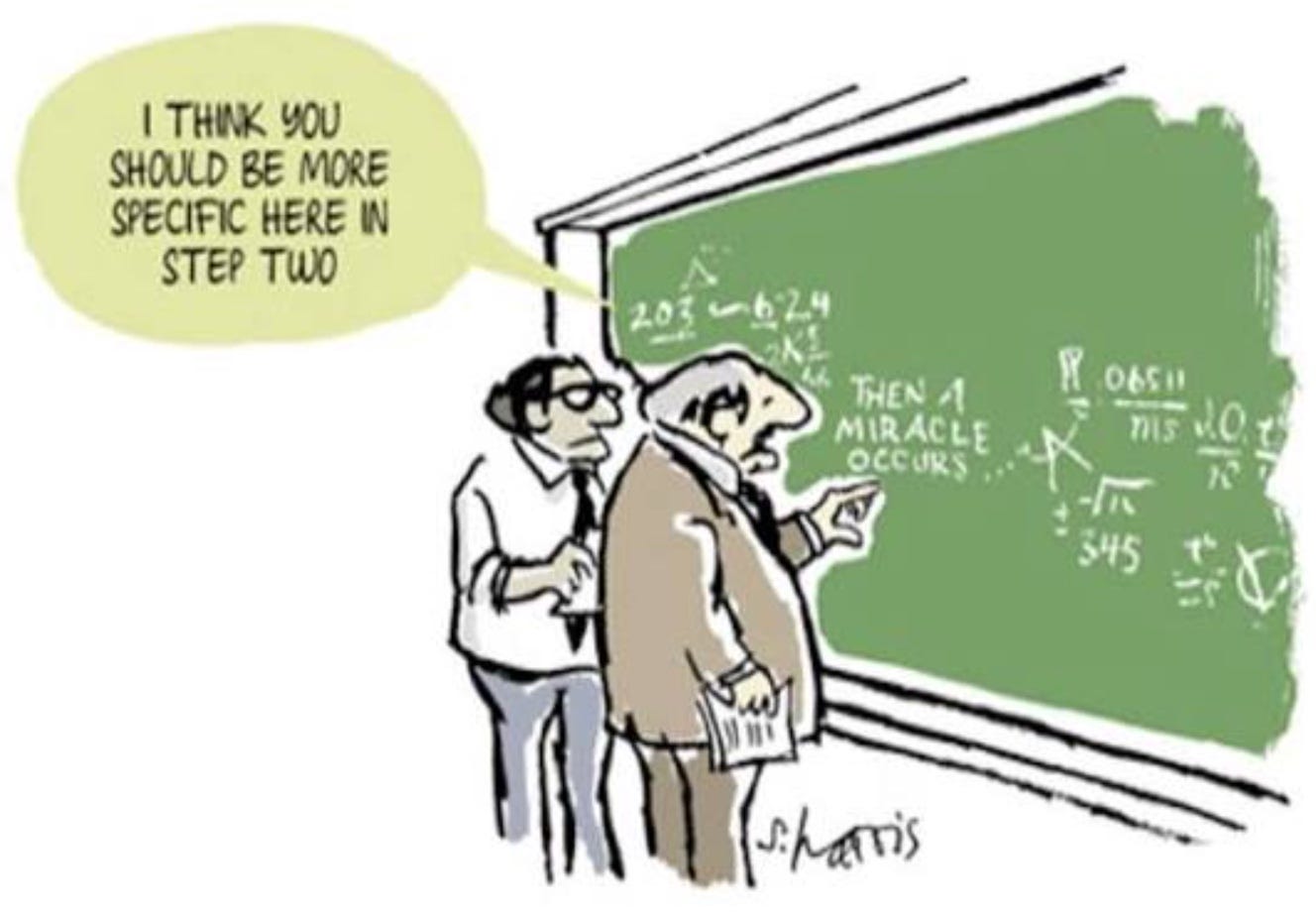
This was not the first time I had heard someone claim that the zeitgeist was changing on some deep and spiritual level. Not the first claim that inner radiance was expanding (so completely on topic for the conference) and that as it expanded, the numerous problems besetting us would dissolve away. That a god (in one form or another) would soon arrive and make everything right. There’s a phrase for this expectation: deus ex machina (DEM).3 And I’m starting to see examples of it everywhere.
On the drive down the morning of the aforementioned conference, I had listened to a book (The God Test) which made a similar claim. Beyond that book I’ve read numerous other books that also demonstrate this phenomenon (vaguely ordered from most to least “woo”):
Undreaming Wetiko: an aggressively New Age version which posits that civilization is trapped in a collective nightmare or mind-virus, but now that we’ve been awakened to this nightmare, we can heal it.
The HeartMath Solution: which I savaged. Contains the line: “We foresee the coherence momentum [meditation, basically] eventually reaching critical mass and creating a millennium of peace and prosperity based on new intelligence.”
The New Copernicans: which I also savaged. This book doesn’t think that it’s meditation that will save us, but rather the innate goodness and expansiveness of millennials.
Journey of the Mind: which puts forth the theory that as individuals become more compassionate, tolerant, and decent the “civilizational supermind” will also become more compassionate, tolerant, and decent.
Books I’ve read are the easiest things for me to point at, but the phenomenon can be seen elsewhere. I’m sure some of you are already screaming “What about AI!” And yes, AI fits the “sudden appearance of the god in the machine who wraps everything up” so well as to be the avatar of the concept.4 Beyond that you have things like Burning Man, solving longevity, the “woo” camp of the psychedelic movement, and even QAnon’s Great Awakening. And obviously there’s Christian millennialism, and expectations of Jesus’ Second Coming.
III.
If we’re going to have this discussion, it’s worth getting more specific. Let’s start this quest for specificity by turning to the OG critique of a DEM: Aristotle’s from Poetics chapter 15:
Thus a person of a given character should speak or act in a given way, by the rule either of necessity or of probability; just as this event should follow that by necessary or probable sequence. It is therefore evident that the unravelling of the plot, no less than the complication, must arise out of the plot itself, it must not be brought about by the ‘Deus ex Machina’.
To me this suggests that if we’re talking about where civilization is going, we should be able to draw support for our prediction from where it has been. We shouldn’t expect a giant discontinuity, something completely out of left field, where everything changes. Turning back to our examples:
We should expect that if meditation, HeartMath, or Burning Man are going to change the entire world, they would have already changed part of the world. And if we are crafting a global mind that is getting more compassionate, we should be able to see that on a chart. The “event should follow that by necessary or probable sequence.” Things shouldn’t come out of nowhere. In other words, we would expect that there will not be any singularities.
The problem with this is that there have been singularities.5 Nothing so extreme as meditation saving the world or AI irrevocably dooming it, but there have been singularities, particularly if you’re generous with the time span. The scientific revolution was a singularity. Anatomically modern humans have existed for 300,000 years, but it’s only in the last 400 or so that we’ve had modern science. We went 300 years with modern science before we figured out heavier-than-air flight, but then it only took us 66 years to go from that to landing on the moon. Fission went from discovery to atom bomb in about 7 years, and even if you want to extend that back to “understanding the atom” we’re only talking about 30-40 years. Under a broad definition these are all singularities.
What turns a singularity into a DEM is the ratio. Allow me to elaborate. Imagine that the numerator is the impact of the “singularity”: the things we have gained through the scientific revolution and heavier-than-air flight or the things we risk from atomic weapons. And then imagine that the denominator is the time it took for the shift to happen: 400 years, 66 years or 7 years, respectively. A DEM is something that inflates the numerator towards infinity and shrinks the denominator towards zero. The closer each value approaches its respective limit the more of a DEM something is.
Clearly there is not a bright line between a DEM and a singularity. (Though all DEMs are singularities, but not vice versa.) The idea of impact divided by time marks the key continuum, but we can’t neglect Aristotle’s causal connection. A civilization-level DEM is not merely gigantic and sudden. It’s gigantic in a way that is unbuttressed by any causal chain. Returning to our original example, individual meditation would appear to have only the most tenuous connection to global salvation. The AI causal chain is not quite so weak (people have been working on neural nets since 1943) but I can tell you that even in June, no one expected math to not make it past October.
Considered this way, the standard Christian version of the DEM fits a little bit awkwardly into the framework. Sure, there’s something of an instantaneous and infinite salvation at the end. But before that most Christians believe that the numerator is going to be profoundly negative, (a time of great troubles and hardships, the four horsemen, etc.) and no one is sure about the denominator, but it’s already gone on a lot longer than many people have expected. And when you have billions of Christians believing something for thousands of years, the narrative foundation (which is what Aristotle was talking about) is incredibly strong.
As a Christian with an eschatological viewpoint, I pretty clearly have some biases here, but I’m not wrong to say that the Christian eschaton is more complicated than the other examples I’ve listed.
IV.
With this definition in mind, it’s worth asking who isn’t expecting a DEM. Which groups, individuals, and movements aren’t awaiting some form of god?
As I thought about this question the first person to come to mind was Tyler Cowen and his rough collection of optimistic market liberals. I would put Steven Pinker in this group, particularly in light of his recent spat with Scott Alexander around exactly this subject. (Alexander believes an AI DEM may be imminent, Pinker does not.) We can expand it further to encompass anyone who believes that the “necessary or probable sequence” of progress points to still more progress. That the line is just going to keep going up. Collected together this all seems like the anti-DEM camp. Though I’m not sure it’s the anti-singularity camp. A permanent victory over civilizational collapse, catastrophic war, and grinding poverty would be a singularity. And to be clear, there have been lots of them recently, so I’m not saying it can’t happen. I’m just trying to place people in the appropriate buckets.
But, if you really want to point at something that’s been a part of the plot for as long as the story has been going, catastrophe, collapse, and conflict is the true anti-DEM camp. And it’s also the best at recommending a course of action. If you’re worried about collapse, the enemy is obvious, the stakes are clear, and the path forward is rough, but visible. Also, historical, non-DEM, collapse moves fast, but not instantaneously. You can see it coming, you can take steps to prepare.
In the end this might be my biggest problem with all of the DEM movements. What am I expected to do? The recommended options all range from risible to impossible. On the one hand I can save the world and avoid disaster if I just practice the right form of meditation? Seriously? On the other hand, I’m supposed to convince China and the US to come to an agreement to cooperatively limit the most powerful technology known to man in the next couple of years? Really?
This is not to say that meditation has no value, or that AI doesn’t pose a danger, more that it’s hard to blame people if they don’t think they can save the world through the one, or from the other.
This would normally be the point where I would hold forth on the pseudo-religious zeal possessed by those longing for a DEM. A way to be done with things once and for all. I think there’s some of that. And of course I would be hypocritical if I singled them out, when I myself believe in a Christian DEM. But as I already pointed out, the Christianity I (and most Christians) believe in says we’re going to have to go through a giant pile of troubles before we get to that point, and maybe being ready for a giant pile of troubles is precisely the advice we all need at this point.
—-------------------------------------------------------------
I am curious what people think of the recent pivot I made away from book reviews towards more essays. I mean, actually I’m trying to not care what anyone thinks about my writing, but that’s not something humans can turn off. It might be argued in fact that we care so much what other people think, that it’s been weaponized, to the detriment of civilization. Maybe that’s why some of the people I’ve mentioned believe that if everyone just thinks the right things about everyone else, salvation will happen. So maybe by asking what you think, I’m empowering the very deus ex machina I’ve been criticizing!!! But I’m willing to take that risk. Let me know your thoughts, and make sure they’re the right thoughts.
I’m not going to name the speaker or the session (though you could probably figure it out if you tried) because I’m not trying to pick on this guy in particular, but rather use him as an example of the phenomenon I’m pointing out.
I don’t remember any exact quotes, but “universal orchestra of meaning” was a phrase in the top-rated review of this guy’s book, so it is a direct quote from someone who knows his work.
Translates to “God from the machine”. It refers to the habit of ancient Greek playwrights having one of the gods get lowered into the theater using a contraption to wrap everything up at the end of the play.
Should you think that this concept, deus ex machina, only refers to happy outcomes, you would be wrong. The gods often appeared to pronounce the final doom as well. (Though sometimes people place this under a separate “diabolus ex machina” heading.) So AI fits whether you’re a doomer or an accelerationist.
Here I’m using the more expansive definition of “singularity”: a point past which the past has almost no predictive power for the future. In Aristotelian terms it marks a point where events do not follow “by necessary or probable sequence”
.
Part of the appeal of the dem is to avoid having to do the hard work of fixing the many small problems nudging society in the wrong direction. Also the realization that everyone else is avoiding that so there's nothing you can do anyway.