

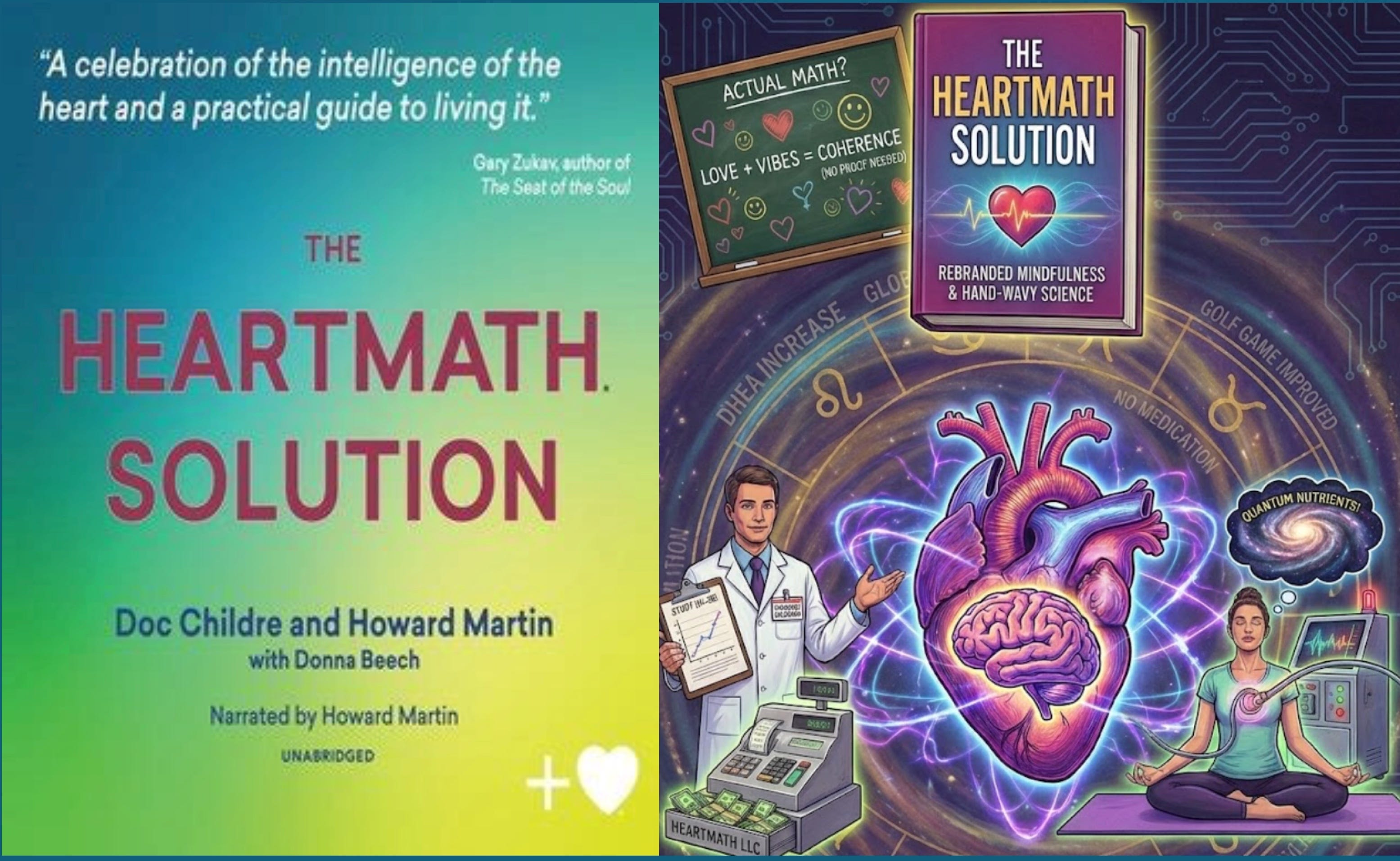
By: Doc Childre, Howard Martin, and Donna Beech
Published: 1999
304 Pages (But somehow this translates to only 2 hours 45 minutes on audio…)
Briefly, what is this book about?
The idea that the heart contains a separate brain, and true emotional health comes from aligning the heart’s brain and its “intelligence”, with the actual brain. Basically it’s mindfulness, meditation, and cognitive behavioral therapy (CBT) wrapped in pseudoscience.
What authorial biases should I be aware of?
These guys are definitely trying to sell you on the HeartMath program. Also many of the studies they cite were conducted by their institute.
Who should read this book?
No one, unless perhaps for its (completely unintentional) value as a work of humor.
Specific thoughts: You had me at “quantum nutrients”
I enjoy most books I read. However critical I may come across in my reviews, it’s very rare that I actively dislike a book. Of the 1396 books I’ve rated on Goodreads, there’s only one book I’ve ever rated as one star. (See my review of that trainwreck here.) This book will be the second.
Though, and maybe you’ve experienced this yourself, hate-reading a book can be enjoyable. And I did enjoy it in that sense. But on every measure other than the “so good it’s bad” this book is awful.
Given that, you’re obviously wondering how on earth I came to read it. What could have possessed me? Well, one of my friends recommended it. He called it a “must read”. In his defense he’s on a religious journey. He’s what you might call a seeker, and I’ve learned that seekers go where they will, and often end up in strange places. I’m optimistic that he’ll eventually arrive at a good destination, but for now he’s in the “recommending pseudo-spiritual, bad science books” phase of his journey.1 One tries to exercise grace in these moments and given that the audiobook was only 2 hours and 45 minutes it wasn’t a huge cost. As such I told him I would read it, but I also cautioned him that I might savage it. Even going into it with that attitude it was worse than I expected.
The Good
I believe that meditation, mindfulness, and particularly CBT do have positive benefits. And when you strip away the babble, and the bad science, and their “nonlocal multidimensional domain that operates under holographic principles” that’s basically what they’re recommending people do. Further I can imagine that the pseudo-scientific, faux-spiritually wrapping might convince people to adopt these practices when they might otherwise not. Finally, these elements of flavor might, in a placebo-like fashion, actually make the core techniques work better.
Nevertheless, there are plenty of great books, programs, and other venues for picking up on mindfulness, meditation, and CBT. This one ends up feeling pretty thin on actual advice when you strip away all the so-called science. It describes only three different methods, and none of them are particularly innovative. This means that the other venues generally have the advantage of being more comprehensive, tying into a larger community with greater practical backing, and most of all not cloaking things in new age bullshit (excuse my french…)
The Bad
It would be one thing if the book made no scientific claims. If it kept things in the realm of the spiritual and supernatural then it might just be another religion, or cult, or mystic society depending on how charitable one wanted to be. But they assert that all of their claims have strong evidentiary backing.
Well there’s evidence and there’s evidence. The most common form of evidence supplied by the book consists of various anecdotes. Not only are anecdotes a pretty weak form of evidence, but because their claims are so ephemeral it’s not even clear that the anecdotes are evidence of their specific claims. For example, if someone has a bad feeling about going into business with their cousin and then that business fails this is not necessarily evidence that:
[T]he heart has its own independent nervous system—a complex system referred to as “the brain in the heart”…[which] send[s] messages back to the brain that the brain not only under[stands] but obey[s].
In fact it is unlikely to act as evidence for something so specific. And without some form of control (does every bad feeling connect to disaster?) it’s really not evidence of anything.
To be fair they do cite some studies. However, all of the studies suffer from at least one of these three problems, and most suffer from all of them:
The studies were conducted by the Institute of HeartMath, so there’s a strong suspicion of bias.
They’re precisely the kind of studies which end up failing to replicate if anyone else tries to conduct them.
The studies are then horribly misused (similar to the example above).
This is really the great crime of the book: the gigantic tower of mystic ramblings built on this very rickety base.
The Ugly
The pseudo-science bugged me. But on some level I tried to accept their stated premise, to run with it as it were. Early on they mention that when someone has a heart transplant that the bundle of nerves connecting the heart and the brain cannot be reconnected. There is no method for splicing nerves back together. I made a note about how these transplant patients would be an excellent source of data for their thesis. Do they behave any differently? Do they have a weaker intuition? Do they get into bad business deals with cousins more often? There’s some evidence that the body regrows the connections over time, can you chart a drop in intuition immediately after the transplant and then a gradual upswing later?
But this would be actual science, and actual science is tough. Meanwhile declaring that heartfelt emotions are “quantum nutrients”, or proposing:
…models that connect electromagnetic theory with an inherently nonlinear, nonlocal multidimensional domain that operates under holographic principles. These models, although not yet proven, help explain how the heart’s field could extend for miles and possibly across the world.
Or declaring that
Appreciation alone is a powerful coherence frequency. Appreciation actually amplifies coherence and aligns us with our true selves. It connects us with the planetary heart and our deeper purpose. By actualizing heart qualities in our lives—appreciation, care, compassion, and love—we help propel the coherence momentum in the consciousness field of the planet.
We foresee the coherence momentum eventually reaching critical mass and creating a millennium of peace and prosperity based on new intelligence. Humanity will eventually make the polarity shift from incoherence to coherence. This will allow people everywhere to more easily perceive and act in ways that are individually and collectively balanced and caring.
Is easy, lazy, and ultimately hilariously crazy.
—------------------------------------------------
The most annoying thing about the HeartMath book is that it contained no actual math. I admit that my blog contains less math than it should, but I have never waxed rhapsodic about coherence momentum with the planetary heart and declared it to be calculus, or even arithmetic. If you appreciate this very narrow quality of my writing, consider subscribing. I could mention additional positive qualities, but I don’t want to recklessly spend all my quantum nutrients.
I met him in a roundabout way through a LessWrong meetup. Whatever the Lesswrongers were going for, I think they failed in this case.
Amusing. Alas, there's probably too much hokum in world for singular takedowns to do too much against it.
"models that connect electromagnetic theory with an inherently nonlinear, nonlocal multidimensional domain that operates under holographic principles."
In this kind of jumble sometimes it's useful to try and zero in on one aspect in the jargon barrage. Just what are 'holographic principles' here? Why would those be relevant?
Still, I blame God for all this. Given how weird quantum mechanics is as we understand it, it's sometimes hard to separate truth from lies from misunderstanding.
> These guys are definitely trying to sell you on the HeartMath program. Also many of the studies they cite were conducted by their institute.
Not a bit dodgy at all, then.