


I.
As I mentioned in my last post, this blog is now ten years old, which gives me an excuse to reflect. I’m not quite done with that. On this occasion I’m going to take a scriptural detour by revisiting my original thesis. Though it’s right there in the title of the blog, it’s been far too long since I spelled it out.
It comes from the book of Jeremiah, chapter eight, verse twenty:
The harvest is past, the summer is ended, and we are not saved.
Surprisingly, and perhaps unforgivably, in the ten years I’ve been writing, I’ve never done a real exegesis of this verse. With the caveat that I’m not a Hebrew scholar, here’s what I’ve uncovered.
Ancient Judah had two harvests. The grain was harvested in late spring/early summer and then at the end of summer fruit was gathered. As such, there was a chance that if the grain harvest was bad you still might get by on the fruit harvest, but if both were bad then you were in trouble. Verse 20 uses this as a metaphor. Both the “harvest” (the late spring/early summer grain harvest) and the “summer” (the fruit harvest) have passed them by, and neither has been enough. So now, as the wise, but dilatory, sage has said, “Winter is coming”, and they’re not ready. Jeremiah is using the actual agricultural cycle of ancient Judah to make a point about their unreadiness in the face of the coming catastrophe.
For “saved”, you could also read “delivered”. This deliverance operates on multiple levels: deliverance from their enemies, deliverance from sins, deliverance from suffering. Which takes us to the present day and my blog, because we’re also seeking deliverance from all those things. And I don’t think that deliverance is coming. We are not saved.
To be clear, I’m not denying the existence of divine salvation. I am, and always have been, a Christian, with all that it entails about the salvific promises of Jesus and his gospel. I’m talking about secular salvation, about deliverance from the sins, shortcomings, and squalor of human existence. To extend the analogy, secular salvation would mean never having to worry about having enough food for the winter, or worse, having an invading army take your food, kill your men, and carry off your women.
Ever since the beginning of the Scientific Revolution, and arguably even before, there has been a hope that an increase in knowledge, or a transformation of government, or a more benevolent ideology would deliver us from one or more of humanity’s ongoing burdens.
To spell it out more directly, a form of secular salvation is what the founders hoped to achieve with the American Revolution, the Declaration of Independence, and the Constitution. The French also thought they were on their way to it with their several revolutions. Every last one of these revolutionaries thought that they could deliver people from thousands of years of tyrannical and cruel despots.
It’s what the communists have been promising us since the time of Marx. They were sure that communism, properly implemented, could deliver humanity from want. (Far more ambitious than the revolutionaries, and far less successful as well. And notice the way things continue to escalate…)
Both the League of Nations and the United Nations were attempts to bring it about. Each was founded after the great wars of our age and each dreamed of preventing such wars from happening again.
Some of these ideological efforts achieved modest success, and that’s not nothing, bringing us to the present day where we have fewer despots, less poverty, and only low-intensity great power conflicts. (Of course some of these ideological efforts, most notably communism, brought us more despots, more poverty, and more great power friction.)
The moment when durable and comprehensive success seemed closest was probably the early ’90s, after the fall of the Soviet Union. The Cold War had ended, and maybe this meant that the promise of the UN could finally be realized as a new, benevolent international order preventing all wars. Tyranny was on the ropes, and it seemed like just a matter of time before it was vanquished. (Tiananmen Square was in 1989, and yes, it was brutally suppressed, but, at the time, there was the feeling that it would keep happening until it succeeded.1) Liberal market democracy was ascendant, and appeared to be the final form of government. Fukuyama declared that we had reached the “end of history”. (In a book that has been massively misunderstood, and was actually quite prophetic about all the ways that it would go wrong.)

One of the members of my writing group insisted that I include this meme.
This moment of seeming global harmony was short-lived, and since then things have not gone well. Despots are gaining ground, and they’ve learned from the mistakes of their predecessors. Their despotism is better cloaked. They’re better at playing the game.2 Poverty is still low, but many people seem convinced that there’s a new poverty of the soul. Wars are back, and getting worse.
Looking into the future, we still hope to achieve secular salvation, but our aspirations have ended up bifurcating. Many (most?) have reverted to the modest hope that we might return to some semblance of the 90s. Some fanatics continue to dream of an ideological promised land, though their promises ring increasingly hollow. Most people have given up on the “harvest” of remaking society through ideology, but there are still many who see the potential for a second “summer” harvest. These individuals think that what we failed to accomplish through ideology can instead be accomplished through technology, and their dreams are even grander. To a certain extent they have a point. Consider the entire globe, and it’s become ever more rare for someone to worry that they don’t have enough food to survive the winter. This miracle was brought about by technology, not ideology.3 And perhaps this second harvest will deliver us even though the first hasn’t.
Prophets of this “summer” harvest include Elon Musk with his plan to establish a permanent manned presence on Mars. He extols a magical future where technology opens up vast opportunities, and the existence of humanity is ensured.
Another prophet is Bryan Johnson, who preaches of immortality. You might also include Robin Hanson and his push for futarchy. (Though to be fair, Hanson isn’t nearly as silly as the other two. He doesn’t dream of utopia. His biggest worry at the moment is preventing cultural collapse—a goal I share.)
Of most salience at the moment, in the role of John the Baptist, preparing for the coming of the messiah, we have AI optimists who imagine that secular salvation will be ushered in by a benevolent AI superintelligence: a godlike entity that will eliminate war, want, tyranny, and terror.
II.
As one considers the chronically ill state of liberal democracy—its continual crisis of leadership, its unsustainable finances, and its cratering birthrates—I hope I don’t have to press too hard to demonstrate that the “harvest” of ideology is past, and it has not delivered us. This does not imply that no improvements are possible, or that liberal democracy isn’t better than the alternatives. Rather it’s to say that secular salvation is not going to happen through the portal of ideology. I understand some people still think that the right ideology, correctly implemented, could yet do it, and perhaps I was wrong to call them fanatics. (“True technocracy has never been tried!”) But we’ve been trying for at least a couple of centuries, and lately it feels like for every step forward we take one (or more) steps back.4 As such I’m optimistic that most people will agree that the “harvest [of ideology] is past”. Most of the disagreement centers on whether the “summer [of technology] is ended”.
Technology has clearly provided deliverance in the past. As long as we’re using agriculture as our driving analogy, we should pause to consider the Green Revolution and the deliverance from starvation it brought to hundreds of millions of people. Given an example like this (and many others) why do I doubt that it will continue to bring deliverance? Clearly it could. I don’t deny that, but so far things never seem to turn out the way we expect.
I confess to being, hitherto, somewhat airy in my use of the term “secular salvation”. There has been a sense of salvation being the achievement of ordinary goodness—the conditions which obtained in the 90s. But I have also used salvation to gesture at a state change. Some broad line of demarcation which separates our age from previous ages. But of course there is also overlap between these two ideas. If we had permanently banished large scale war with the UN; if we had solved the problem of energy with nuclear power; if the fall of the Soviet Union had led to the liberalization of China, or if that liberalization had just managed to stick in Russia; or if we had managed to create sustainable welfare states that didn’t eventually bankrupt those same states, we would also consider these to be state changes and worthy of the label “secular salvation”.
Instead war is back, China and Russia are becoming increasingly illiberal, and government debt is exploding. All while our population slowly dwindles. These are all developments which cut against “ordinary goodness” but also represent potential negative state changes—the opposite of salvation.
As pessimistic as this list is, as dour as it seems, it doesn’t change the fact that technology has been truly amazing. For many, it’s going to take much more than this to convince them that technology will eventually fail us. But, once again, I think there are some valuable parallels to be found in Jeremiah.
The dating of chapter eight is open for debate, but as scripture it’s anticipating the invasion of Babylon and the eventual Babylonian captivity. Verse 19 portrays a nation very much in distress. This causes the people to ask “Is not the Lord in Zion? Is not her king in her?” The assumption being that as long as the temple exists, and divine protection continues, shouldn’t they be safe? But then the Lord responds by pointing out “their graven images” and “strange vanities”—things they shouldn’t be doing if they want the Lord’s protection. They have had various chances to change their course, but they didn’t take them—which brings us back to verse 20, and the lack of salvation.
It’s obviously possible to make too much of the parallels, and it is tempting to swap Babylon for China, or even the giant-haunted land that waits for us as we climb the AI beanstalk we’ve planted.5 I prefer to focus on the generalized distress present in the chapter. I see the same generalized distress in the modern world, which is surely greater than one would expect given that we are otherwise very materially blessed. But within this distress there are nevertheless similar voices asking “Is not the Lord in Zion? Is not her king in her?” Only this time they’re asking “Is not America the richest nation on earth? Does not the line always go up?” Or, more to my point, they ask, “Hasn’t technology always saved us?”
These are the questions we must grapple with. And it’s by no means clear that the answer is “yes”. This is one of the reasons why I selected Jeremiah 8:20 as the theme of this blog. It acknowledges that there was a harvest, and there was a summer. Analogously, I’m not denying that some amazing things have come out of the harvest of ideology and the summer of technology. The question is, if we assess these two bounties against the potential for winter, are they enough? The answer to that question hinges entirely on what a “winter” ends up being.
III.
To begin with, I don’t think people are truly grappling with the potential for the season to change. We’ve had many decades of mild weather, and it’s tempting to fall into the trap of thinking that it will just keep going.
Scott Alexander was discussing this mildness and its potential continuation in a recent post. As it speaks directly to what I’m saying, it’s worth a brief detour. Alexander opens with a quote from Cassie Pritchard:
The Kingdom of Heaven, as liberalism conceives of it, has already been made real on Earth. We are living in their Eden, and 20% of people are depressed. We’ve stopped reproducing ourselves. We’re overwhelmingly dissatisfied with our governments, anxious about our economies, and pessimistic about the future.
As you might imagine, I’m basically on Pritchard’s side here. This is the generalized distress I was mentioning earlier. And she’s got a point, if we were strictly materialistic we should be experiencing the Kingdom of Heaven. We should be saved, but we’re not.
Alexander retorts:
Based on Pritchard’s own politics, I imagine she is using this to argue for socialism, but other people use the same reasoning to push fascism, theocracy, or other postliberal commitments.
Here I agree with Alexander, for all of the reasons mentioned above. We have tried to find salvation through a specific ideology, and it hasn’t worked. Doubling down on one of the ideologies which has already failed is even less likely to bring about the “Kingdom of Heaven”. But having just pointed out the pointlessness of solving the problem with a specific ideology, Alexander proceeds to say that his favored ideology has already mostly solved the problem and will solve it entirely if we’re just patient.
To be fair to Alexander, his favored ideology seems to include a strong emphasis on technology (as in the second “harvest”) though he doesn’t spend much time on it. The most definitive statement he makes about his position (at least in this post) is when he says: “Our plans are measured in centuries.” What exactly are these plans? That’s a little unclear, though he does mention “liberal capitalism” on several occasions, but it’s not clear if that’s the totality of “our plans” or just one component.
Leaving aside the specifics of ideology, we can definitely say that Alexander is asking us to exercise a lot of patience, centuries of patience. The progress engendered by “our plans” is coming along just fine. We’re more or less where we should be once you take into account that happiness scales with log(income), not with income. Based on this, we only have to wait another 300 years for our material abundance to be sufficient to take everyone from an average of 6.5 out of 10 on our happiness scale to an average of 10 out of 10. To reach the “Kingdom of Heaven”, deliverance and secular salvation.
Alexander agrees that “we are not (quite?) saved”, but he predicts that we will be in another 300 years. My question is, do we have 300 years of harvesting left?6 Alternatively, and perhaps phrasing it this way is closer to the mark, have we somehow eliminated winter?
I don’t think we have 300 years, and I’m not even sure we have 20. Alexander himself is loosely affiliated with a project which has the AI singularity arriving somewhere in the 2028-2031 timeframe.7 Rather than get sucked into another discussion of AI, I’m going to (mostly) set it aside, as Alexander himself has presumably done by bringing up a timeframe of 300 years, so let’s see where that leads us.8
If we’re going to look 300 years in the future, and imagine what it’s going to be like, there’s a certain utility to looking 300 years in the past, and examining the kinds of things that might happen in the span of three centuries. One can assemble a terrifying list of moments of potential salvation followed by winters of unparalleled brutality—harvests that weren’t quite sufficient, or even outright poisonous.9
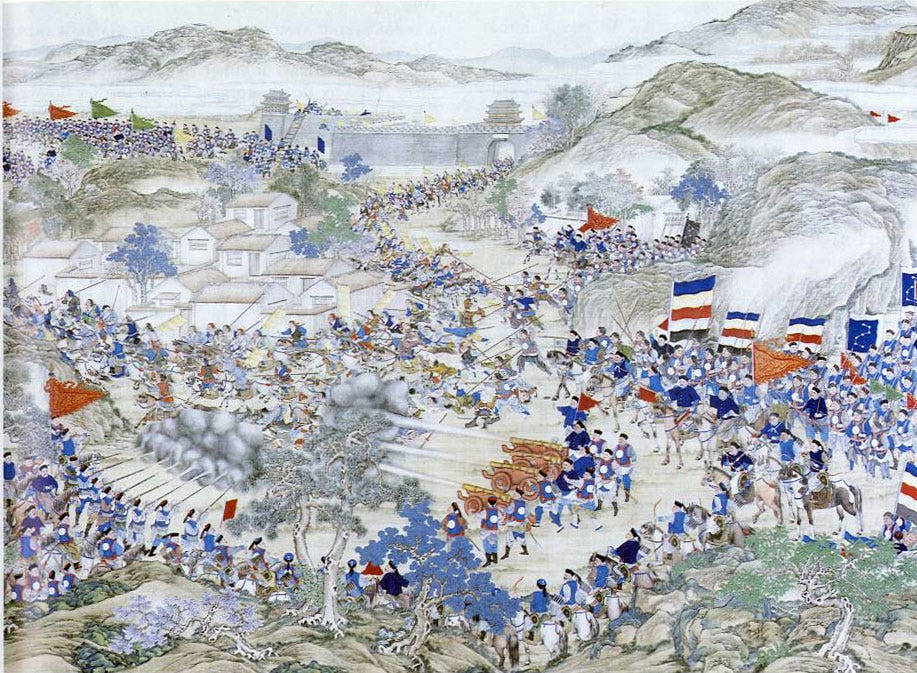
The Taiping Rebellion: China’s old order is exhausted and corrupt, but then Hong Xiuquan (who claims to be the younger brother of Jesus) appears on the scene preaching religious salvation. This includes sweeping away the corrupt Manchu overlords, banishing opium, sharing lands, and equality between the sexes! Instead of the promised salvation it ends up in a truly bizarre theocracy which culminates in one of the greatest bloodbaths ever, with 20-30 million people killed.
The Russian Revolution: For decades Russians had been working to overthrow the tsars, and they finally did! The workers’ paradise is at hand! Instead they eventually end up with Stalin, who is easily ten times worse than the Romanovs.
Post-WWI: The war to end all wars is over! The League will guarantee peace! And just to make sure we’ve outlawed aggressive war with the Kellogg-Briand Pact! We’ve done it! Wait… the stock market has crashed and economies are tanking? And there’s that strange man in Germany? Another world war?!? This one killing three times as many as the previous one.
I will grant that Alexander probably has a point about patience. All of these examples definitely evidence a certain degree of hurry. But, on the other hand, humanity is really bad at being patient, so I don’t know that expecting 300 years of it is a reasonable plan.
Let’s set aside talk about centuries, and focus on decades. I think most people who champion liberal capitalism aren’t thinking about 19th-century Chinese civil wars, or even the two World Wars. They’re thinking about the period after that. They would claim that if you want to know what the “weather” is going to be like next week you should look at what the weather was like this week, not three months ago. In other words, we should be looking at the postwar period. The last 80 years when the climate definitely changed for the better.
Since the end of World War II we have lived in a certain kind of world where the United States has always been the strongest country, the dollar continued to be the global currency, and government debt remained manageable. Each generation has been richer than the last and there has been no great power war.10 Territorial conquest became passé. The line has mostly gone up. Trade has been comparatively unrestricted. Technology has continued to advance. And people reasonably ask, can’t we exercise a little bit of patience with the system that has thus far served us so well?
The retort is that every one of the items I just listed is looking shaky.
The relative strength of the US when compared to its nearest peer competitor (China) has started to decline.
The dollar’s share of central bank reserves has been going down for years.
With interest rates up, and the US debt passing $40 trillion, even those who previously didn’t worry about debt have started to panic.
There’s debate on whether Millennials and Gen Z are worse off than their parents, but it’s definitely gotten harder to be better off than one’s parents.
We still haven’t had a great power war, but the Russian invasion of Ukraine is about as close to the line as you can get without crossing over.
The one line that isn’t going up is fertility, and without that line going up, none of the other lines much matter.
The kerfuffle over the Strait of Hormuz appears to be the beginning of the end for freedom of navigation.
Yes, technology has continued to advance, but most of our hopes are pinned on AI, which, as already mentioned, is a whole separate bucket of craziness. And outside of AI, R&D productivity is down. And there’s the whole replication crisis.
The counter-retort might be a similar list of things that are going great. (e.g., Lower crime, mRNA vaccines, ongoing reductions in global poverty, etc.) We are mostly saved and that salvation is just going to keep incrementally improving. But none of this has brought secular salvation, which is to say, we haven’t eliminated “winter”. And whatever the harvest has been, is it going to be equal to the inevitable winter? COVID could be considered a mini winter, a preview if you will, and it wasn’t pretty. What does that say about our ability to cope with a real winter?
IV.
It’s time to get more specific with this idea of “winter”. I claim no ability to predict the future, but I do think it’s important to lay out all the possibilities, not just optimistic ones.
But the first possibility is the optimistic one. Alexander is absolutely correct. The line will continue to go up, logarithmically, not linearly, but it will continue to go up. The harvest is not past, the summer has not ended, they’re both going to keep going until eventually the “Kingdom of Heaven” arrives.
As long as we’re on the subject of Alexander, for completeness’ sake we should cover the other possibility he spends a lot of time talking about: an AI singularity, a secular eschaton. A moment when we are all damned by a malevolent artificial superintelligence, or alternatively all taken up and transformed by a benevolent AI god. But other than mentioning it for the sake of being comprehensive, I’ve already said I’m going to set it to one side.
Considering other possibilities, the thing about seasons is that they’re cyclical—winters eventually follow summers and are in turn followed by springs. “Winter” has either been long delayed or perhaps we’ve been having winters (e.g., 9/11, the 2007-2008 financial crisis, COVID) but they’ve been exceptionally mild. Certainly one possibility is that this mildness will continue. All the things I mentioned in my list above are just proof that we’re presently in the midst of another mild winter, and it will pass just like all the previous winters. We’ll call this the “Winters come and go, but the harvest keeps improving” option. And it’s largely in line with Alexander’s assertions.
Alternatively, just because “winters” have been mild doesn’t mean that they will continue to be mild. As I also laid out above, we’ve had a lot of moments where things seemed to be going in our direction, and then they ended up in catastrophe. We have seemingly eliminated a lot of potential catastrophes: Famines are rarer, and less widespread. Poverty is far less than it used to be and continues to trend down. Technology marches onward producing ever more miracles. But alongside the catastrophes we’ve eliminated, we’ve also created numerous potential new catastrophes: nuclear war, climate change, engineered pandemics, a global financial system underpinned by runaway government debt, and cratering birth rates, to name just a few.
The harvest of ideology has been disappointing. The summer of technology has not merely failed to provide salvation; it may have actually delivered damnation. We could be due for a very deep, very nasty winter before spring comes again.
That last item on our list, falling birthrates, hints at the final possibility, perhaps the darkest one of all, complete civilizational exhaustion. It’s possible that we’re about to enter the long winter. Things aren’t cyclical, or if they are, they’re cyclical at the level of the rise and fall of empires. The harvest and summer we’re talking about began in the 1500s, and after centuries of progress things are starting to wind down. Our glories are coming to an end. The decline is starting. I’ve said before, in fact in the very first post, that I don’t think this decline will be precipitous. It could be, but I think it’s more likely that it will be slow and long, and easy to miss from the inside.
Of course, I don’t know what will happen in the future. I have no special foresight into which of these possibilities will become reality, but I can’t escape the sense that decline has begun, and the long winter is starting. Just because I have this intuition and experience this dread doesn’t mean I’m right. In fact I very much hope I’m wrong. Perhaps technology will save us. Certainly it’s delivered many miracles. I’m just not sure it’s capable of delivering the ultimate miracle: the miracle of salvation.
--------------------------------------------
Inexcusably, while I mentioned you, my long-suffering reader, in my last post (celebrating 10 years of blogging) I couldn’t be bothered to spend an additional 10 seconds thanking you! Allow me to rectify that. It would be difficult, and frankly embarrassing, to describe how much I appreciate all the people who’ve read my stuff over the years. Appreciate?!? No, that’s too weak. I love you guys. There I said it.
Well, except people who leave mean comments… I merely tolerate those people.
For those who don’t remember this time, you’ll kind of have to take my word for it, but it really did feel like it was just a matter of time before all the totalitarian states collapsed.
I would count Putin and Xi Jinping in this category, and I imagine my readers have other people in mind as well.
I understand some will argue this point and mention markets as a critical ideological component. I will just say that it’s a lot easier to have free markets if you already have an abundance of tradeable items in the first place.
Indeed, it seems ever more likely that the cracks in our ideological foundation will create such profound dysfunction it will prevent us from pursuing technological salvation.
I certainly hope that we end up being as clever and successful as Jack, but despite what some people claim we are not in the realm of fairy tales.
I understand that there is a certain lack of charity to pinning so much on his 300-year time frame, a figure he only mentions once. Certainly this time frame does not loom large in his other writings, but it is his answer to the subject of this post, so it seems appropriately germane.
He does mention the possibility of a positive singularity (which presumably also represents secular salvation) via the means of a well-aligned AI. If it follows the arc of his preferred plan (Plan A) we could reach salvation by 2040. But that would mean avoiding a negative singularity in the meantime.
Clearly it’s not the thing that should be set aside, and I will be tackling it in the near future. Particularly when we’re getting posts about AI with titles like: “We Will Never Have “Normal Times” Again”. And I largely agree, but I thought the more general discussion was worth having first.
Describing some of the technological advances of the last few decades as a “poisonous harvest” rings with more truth than I would like.
Was China a “Great Power” during the Korean War? I’m going to say they weren’t, but I suppose I would, wouldn’t I. You’re free to make your own decision here and adjust accordingly.