

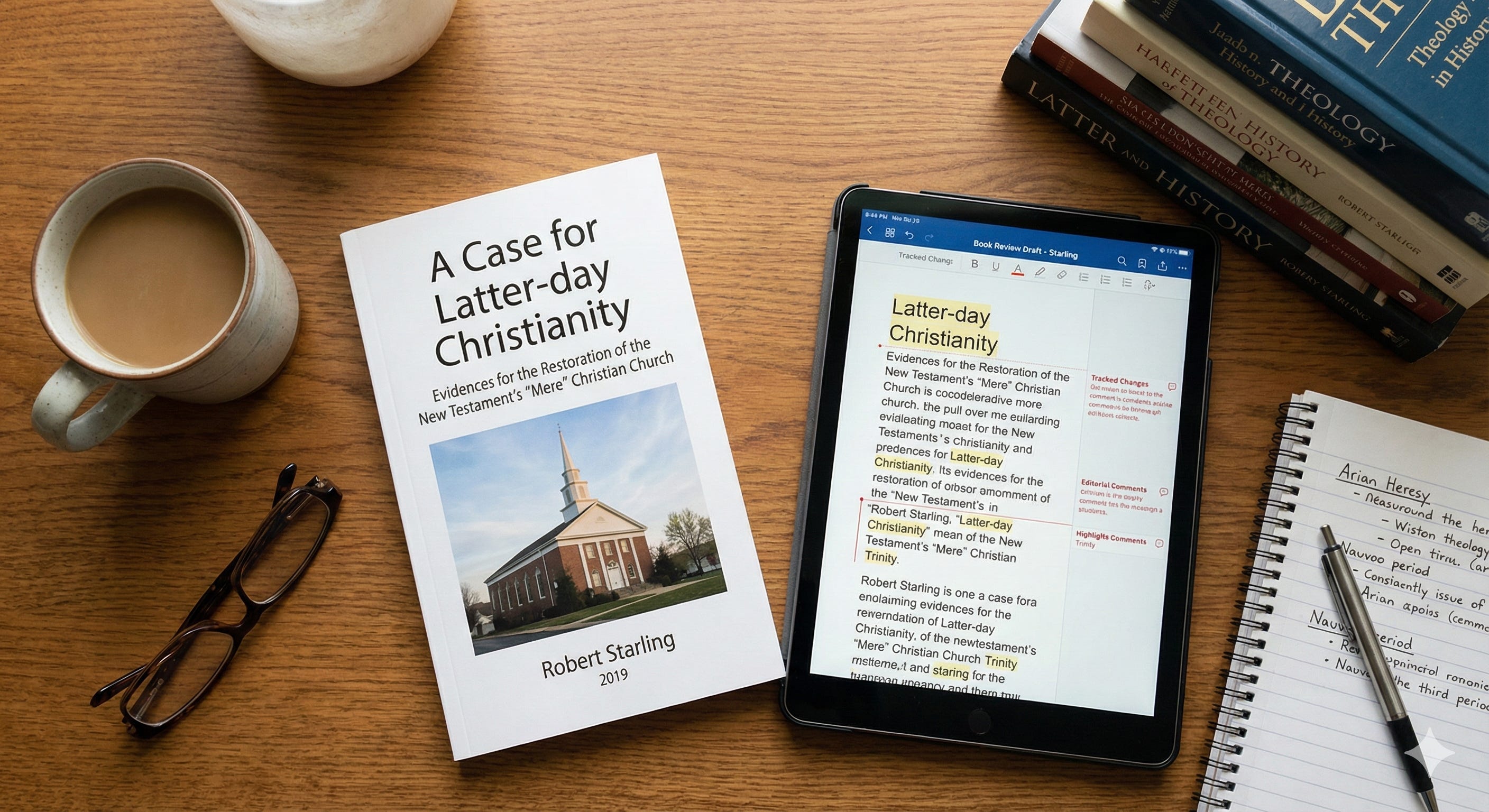
By: Robert Starling
Published: 2019
360 Pages
Briefly, what is this book about?
A broad, and intensive defense of the theology of The Church of Jesus Christ of Latter-day Saints (LDS). With a special focus on tying that theology to the theology of the early Christian Church. As such it spends a lot of time examining differences between LDS theology and other Christian denominations (things like the Trinity, Grace, The Book of Mormon, etc.) and how those differences look in relation to actual scripture.
What authorial biases should I be aware of?
Starling has obviously been compiling stuff and working the “Mormons are Christians” beat for a long time. Which is to say he definitely has a dog in the fight. This gives the work a somewhat tendentious tinge.
What about my biases?
I met Starling at a conference and he asked me to read his book. Outside of that meeting and a follow-up email he sent me there hasn’t been any further interaction. So I wouldn’t say we were close. I am however pretty close to the topic of “Latter-day Christianity”, so that’s a pretty big bias.
Who should read this book?
Anyone who wants to see the comprehensive case for The Church of Jesus Christ of Latter-day Saints being the same Church Jesus Christ established in the 1st Century.
Specific thoughts: Who is this book for?
This book is obviously geared towards people who are not LDS. Which is not to say I didn’t enjoy it, or that it doesn’t have a lot of great stuff, merely that people who are already members of the Church generally don’t need to be convinced that they’re Christian. Also they are probably familiar with much of the evidence laid out by Starling. Even if they’re not, I’m sure they’ve encountered the high level arguments.
Before we get to a discussion of the strictly non-LDS audience, there are a couple of categories in between: those who are thinking of joining the Church, and those who are thinking of leaving the Church. Let’s take them in reverse order.
The Church does have a problem with retention, and anything that helps with that is obviously welcome, but when I consider people I know who have either left the Church or are on the fence, questions about whether we’re really Christian don’t come up that much. The concerns that get raised are generally around modern cultural issues (think stuff like LGBT issues and racism) or problems with the early history of the church (think Joseph Smith polygamy).
I do have a couple of relatives who have left the Church and become Catholics, and perhaps this would be the perfect book for them. Unfortunately it’s been years since I talked to these relatives, but should I find myself in conversation with either of them I’ll try to steer it in this direction.
(I know that many of my readers are LDS, so if you have anything to add to the above, or really anything else, please don’t hesitate to chime in.)
Our next category is people who are thinking of joining the Church. People in this position might have questions or concerns about a large variety of things, from giving up smoking, to polygamy. One of these concerns might be, “Are Mormons really Christians?” At which point the correct response is “We don’t say ‘Mormons’ anymore! It’s The Church of Jesus Christ of Latter-day Saints! And if you use the correct name it’s right there in the title! Duh!” Case closed.
Okay, I assume everyone knows I was joking. The nature of God is an important topic. Violent schisms have erupted over competing conceptions of the divine. See for example the conflict which attended the Arian Heresy, and Arianism is actually closer to Nicene Christianity than LDS theology. As such, christology is a legitimate area of concern regardless of what the official name of the Church is. Still, these days, it would be a rare investigator who was so concerned about the subject that they needed a book the length and depth of Starling’s before being satisfied. That said, it’s good for these people that the book exists, and I could imagine someone picking and choosing a chapter here or there to answer specific concerns. But you end up looking at a pretty narrow slice of the “thinking of joining the Church” audience.
This just leaves us with a non-LDS audience that might be interested in this topic for reasons having nothing to do with their personal religious journey. I’m not sure how big this group is. Despite this it appears that this is Starling’s primary audience. This is fine. Should I ever find the time to finish the books I envision they will have a similarly tiny audience. What is regrettable is the tone of the book. I know Starling claims that his “purpose is not to engage in contention or debate” and I’m sure there’s true, but I did detect quite a bit of defensiveness. This is probably understandable. People have been attacking the LDS Church for not being Christian for a very long time. But for those who are just interested in the topic I think it would color the presentation.
Still whatever its flaws I hope people find this book, and gain some benefit thereby. It covers a lot of fascinating material. As just one example, there’s the issue of baptism for the dead as mentioned most prominently in 1 Corinthians 15:29. Even people outside of the Church (see for example the New Testament guide I recently read) admit that the plain reading seems to support the LDS interpretation. I already mentioned my biases here, but I think there are quite a few things in the New Testament that match up better with LDS Christianity than Nicene Christianity, but I don’t want to spoil everything.
—-----------------------------------------------
People have various standards around spoiling things. My standards are entirely based on my own selfish desires. I want free reign to spoil things for other people, but never to have anything spoiled for me. But I also want to make sure spoilers are available if I happen to go in search of them. But if I come across a spoiler without looking for it, I’m really annoyed. So when I urge you to check out the archives, which I frequently do, and those archives contain a lot of book reviews, you should probably keep this entirely arbitrary standard in mind.
Not sure if the book addresses the theological roots for why Nicene Christianity rejects the LDS viewpoint as being "Christian". I couldn't tell from the ToC. It took me a long time to understand why a seemingly unrelated point about the Trinity should become such a strong sticking point for terminology and questioning a whole people's testimony of Jesus. I think most members of the Church of Jesus Christ of LDS (hereafter LDS) see invocation of the trinity doctrine as a way to sneak in an unjustified exclusion of LDS from the "Jesus club", as though they were the ones with exclusive rights to define who gets to have a testimony of the Savior. This impression of willful exclusion is part of why I think many LDS get worked up about this topic. There's a sense of being unfairly excluded from a group to which we strongly feel we belong, even as we recognize we're a little different in some of our doctrinal points. But then again, who isn't? (Also, there's some incredulity/offense that Christians are denying our testimony of the risen Lord.)
I think both LDS and Nicene Christians could benefit from attempts at mutually understanding one another. However, since there are fewer LDS by far, the onus is on us to reach for understanding a little more. A little charity is warranted here. Understanding requires that we suspend our theological understanding/definitions for a minute so we can understand where our Christian brethren are coming from.
The reason the Nicene creed comes up is because it's literally at the heart of the issue. The Arian Heresy was/is seen as an attempt to redefine God. In an ex nihilo creation, what comes first? If, as Arians claim, it's the Father, and He creates the Son, then the Son isn't really God. He's subordinate to God, with perhaps a role in salvation, but as a created being he is distinct from God, who is uncreated. What do you call someone who thinks Jesus Christ is special, but is not truly God? Muslims teach exactly this doctrine, as do some religions who follow the New Testament tradition, but who do not see Jesus Christ as truly God. Can we all accept that someone who holds such a view should not be defined as a Christian? Is there a good metric we might use, other than engaging in long theological discussions, to tell who believes in the true divinity of Jesus Christ?
Enter the Nicene Creed.
Although the Nicene Creed seems difficult to parse for LDS readers, what's important isn't what it 'means' definitionally so much as what it's trying to state about the nature of Jesus Christ. To the Arians who say the Son must come after the Father, and therefore cannot be truly God, Nicene Christians proclaim that Jesus is not 'demoted' in their eyes. You're not going to pull a semantic trick and redefine Christ as 'lesser' because he's the Son. If the Father is the uncreated first mover, so too is the Son. And anyone who isn't willing to proclaim as much cannot be considered a Christian, because they don't believe that Jesus Christ is truly God.
Now look, there are many places here where an LDS observer will say, "But I don't agree with so many of these premises, to the point where none of this is even an issue for me!" Of course Jesus Christ is truly, fully God. If you don't believe in creation ex nihilo, and if you're read into LDS theology about the eternal nature of what other Christians might call the "soul", much of the subsequent analysis about an uncreated creator doesn't follow.
What's important to understand is that while the LDS tradition ENDS in the same place (with Jesus Christ as our God, Creator, and Savior), these two theologies have divergent starting points. The reason Nicene Christians point to the creed is because most of the New Testament-believing world has the same starting point as them, and if you diverge from this place, it's clear you've left Christianity. Because of this dynamic, it may not be helpful to try and lead a Nicene Christian from their starting point to our ending point, "... and that's why we're obviously Christians."
It may be helpful to employ terminology that helps clarify the distinction. I'm not sure what fits best, without invoking echoes of an Arian tradition that LDS theology totally rejects, but a few options I've heard include: non-Nicene Christians, non-Orthodox Christians, or even heretical Christians. The point is to concede something everyone already agrees on: the LDS tradition is distinct from the rest of Christianity because we follow a very different theology - especially as it relates to the Creation (and a number of assumptions that were introduced by the early Greek philosophical influence that is not found in the Bible). But our theology would as thoroughly reject an Arian assertion that Jesus is not "truly God" as would any Athenasian Christian.
Hi, This is Robert. Thanks for thinking about my book. Anyone who would like to actually READ it can download a FREE pdf of the whole thing here:
https://drive.google.com/file/d/1mddqWAbrtnJ7dtNUJagCJ-yULu61WS29/view?usp=sharing
If you do that, and read the Introduction, you'll see that I describe myself NOT as a "traditional" or "orthodox" (big or little "O") Christian, but as a Biblical follower of Christ who believes the same things as those who were "first called Christians at Antioch" believed. NOT a Greek philosophers's "triune god", NOT a closed canon of 66 books, NOT a "faith alone" salvation, and NOT a "patristic connection" to a 4th-century "church" that would not have been recognized by Peter, Paul, or my brothers and sisters in Antioch.
In my book I DO "contend for the faith once delivered to the Saints" without (I hope) being contentious. That same Gospel of "one Lord, one faith, and one baptism" has been RESTORED in these Latter-days, as part of the "restitution of all things" (Acts 3:21) that the author of Acts says MUST happen before the second coming of Christ.
A restoration was required because of the "falling away" or "great apostacy" that we're told in 2 Thess 2:3 MUST occur before the Lord's return. History shows us that the apostasy DID happen. "Mormonism" is not "traditional" or "historical/orthodox" Christianity, but it IS Biblical Christianity.
And to those "kindergarten Christians" who are content with the "milk" of the Gospel, what we have is "graduate level" Christianity. Like the three degrees of glory that Paul likened unto the sun, the moon, and the stars (1. Cor. 15:40), all believers in Jesus are "Christians", but what kind do you want to be?
The FULLNESS of the "good news" (gospel) that Jesus told his apostles to teach to "all the world" is today found only in The Church of Jesus Christ of Latter-day Saints, or as I call it - "Latter-day Christianity". Do you want to see how I make my case? Read the book.
(Questions? contact me at: starlingrd -at- msn dot c0m)