

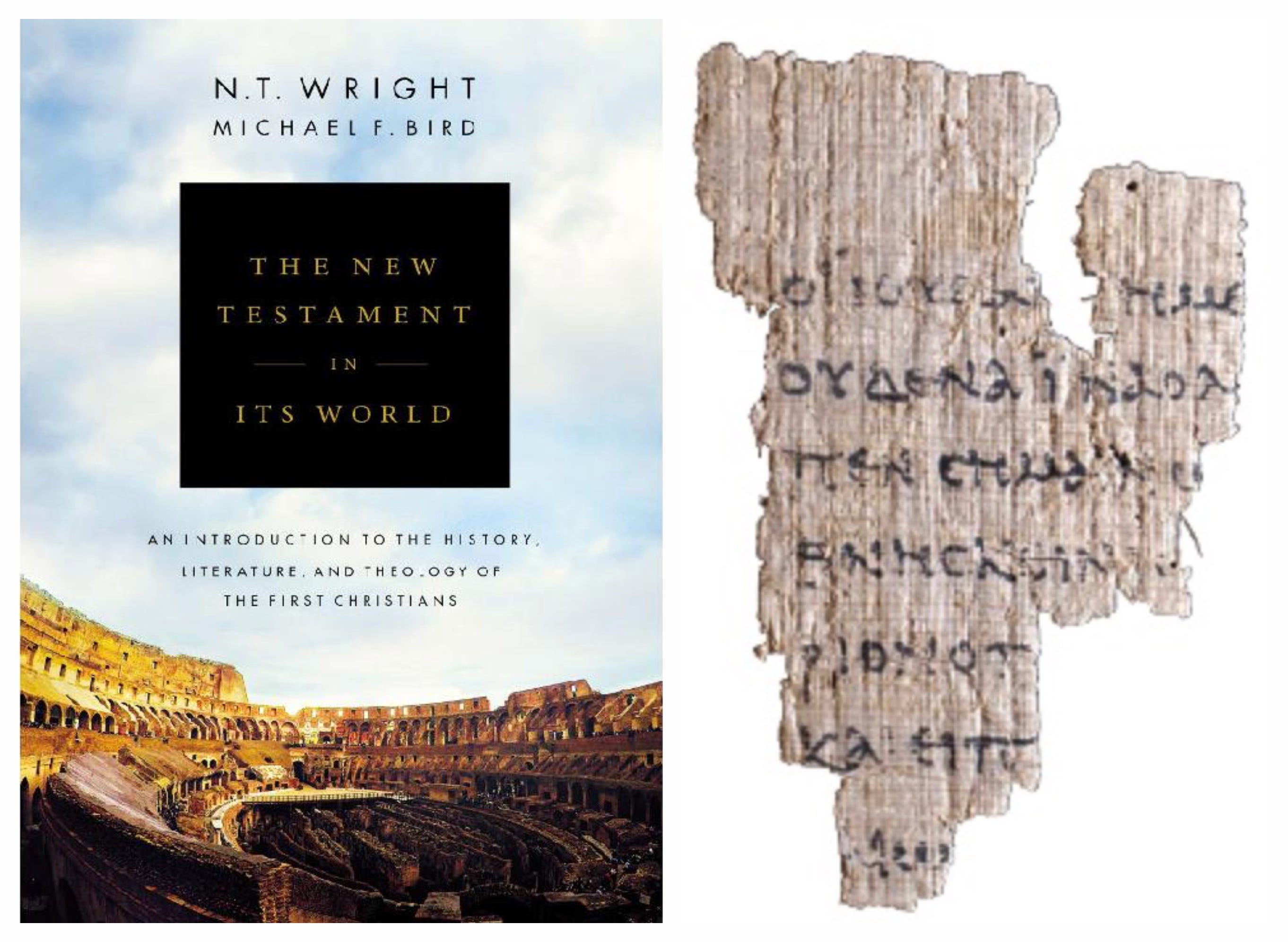
By: N. T. Wright and Michael F. Bird
Published: 2019
992 Pages
Briefly, what is this book about?
An deep dive on the New Testament covering (as the subtitle suggests) the history: Second Temple Judaism against a Greco-Roman background; the literature: the New Testament’s genesis, structure, authors and audience; and theology: the religious claims of the book, the doctrine, miracles, and contentions.
What’s the author’s angle?
Despite me saying that this is a deep dive, it is also something of a sampler for Wright’s other, even more expansive books. Also it’s important to note that Wright is very much a believing Christian and while the book is exceptionally scholarly, it’s also backgrounded by the idea that Jesus Christ is the Messiah who died for the sins of the world and was gloriously resurrected.
Who should read this book?
This is a long book, and I ended up deciding to read it, rather than listen to it. As such, it honestly took me several months to get through, so you should certainly take that into account. This should not be construed as saying the book is difficult. It’s very accessible, and reads easily. I will say that I learned a lot, but I’m not sure that will be true for everyone. Members of The Church of Jesus Christ of Latter-day Saints (LDS) don’t generally focus on straight down the line Bible scholarship. To the extent that we do deep scholarship in this area it’s in search of parallels between early Christianity and LDS Christianity. (For example in 1 Corinthians 15:29 when Paul mentions baptisms for the dead. Something no major denomination does, other than us.) This is all to say that I think LDS individuals might find this book particularly enjoyable, as being somewhat outside of our normal wheelhouse.
Specific thoughts: It’s both shocking how much New Testament we have and how little we have of everything else
What enables this book, in large part, is the sheer volume of ancient material. On the one hand I did not recognize how much historical material we have around the New Testament, and on the other hand I didn’t recognize how little we have for everything else. From the book:
We should celebrate the fact that there are over five thousand Greek manuscripts attesting the text of the New Testament, plus over ten thousand manuscripts in Latin and other ancient languages; this is light years ahead of the evidence for any of the other great texts by authors from the ancient world, including Homer, Plato, and Julius Caesar, whose works survive in a very small number of mostly medieval manuscripts.
Let’s consider the people mentioned:
Homer: The Iliad is the runner-up for the most well-attested ancient work, yet it still trails significantly behind the New Testament. Current scholarship estimates around 1,757 surviving manuscripts of the Iliad. The Odyssey has significantly fewer, with papyri finds numbering in the dozens.
Plato: While there are roughly 250 known medieval manuscripts of Plato, the gap between the author’s life and the earliest substantial copies is over a millennium.
Julius Caesar: For his Gallic Wars, we have only about 10 good manuscripts, the earliest of which dates to some 900 years after Caesar wrote.
There are a couple of books whose survival was even more tenuous. One of the most extreme examples is Tacitus’ The Annals of Rome which survives in just two manuscripts.
Part of the reason there were so many manuscripts is that the early church was particularly “bookish”. Not merely being generally more literate than the average person of the time, but going so far as to develop a new technology for translating the written word:
By contrast with most of the ancient world, early Christianity was very much a bookish culture. We sometimes think of the movement as basically a ‘religion’; but a first-century observer, blundering in on a meeting of Christians, would almost certainly have seen them initially as belonging to some kind of educational institution. This is the more remarkable in that education in that world was mostly reserved for the rich, for the elite.
What’s more, Jesus’ first followers were at the forefront of a new kind of textual technology. From quite early on they used the codex, with sheets stuck together to comprise something like a modern book, rather than the scroll, which couldn’t hold nearly so much and which was hard to use if you wanted to look up particular passages. In fact, though the codex had been in use already, the type the early Christians developed was more user-friendly than the earlier models. They really did want everyone to be able to read this vital and life-giving text.
It could be said that this book partakes of a similar spirit, a desire that everyone might be able to not only read, but better understand the New Testament. In this it was an unqualified success.
—----------------------------------------------------
I always feel guilty when I spend fewer words on a book than there are pages in that book. But I suppose this review was always going to feel a bit cursory. And perhaps the individual reviews are cursory, but there are a lot of them! And more to come in 2026! I’m sure you don’t want to miss even one, and there’s one sure way to do that. Subscribe!
Just want to tell you how much I like these book reviews and how useful they are. Thanks.
I'm somewhat familiar with Patristic culture, and while the early church did not agree on the contents of their "book" (the Bible) for several centuries, you're correct that they were "bookish", circulating copies of the letters (that would eventually become the Bible) widely. In the 7th century, Mohammed parodied this with his title for Jews & Christians: "people of the book".
The manuscript counts are striking, but the bit that seems more explanatory is the codex point. “The early church was unusually bookish” is a cleaner reason for NT survival than treating the raw counts as a standalone miracle of history.