

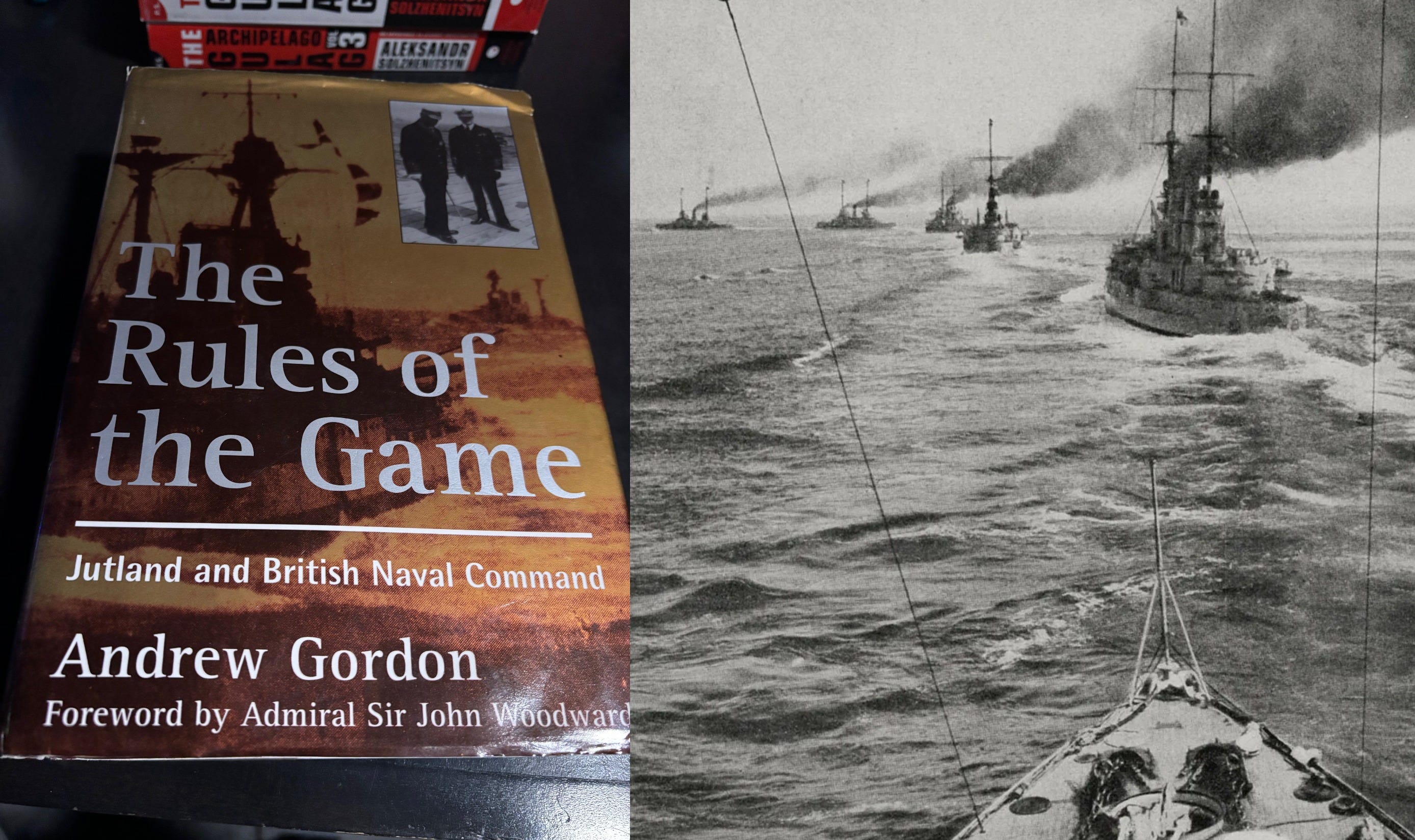
The Rules of the Game: Jutland and British Naval Command
By: Andrew Gordon
Published: 1996
708 Pages
Briefly, what is this book about?
An incredibly detailed examination of the battle of Jutland, combined with an equally detailed history of naval command, and its failings in the lead up to the battle.
What's the author's angle?
Gordon’s target is excessive signalling. And he’s written a very long book to demonstrate just how bad it was.
Who should read this book?
You have to be pretty committed to WWI naval history or military minutia before this is the book you should be reading. But if you are, it’s excellent.
Specific thoughts: Militaries acquire bad habits during peacetime; it’s hard to know which of these habits might end up causing great harm
I’m going to spend most of my time talking about what lessons the modern navy should take from this book. If you’re interested in an actual breakdown of the subject matter of the book I highly recommend this review from the master of all things naval, bean, and his fantastic blog Naval Gazing. For my own part I find it strange that Gordon ends up taking Beatty’s side over Jellicoe’s in that eternal debate. There seems to be plenty of blame to go around. Also Beatty is something of a poppinjay who went to extraordinary lengths to protect his reputation. With that said… let’s talk about Taiwan.
Lots of people would very much like to know how a conflict between China and America over Taiwan would/will play out. If you ask 10 different experts, you’ll get 10 different answers. I don’t consider myself an expert, but I do have some opinions on methodology. In particular I think it’s worth looking at past conflicts for clues about future conflicts. Things are never going to map one to one, that’s why I used the word “clues”. We should be looking for important military elements. Elements which might still be important and therefore worthy of closer examination in our current analysis. However much experts may disagree on other topics, everyone agrees that a conflict between China and America will have a large naval component. Which means that Jutland, the great naval engagement of WWI, is a good place to mine for these elements.
Gordon calls these elements “syndromes”, and he has mined both Jutland, and the history of the Royal Navy in the lead up to Jutland, in order to extract these syndromes. This “mining” uncovers 28 syndromes. I’m not going to reproduce all of them, but the first three should be sufficient to give you a feel for Gordon’s conclusions and where I’m headed
(1) In times of peace, empirical experience fades and rationalist theory takes its place. This trend, we may aver, is most marked in periods of major technical change, for, (2) The advent of new technology assists the discrediting of previous empirical doctrine. Furthermore, through both myopia and self-interest, (3) The purveyors of new technology will be the most evangelizing rationalists.
It doesn’t take much imagination to wonder if this applies to the US Navy. It’s been 80 years since WWII, clearly some large amount of the empirical experience, won at such cost during that war, has faded. And while I’m not well-versed enough in modern navel culture to identify what sort of rationalist theories may have emerged, it sounds reasonable to imagine that something along those lines must have developed. On top of these two trends it’s undeniable that we’ve gone through major technical changes in the meantime. As such it’s worth asking whether the US Navy may be misaligned in the same way the British Navy was before Jutland.
Obviously this assessment comes with numerous caveats. For example:
I understand that as bad as it might be for the US Navy, the last time China collected any “empirical experience” in large-scale naval warfare was probably the Battle of the Yalu river in 1894.
I also understand that there has been significant advances in technology between WWII and now, and clearly some aspects of naval doctrine need to take account of this new technology.
Considering all of these factors, should this book make us more worried about the US Navy’s performance in a future battle with China? Or should we be less worried, because Gordon’s analysis is out there. And certainly some current US Naval officers must have read it.1 Certainly a large number of officers have to be aware of how peacetime degrades capabilities and prioritizes different things, and being aware they must have taken some steps to mitigate those problems right?
We would certainly hope so. I hope that Gordon’s warnings have already been heeded, but there are reasons to suspect that they have not. Gordon’s primary accusation is that the British Navy had grown too dependent on a complicated system of communication. On October 7th one of the reasons things ended up as bad as they did is Hamas started by cutting communications. The Israeli military relied too much on these communications and as a result they had no idea what was going on for many long hours. Rather than using their vast air force to scout, they sent them to protect offshore oil rigs.
Since then the war has gone better for Israel. The booby-trapped pagers were a stroke of genius which no one saw coming. But that goes to my point, wars never develop as expected. Not to pick on France, but in the leadup to WWI they put all their faith in soldierly élan which basically amounted to reckless charges leading to tens of thousands of deaths in the first month of that war. In the lead up to WWII they put all their faith in the Maginot Line. This was the opposite of a reckless charge, but somehow similarly ineffective, and France fell after only six weeks. Both stories are more complicated than the simple narrative I laid out here, but the point remains: what systems are we relying on now that we shouldn’t be? And what systems should we be implementing, but which we aren’t?
My sense is that the US Navy is better prepared and more cognizant of the potential problems than the British Navy was in the lead up to WWI. I really hope I’m correct about that, and I also really hope that they’ve all read this book.
As a final tangent, I wonder who’s learning more from the war in Ukraine. The USA or China? Presumably whatever is happening there is more helpful than any book, even this one. In particular I’m wondering what sort of lessons there are for the respective navies. If they want ill-informed opinions from someone who’s “read a lot of books” they need look no further!
I was directed to this book because it showed up in a speech given by General Mattis that an acquaintance of mine happened to be at, which I heard about not from that acquaintance, but from yet another acquaintance (the aforementioned bean)
.
>In the lead up to WWII they put all their faith in the Maginot Line. This was the opposite of a reckless charge, but somehow similarly ineffective, and France fell after only six weeks.
I really should sit down and write this out at length, but in a narrow sense, the Maginot Line was entirely successful. The basic theory was to protect the Franco-German border and force the Germans to move through Belgium, which the Maginot Line proper did successfully. Step 2 was supposed to be stopping the Germans in Belgium with mobile forces, and that bit went less well for a variety of complicated reasons.
Re the bigger question, I do genuinely think this is less of a concern than it used to be. First, WWII isn't the last time we had combat experience. We're currently getting that from the Red Sea, and operating in combat-like conditions elsewhere around the world. Yes, going up against China is different from fighting the Houthis, but I think the gap between them is smaller than the one between what the British battle fleet spent the late 19th century doing and Jutland.
Second, there was a sort of mental shift on strategic issues around WWI. (Another topic I should cover at more length, and I probably should have talked about this in "fighting the last war".) The degree of casualness around a lot of really basic stuff in the RN of this era is kind of baffling, with experienced admirals making mistakes that you would need to go to the bottom half of Congress to find today. If I had to pick a start to the change at sea, it would probably be the founding of the (US) Naval War College in 1884. (The British don't seem to have set up an equivalent until 1900, and I don't think it was very prominent.) Jellicoe doesn't seem to have read Mahan until he was about to take command of the Grand Fleet, IIRC. There's other stuff, too, like much better simulation options than we used to have, and a whole infrastructure devoted to looking at this, instead of whatever officer felt like writing about it in their spare time.
> On October 7th one of the reasons things ended up as bad as they did is Hamas started by cutting communications. The Israeli military relied too much on these communications
That ought not to be possible. What I mean is that Israel, like all modern militaries, has highly sophisticated military radio systems such that you cannot shut down the radio network except by destroying all the nodes in it. You can see some of these radios advertised here:
https://www.elbitsystems.com/networked-warfare/secured-communication
It's said that Hamas was able to shut down the telephone-based communications the Israeli troops were using on the border. But why would they be using a system so easy to disable? No competent army would do so, and Israel has shown it has a competent army in its recent wars against Hizbollah and Iran.