

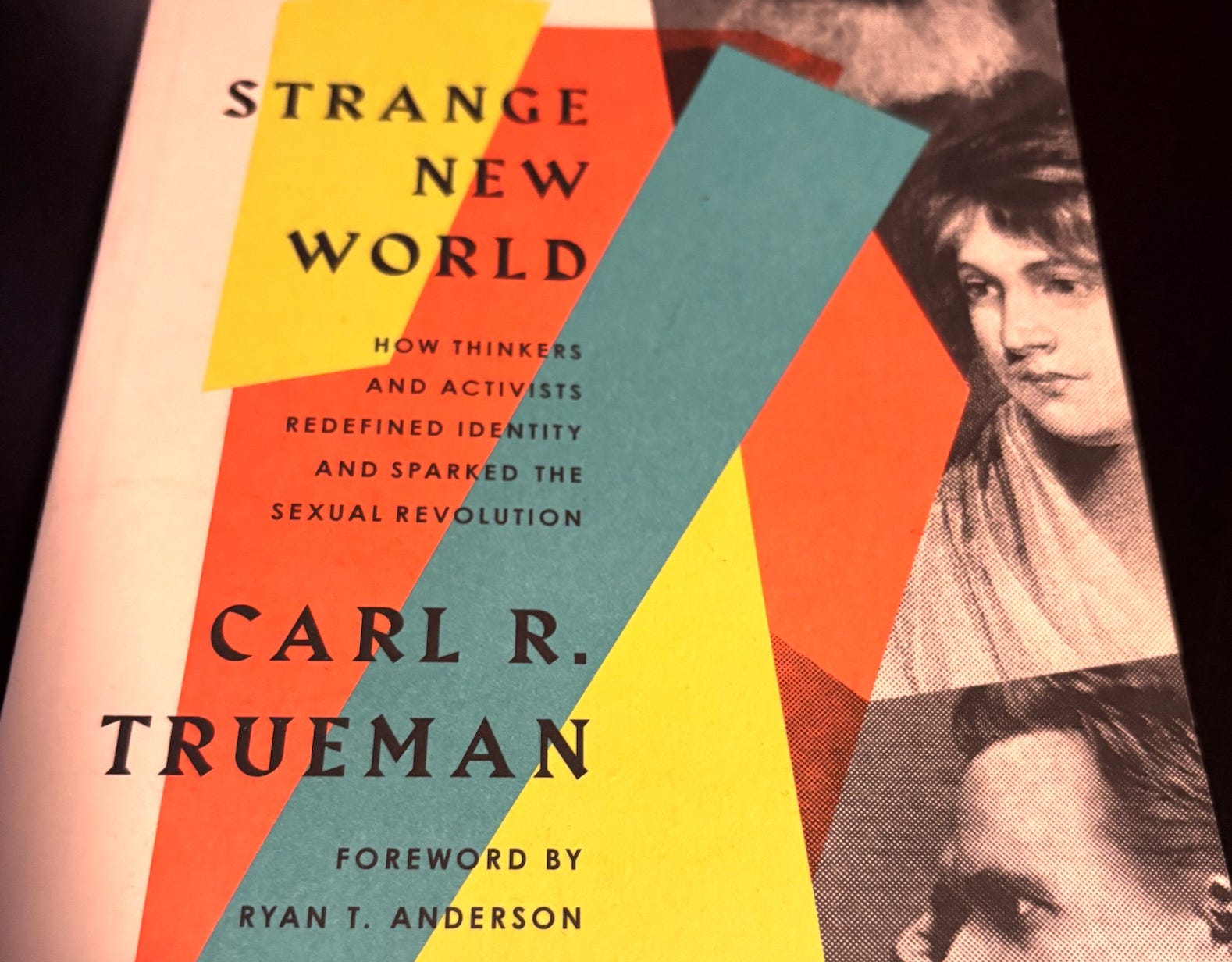
Strange New World: How Thinkers and Activists Redefined Identity and Sparked the Sexual Revolution
By: Carl R. Trueman
Published: 2022
208 Pages
Briefly, what is this book about?
The long philosophical journey that took us to the current prioritization of expressive individualism, and how this journey eventually carried us to a strange new world, where expressive sexual/identity politics seem normal if not inevitable.
What’s the author’s angle?
Trueman is a Christian, and this book is written towards a religious audience.
Who should read this book?
Trueman’s previous book, The Rise and Triumph of the Modern Self is one of my all-time favorite books. (You can see a review here.) This covers basically the same territory, but in a shorter, more accessible format. If you’ve read his longer book, you can probably skip this one, but if you haven’t then I would recommend this book to anyone trying to understand the modern world.
Specific thoughts: It is indeed a strange new world
I’ve been thinking about several ways to illustrate how culturally strange the modern world is. And I’ve decided to pick the ten year period from 2012 to 2022. 2022 was the year this book was published, and 2012… Well, what was 2012 like? Most of the big culture issues we’re dealing with now were very fringe at that point. Youth gender transition existed, but it was rare, the term “gender dysphoria” had not made its way into the DSM. 2012 was the first year the NCAA allowed trans-identified men in women’s sports, but it is unclear if anyone took advantage of that, and if any did it was almost certainly single digits. Barack Obama came out in support of Gay marriage in 2012, but Hillary Clinton didn’t offer her support until 2013. Trayvon Martin was shot in 2012, but it wasn’t until George Zimmerman was acquitted in 2013 that the Black Lives Matter movement got started.
By contrast, ten years later gay marriage was legal. We’d had the George Floyd riots. The transgender movement had reached its maximum level of cultural clout. People were being punished professionally for saying that transwomen aren’t women. Not a ton, but once again, imagine telling someone about it in 2012. Would they even be able to understand what you’re saying? A lot had changed in 10 years.
This is the environment this book was written in. Some might say that Trueman’s alarm was premature. Sure things got a little crazy there for a bit, but isn’t a lot of that related to the pandemic and the unprecedented changes implemented in response to that?
Trueman’s premise is that it was not temporary, or especially recent, but rather the culmination of a philosophical project that began with Descartes and is still ongoing. It’s tempting to think that, whatever his other failings might be, Trump decisively ended the greatest excesses of wokeness. But this has proven not to be the case. There has been something of a retreat, but it’s a retreat to a more powerful, and more insular echo chamber. (This has been called blueskyism after the left-leaning twitter clone.)
Unfortunately that was only its most pernicious strain, the larger world altering change is still very much with us. What is this change? I’ve gotten a fair bit of the way into things without elaborating on it much.
Trueman uses the term “expressive individualism” as a shorthand for what the phenomenon he describes. And at its heart this is an epistemic phenomenon. The greatest source of truth lies within people, and expressing that truth is the one true path to joy. To frame things in a freudian analysis, unchaining the id is the greatest good. (Perhaps you remember my review of the horrible graphic novel Crisis Zone; it was full of expressive individualists.)
Sexual desires and identity have a sense of depth to them, giving these impulses a feeling of particular weight. Which is how we’ve ended up sanctioning just about any expression of them as long as there’s consent. Frequently because of the primacy of the individual the only consent needed is from oneself, regardless of what the societal standards exist more broadly. People try to extend it, but it ends up being a very weak foundation. (See my review of Louise Perry’s book The Case Against the Sexual Revolution for more on that.)
In the end I think everyone agrees that we live in a strange new world, that, culturally, things really have gone incredibly fast. The question is whether this was mostly a good thing, or mostly a bad thing? But also what does the future hold? Trueman comes down on the “it was bad” side of things, but the book’s purpose is to point out that it’s been building for longer than people realize and it’s going to be very difficult, if not impossible to undo.
I know I’ve said it before, but, on account of my upbringing, I long expected to live through the end of civilization, I just never expected it to be so weird. I’ve been talking about this weirdness since 2016. And I’m sure I’ll continue talking about it for a long time to come. Which is my way of saying that if you haven’t subscribed you should.
A great summary of an oft-overlooked perspective.
Many normie conservatives draw a sharp line between "liberal", "progressive", and "woke". The first is good since it allows for freedom of choice. The last is bad since it punishes freedom of choice. Patrick Deneen ties the two together in Why Liberalism Failed. Brad Gregory ties it back to the 1500's in The Unintended Reformation. Louise Perry's book you mentioned. Regardless of the starting point, the trend is far longer than commonly acknowledged. That longevity will make it harder to defeat than most realize.
My own view is that "woke" is J.S. Mill achieving supremacy. If Mill is correct that a good society provides maximal individual autonomy -- any restriction (social, financial, or legal) on my choices is legitimate only to prevent farm to another -- defending any social norms or standards (dare I say "virtue") is impossible. Any such restrictions will inevitably hamper my choices, so they must fall. And govt must be used to help bring them down in the name of individual liberation. Reality is the ultimate restriction, hence wokeness' war on reality.