

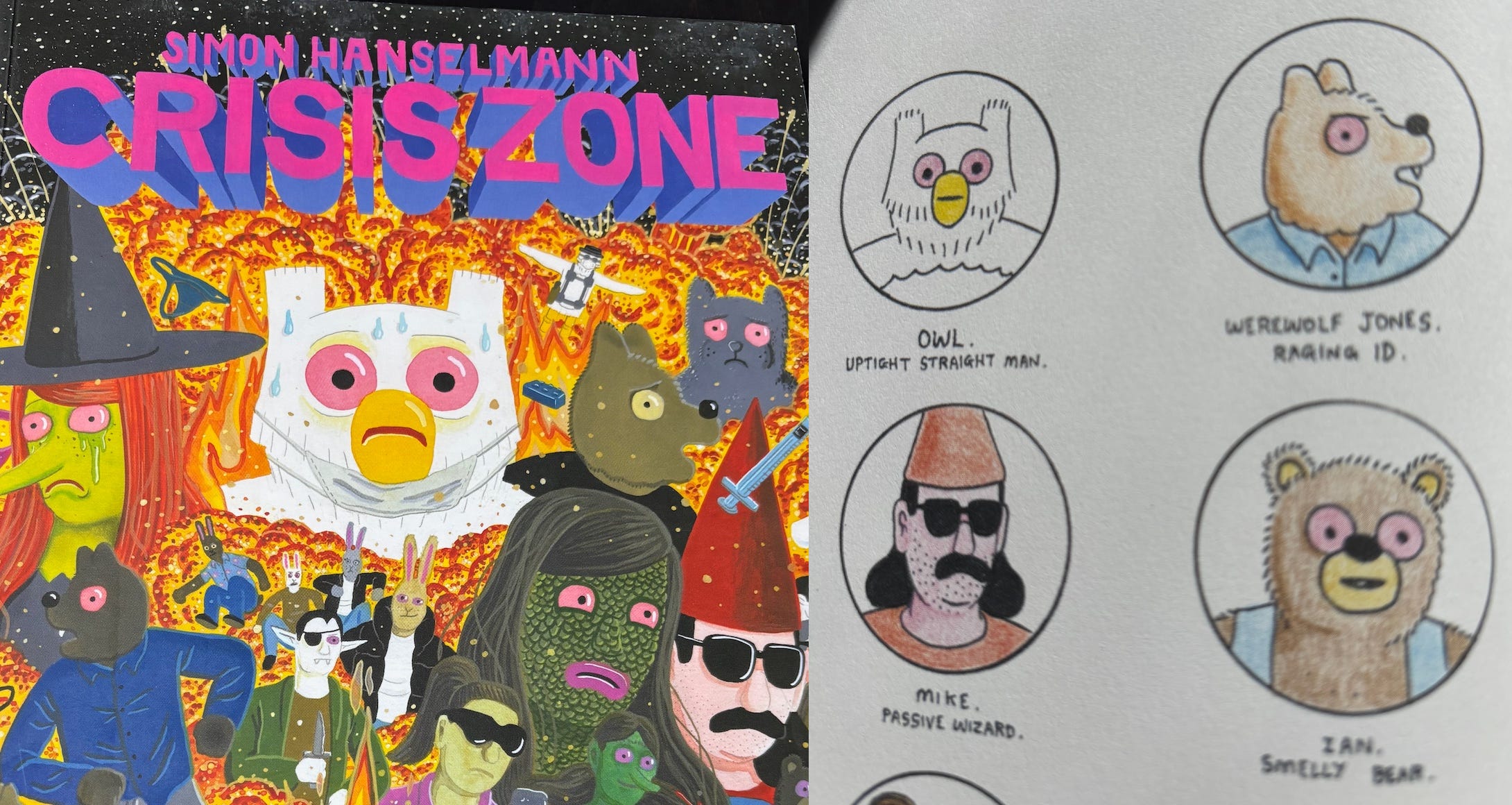
By: Simon Hanselmann
Published: 2021
296 Pages
Briefly, what is this book about?
A VERY non-traditional household navigates the pandemic using violence and porn production.
Who should read this book?
I would not recommend this book to anyone. It is without a doubt the grossest, crudest work I have ever read. Though Forbes reviewed it and said:
In the deluxe and beautifully designed Fantagraphics edition, Crisis Zone ends up looking like a children's book produced in an institution for the criminally insane. … Assuming we have a future ahead of us, Crisis Zone will be the keepsake to remind us what we became in [2020].
But even they had to admit that it was “a filth-spattered lens of depravity and dysfunction”.
Specific thoughts: A strong case against a certain lifestyle.
Someone told me that this graphic novel, “populated by gays, transvestites and assorted miscreants, and written by a cross-dressing Australian” was one of the most right-wing graphic novels he owned. When I pressed him later he amended his description and replaced “right-wing” with “anti-woke”. I can see that. Hanselmann includes notes covering each of the arcs within the book. Within these notes he spends much of his time railing against the witch hunts of 2020, and because he does it as someone who you would otherwise expect to be sympathetic, his criticisms carry particular force.
It’s also anti-woke (or maybe pro-tradition or pro-normalcy) on a different level. The non-traditional household Hanselmann depicts in the book is a veritable hellscape. There are eternal punishments in Dante’s Inferno that I would rather undergo than the household depicted in this book. Now I assume that Hanselmann’s message is not that all non-traditional households are as bad as this one, but I know quite a few people living very “non-traditional” lifestyles and Hanselmann’s description rings true, albeit with everything turned up to 11.
Though I think it’s pretty clear that I have some serious prejudices in this area, so you should take that into account.
Of course the issue of prejudices is precisely the point. However anti-woke he might be, I hardly believe that Hanselmann was looking to confirm conservative prejudices. I’m guessing he was just calling things as he saw them, admittedly with lots of exaggeration, but I’m convinced they came from real experiences he was having. Regardless of the source or the veracity the book ends up being anti-aspirational: “What do I have to do to avoid that?!?” Without ever mentioning traditional conservative values, I think it has the effect of pushing people in that direction.
In so far as there is a main character to the story it’s Werewolf Jones, whose “profession” is “raging id”. Hanselmann doesn’t spend much time telling us exactly how Jones is the avatar of a “raging id” but he does plenty to show it. (This is the source of much of the “depravity and dysfunction”.
By using the term “id” Hanselmann has opened up the door to a Freudian interpretation of his work, and if we decide to walk through this door, the first thing we notice is that almost everyone in the book is 90% id, even if they’re not full on “raging id”. The superego, internalized societal values and morals, is almost entirely absent and to the extent it does exist it’s represented by woke standards which, as I already mentioned Hanselmann mostly rejects. I suppose this leaves the ego, but as its role is to negotiate between the id and the superego, the lack of the latter makes its role essentially ceremonial.
The term “late-stage capitalism” was coined in the wake of World War I, but it periodically re-emerges to describe some new phenomenon, some even later stage of capitalism. Its latest re-emergence started around a decade ago, with a particular peak in 2016-2017. I’ve never minded it, it’s always struck me as having something of a conservative connotation. This book would seem to depict something similar, but more alarming. We might call it “late-stage hedonism”, though capitalism is certainly in there.1
It feels like we’ve been on the path towards “late-stage hedonism” since the cultural revolution of the 60’s. Hanselmann, intentionally or not, has done a great job of illustrating how bad of an idea it always was.
My id doesn’t want to write at all. My superego feels like not only should I write, but I should do everything else as well. Somehow my ego’s solution is to say, fine you can take a break and listen to a book at 3x speed, but only if you write a review about it later. My, decidedly, non-raging id asks “What about a depraved graphic novel like Crisis Zone. Do I have to review that?”
“Even Crisis Zone.”
If you’d like to read those reviews there’s only one place to do it!
The biggest capitalist element in the book is a reality TV show, which is definitely late-stage something.