

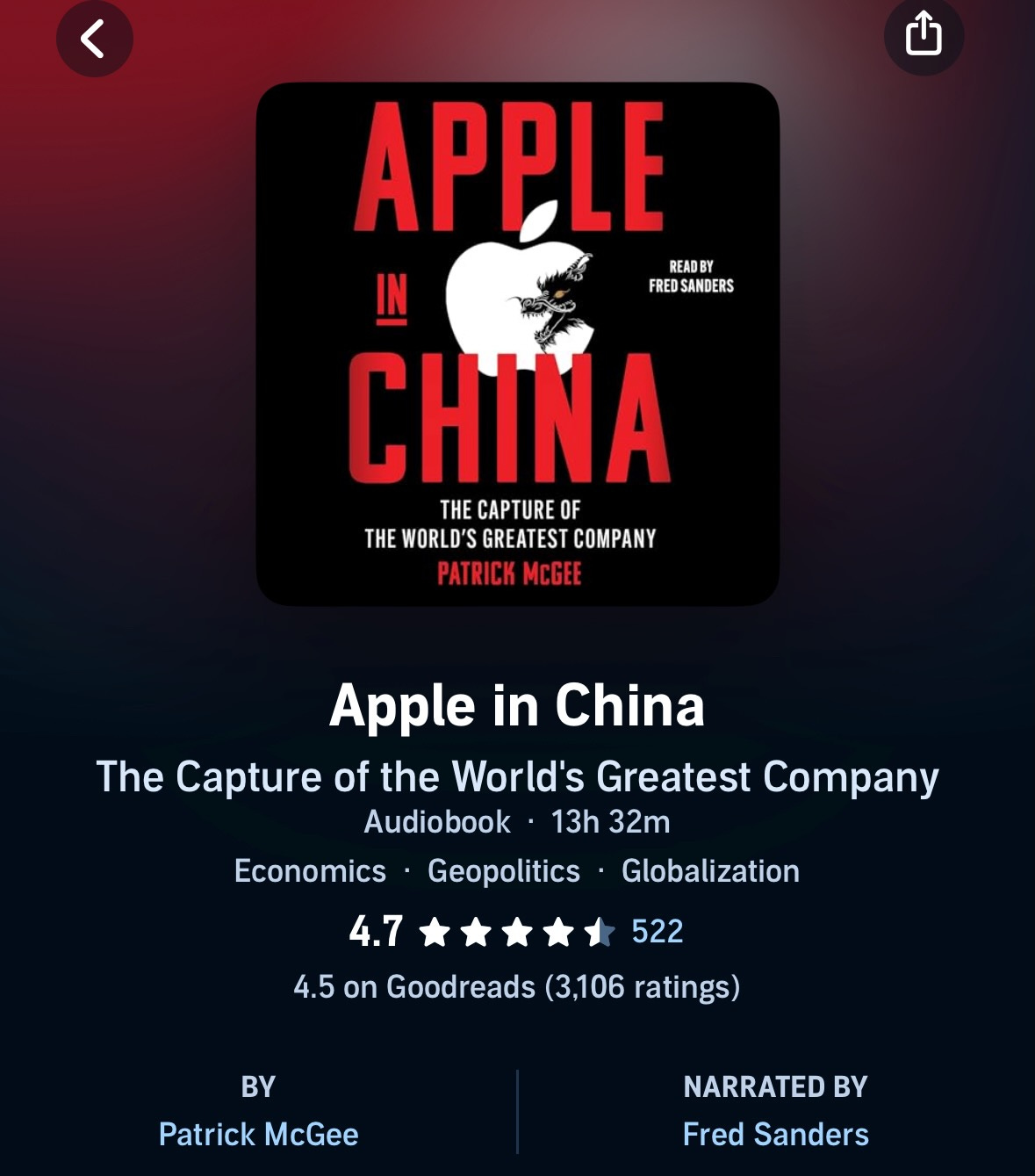
Apple in China: The Capture of the World's Greatest Company
By: Patrick McGee
Published: 2025
448 Pages
Briefly, what is this book about?
How Apple went all in on China, not merely moving manufacturing there, but also educating their companies in, and co-developing with them, numerous advanced manufacturing techniques. These techniques then spread all throughout China. As such, Apple, far more than any other company, enabled China’s rise to be the world’s most sophisticated manufacturer. In effect they imported a super-charged industrial policy for China. This was bad enough, but the eventual result was that Apple is now utterly dependent on a capricious one-party state.
What's the author's angle?
McGee is not entirely unsympathetic to Apple, but it’s also clear that he finds the consequences of their actions to be damaging, and, most of all, dumb.
Who should read this book?
If you’re interested in China, technology, the future, or competition then you should read this book.
Specific thoughts: Does it all come down to time preference?
Decades ago I read The Macintosh Way by Guy Kawasaki who for a time was the “Macintosh Evangelist”. One metaphor stuck with me all through the years. In describing what it was like to compete with Microsoft back then. He said, “Imagine that your head is in a vise, and it has been tightened to the point where you can no longer bear it. Now tighten it two more times. That’s what it feels like to compete with Microsoft.”1
That was 1989, in 2007 when production on the iPhone started, it was Apple that was putting people’s heads in vises—specifically manufacturers. And it turned out that only Chinese manufacturers were willing to step up and put their heads in. Why?
Sure they were desperate. Yes, they made money, And yes, they got access to amazing manufacturing tech (interestingly this is more Apple pushing the tech in, than China pulling the tech out). But my read is that in large part they did it because they had very low time preference. And conversely Apple had a very high time preference. In other words Apple had a high preference for things being done soon. Things needed to happen now! And Chinese manufactures, and even China itself was content for things to happen eventually. And both of them got what they wanted out of the deal. Apple was able to ship millions of units at enormous profit margins in the moment and eventually China ended up with the best and most proficient manufacturers in the world.2
Now McGee describes a situation where, by volunteering to put their head in the vise, China eventually learned how to make vises of their own, and now it’s Apple that’s caught in a vise of its dependence on Chinese manufacturing. Which takes us to the other part of the Chinese advantage. On top of the low time preference, they’re just better at hustling. For example, here’s what happened when Apple tried to open a plant in Texas:
There was a bunch of stuff that we at Apple were very used to doing, that just didn’t work anymore. Like, we’re very fond of making custom fastening hardware, custom screws—you know, little nuts and stuff like that. Well, in China, if you’re building and it’s like, “Oh, shit, the screw is too short,” and like, “I need a longer one,” you call someone on a cellphone and 1,000 are at the factory tomorrow. That was not a thing in Texas. It would take two months. It was absurd.
This “at the factory tomorrow”, this hustle, can happen because a Chinese company can call its workers in on short notice and make them work 24 hours straight. Which takes us to the third advantage China has. They can expect their employees to work far longer and harder than western workers. This is great for a very demanding company like Apple, but it’s obviously worse for the workers.
As you may recall Apple took some heat for that back in 2012 and they even brought on someone to try and rectify the problems, to ensure that their manufacturers were complying with things. In the end the sales guy Tony Blevins (who seems like a real piece of work) was writing contracts that were so demanding that they couldn’t be fulfilled while at the same time maintaining labor protections. As a result, there was a year or so of pretending to take labor abuses seriously before they quietly eliminated the role and went on mostly as before.
Where does this leave us?
First, I expect to read Breakneck, the new book on China by Dan Wang, shortly. As I understand it his argument is that in addition to everything else China has going for it that they’re a nation of engineers. You can see where the two books dovetail. McGee’s point is that Apple gave all of these engineers a crash course in all the most advanced methods, oftentimes with the result that they’re the only people who can do it.
Second and relatedly, I’m hearing lots of noise around the tariffs which boils down to, we’d like to do this thing in America or someplace other than China, but it’s literally impossible. No one else has the equipment. McGee would claim that this is downstream of Apple’s many decisions to develop and expand advanced manufacturing in China.
Third, there is the whole separate question of China’s industrial policy and the support China gives to key manufacturers—which McGee doesn’t get very deep into, but this all certainly plays a role.
Finally, lurking behind everything is the potential war with China. Should that happen (when that happens?) and should books be written about it, what role will Apple play in the story? I don’t think their role will warrant a book by itself, but I imagine that they could end up being the subject of some very negative chapters.
I talk a lot about China in this space, at least a half a dozen book reviews and numerous posts. Despite that I still have no idea if an eventual conflict over Taiwan will resemble the Bay of Pigs or the Spanish-American War. I guess if I had to bet, I’d bet on the former, but there are definitely some interesting things going on over there. Things I’ll keep writing about through my patented blend of technological pessimism and religious conviction. If either of those appeal to you there’s more to come!
I looked up the quote and the bit about tightening it two more times isn’t in there, but I think the way I remember it is better so I’m keeping it.
Yes, TSMC, which is in Taiwan, still creates higher tech chips, but as I’m talking about culture not politics I believe the theory of low time preference still applies.
It's almost as if Apple would've been better off if they cared about other things than short-term profit. But what's the chance of that ever happening?