

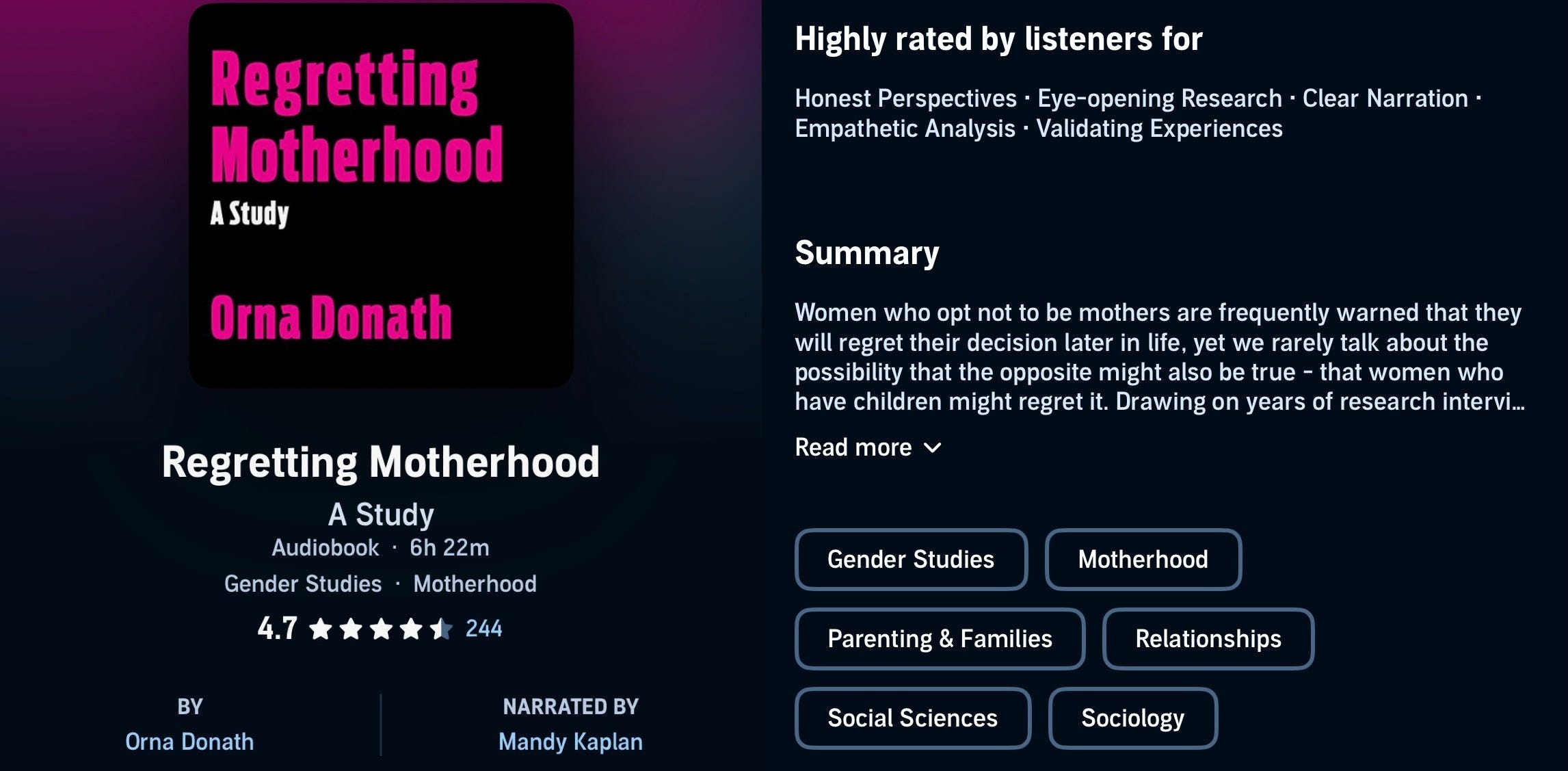
Regretting Motherhood: A Study
By: Orna Donath
Published: 2017
272 Pages
Briefly, what is this book about?
Donath interviewed 23 Israeli women who regretted motherhood. In most, but not all, cases these mothers asserted that they still loved their children, they just didn’t like the responsibilities and restrictions that came with being a mother. In some cases they only realized this after having children, in other cases they knew they would regret motherhood, but reported feeling forced into it by societal, patriarchal, and pro-natal pressure.
What's the author's angle?
This book belongs to the “unsilencing” genre. Donath is “unsilencing” mothers who regret their motherhood. Whether they are actually being silenced just in Israel in 2017, or everywhere even now is a good question, but outside of the scope of this review. Donath herself does not want kids, so she’s not an unbiased observer of things.
What's my angle?
This was recommended to me as a counterpoint to Hannah’s Children by Cathrine Pakaluk (see my review here). I am definitely more Pakaluk’s side than Donath’s, but it is important to see what the opposition is saying. Nevertheless I was biased going in, and I remained biased all the way through.
Who should read this book?
If you’re trying to gain a broad perspective on mother’s feelings about motherhood, then this book definitely lays out one side of the debate, and you will have a broader understanding after reading it. Otherwise I would skip it.
Specific thoughts: Where will the fertility rate naturally settle?
Imagine that Donath’s philosophy was universally applied. No women would have children unless it really was the thing they wanted most in the world. Unless children brought them more pleasure than having a career, or traveling the world with their partner, or what have you, they would not have any. On top of this there’s no social pressure to have kids. Everyone celebrates your childlessness, and they may even go so far as to try to talk women out of having children, by pointing out how difficult it can be. Under these conditions, what fertility rate would we end up with?
I think it’s safe to assume that it would be even lower than it is now, and it’s already below replacement among the majority of women. I understand that there’s no individual component of Donath’s philosophy that seems especially objectionable. Children should be wanted, and they should hopefully bring pleasure to their mothers. I also understand that social pressure to have kids is annoying at best, and coercive at worst, and that perhaps the difficulties surrounding childbirth are often obscured. But if it’s inevitably going to lead to the extinction of the human race as it pushes rock bottom fertility rates even lower, then you would still have to conclude it’s a bad philosophy.
So, if you’d rather that humanity does not eventually wither away then something needs to be done. But what? That is the trillion dollar question. By mapping out the inverse of what we’re looking for does Donath provide any clues? A few, but I’m not sure anyone is going to like them.
Many women viewed motherhood as the default option. It was going with the flow. So there does seem to be a fertility benefit from making motherhood the cultural default. This is one of the least troublesome takeaways, so we should probably keep it as the default.
A significant number of the women in Donath’s study knew that they would regret having children and did it because of societal pressure. This is no one’s ideal, but it does work.
At the extreme end of societal pressure was stigmatizing women without children. Most often this occurs in a religious context. Israel has a lot of religion, much of it very orthodox, so this stigma does exist, and it works, but stigmas are not likely to draw much support. Perhaps we can just split the difference and just encourage people to be religious.
The majority only discovered their regret after having their first child, but most of these still went on to have more children because of the widespread understanding that only-children end up lacking necessary skills. And in some cases because they figured their life was already ruined, so what did it matter? Once again no one likes these options, but keeping the “possibility of regret” secret and the “only-child weirdness” idea do seem to work.
There is obviously the standard stuff everyone mentions like greater involvement by fathers, better childcare, career flexibility, etc. The socially acceptable answers for having more children. But to the extent that these sorts of things came up among the women in Donath’s surveys they seemed to have minimal impact on regret.
Another potential point of leverage is that it was motherhood they regretted, not pregnancy. This is good and bad news. It’s good news in that the problem is not fertility per se. It’s not bearing children that mother’s regret, it’s being saddled with them for the next 20+ years. So perhaps a greater openness to adoption could help a little bit? I don’t see it helping a lot. But it’s probably worth further exploration.
The bad news is that this means that certain forms of technology are unlikely to solve the problem. One that comes up a lot is the idea of artificial wombs. But if the problem is not pregnancy, but the actual raising of children, then artificial wombs aren’t going to help. I understand I’m being excessively flippant about this idea, that not only are we a long ways away from artificial wombs, but also predicting what effect they’ll have on fertility, or really the whole of society is obviously impossible.1
If most of the problem is raising the kids not having them, and if we’re already in the realm of speculation. Then you could imagine some form of caregiver technology. At the science fiction-iest end of the spectrum you have actual robot parents, which seem a ways off (though perhaps closer than artificial wombs?) Nearer to reality we might imagine communal child-rearing with a limited number of adults augmented by technology like LLMs and surveillance.
None of these solutions seem adequate to the massive size of the problem. And perhaps, given that, Donath is doing a good thing by documenting the problem. And maybe the biggest takeaway is that we’re not going to be able to have it all. We’re not going to be able to have the fertility we need without also having some regrets. And Donath’s book is one more example that the idea women or really anyone could have it all was always a lie.
Many people would argue that men shouldn’t even be opining on these issues. I take their point, and certainly I will always lack a certain amount of practical knowledge, but isn’t that the point of reading books? Certainly no one would claim that I don’t do enough of that? And of course there’s also the point that now that I’ve read the book you don’t have to. If you’d like me to read more books on your behalf, consider subscribing (if you haven’t already).
Think of the impact on the abortion issue alone!
"Imagine that Donath’s philosophy was universally applied. No women would have children unless it really was the thing they wanted most in the world. Unless children brought them more pleasure than having a career, or traveling the world with their partner, or what have you, they would not have any. On top of this there’s no social pressure to have kids. Everyone celebrates your childlessness"
I realize that's your characterization of her view and potentially somewhat a shorthand, but I have to comment on the word celebration. It's of a piece with the whole progressive identity movement, wherein something is celebration worthy if it is important to anyone --- nevermind that it might be selfish, or short-sighted. It's a very postmodern, everyone gets their own truth kind of perspective.
This point of view seems incompatible with sacrifice and struggle entirely as well.
> Unless children brought them more pleasure than having a career
I wonder what proportion of people, on their deathbed, say "I wish I'd spent more time in the office"