

By: Annie Jacobsen
Published: 2017
544 Pages
Briefly, what is this book about?
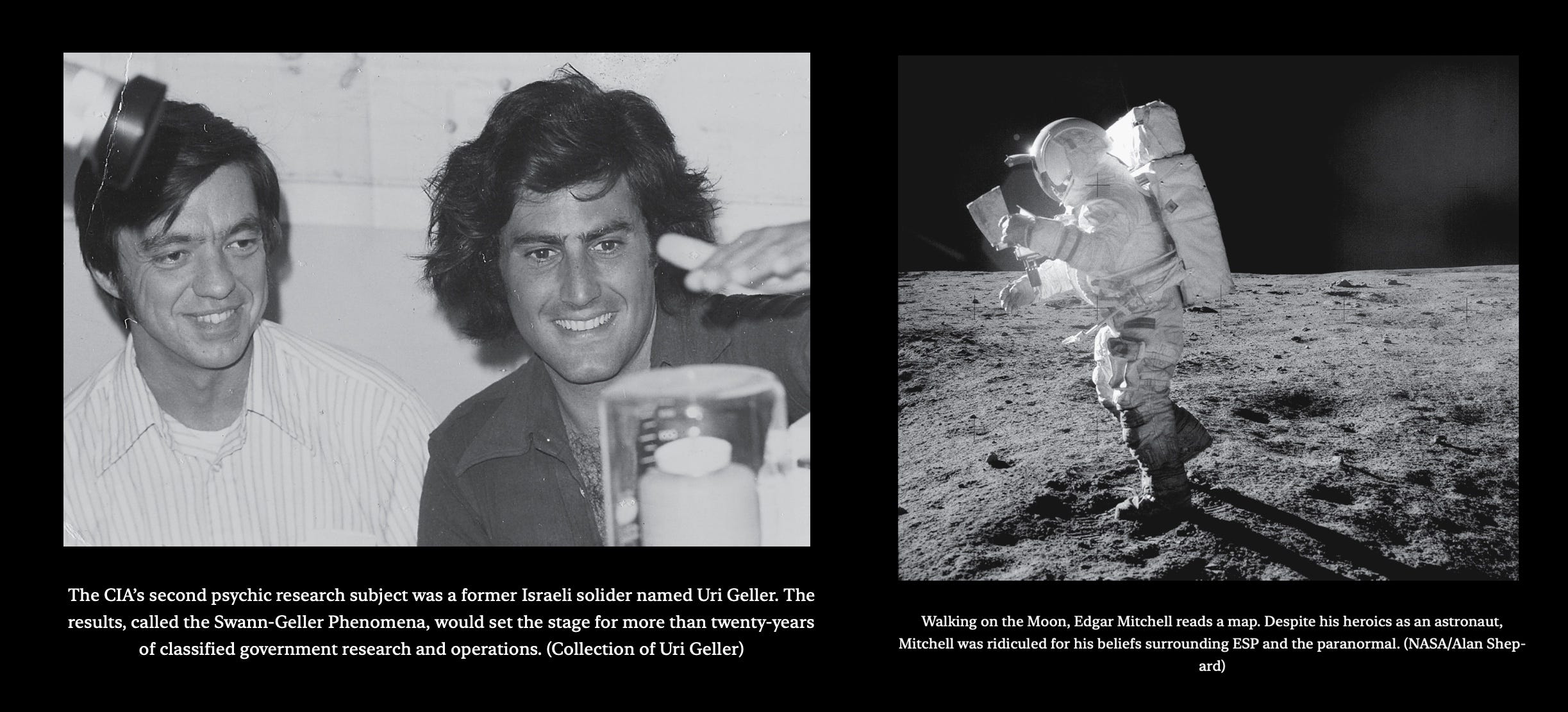
An exhaustive history of the government’s attempts to systematize and weaponize paranormal abilities. It also covers the broader paranormal research landscape, with lots of discussion of Uri Geller.
What authorial biases should I be aware of?
Jacobsen claims to be approaching the subject as a neutral observer, but I got a strong “I want to believe” vibe from the book. Her approach appears to assume what it claims to be investigating. The overarching question of the book is: “Why did the government spend so much time and effort on these areas if there’s nothing there?”
As one example of bias, I grew up reading Carl Sagan, and in his telling the appearance of Uri Geller on The Tonight Show with Johnny Carson was the smoking gun. Carson went to great lengths to make sure that Geller couldn’t influence the demonstration, and, what do you know? Geller failed to bend any spoons.1 I read about this when I was a teenager and it has loomed large in my memory ever since, so I was very interested to see how Jacobsen would handle it. She devotes one sentence to it:
Geller was nervous, he said, having recently been unable to demonstrate psychokinesis on Johnny Carson’s Tonight Show.
I’m sure I’m reflecting my own biases with this focus, but if she was truly being a neutral observer, I would have expected Geller’s Carson appearance to have gotten several pages.
Who should read this book?
This book was another one recommended by my friend, the seeker. (See my review of HeartMath, though this book is significantly better.) I had read a previous book by Jacobsen, which was decent, though sensational in places. So I thought I’d give it a shot. This book is similarly sensational, but it does compile all of the information about governmental investigation into extrasensory perception (ESP) and psychokinesis (PK), and the evidence thus acquired, into a single book. Jacobsen oversells much of it (particularly Uri Geller’s results at the Stanford Research Institute (SRI)) but she has done the legwork and talked to many of the individuals involved. If you’re interested in this sort of research at all, Jacobsen does a pretty good job of presenting it, as far as what you should make of it? That’s a far more difficult question.
What does the book have to say about the future?
Research into supernatural phenomena has obviously not ceased, even at the government level. And near the end of the book Jacobsen profiles a program by Dr. Kit Green and Garry Nolan to isolate a gene for ESP and PK and other psychic abilities. They describe the project as a “genomics of supernormality”. Green is a former CIA officer, with an impressive record of government service.2 Nolan is an impressive Stanford scientist,3 but he previously made an appearance in this space as a major figure in a UFO book, which is the area he seems to be spending most of his time these days.
As a consequence of work like this Jacobsen muses that we might be on the verge of something akin to the Copernican revolution, only for ESP and PK:
There presently exists a huge gap between where researchers are on a hypothesis for anomalous mental phenomena and where the science needs to be for them to move toward general theory. But it took more than a thousand years for man to move from the hypothesis that the Sun, not Earth, was the center of our solar system to the general theory of Copernican heliocentrism. Will modern technology allow for more interest in scientific research into the paranormal, or will the stigma prevail? If the stigma regarding ESP and PK research were removed from the world of science, what might be uncovered?
So I guess one possible future is for humans to be able to use gene editing and embryo selection to create a psychically sensitive master race that will rise up against the machines and found the Bene Gesserit order. But I don’t think that’s the way to bet.
Specific thoughts: What framework should one use to consider supernatural claims?
When considering claims like these there are three broad approaches one might take:
1- The absolute skeptic: This is the materialist, New Atheist, extreme skeptic position. Everything has a scientific explanation. If it exists we should be able to test it. It should be replicable. If ESP is a thing, someone should be able to reliably demonstrate it working, even if we can’t explain how it works. This has not happened. (Though see Scott Alexander’s post on such experiments.)
2- It’s true, all of it: Alternatively one might go in the exact opposite direction and credulously accept everything Jacobsen says, or for that matter, all paranormal claims. The “truth is out there” approach which accepts nearly all claims of paranormal phenomena. With a consequent claim that people are just too blinkered, scared, or oppressed for this truth to be widely known
3- Some position between these two extremes: Obviously anyone who’s religious at all (Or spiritual but not religious) falls into this camp. But this also includes anyone who accepts that things like near-death experiences (NDEs) and terminal lucidity appear to have real evidentiary backing. Or maybe you’re really unsettled by the story of Joan of Arc. Or maybe it’s that if you dig a little bit, everyone (even Michael Shermer!) has a seemingly supernatural story.4
As a religious person I definitely fall into this third bucket. And you might imagine that because of that, if I’m on the edge about a particular supernatural claim, I might default to acceptance, to the second approach, but I actually go the opposite way. I default to being a skeptic.
There are a couple of reasons for this. First, on some level I do agree that extraordinary claims require extraordinary evidence. And second, I really believe that all of the various beliefs, claims, and phenomena need to cohere in some fashion. It all needs to fit into a single framework.
Allow me to explain. If one believes in some sort of god (let’s set aside the actual denomination for the moment) where does ESP and PK fit with this belief? Are they divine powers? Are they miracles performed by the righteous? Are they granted by some force opposed to God? Based on the evidence offered up by the book the answer to all of these questions would have to be “no”. To put it a different way, NDEs fit very well with most conceptions of God. ESP as a genetic gift, much less so.
Alternatively, ESP and PK could have a materialist explanation, and Jacobsen seems to offer this up as a serious possibility (the word “quantum” appears 44 times in the book). But she also appears to want to have it both ways. Offering up a grab bag of supernatural stories, many of which would remain outside of the materialist theories she proposes. In order to create a coherent framework you have to draw some kind of a line. You have to take a position between the two extremes of absolute doubt and capacious belief.
This is all to say that when I read a book like this, my first goal is to gather more information, then I want to determine if this information should actually be considered evidence. This involves evaluating whether it’s true or not. If it is true how does it fit together with other things I believe to be true? How does it fit into the framework? Or I guess if I were going to be Bayesian (something I seem to be slipping into more frequently despite my best efforts) how should I update? In this effort, I have obvious biases. I have the obvious biases of my original beliefs, but I also have a bias towards coherence.
With that incredibly long preamble out of the way, let’s consider some of the evidence presented in the book. Of course I can’t fact check everything, but I’ve selected four items, that hopefully represent a cross section of the kinds of phenomena and incidents represented in the book:
First, let’s start with a broad overview of the case for the existence of ESP and PK. Jacobsen and others will often point to the positive reports and the ongoing funding of paranormal research, though in a different form. The Pentagon still has a large “sensemaking” initiative which is focused on training intuitive decision making. But one of the most concrete artifacts to emerge from the period discussed in the book is a comprehensive, 183 page, after-action report conducted by the American Institutes for Research in 1995. It was something of an adversarial collaboration with one of the lead researchers being sympathetic and the other one, Ray Hyman (a founding member of the skeptics’ organization CSICOP) being skeptical. Despite this Hyman had this to say:
I have played the devil’s advocate in this report. I have argued that the case for the existence of anomalous cognition is still shaky, at best. On the other hand, I want to state that I believe that the SAIC experiments as well as the contemporary ganzfeld experiments display methodological and statistical sophistication well above previous parapsychological research. Despite better controls and careful use of statistical inference, the investigators seem to be getting significant results that do not appear to derive from the more obvious flaws of previous research. I have argued that this does not justify concluding that anomalous cognition has been demonstrated. However, it does suggest that it might be worthwhile to allocate some resources toward seeing whether these findings can be independently replicated.
To an extent this is damning with faint praise, but the phrase “getting significant results that do not appear to derive from the more obvious flaws of previous research” is stronger than I would have expected.
Second, we should look at one of the purported successes of the CIA’s ESP programs. My attention was drawn to the story Jacobsen told of a downed Russian bomber:
[Graff] was told that the Tu-22 bomber was being flown by a member of the Libyan air force… Wanting to defect, the pilot chose to bail out of the aircraft while it was in flight. The plane continued to fly on autopilot until it ran out of fuel and crashed in the jungle somewhere in Zaire… but U.S. officials had no leads as to where the bomber may have gone down…
[A “sensitive”, Rosemary Smith] was brought to the briefing room and asked to look at the map. Could she home in on a spot where she perceived the aircraft might have gone down? Using an impromptu map dowsing technique, “She marked a spot,” remembers Graff. “Map technicians converted her notation into a geographical coordinate, then sent that coordinate to the CIA station chief in Zaire.”
…Graff headed home feeling excited and apprehensive. He sensed that the future of an Air Force phenomena program hung in the balance.
Two and a half days later, there was a knock on Graff’s door. “We found the airplane,” he was told. The CIA’s helicopter team landed in the village nearest to the coordinates provided by Rosemary Smith. The briefer told Graff that shortly after touching down, the team spotted a villager emerging from the jungle with an airplane part under her arm. This person led the search team back to the airplane. “The unit was able to extract valuable foreign technology” from the Tu-22 Blinder, says Graff, making the Zaire mission an unprecedented success.
You would think this would be a slam dunk. Heck, former President Carter even mentions it happening! Jacobsen reports that:
Years later, in September 1995, Jimmy Carter publicly confirmed the incident as having taken place. He was impressed, Carter told a group of college students in Atlanta, that after spy satellites failed to locate the wreckage of a downed airplane, a psychic had pinpointed the location of the missing aircraft.
I tried to find some record of this September 1995 confirmation. It appears to refer to an article from Reuters, which I was unable to locate. However, I did find him talking about it in 2005 in GQ Magazine.
We had a plane go down in the Central African Republic—a twinengine plane, small plane. And we couldn’t find it. And so we oriented satellites that were going around the earth every ninety minutes to fly over that spot where we thought it might be and take photographs. We couldn’t find it. So the director of the CIA came and told me that he had contacted a woman in California that claimed to have supernatural capabilities. And she went in a trance, and she wrote down latitudes and longitudes, and we sent our satellite over that latitude and longitude, and there was the plane.
Interestingly most of the details are different from what Jacobsen describes in the book. Carter mentions the “Central African Republic” (not Zaire, though apparently it was Zaire in the Reuters piece) and the fact that it was one of our planes, a “small” “twinengine” plane, not a Russian bomber.
It is still interesting that he was talking about it, and perhaps he was trying to maintain some kind of cover story. But you would hope that if Jacobsen really is trying to be objective she would mention that Carter later gave out details very different from her version of the story.
Third, let’s consider an example taken at random.5 This occurred in the mid-1970s at the Lawrence Livermore National Laboratory:
Yet it was not the results of the tests that were most troublesome, says Green, it was the strange effect Geller seemed to have on several of the nuclear physicists…
After the second day of tests, AEC security officer Ron Robertson called Kit Green at CIA headquarters. “He told me there was a serious problem,” recalls Green. Several of the nuclear weapons engineers had reported seeing things they could not rationally explain. These included “items flying across the room. Lights flashing. A six-inch ball of light, rolling down the hallway. One scientist reported seeing a flying orb,” remembers Green. “One of the scientists claimed to have seen a large raven, perched on a piece of furniture inside [his] home.” Privately, Green thought these sounded “like poltergeist events” from folklore. The AEC was concerned, and so was the CIA.
Green flew to San Francisco and met with the scientists individually… One of the scientists confided in Green about a particular incident he could not get out of his mind. It happened in his bedroom, in the middle of the night. It made no rational sense, except he woke up his wife and she saw it too, Green recalls. “He told me that he saw a disincarnate arm, rotating like a hologram,” meaning an arm that was free-floating, not attached to a body. “An arm wrapped in some kind of gray cloth… instead of a hand the arm had a hook. He talked about the [horror] of seeing this hook floating over the foot of his bed. How it rotated like it was on a spit.
I like this example because it takes us to the framework problem. There are a lot of stories about Geller in the book. (And I mean a lot!) And wherever Geller goes there is a lot of spoon bending, but this is the only case where poltergeists show up to haunt people during the night after Geller visits them. So if you’re attempting to create a grand explanation for ESP and PK, how do poltergeists fit in? And why was it only this one time?
Beyond my fascination with creating some kind of framework that exists outside of pure skepticism and pure belief, what about the fact-check? All of the really sensational stuff comes from Green’s recollection. There’s no independent confirmation of any of the claims. This is a story Green has been telling for a while and eventually he tells it to Jacobsen. A “Ron Robertson” is mentioned, and you can find evidence of him talking about why the government is interested in psychic phenomena, but no one ever tried to get him to corroborate the poltergeist stories. And despite the “interest” of the “CIA”, there are no official documents which mention the raven, or the flying orb or the “disincarnate arm”. All of that derives from a single source: Green’s recollections long afterwards.
Finally, there’s Uri Geller. If Uri Geller is really a powerful psychic, then this all gets a lot more interesting. If, on the other hand, he’s one of the world’s most successful frauds, then I wouldn’t say this book is gutted, but it has suffered a major wound. Jacobsen uncritically reports all kinds of stories, this may be my favorite:
“My wife, Sara, and I were at a restaurant in Caesarea. We were having lunch with Uri. Everyone came in and they wanted to see Uri… to have him bend their spoon. He said, ‘I can’t do it right now, I can’t bend all these spoons.’ He is very gracious, you know, but they kept [asking].… Finally he said, ‘Oh, all right.’ So he stood at one corner of the restaurant and he simultaneously bent the spoons of all the people who were there.”
If he can really do that, on command, then why couldn’t he bend a single spoon on Carson. Why hasn’t he done it in a controlled setting and put to rest all doubt?
Obviously I can’t fact check that one, but there are a few that I can fact check. This review is already way longer than I planned, so I’ll just do one more. Geller spent some time with SRI, and here’s how Jacobsen reports it:
Between December 1, 1972, and January 15, 1973, Puthoff and Targ completed nine days of official tests with Uri Geller. The experiments were recorded on film, videotape, and audiotape simultaneously. According to the scientists, Geller’s tests with dice were among the most statistically significant. In these tests, he sat sequestered in a room with Puthoff and Targ while an SRI researcher in a separate room placed a single square die inside a closed metal box. The sealed box was brought into Geller’s room, then shaken by a technician, and placed on the table in front of Geller. “Mr. Geller would then look at the box without touching it and call out which die face he believed was uppermost,” states the declassified CIA Progress Report. “Geller gave the correct answer each of the 8 times the experiment was performed. The probability that this could have occurred by chance alone is approximately one in a million,” the scientists informed the CIA.
This seems pretty incredible, but it turns out that the experiment was not as closely controlled as they claimed. There’s a whole article examining all the peculiarities, but among the most startling is this:
In the fall of 1981, almost ten years after the die test, Puthoff finally revealed an astonishing fact. No film or videotape was ever made of any of Uri’s eight successful guesses!
Also the die tests were spread out over a couple of days, conducted at various locations, slipped in at the end of his time, and often involved Geller touching the box with the die. Once you understand all this, it seems far less impressive.
To be clear I’m not discounting everything Jacobsen claims. She includes the story of a near death experience. I think NDEs are supernatural and have a lot of genuine evidence around them. Also, as I mentioned in the first example, the government ESP programs produced some genuinely interesting data.6 But I think Jacobsen was far too credulous, and above all else I’m entirely convinced that Uri Geller is a fraud.
—--------------------------------------------------------
I started this review thinking, this will be a quick one I can whip out in a day or two. Mostly because I knew exactly what I wanted to say. I overlooked how much I wanted to say. And I still ended up leaving a lot of the juicy Geller stuff. Perhaps I’ll read one of the many books specifically about him. If that sounds interesting let me know. Leave a like or subscribe or an insult and I’ll catch you next time.
Spoon-bending was his go-to demonstration of psychokinesis, as you’ll see reading farther into the review. But Geller also had the opportunity to do other things as well, like identifying which metal cans had objects hidden in them and he failed all of the potential tasks.
From the book:
“Over the past thirteen years, Dr. Green has been a professor in the Departments of Psychiatry and Radiology at the Harper University Hospital, and the Detroit Medical Center, and served as the medical school’s executive director for Emergent Technologies (i.e., forensic brain scanning applications)”
...
“After Green officially left the CIA in 1985, he worked for General Motors’ Research Labs, and was eventually promoted to chief technology officer for Asia-Pacific. He has remained an active military and intelligence science adviser to the CIA and the Department of Defense, serving on more than twenty Defense science and advisory boards. His positions have included chairman of numerous National Academy of Sciences Boards and Studies; Fellow, American Academy of Forensic Sciences; founding member, Defense Intelligence Agency Technology Insight-Gauge, Evaluate, and Review Committee; chairman of the Independent Science Panel for the Undersecretary of the Army for Operations Research and later for the Assistant Secretary of Defense for Chemical, Biological, and Nuclear Matters. He also recently served as chairperson of a nineteen-member National Research Council effort to examine the future of military-intelligence science and brain research over the next twenty years. Green’s bona fides are clearly not lacking. In 2016, he was asked to join a classified science advisory board for James R. Clapper, director of National Intelligence (to whom the directors of all seventeen U.S. intelligence agencies and organizations report) and the man who, in the 1990s as director of DIA, criticized the anomalous mental phenomena programs calling them ‘just too far out at the leading edge of technology.’”
From the book:
“Dr. Green teamed up with the Nolan Lab at Stanford University, run by Garry Nolan, one of the world’s leading research scientists specializing in genetics, immunology, and bioinformatics. Nolan trained under the Nobel Prize–winning biologist David Baltimore, has published over 200 research papers, and holds twenty biotechnology patents. Age fifty-five, he has been honored as one of the top twenty inventors at Stanford University. His research is funded by grants from the National Institutes of Health, the Food and Drug Administration, the National Cancer Institute, and others. In 2012, Nolan was awarded the Teal Innovator Award from the Defense Department, a $3.3 million grant for advanced cancer studies. The Nolan Lab is perhaps best known for pioneering advances in large-scale mapping of cellular features and human cells at an unprecedented level of detail.”
For example, a couple of hours before writing these words I heard the story of someone with an estranged, homeless, addict son. Obviously this gentleman was very worried about his son, and then one night he dreamed that his father told him that he didn’t need to worry any longer, his father was going to handle it. A few days later the estranged son called, and wanted to come home. After being home for a bit the son revealed that he had been on the verge of suicide, when he heard the voice of his grandfather, the same person from the dream. Is this story true? Who knows? But I’ve found that if you start asking around, everyone has a story like this. You can find one of mine here.
I generated a random number between one and the last page of the book, and then looked around that spot for something “checkable”. I ended up doing it twice before finding something I “liked”. In part I was trying to avoid another example involving Geller, but that proved difficult.
If you want more of that look into the Ingo Swann Magnetometer Test which I didn’t have time to cover.
Thanks for the interesting book review, Richey, always (literally) commendable.
"I also have a bias towards coherence."
I share this, but I'm not sure it should qualify as a bias. The mutual compatibility of all true things should be a default position.
The potential for error comes in when I assume my *understanding* of one set of facts is much more certain than is warranted, and use that to rule out only apparently contradictory facts.
Ahhh yes, Annie Jacobsen.....Annie Jacobsen. I too encountered her after her more recent book on Nuclear War. The one I read was about Area 51.
The book had three streams. One was the history of the types of experimental planes developed, mostly for the CIA. There was the U2, flying higher and faster to justify the risk to pilots collecting intelligence. There was the story of how the US got its hands on the first Russian made Mig so they could study it. There was the first remote piloted planes, used mostly over China to avoid the Gary Powers fiasco.
Another was the institutional history of Area 51. The promises to develop planes immune to radar. Navigating how to interview people to work at Area 51. Incidents like what happened when a private plane had to make an emergency landing or a test plane crashed and civilian picked up the pilot along an empty road. The tension with the airforce, which didn't like the CIA having its own fleet of planes, plus the whole question of why use planes at all if space is an option? All good stuff.
But then there was her 'hook', which I'm just going to spoil.
She tied together several threads. An old man who was one of her main source: The War of the Worlds panic that she alleges Stalin made a mental note of. Nazi experiments with single wing aircraft, which included an effort to secure an aircraft designer who was briefly gotten first by the Soviets in Germany after the war.
Her 'idea'...... Stalin wanted to create a panic in the West. He used a Nazi aircraft engineer to design a single wing aircraft that could be remote piloted (think something advanced and vaguely UFO looking). He used Josef Mengele's experiments or possibly direct consultation from Mengele himself to produce deformed, misshapen children or adults that looked a bit alien and wouldn't survive long. This aircraft would fly into the US and land somewhere noticeable. With its futuristic look and unknown technology would appear alien and with the non-communicative people inside who'd die, an alien invasion panic would ensue. This plane, however, didn't make it to some place where it would be so easily noticed as it crashed in an obscure place called.....Roswell.
I was left for a serious loop with this book. On one hand here was a well done, readable history of Area 51 with a lot of good stories about development and challenges that seemed quite grounded. Yet out of left field we get this wacked out story whose primary source is an old retired officer who died not long after the book and, of course, hinted he could only give her 'some of the truth'. She, of course, asked none of the most obvious questions like how could the Soviets have a plane that could penetrate so far into the US? Why this 'saucer' technology was not incorporated either into the planes Area 51 worked on or used in Soviet aircraft? What exactly was the endgame of this 'publicity stunt'?
My working theory is that she knew an Area 51 book would sell a lot more if it had a good hook for the UFO crowd. Intelligence people, esp. old retired ones, probably have a habit of spinning tales and maybe enjoy trolling a bit. She combined the two, possibly arguing to herself she was simply reporting what this 'source' said so she technically wasn't violating any rules of journalism.
That leaves me with a credibility gap for her that I think is more serious than her Nuclear War book. Or maybe it's a gullibility gap.