

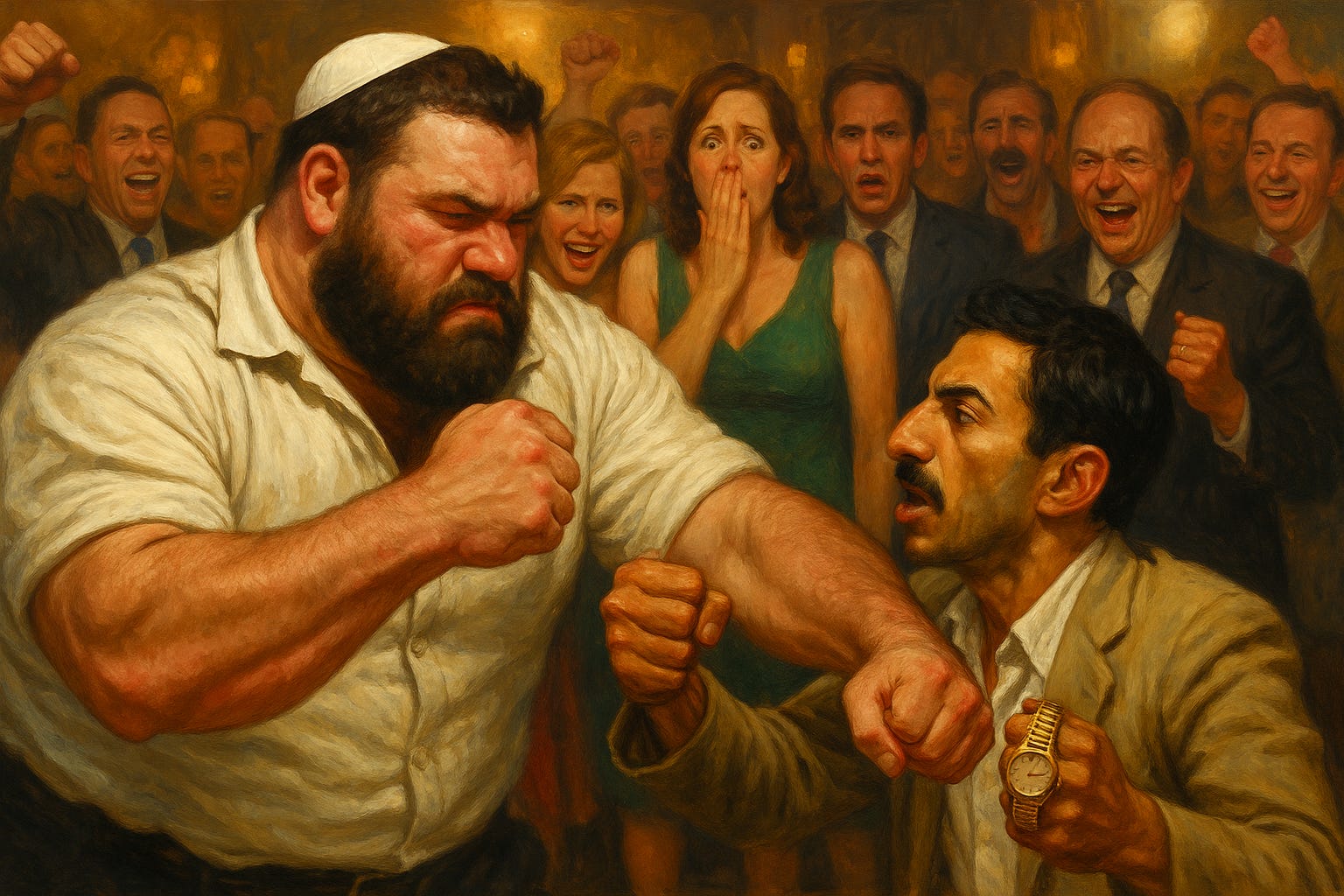
This is another book review—or at least that’s how it began. Unfortunately, the subject is rather volcanic: it keeps erupting, spewing ash across the geopolitical landscape. And the author, for better or worse, has been erupting too. What began as a stroll around a scenic mountain has turned into one of those panicked car rides where both sides of the road are on fire, and I’m wondering how I ended up in the middle of it.
So without further ado… The book, and then I have thoughts…
On Democracies and Death Cults: Israel and the Future of Civilization
By: Douglas Murray
Published: 2025
240 Pages
Briefly—what’s the book about?
An after-action report of the events of October 7, 2023, with extensive interviews of people in Israel about what happened. This includes discussion and reporting of Israel’s response, and the response to the response, particularly of those elites who were critical of it. Murray then puts forth a framework where life-loving liberal democracies sit on one side and rapacious death cults reside on the other.
What’s the author’s angle?
Murray’s affection for Israel and his devotion to their cause is undisguised. He’s a strident polemicist, arguing vociferously on the evils of Hamas and the necessity of the Israeli response. Whether his stridency is justified is the point on which everything hangs.
Who should read it?
Those seeking vivid, first-person accounts of the October 7th atrocities will appreciate the book. Those seeking a deep exploration of Palestinian grievances should look elsewhere. Outside of that, if you have any familiarity with Murray you’ll mostly get what you expect.
Specific thoughts I: Murray on Joe Rogan
The subject of this book sits right in the middle of the biggest controversy of our day: the Israel-Hamas-Gaza mess. We’ll get to that by and by. But Murray himself ended up in the center of his own controversy when he appeared on the Joe Rogan podcast.
Murray opened by criticizing Rogan for not exercising more discernment with his selection of guests. He pointed out that some of his guests pushed fringe historical and geopolitical claims while lacking any qualifications (formal or otherwise) in the areas on which they were opining. But despite this lack of qualification, Rogan never pushes back on their claims.
This is an interesting point, and worth considering separately from Murray and the Israel-Hamas-Gaza mess. Before chiming in I should mention that I have never seen/listened to an entire episode of Rogan’s podcast. Though, like many people, I have watched tons of clips. Also I’ve been following Rogan’s career since his days on News Radio and I even watched a ton of Fear Factor back in the day. So I’m not an expert on Rogan but I’m not a complete naif either. Having covered the necessary caveats, I think four things can be said:
First, if you consider Joe Rogan, his podcast, and his guests in their totality, it seems obvious that it’s a good thing. It’s brought the world some deep conversations that wouldn’t have existed otherwise. Rogan and his format are responsible for that.
Secondly, and on the other hand, I do think that Rogan suffers from something akin to Gell-Mann amnesia. He is hypercritical of stuff he knows a lot about. Rogan climbed on stage and called out Carlos Mencia for stealing jokes. The public perception of him as someone on the right (not necessarily matched by his actual politics) started when he called for Fallon Fox, a transwoman, to be banned from competing in female MMA. But when you get outside of that expertise, he does seem to fall into a mode of agreeing with whomever he’s talking to at the moment.
Third, I think some amount of pushback of the sort Murray engaged in is good as a general method. Ideas and assertions should not be accepted uncritically. And it’s interesting that Joe Rogan’s podcasts are almost never formatted as a debate. Murray was one of a half dozen exceptions. What makes Murray bad enough to be challenged, but not Darryl “Churchill was the true villain” Cooper?
Finally, and most importantly, were Murray’s tactics the most effective way to change Rogan’s mind? Is Rogan likely to be more circumspect in who he invites on? Did Murray sway any people from one side to the other? I’m not sure that he did either of those things. Based on what I’ve read after the fact it appears that this was another case where one side felt like Douglas Murray had finally engaged in much needed pushback (see for example this article in the Free Press) and the other side felt like Murray was yet one more so-called expert who wanted people to defer to his authority regardless of the actual facts.
Specific thoughts II: Sam Kriss apparently loathes Douglas Murray
As I mentioned there was a lot of discussion of Murray’s appearance on Rogan. One of the more interesting takes came from Sam Kriss, possibly the best writer on the internet. His article was titled “Douglas Murray, gruesome toady”. As you may have surmised from the title, he’s not a fan. Kriss also brings up Murray’s appearance on Joe Rogan, mostly remarking that Murray isn’t exactly an authority either, but rather a polemicist who is engaged in much the same thing he’s accusing Rogan’s guests of: genocide denialism. The Rogan guest Murray has the most problem with is aforementioned Daryl Cooper who denies the Holocaust. But Murray is denying the genocide being committed by Israel, at least according to Kriss.
I try to subscribe to substacks from a variety of ideologies, and I think I’ve ended up subscribed to about a half a dozen “Israel is committing genocide!” newsletters. I’m even a paid subscriber to a couple. (Including Kriss despite his entreaties that I shouldn’t.) So I’m not unfamiliar with the claims of genocide, but like everything else about the situation it’s messy and complicated.
Let me start by disclaiming all expertise. Sure I’ve read a lot of stuff, but hasn’t everyone at this point? Also I should make it clear that I start with a pro-Israel bias. I mean I read Murray’s book, right? I also recently read Steven Pressfield’s The Lion’s Gate, a gripping account of the Six Day War.
On the anti-Israel side there are the aforementioned substacks. Also I read John Ghazvinian’s book America and Iran which was basically Iran apologia, so despite my initial biases I have tried to understand the other side. Finally if someone has a book they think I should read please leave it in the comments.
This all leads to the question, how should someone approach understanding the complicated geopolitics of this question. I’m interested in a general approach, but also specifically how should I evaluate the claims of Kriss and other anti-Israel pundits? As always part of the problem is I don’t have unlimited time, nor is this topic anywhere close to being my primary intellectual interest, i.e. I’m not going to drop everything else just to focus on getting to the bottom of the situation in the Middle East. (Could any endeavor be more quixotic?)
All of this takes me to one of the central points I want to make. Most people, when confronted with a complicated situation like the Israel-Hamas-Gaza mess, just want to find a smoking gun, some fact, or incident, or piece of logic that allows them to figure out who’s the good guy and who’s the bad guy and call it a day. They’re trying to make the question legible.
Yes, this is lazy. Yes, this is a bad way to go about it. But when there are smoking guns of all makes and models stretching to the horizon, it’s delusional to expect everyone to look at all of them, and unrealistic to expect people to look at more than a handful. But I do have Kriss telling me to look at a few particular smoking guns, which I am happy to do.
Specific thoughts III: Israeli abuse of Palestinian prisoners
Kriss mentions the following incident:
When it emerged that Israeli hostages in Gaza were being subjected to extreme torture, including being gang-raped, raped with metal bars and cattle prods, raped by dogs, Hamas put some of the militants involved under arrest. Almost immediately, there were massive street protests by ordinary Gazans. They weren’t marching for peace, an end to the torture, or the release of the hostages: they were demanding that the rapists be set free. Some Hamas officials broke ranks to officially endorse gang-rape as part of their struggle. ‘If he is a Zionist,’ said Idris Khalidi, a member of the Shura Council, ‘everything is legitimate to do! Everything!’
The big reveal is that it’s actually the exact opposite. It’s Palestinian prisoners in Israel who are being subjected to torture and rape by Israeli guards. And, when these guards were arrested, it was far-right Israelis who were protesting for their release. Finally it was a member of the Knesset, Hanoch Milwidsky, who said “If he is a Nukhba [Hamas militant], everything is legitimate to do! Everything!”
This is obviously horrible and I was unaware of it, so I’m grateful to Kriss for pointing it out. But I’m also unsure of what to do with it. Kriss is far too smart to be a Hamas apologist, and he, quite accurately, points out that:
…there is a germ of evil buried inside all of us, and most of the time that germ is something perfectly mundane. Georges Ruggiu [a Belgian who assisted in the Rwanden genocide] just wanted to be respected: that desire is not evil in itself, but it can make you do evil things. (There’s evil in me as well. I’m no stranger to the pleasure of hating; I’m doing it right now.) I think the sadism and cruelty of October 7th—and the far greater sadism and cruelty Israel has displayed since—have their origins in entirely ordinary human frailties, the petty self-deceptions and insecurities that churn away inside everyone’s mind basically all the time.
Despite this assertion that there’s evil in all of us, he goes on to say that Israel has displayed “far greater sadism and cruelty”. In other words, like nearly everyone, he wants me to pick a side. And, despite Kriss’ exhortations to the contrary, if I have to pick a side I’m going to pick Israel.
This is not to say that I don’t agree with many of the criticisms of Israeli actions. Also, Kriss did a good job of persuading me that Murray is far too “captured” by Israel. But, if “the line dividing good and evil cuts through the heart of every man” (I prefer Solzhenitsyn to Kriss) then a large part of any judgement should be what measures are taken to guard against that evil? To return to Kriss’ anti-Israel example, it’s important to note that Israel did arrest and charge the guards who were committing the abuse.
In fact when I read Kriss’ account of the abuse, I immediately knew that he wasn’t talking about Hamas, he was talking about Israel. First, because pieces like Kriss’ always use this tactic, but also because the line “Hamas put some of the militants involved under arrest” struck me as utterly unimaginable. I’ve never heard of Hamas or any similar organization formally punishing members of its own organization. In the course of writing this post, I tried to find any instance of where Hamas even acknowledged that there might be incidents of rape or similar abuse to investigate, let alone arrested someone, and I’ve been unable to find anything.
The closest I found was a report that Hamas may have executed some of its members for raping male Israeli prisoners, though the execution was not punishment for rape. It was punishment for the evident homosexuality evidenced by the rapes.
Now to be clear, when Israel does investigate such things, they generally drag their feet. Oftentimes the investigation starts only after the evidence is overwhelming. And when all is said and done they give the people responsible pretty light sentences. But, also, when all is said and done Israel will punish their own for these crimes, while Hamas will not.
Specific thoughts IV: Maybe it’s a matter of legibility
To repeat what I said above, I disclaim all expertise. I am not trying to persuade anyone to pick the same side as me. Or any side at all. I am attempting to speak from the position of the normal, opinion consuming individual who is informed daily, if not hourly, that it is their responsibility to pick a side in this conflict. I speak for the vast majority who only have time to look at a small fraction of the “smoking guns”. Some of these people look at the prisoner abuse incident mentioned by Kriss and immediately determine based on that particular smoking gun that Israel is definitely the bad guy.
The badness in that example is very easy to see. It’s legible. And I’m not sure I have any right to criticize them because I also end up looking for legible examples to hang my hat on.
I’ve already listed one, the fact that Israel actually did imprison the guards for the rape of prisoners. Other pieces of easy to understand and starkly differentiating evidence I’ve used to pick a side (when forced) include:
Israel entirely withdrew from Gaza in 2005.
Anti-Israeli protests started on October 8th, in support of what even Kriss calls the “sadism and cruelty” of October 7th—before Israel had done anything in response.
Arabs can be citizens of Israel and even members of the Knesset, whereas the same could not be said of Jews in any of the countries Israel is fighting.
Israelis are not only allowed to, but have held anti-war protests.
Hamas started it.
Now I know that a great many people will argue that things did not start on October 7th. But this is entirely my point. Nothing could be more complicated than the Middle East mess, and there is plenty of blame to go around. I would certainly never say that Israel is blameless. The number of Gazan civilians who have died, along with journalists, is appalling. But if you really want people, including me, to pick a side then they’re going to look for evidence that’s easy to understand. They don’t have time to start with Hagar and Ishmael and work forward from there to the present day, keeping some kind of comprehensive tally of crimes as they go.
Boiling all this down, when I say that I’m on Israel’s side, I might just be saying that it’s the side with the more legible case. But I’m also saying that there appear to be a lot of easy things Hamas could do to make their cause more legible, which they refuse to do.
Specific thoughts V: The legibility of results
I’ve long been interested in the role of war as a true test of a society. You may think that something is a good idea, but if it turns out to reduce your chances of survival, then you were wrong. From an evolutionary perspective, and over a long enough time horizon, anything that makes you less likely to survive is a bad idea.1 And war is where survival is tested.
The results of this testing can be viewed on both sides of the Israel-Hamas-Gaza mess. Let’s start with the Hamas side, because as I pointed out, that’s where things actually did start. What did they expect to get out of starting this fight? It seems like their major goals were to:
Puncture the sense of Israeli invulnerability
Take hostages for future leverage in prisoner swap deals
Increase their reputation
Derail a follow-up to the Abraham Accords
Encourage other factions and even nations to join in, like Hezbollah and Iran
Turn public opinion in their favor
Considering these goals I think it might be worth viewing October 7th through the metaphor of an actual fight. Also a metaphor is the ultimate method for creating legibility.
Imagine you’re at a party and there’s two guys, a big beefy dude everyone is afraid of, let’s call him David, and a scrawny guy who has a long standing beef with David. We’ll call him Ahmed. Let’s say that Ahmed sucker punches David, maybe he has good reasons, and David goes down. While he’s down Ahmed quickly pulls off David’s expensive watch, because he knows David really loves that watch. Ahmed has accomplished goals 1 and 2 right out of the gate. But what does he think is going to happen once David stands up? Particularly if Ahmed doesn’t run (which he can’t do if he wants to accomplish number 3.) David’s going to beat the shit out of him, at the very least until he gets his watch back. And perhaps this will be surprising to some people, but it shouldn’t be surprising for Ahmed. If he’s going to throw the first punch he has to be prepared for a possible beat down.
Obviously David is really mad (he was sucker punched after all) and he’s really laying in to Ahmed, to the point where his friends are like “Dude, calm down.” (Ahmed has achieved goal 4) On the other side maybe Ahmed’s friends jump in (goal 5) and they land some glancing blows, but David’s a big dude and before you know it Ahmed’s friends have taken enough of their own pounding to stay out of it.
Still, the longer David is beating on Ahmed, the more the crowd turns against David (goal 6) regardless of the sucker punch, and regardless of the fact that maybe Ahmed should just give the watch back. I share the crowd’s disapproval, but disapproval has a poor track record for stopping fights. In an actual brawl between two individuals the police might eventually show up, but that’s not going to happen in our metaphor. In our metaphor there are no police, there are just two rival gangs, and David happens to belong to the more powerful of the two.
However justified or unjustified David is, this is how power works. You sucker punch the big dude, and refuse to give back his watch and you may get beat on for a very long time.
But just as Ahmed should have expected a beat down if he sucker punched David. David should have expected the sucker punch. What would have happened if he’d been more on his guard? I mean he knew Ahmed hated him. He knew that he was just waiting for a chance to sucker punch him. It seems like he should have been more careful. Which takes us to the other side of “the test” of war. Because if Ahmed getting the shit kicked out of him has to be counted as a failure for Ahmed, David being knocked out and having his watch stolen has to be counted as a failure for David. Particularly given how much he likes that watch.
Whatever success Israel has had since October 7th, in the beginning they made a lot of mistakes.
Here I would direct your attention to a great article “The Untold Story of How Israel Failed on October 7”. There are numerous elements that are hard to believe:
Israel assumed that Hamas had been placated that things were going well and they wouldn’t rock the boat.
Israel had the full October 7th Hamas plan, they just didn’t take it seriously.
There was a huge overreliance on tech at the border. They had faith that cameras, seismic sensors and remote gun-towers were sufficient, and as a result there were very few people on guard.
Several army posts had no one actually at the gates and their weapons were under lock and key.
The same thing happened with community weapon stores which were always in the same place so Hamas could easily find them.2
The standard was that every civilian and even every soldier had to enter a rocket-shelter if there was an alarm. So no one was around to spot the approaching Hamas troops.3
Everyone had a safe room, but virtually none of these safe rooms locked from the inside. Supposedly this was for safety because it would make it harder for people to be rescued. But as a result militants could just open the door.4
From the perspective of our metaphor, David has a text message with Ahmed’s plan to punch him and take his watch, he dismisses it, and then when Ahmed approaches he puts both hands behind his back, sticks out his jaw and says, “Take your best shot.”
What changes if the sucker punch never happened? What happens if Ahmed doesn’t end up with the watch he refuses to return? Obviously hypothetical counterfactuals are hard to evaluate (they’re not particularly legible) but, if we’re going to reduce it to the arenas of war and power, Israel made some major mistakes that allowed October 7th to be as devastating as it was.
I’m not sure where I stand after all of this. I can continue my simplification and say we should try to break up the fight between David and Ahmed, and ideally Ahmed would return the watch. And then I could further simplify the impossible path forward by remarking that even if the fight ends there’s no possibility of David and Ahmed hugging it out. But if someone were to claim I’m oversimplifying things they would certainly have a point.
My options would appear to be:
Drop everything else and commit myself to a deep understanding of the conflict, with all its claims and counterclaims and use that to pick a side. The “Talk to the friends and relatives of Ahmed and David. Mine their social media history for information” option.
Focus on the facts that are easy to understand, and pick a side that way. The “Ahmed sucker punched David and stole his watch?” option.
Refuse to pick a side at all. The “Ignore the fight in the middle of the party with all of its blood” option.
My point is that most people are going to pick option 2, and that whatever Douglas Murray’s faults may be his book recognizes that. And if someone has a suggestion for a similar book written from the other side please point me in that direction.
We will have to leave to another post the levels of legibility one can pursue, the relationship between legibility and epistemology, and most importantly the problems that come from trying to make everything in the world legible.
With any luck I’ve annoyed everyone with this post. That’s how you can tell it’s not AI. AI really bends over backwards to not be annoying. And speaking of future posts, I’ve been meaning to write one about distinguishing oneself from AI as well. Should you wish to see these posts when (if?) they come out, consider subscribing, or liking, or sharing, or whatever else is required to bring me to the attention of the all powerful algorithm from which all blessings flow.
From a materialist perspective at least. I’m setting aside questions of religion and rewards in the hereafter. If I bring religion into my discussion of the Middle East we’re never going to get out of here.
In 2023 the IDF told all the kibbutzim near Gaza to move their weapons to a centrally locked storage unit (located in the same spot). One guy thought that was dumb and refused, instead allowing individuals to keep their rifles. As a result this kibbutz held off two waves of Hamas for four hours and no one was captured or killed.
One of my favorite stories was of a grumpy old man who refused to enter the shelter. As a result he saw Hamas coming and saved his kibbutz.
There are several awful stories of people desperately trying to hold the doors closed.
A book that intensely affected my opinion on this conflict was We Belong To The Land by Elias Chacour, a memoir of a Christian Maronite priest in the West Bank who spent his life trying to nonviolently maneuver past Israeli manipulation of procedural outcomes. Israel can look reasonable and civilized on paper because it is in their interest to do so and their factions can easily agree on this, which obfuscates how frustrating and humiliating life can be for the manipulated.
Chacour was evacuated as a boy from his family's ancient Christian village so the IDF could sweep it for terrorists. They remained evacuated as he grew up and the inhabitants' request to reenter went through the court system. After decades the Israeli Supreme Court ordered the military to relinquish the village. They did - after using it as target practice for a bombing run. It can be easy to overlook this sort of thing if it's done with the proper paperwork, but it's excruciating for the people on the ground.
Later in the book he mentions the first intifada in the 80s, and how he disagrees with violence and believes that only peaceful methods can effect lasting change... and notes that, that said, it would be hard to find anyone he knew that was against it, because they were just that frustrated with trying to get Israel to let them do anything. His life's crusade, something that took many years of effort and negotiation and eventually international media coverage, was to get Israel to approve the building of a high school in his new village. You can imagine people looking at that, looking at their supply of saintly priests, working out how long it would take for a community college, and giving up on peaceful solutions.
Again, all of that might look above board, but my read on the situation is that Israeli factions put minorities through vicious anarchotyranny for the sake of interfaction rivalry and tribal animus. Hamas' character as a militia with a political party attached seems to be an evolutionary adaptation to Israeli factional preferences and how they shape assassinations. Arabs are some of the easiest people in the world to bribe; the squalor and subsequent rebellion of Palestinians seems to be entirely a policy choice.
For me, the Israeli story is more legible because the culture and values are more aligned with mine. I think this is true for almost all Americans, supporters of both sides. But supporters of Hamas are in a conflict with their own prevailing cultural norms.