

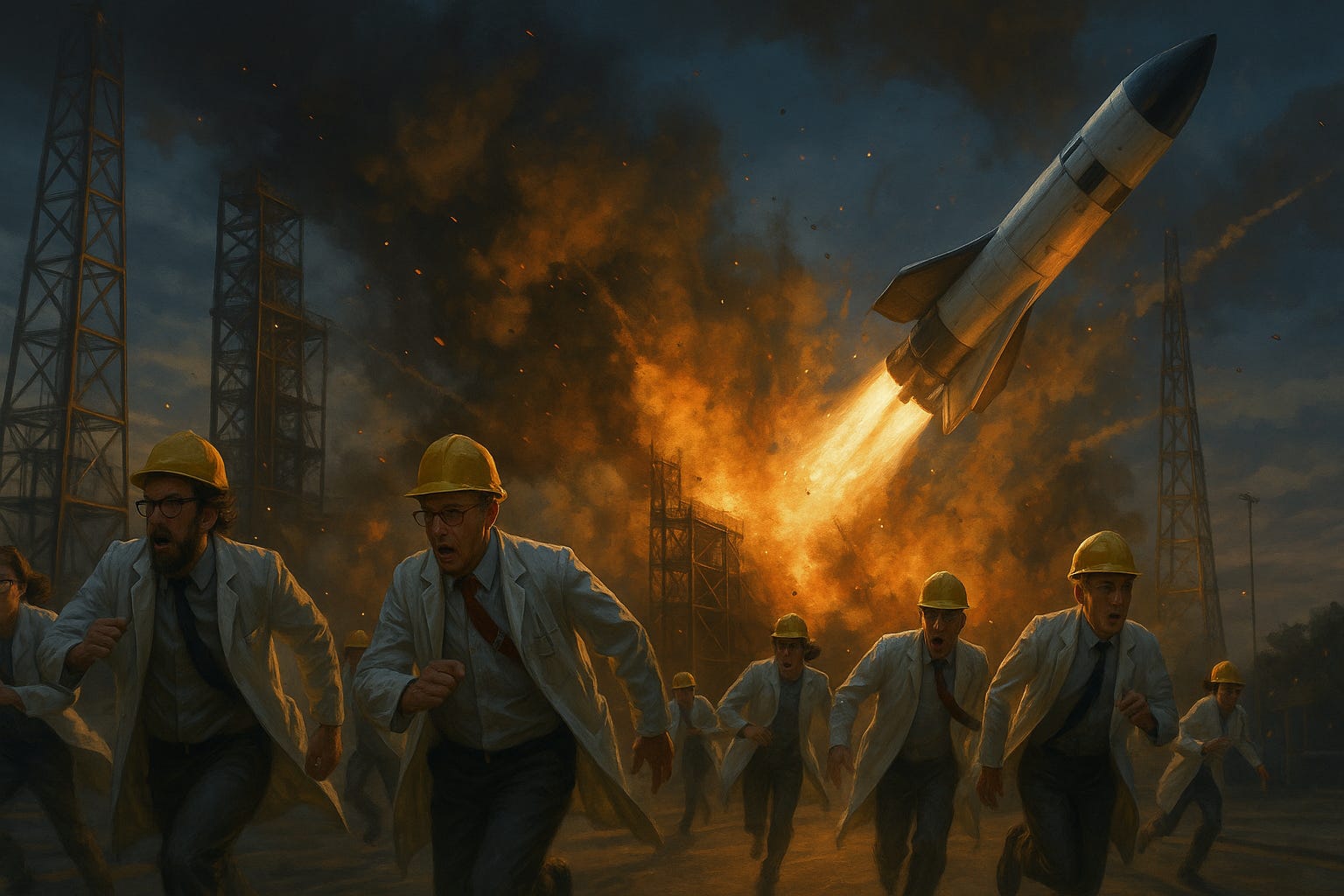
Ignition!: An Informal History of Liquid Rocket Propellants
By: John Drury Clark
Published: 1972
216 Pages
Briefly, what is this book about?
An insider’s account of the always exciting, frequently terrifying, attempts to develop the perfect liquid propellant.1
What’s the author’s angle?
Clark was a program director, and he’s mostly telling personal stories about the vast effort to find better liquid propellants. His sense of humor is great and his disdain for bureaucratic minutiae is obvious. He’s one of those steely-eyed missile men you hear about.
Who should read this book?
People interested in a behind the scenes look at a fascinating period of engineering and discovery.
Specific thoughts: Once We Were Engineers
One of the themes of several books I’ve touched on recently is the difference between a country run by engineers and one run by attorneys. (See my review of Breakneck, but also my essay on a legalistic society.) Clark is a great avatar for peak US engineering ethos. He was rigorous in his application of the scientific method; his engineering was top notch; and he got stuff done.
Of course it wasn’t just Clark, this book is also set in a time and place when the US as a whole was at the peak of its engineering prowess. There are a lot of factors that contributed to this peak, especially in the domain Clark’s describing. The importance of rockets in the immediate aftermath of WWII and during the early Cold War is hard to overstate. We were definitely in a race against our enemies in the development of ICBMs.
Beyond that there were obviously other factors that you can extract from the book if you read between the lines a little bit. Clearly safety standards back then were not as stringent as they are today. (You’ll see what I mean in a moment.) But as I think more about the general topic of attorneys vs. engineers I wonder if one of the final steps in the process was the combination of legalism with safetyism, and that’s what actually created the toxic alchemy we know today.
Speaking of toxic alchemy, I think my favorite parts of the book were the numerous investigations they conducted into increasingly exotic oxidizers, mostly involving fluorine.
As an example, let’s take chlorine trifluoride, ClF3, or “CTF”. As an oxidizer it’s fantastic. It checks all the boxes. Not only is it fantastic in its primary role, it’s also easy to make it liquid at room temperature, and it’s also dense, a big problem with other potential oxidizers. However, handling the stuff was a total nightmare. I can’t do better than Clark’s description:
[CTF] is, of course, extremely toxic, but that’s the least of the problem. It is hypergolic [it will spontaneously ignite] with every known fuel, and so rapidly hypergolic that no ignition delay has ever been measured. It is also hypergolic with such things as cloth, wood, and test engineers, not to mention asbestos, sand, and water—with which it reacts explosively. It can be kept in some of the ordinary structural metals—steel, copper, aluminum, etc.—because of the formation of a thin film of insoluble metal fluoride which protects the bulk of the metal… If, however, this coat is melted or scrubbed off, and has no chance to reform, the operator is confronted with the problem of coping with a metal–fluorine fire. For dealing with this situation, I have always recommended a good pair of running shoes.2
The bit about “running shoes” takes us to one of two fatalities related by the book.
At one point a cylinder of CTF cracked. It “chewed its way through twelve inches of concrete and dug a three-foot hole in the gravel underneath” and “corroded everything in sight”. Based on what I’ve already said about CTF you might imagine that people invariably died, but as the book describes it:
Miraculously, nobody was killed, but there was one casualty—the man who had been steadying the cylinder when it split. He was found some five hundred feet away, where he had reached Mach 2 and was still picking up speed when he was stopped by a heart attack.3
In addition to this indirect death, there was one direct casualty mentioned in the book. It happened in 1953. At the time there was a lot of interest in using titanium to construct rockets. But they wanted to know what happened when it was exposed to red fuming nitric acid (RFNA), another exotic oxidizer in common use at the time.
A technician at Edwards Air Force Base was examining a set of titanium samples immersed in RFNA, when, absolutely without warning, one or more of them detonated, smashing him up, spraying him with acid and flying glass, and filling the room with NO2. The technician, probably fortunately for him, died of asphyxiation without regaining consciousness.
Ideally there wouldn’t be any fatalities, but when you consider the awfulness of the stuff they were working with, they did pretty well, and this in spite of what many would perceive as a somewhat cavalier attitude.
Obviously this touches on the theme I mentioned in the beginning. Attorneys are naturally going to create a wall of regulations and laws around dangerous stuff like exotic oxidizers. (Which is not to say they hate progress.) And engineers are going to want to freely experiment with exotic oxidizers. (Which is not to say that they don’t care about safety.)4 But you can see where there would be something of a tug of war.
At the moment, particularly after reading a book like this, it certainly feels like the attorneys have pulled the rope well onto their side of the field, and the engineers are about to pitch headfirst into the mud. Or perhaps it’s better to say that they already have, that the attorneys have in fact won the last few games. But maybe a new game is about to begin, and we can hope that this time around the engineers will do something amazing and maybe, even a little bit dangerous.
I’m embarrassed to admit that I did now know that fluorine and fluorine compounds were amazing oxidizers before reading this book, but then again chemistry was never my strong suite. I imagine having a strong chemistry background would add to your enjoyment of the book. While having a strong stomach probably helps when you’re reading my posts. If you have just such a stomach, consider subscribing, and checking out the archives. There’s all sorts of vaguely nauseating stuff in there.
There’s also a delightful forward by Isaac Asimov.
Metal-fluorine fires sound like a fireman’s worst nightmare.
Did I say he had a sense of humor? Yeah, a pretty dark one.
After the fatality involving the titanium, that metal was ““in the doghouse for years, as far as the propellant people were concerned.”
A fun review of a truly excellent book.
I will say that this is an area the engineers have largely abandoned because there's not really anywhere left to go. At least for bipropellants, we've explored basically the entire possibility space and are up against the fundamental limits of chemistry in getting better propellants. I'm not sure there's no room to make better monoprops, but that seems somewhat unlikely.