

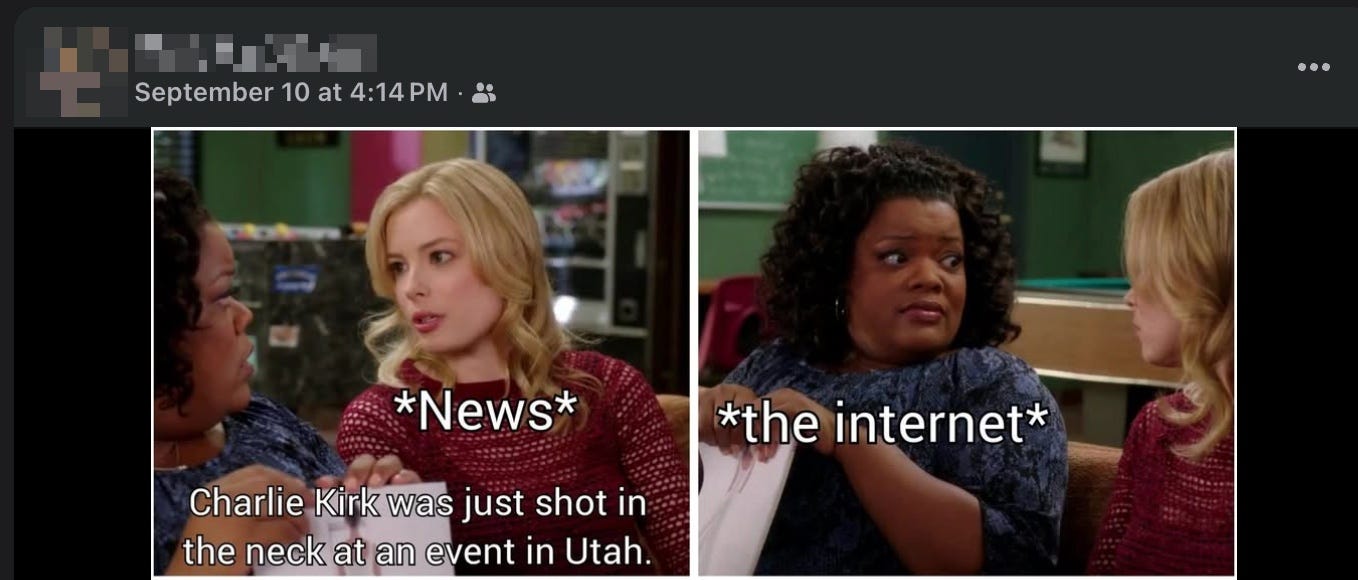
The beginning of a meme posted by an acquaintance of mine. The rest is below.
Like many of you, I saw quite a few people responding with glee in the wake of Charlie Kirk’s assassination. I’m sure some of these were bots, trolls, or some other category we shouldn’t take seriously, but some portion of them were real people. I know this because some of them were real people I know; people I’ve met in person and a few I might even call friends.
Generally this is not the first time these people have expressed happiness at someone’s death, or near death. I saw similar things when Trump was shot, when someone planned to kill Justice Kavanaugh or, to go back even farther, when Margaret Thatcher died.
These reactions always surprised me, but in the past either someone had died of natural causes or they had not died. This made their glee a little more abstract. Still it was like hearing grandma drop the “F-bomb”. Sure, some people swear, “But not grandma!?!” And sure some people rejoice in the murder of their enemies, “But not Jim!?! We had such a great talk at the last family reunion.”1
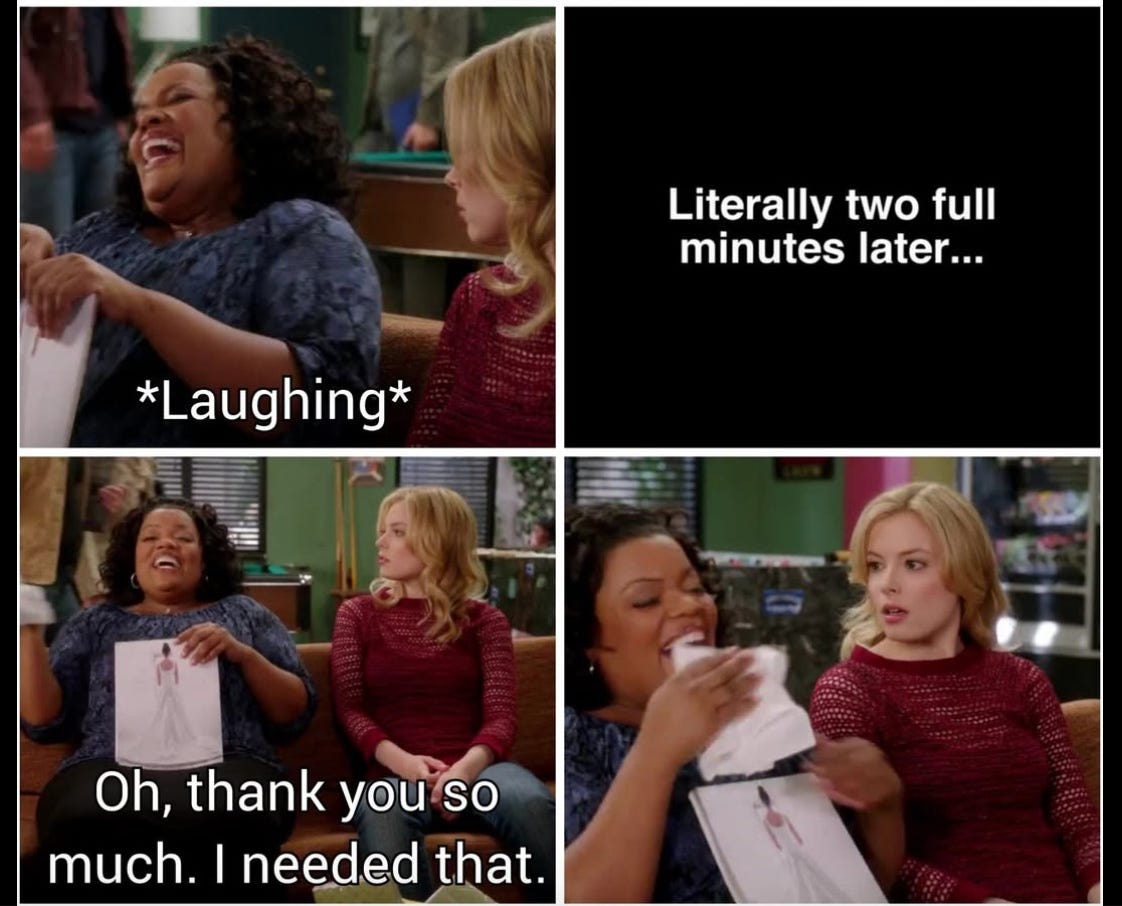
Example of the glee I’m referring to.
When it happened in the past, I was both surprised and alarmed, but I didn’t give it much thought. I guess it was kind of a “no harm, no foul” situation. Trump was only grazed, Kavanaugh was never in real danger, and Thatcher died naturally. But when the same glee showed up after an actual, violent, graphic murder, it felt different. It caused me to consider the matter more deeply, to wonder what it meant. When someone is not merely happy, but gleeful about someone’s death, what should we translate that to in our heads? Consider one possibility:
Imagine a very temporary “Freaky Friday” situation. Imagine that “Jim” was, by some strange and twisted miracle, to suddenly find himself swapped into the body of Kirk’s assassin at the moment of the shot. Imagine that he found himself on the roof of the Losee Center, on the Utah Valley University campus, gun in hand, crosshairs on Charlie Kirk, and finger on the trigger. Imagine he feels the tug of his actual body. He’s just here for a moment, he won’t be punished. Under these circumstances would he pull the trigger? Should I translate his glee at the murder into an actual willingness to commit it? If not, then why not?2
I can think of a few reasons why not, but none of them are particularly exculpatory. Maybe in that moment—despite all of his bluster, despite all of his glee upon hearing of the act—he, himself, would be unable to commit that act. Perhaps talking about murdering someone is one thing and actually doing it is quite another. Maybe he would think of the words of William Munny (Clint Eastwood) in Unforgiven when he says “It’s a hell of a thing, killing a man.”
Or perhaps, even though Jim expressed glee, his glee was somehow more abstract. You did see some of that in the wake of Kirk’s assassination. People who posted about how they felt bad for Kirk’s wife and his daughters, BUT… “Kirk had it coming”, or it was really “Trump’s fault”, or some other way of deflecting it back on the victim and his tribe rather than on the shooter. This is to say perhaps those who expressed glee at the death of Charlie Kirk actually had some unexpressed reservations. Perhaps their extremism is an outgrowth of the radicalizing effects of social media. But I saw lots of these posts, and I didn’t see anyone backing down. Even when they were challenged in comments that were probably only going to be seen by a few dozen people. Also, given the awfulness of the act and of political violence in general, this sure seems like the time to offer one’s full opinion on the matter, particularly any reservations.
So yes, perhaps some caveats are in order, but as a general matter, if someone is overjoyed by someone’s death, then it seems logical to imagine that they support the act. And if they supported the act what would stop them from committing the act themselves should the opportunity arise? We’ve covered some possibilities for why they might not pull the trigger, all else being equal, but what stops them from taking a gun to the roof of a building in the first place? Obviously the incidence of political violence, while rising, is (thankfully) still pretty low, so apparently something stops them from doing this, but what is it?
This is part of the reason for my thought experiment. Is it logistics? Opportunity? Does carrying something out just take more effort than they want to put forth, but if all of that was taken care of and they found themselves on the roof with the gun then they’d take the shot? Is it only the fear of getting caught and punished that stops them? If those items were no longer a concern, would these gleeful individuals pull the trigger?
If this is the case, and the people celebrating Kirk’s death have given me no reason to believe that it’s not, then this has some profound and disturbing consequences. It would mean that the law or possibly just laziness is the only thing standing between us and a lot more political violence than we currently experience.
It further means that all these gleeful individuals are giving the green light to people who are confident (or foolish) enough to believe they won’t be caught. And maybe better organized. This may be a form of moral delegation, but it’s not a species of moral difference. Does it not therefore follow that the gleeful supporters bear some responsibility?
Of course in our hyper-partisan times, everyone wants to make it the fault of “the other side”. I’m not trying to do that (regardless of “the side”). I don’t want to pull in 50% of the people, rather I’m trying to make the case for a much smaller subset of people. The people who, if presented with the “Freaky Friday” hypothetical, would pull the trigger, but are equally happy to delegate it to someone else. How many of these hypothetical trigger pullers are there? I’m not sure how to map “gleeful responses” onto “trigger pulling” but, viscerally, people assume it’s close to one to one. Thus, when people see someone celebrating an assassination, understandably, they feel like they’re looking at the assassin himself.
Perhaps I’ve missed something. Or perhaps the difficulty of planning, the awesome weight of murder, or the fear of being caught are all so great that only someone insane will actually overcome all three, and it’s hard to do anything about them. Or perhaps people expressing glee really would pull the trigger, and we should treat them with appropriate revulsion. I do know some of these people, and maybe I could ask them. This will probably prove difficult for all sorts of reasons, but I’ll give it a shot. Should I manage to plumb the depths of their depraved indifference, or at least excavate their glee, I’ll report back.
Identities and circumstances have obviously been changed.
These questions flow from an event that’s become, for obvious reasons, very partisan, but I intend my questions to be entirely neutral. I would wonder the same thing about anyone who expresses glee about any murder regardless of the political affiliation of the victim.
"“You have heard that it was said to the people long ago, ‘You shall not murder, and anyone who murders will be subject to judgment.’ But I tell you that anyone who is angry with a brother or sister will be subject to judgment. Again, anyone who says to a brother or sister, ‘Raca,’ is answerable to the court. And anyone who says, ‘You fool!’ will be in danger of the fire of hell."
I have considered this a kind of hyperbolic demand for keeping thoughts pure for the sake of holiness, or for preventing the breakdown of relationships, etc.
But perhaps it's also a comment on our psychology and the ease at which we could slip from thought to deed.
Optimistically, the verdict and punishment of the killer will be deterrence. Pessimistically, normal people just hadn't really thought about how easy this would be, and we'll see more extreme actions.
Perhaps a slightly different hypothetical should be considered as well, suppose a Jewish person killed Candace Owens. What would be assumed about the attacker if no other facts were clear? Would everyone behave with proper online dignity?