

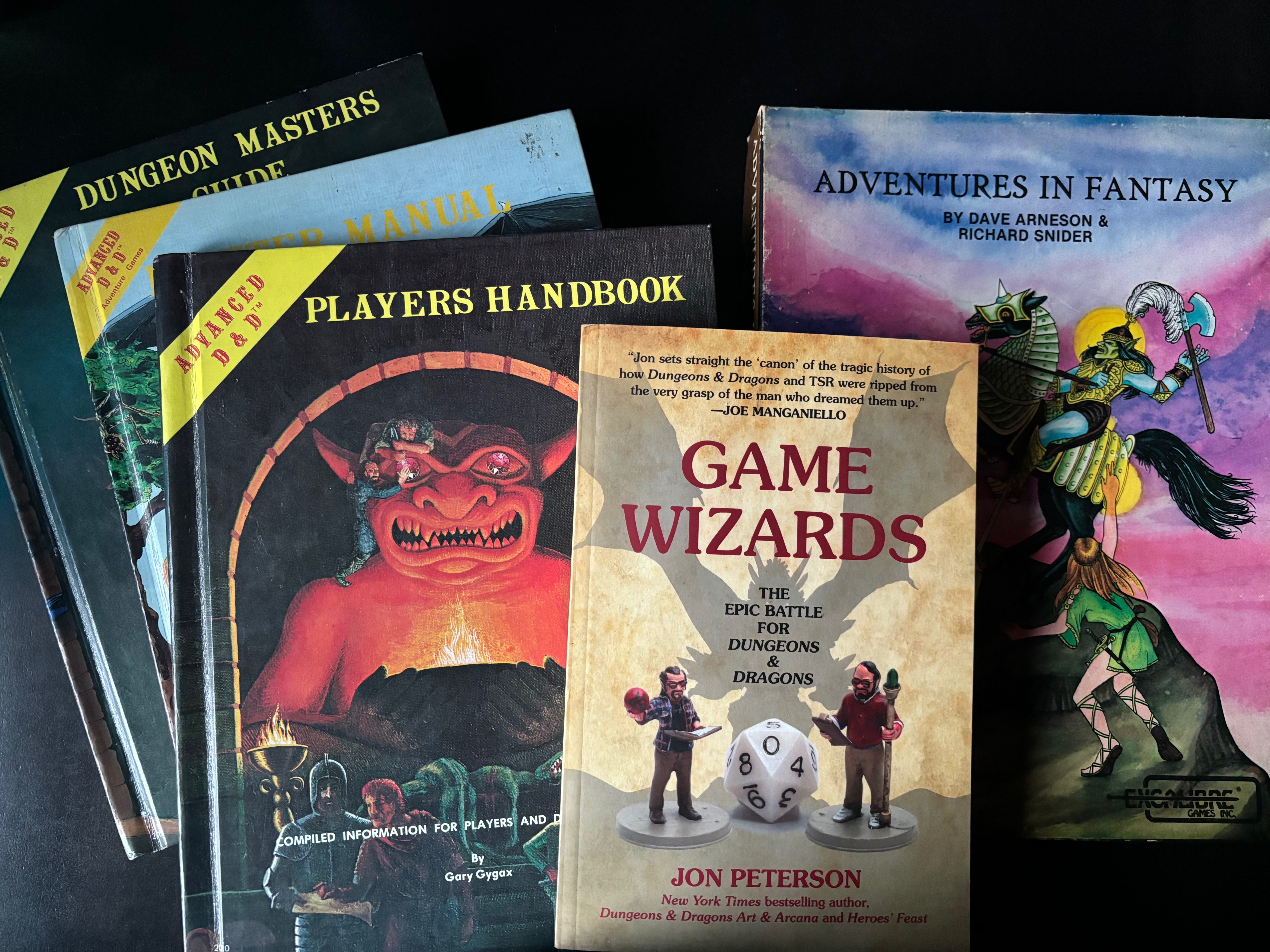
Game Wizards: The Epic Battle for Dungeons & Dragons
By: Jon Peterson
Published: 2021
400 Pages
Briefly, what is this book about?
The history of Dungeons and Dragons, TSR’s meteoric rise, the fights that inevitably happen when something becomes enormously successful, and the catastrophes that follow when people are in way over their head.
What’s the author’s angle?
Peterson is the man when it comes to the history of RPGs and D&D in particular. He’s basically a historian, and he has no dog in any of the fights.
Who should read this book?
I really liked this book, and I really liked everything I’ve read by Peterson. That said, I might recommend the podcast When We Were Wizards, as an easier entry point for people interested in the story. And of course if you have no interest in the battle between Arneson and Gygax or the crazy initial years of D&D, I would not recommend either.
Specific thoughts: Gygax was a jerk, and he was dumb, but he also deserves 90% of the credit for D&D.
If you open the cover of any current D&D book and examine the credits at the very end of those credits you’ll find the following:
Building on the original game created by Gary Gygax and Dave Arneson and then developed by many others over the past 50 years.
The last bit was added only recently, and it’s nice that they’ve given some nod to the hundreds of people who’ve expanded the game into the form it is today. Game Wizards, however, is focused on that first bit. Gygax and Arneson, the original game, and all the crazy things that happened during this initial phase. There was the death of Don Kaye, one of the original co-founders of TSR, from a sudden heart attack at the age of 36. There was incredible nepotism and mismanagement, by both Gygax, and the Blume family (who ended up as the largest shareholders once they purchased Kaye’s shares.) There was the “Ambush at Sheridan Springs” when Lorraine Williams seized control of the company from Gygax through strategically buying out the shares of the Blumes. But one of the craziest things was the fight over credit. Who should get credit for D&D, the original RPG, the product that would go on to spawn hundreds of table top imitators and thousands of video games?
Before reading this book I was already convinced that Gygax deserved the bulk of the credit. This book just strengthened that conviction. After reading this book I was even more convinced that Arneson was lucky to get any credit. It was only because Gygax was a colossal jerk, and a bad businessman to boot that Arneson ended up getting as much credit as he did.1
My unwillingness to give Arneson very much, if any credit, comes down to three factors:
First, to the extent that Arneson does deserve credit, it was for an idea. Now don’t get me wrong it was a great idea, actually a synthesis of several ideas, but ideas are copious. The law recognizes this fact. You can’t patent an idea, or copyright it, or otherwise claim ownership of it. The fact that Gygax gave him a 50% share of the royalties right out of the gate was just an example of Gygax being a bad businessman, not any statement as to Arneson’s leverage in the situation, or the intrinsic value of the idea. It’s obvious to me that if TSR and Gygax had chosen to fight it out that they would have prevailed, but it was one of those situations where it was much more advantageous to put the whole matter to bed, so TSR ended up settling with Arneson on very generous terms. So what did Arneson do with all this money? This takes us to the next factor.
Second, you have to put in the work. An idea is, at best, the first 10%. Creating a successful business is hard work, and most of that hard work is making products that people want to pay for. People (other than Gygax) don’t pay anything for just an idea, they pay for something tangible. Gygax produced these tangible goods again and again and again. Arneson did not. Arneson barely wrote anything. In the past I gave some weight to the idea that when Arneson finally joined TSR they stuck him in shipping where there was an overwhelming amount of work to be done.. And this is why he didn’t ever write the books he was supposed to. To be fair it was a sucky job, and his overall situation was also pretty sucky. But by the end of 1976 that sucky job was gone. He had money. His reputation was as good as it was ever going to get, and yet it still took him three years and lots of help from a co-author to produce anything.
When Arneson left TSR he quickly promised to release his own fantasy RPG, a bold and inventive system that fixed all the issues with D&D. After numerous delays, Adventures in Fantasy (AiF) was finally ready for commercial release in 1979. Perhaps that doesn’t seem like very long, but I picked up a copy of AiF, and it looks like more of a three month product than a three year product.2 It might have done okay if it had come out in 1977, which was the plan, but by the time it did come out, essentially all of the hardcover AD&D books had been released. And there’s really just no comparison in quality or content. AiF only has two classes for crying out loud!
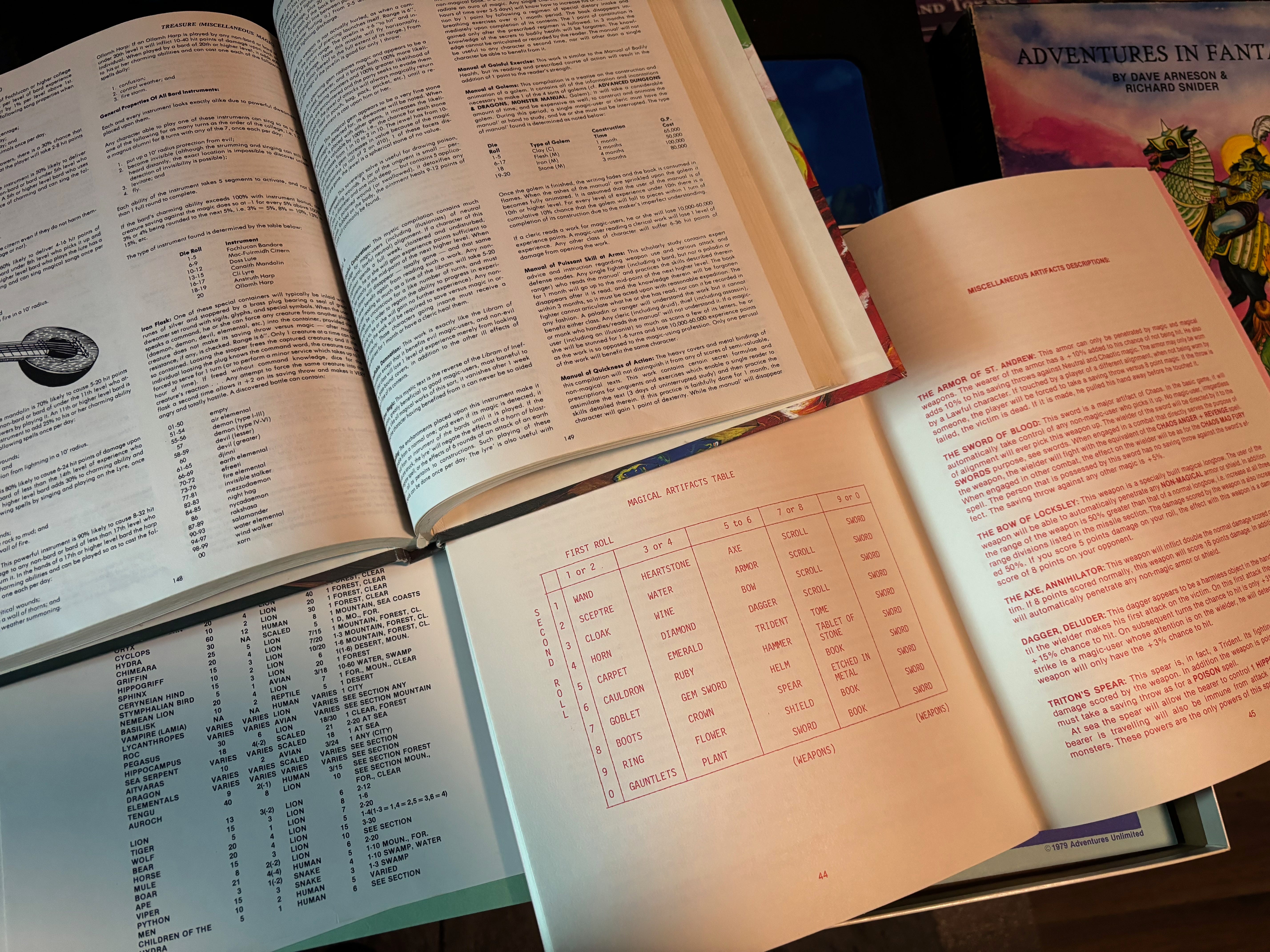
The third factor is related to the second. Even when Arneson did put stuff together it was of very poor quality, and needed a ton of editing. This point came up again and again in the book. No one wanted to edit Arneson’s stuff. I assume that this explains much of the delay in releasing AiF. And possibly much of the explanation for Arneson getting moved into shipping at TSR. I might not have made this into a separate factor (It is kind of petty) if I didn’t come across a couple of interesting letters while I was looking into the story. If you’ve made it this far into the review you probably know that Wizards of the Coast bought TSR in 1997. (Had they not TSR would have gone bankrupt.) Arneson saw the purchase as an opportunity to get back into the game, and so he sent Peter Adkison a letter, and when Adkison didn’t respond to the first letter he sent him another one.
If you’re interested in this sort of minutia I would definitely recommend clicking on the links, but the upshot is that Arneson’s letters were full of okay, but not revolutionary ideas (certainly nothing he mentioned ended up being on the list of revolutionary things they actually did do). But beyond that the letters are full of typos, grammatical errors, and spelling mistakes. Up to and including Arneson misspelling Adkison. You know the name of the person Arneson is hoping will put him in charge of millions of dollars worth of IP…
Given all of the foregoing, why are there still people who want to give equal credit to Arneson? I’m sure there are lots of reasons. And I suspect that one of them is that these people have never actually started a successful business, and so they have no idea how important actual execution is. The book reveals another one. People want to give credit to Arneson, because when all of this was happening Gygax was a huge jerk. You can get away with being a jerk if you’re a business genius. See, for example, Steve Jobs. But TSR was run horribly, and as the company careened towards disaster Gygax was spending all of his time in Beverly Hills burning through tens of thousands of dollars every month.
In particular he was a jerk to other people working in the gaming community. This made it easy for an insider narrative to develop where Arneson was the visionary genius and Gygax was the crude businessman who’d come along and stolen the idea. Public pronouncements from Gygax didn’t help:
[T]he focus of Gygax’s year-end address was the position of D&D and TSR in the industry. “Not surprisingly, we take the view that the creators and publishers know best how to develop the creation.” In Gygax’s mind, however, the “creators” did not seem to include Arneson, nor indeed anyone not then working at TSR. Gygax effectively doubled down on the rhetoric Tim Kask had expressed at Origins. “Quite a few individuals and firms have sought to cash in on a good thing by producing material from, or for, D&D … For most of these efforts, TSR has only contempt.”
“I cannot resist the analogy of a lion standing over its kill,” Gygax explained by way of conclusion. “The vultures scream, and the jackals yap, when the lion drives them off without allowing them to steal bits of the meat.” But it is clear here that the “kill” for Gygax was the release of a commercially successful product around D&D more so than the conception of a game, and this he credits to TSR alone. “TSR was the lion which brought down the prey, and we intend to have the benefits derived therefrom. If we share with anyone, it will be on our terms.”
The entire story of Gygax’s rise and fall, the fight with Arneson, and the enormous number of dumb decisions that were made, come together to make a truly Shakespearian tragedy. A very niche tragedy, but an epic tragedy nonetheless.
I’m not sure what it says that my review of a book about the early history of D&D is twice as long as my average review, and that I went to the trouble of taking pictures and purchasing supplementary material. Perhaps I’m in the wrong business. Or perhaps I’m just a gigantic nerd. Certainly anyone blogging in relatively obscurity for this long has to be something of a dork. For all of my dorkiness, as it emerges blinking into the light, consider subscribing.
We’ll get into his mistakes and malice, but it is worth mentioning that Gygax mellowed quite a bit as he got older. (Being repeatedly humbled will do that.) I only had one short conversation with him in 2007, the year before his death, but I can report that he was delightful.
I don’t want to tell you how much I spent. It’s a collector’s item because of its place in history, and its rarity, but certainly not because of the quality. It has some interesting ideas, but too few to overcome its other deficiencies.
"Or perhaps I’m just a gigantic nerd."
That was proven when you bragged about owning Adventures in Fantasy, I think, a game that lesser nerds have never even heard of.
(Just now noticing the sub-title, too; nice, but also telling on that matter!)