

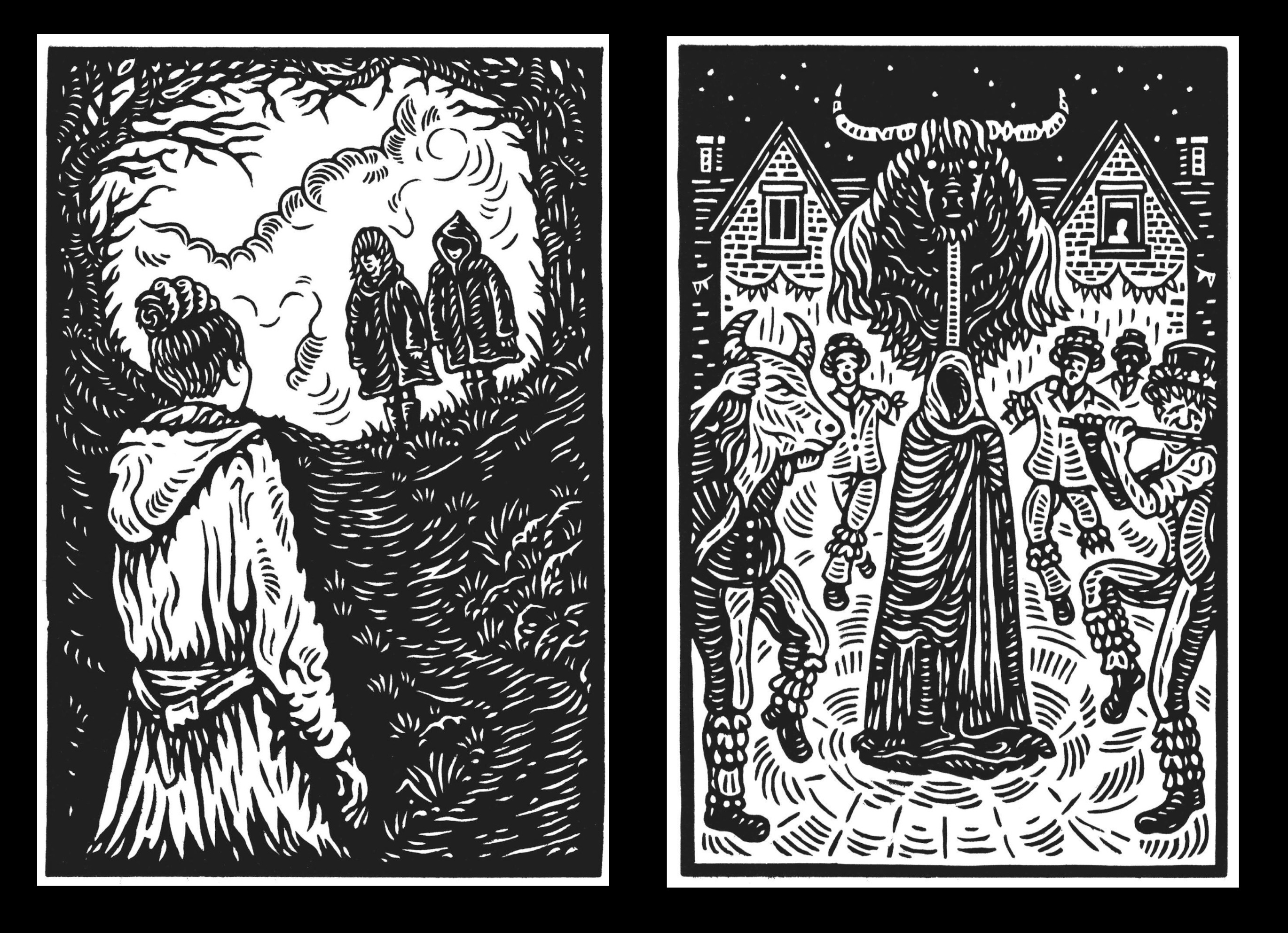
Damnable Tales: A Folk Horror Anthology
By: Various, Edited by Richard Wells
Published: 2021
479 Pages
Briefly, what is this book about?
A collection of 22 older scary stories, presented in chronological order. The oldest story is from 1875, while the newest was written in 1965. But the majority are clustered in the late-victorian period 1880-1910.1 It includes stories from a few authors you might not expect like Thomas Hardy and Robert Louis Stevenson.
Who should read this book?
Anyone who has enjoyed an HP Lovecraft story will probably enjoy this book. Though I will say that you should view most of the stories as inspiration for Lovecraft, rather than similarly situated.
Specific thoughts: A nice way to create a Halloween atmosphere.
A friend of mine recommended this book to me in June. I started reading it and quickly decided that it was not the sort of book one reads in June, so I set it to one side and decided to pick it back up in October. It definitely worked in October, though I think it might work even better in November or December (for those who are thinking of picking it up). October had its share of rain here in Utah (as a matter of fact October 4th was the wettest single day since 1901) but the last few days have been completely clear and sunny. I think once we get into November and December, past the end of Daylight Saving Time, it might be even better. Recall that “The Raven” by Edgar Allen Poe, often thought of as the quintessential Halloween poem, actually takes place in December:
Ah, distinctly I remember it was in the bleak December;
And each separate dying ember wrought its ghost upon the floor.
Eagerly I wished the morrow;—vainly I had sought to borrow
From my books surcease of sorrow—sorrow for the lost Lenore—
For the rare and radiant maiden whom the angels name Lenore—
Nameless here for evermore.
Enough scene setting. You’re probably interested in the actual stories. They’re a little bit of a mixed bag, and they’re generally stronger from an atmospheric perspective than for their novel plotting. But the ones that are good are quite good. Here are some standouts:
“Man-Size Marble” by E. Nesbit (Co-founder of the Fabian Society)
A straightforward story where the ending is pretty obvious, but no less tragic because of that.
“The Withered Arm” by Thomas Hardy
Well written as you would expect. Nice and twisty and suitably horrific.
“The Shining Pyramid” by Arthur Machen (Stephen King described his novel The Great God Pan as maybe the best horror story in the English language.)
Written a couple of decades before Lovecraft, this feels like it anticipates many of the themes Lovecraft would eventually make his name with.
“How Pan Came to Little Ingleton” by Margery Lawrence
I know it’s strange to say with a collection like this, but I thought this one had a really good message.
“Summer People” by Shirley Jackson (The other author I had heard of alongside Hardy.)
This was among the more mundane of the stories, but somehow also one of the more horrifying. This was the only one where I thought. Yeah, I could see that happening to me.
To re-emphasize the point I already made. If you’re looking for some seasonal reading, and you don’t mind reading older prose, this is a great book to scratch the itch of the dark and gloomy end of the year.
My last post did not get a lot of likes. I wonder how this one will do. I do pay attention to them, but perhaps I’ve been shooting myself in the foot. Everyone else says “Like and Subscribe!” And I mostly just say subscribe. I guess maybe it’s because subscribing seems more mechanistic: you click a button. But asking someone to like something? I can’t reach into someone’s heart and change their inner essence. So I guess if you do like it, I would appreciate it if you indicated that, but if you don’t, well there’s not much I can do about it. Except maybe write better in the future I suppose? I do think I wrote some pretty good stuff in the past, maybe you’ll like that.
ChatGPT tells me that I could also use the term fin-de-siècle to describe the period and the atmosphere. I don’t feel like I have a sense for the connotations of that term, but perhaps it means something to you.