

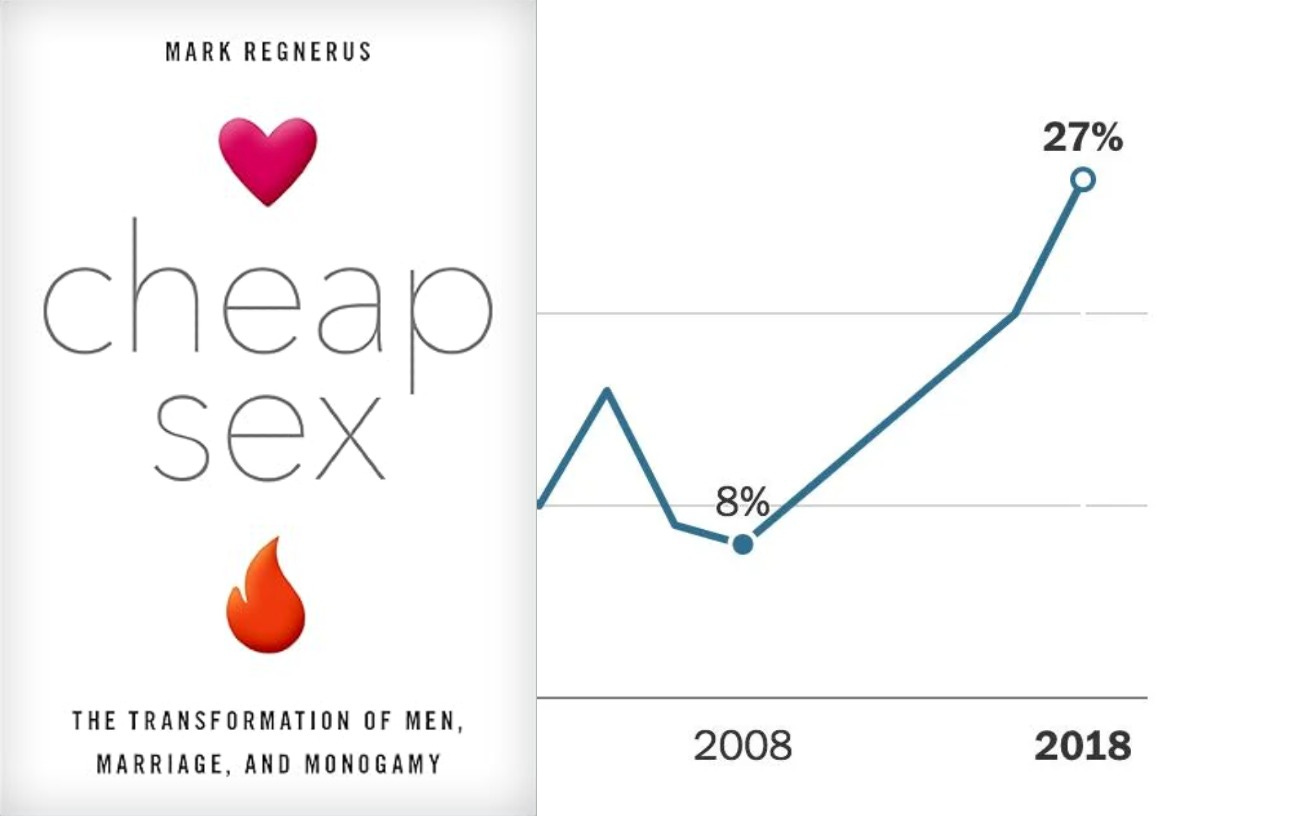
Cheap Sex: The Transformation of Men, Marriage, and Monogamy
By: Mark Regnerus
Published: 2017
280 Pages
Briefly, what is this book about?
A data-driven look at the modern dating and “hook-up” culture. As you can tell from the title, he argues that sex has become cheap, not so much in dollars and cents, but in the level of commitment it requires. He points to three reasons for this change: the pill, porn, and dating apps.
What's the author's angle?
As I was reading this book, I was trying to remember where I had heard the name Regnerus before. It took me a while to get around to looking him up in Wikipedia, at which point I was reminded of the “New Family Structures Study”. He was the lead author on this study which claimed that children raised by a parent who had been in a same-sex relationship had worse outcomes than those raised by heterosexual parents. If you guessed, based on this, that he’s a conservative, then you would be correct. However, that didn’t really come through very much while reading the book.
Who should read this book?
If you want data to back up the online arguments you’ve been making. Or if you’re looking for a better understanding of the underlying reasons for the continued decline in fertility.
What Black Swans does it reveal?
Most of the trends he described are continuing to worsen. Sex just continues to get cheaper. As bad as it is already, it's not crazy to imagine that VR, AI, and sex bots might really cause the bottom to drop out.
Specific thoughts: Differing views of sex
For me the big weakness of the book is that it had very little to say about the “incel” phenomenon (both voluntary and involuntary) or the ongoing and deepening “sex recession”. Neither of which is mentioned in this book.
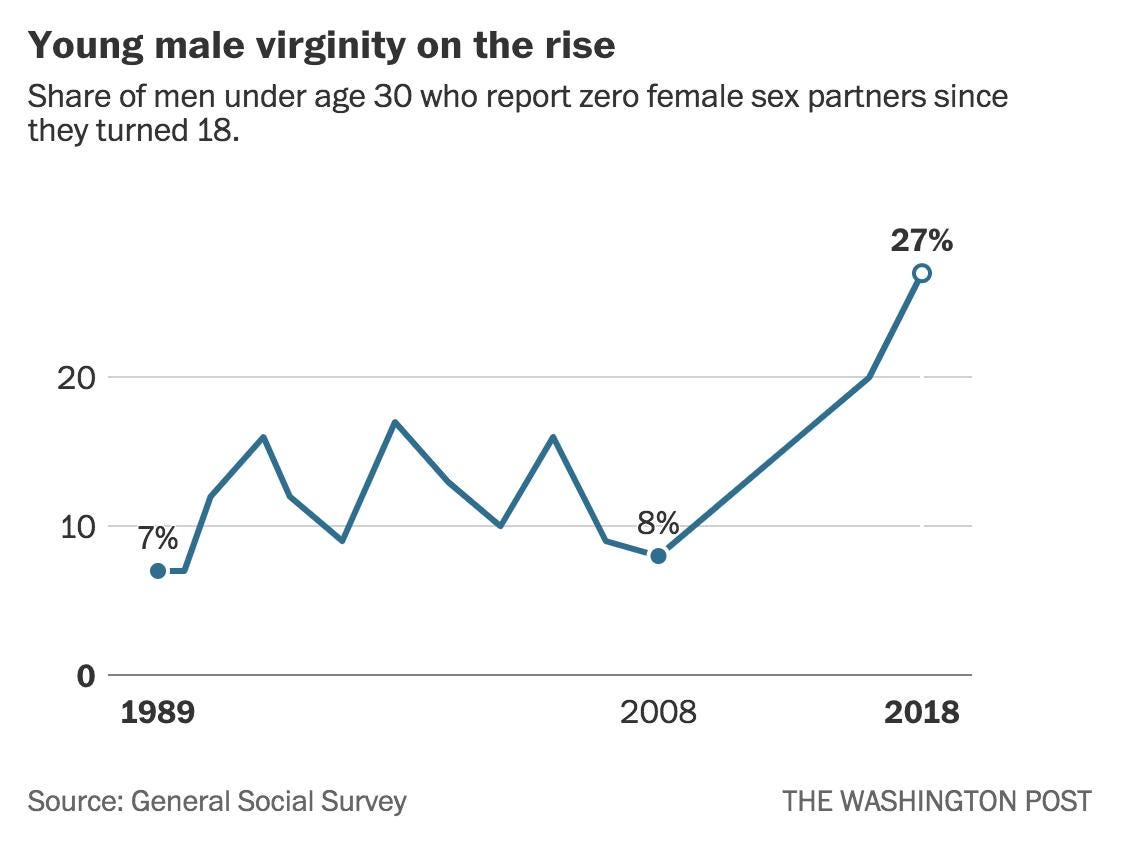
I understand that a lot has changed since the book was published, but 2018 is when that famous graph was making the rounds.
Regenerus does mention that “Far more men than women come up empty in the mating market.” But he also says that:
Pareto would be proud, or nearly so. It turns out that 20 percent of men (between the ages of 25 and 50) account for about 70 percent of all self-reported sexual partnerships with women in the United States. It is not 20/80, but it is not far off.
Some hold that the Pareto Principle, if it fits sexual partnering patterns in the United States, means that claims I have made about the wide availability of cheap sex are not true for the majority of young-adult men in the United States. I understand their logic: sex may seem cheap, but it is only cheap for a minority of men. The rest do not share their experience. But I see no reason to conclude this. The thesis of cheaper sex in the era of wider contraceptive access assumes nothing in particular about a high average number of lifetime partners among men. It asserts, rather, that cheaper sex should lead to more sexual relationships overall, more one-night stands and “friends with benefits” relationships, and especially to the more rapid addition of sex within romantic relationships, to say nothing of making greater use of pornography and masturbation. Cheap sex is all of that. The fact that John has had 17 sexual partners by the time he turns 25 but Fred has only had two does not mean sex is “expensive” for Fred.
“Majority” is doing a lot of work in this excerpt. Yes, in the graph I posted 73% of men are not virgins, which is a majority. And I’m open to the idea that for those 73% sex is “cheaper” than it was historically. All this could be true and yet the increase in virginity from 8% to 27% over the course of ten years would still be a big story. A story that Regenerus largely ignores. But beyond that Regenerus claims that “cheaper sex should lead to more sexual relationships overall”. Which is not what ended up happening. Instead we’ve ended up in a sex recession.
Regenerus tries to lump everything. Current hookup culture, and pornography into one “cheap sex” bucket, but instead I think we have two phenomena happening at the same time. Online dating and previous to that the sexual revolution have radically changed the “real sex” market. And ubiquitous pornography has radically reshaped the incentives to enter that market. Regenerus extends the idea of cheap sex to include masturbation and make it one big market, but I think that’s a mistake.
While I think it was a mistake to broaden his definition in this way, there are other ways in which he broadens the definition of sex that I find more interesting.
First he points to interviews and data which show, paradoxically, that people have sex more quickly with people they don’t feel a connection with. Consider this exchange with Sarah, a 32 year old who recently moved to Texas from New York:
Sarah: And then a lot of times, though, I will say, like, there are times when I feel comfortable with having sex on the first date, and other times I don’t feel comfortable.
Interviewer: How do you discern those?
Sarah: Depending on if I like the guy more or not.
Interviewer: So if you like the guy more which one happens?
Sarah: I don’t want to have sex with him.
Interviewer: OK. Can you explicate that a little bit?
Sarah: (Laughs) … Because I wanna see him again, and I don’t want it to just be about something physical.
Sarah goes on to explain that she always plans to wait, because she often regrets “first-date sex”, but she rarely does.
Certainly this represents one area in which sex has definitely been cheapened. So much so that its position has been flipped from being a true sign of commitment, to actually signalling the opposite of that.
Second, he notes the remarkable correlation between a woman’s politics and whether they desire more sex. Politics seems to be the biggest predictor of this desire, with things breaking out thusly:
Here are the estimates of which women said yes, they would prefer to have more sex:
16 percent of “very conservative” women
30 percent of “conservative” women
38 percent of moderate women
44 percent of “liberal” women
53 percent of “very liberal” women
Why should this be? Obviously there are many theories one might propose. Regenerus ends up offering the following:
I discussed this conundrum with others, and a plausible, four-part path explanation emerged:
1. More liberal women are less religious than conservative women. (True.)
2. More liberal women are therefore more likely to have a difficult time attributing transcendent value to aspects of life such as work, relationships, children, and daily tasks. Some psychologists speak of this attribution as “sanctifying daily life.” That is, liberal women are less apt to conceive of mundane, material life as somehow imbued with or reflecting the sacred. For them the world is, to use Max Weber’s term, more disenchanted—predictable and safer, but emptier and less mysterious.
3. Nevertheless, most people experience sexual expression as, in some significant way, transcendent, or higher-than-other experiences. Giddens concurs: “Sexuality for us still carries an echo of the transcendent.”
4. More liberal women therefore desire more frequent sex because they feel poignantly the lack of sufficient transcendence in life. If sex is one of the few pathways to it, then it is sensible for them to desire more of it.
As someone who’s deeply interested in modern mutations of religion, this is a very interesting idea; although I don’t know if Regenerus quite nails it. For one thing I don’t think this is restricted to just women. Anyone dealing with the absence of religion will desire other sources of meaning. Combine this with the recent prioritization of someone’s inner life as the true source of meaning—and what’s more representative of someone’s authentic inner self than their sexual preferences?—and it would be hard for sex to not stand in as a source of meaning. The strong emotions and powerful feelings it creates then makes it naturally seem like a transcendent source of meaning. I guess the tweak I’m trying to make to Regenerus’ account is to make it less solitary. I would say that there is a fairly broad-based religion of sexual transcendence. People just haven’t gotten around to labeling it as such.
Here we tie things back to the beginning. Many people in the “incel” cohort and those suffering from the sex recession are believing members of the religion of sexual transcendence. But they are being denied the ultimate sacrament of that religion, and probably feel that it will forever be denied to them. Porn and masturbation provide a grubby substitute. But it’s definitely inferior. Regenerus reports that “masturbation was negatively associated with satisfaction on all measures: sex life, relationship, mental health, and life in general.”
When we consider the frustration of those who do not have access to real sex, however cheap it might be in general, how does this potential religious angle factor into things? I’m inclined to be circumspect here and say that it’s still a matter of degree and not of kind. That even if sex is framed as part of a transcendent religion, that this framing just creates one more frustration on top of the many experienced by those who are being denied. It is not a unique violation.
Still we should add it to the long list of changes being wrought in the domain of sex. The ones Regenerus cover in his book: hookup culture, the ones he doesn't: incels and the sex recession, and the ones still on the horizon: LLM girlfriends, in sex bot bodies, acting as high priestesses of a transcendent sexual religion, preaching from sad, dark basements where the light of human romance has never been seen.
Just to be clear, my office is not in a sad, dark basement. It’s on the top floor. And I have a giant picture window that looks out on a nearby mountain. Also I’m not sure why I’m so defensive… Maybe I should explore that. If you’re interested in that exploration (should it ever happen) make sure to subscribe so you won’t miss any of my angsty introspection.
The interview with the girl is very interesting. Do you know of any good data about whether first date
sex is good for relationship formation?
Reading through, got tripped up here:
"Here are the estimates of which women said yes, they would prefer to have more sex:"
Does that mean these women want more sex than they have, or more sex than others? That is, are conservative women, being lower on the chart, withholding sex, or are they more satisfied with their sex lives?
Also, if it's "want more sex than they have" it could just be a result of more conservatives getting married. It's widely known and little acknowledged that married people have more sex.