

I.
When I pivoted a month ago I stopped posting book reviews to this space, and started posting them to Notes. My idea was that I would then do one long book review every month and also link to all the reviews I had done through Notes, so that anyone who was really interested in my take on the great historical novel, Ivanhoe, or alternatively the queer, postmodern New Testament essay collection, Sex and the Single Savior could see that I had in fact opined on both and click through on whichever one actually interested them.1
That is still the plan, but on top of that I have the urge to use this space to ruminate. Whenever I ask someone to critique my writing they always say I do too much rumination, but what do they know?!? Sure, maybe they went to Yale or Notre Dame.2 But do they understand the public’s deep yearning for kidney stone stories set in Edinburgh?
This time, my rumination is justified because it ties into the review. I’ll get to the actual book in a moment, but first I want you to travel with me back to November 20, 1983, and the television broadcast of The Day After. It was a movie about a nuclear exchange between the Warsaw Pact and NATO, and its aftermath. Here’s how Wikipedia describes the closing scenes:
In a radio speech, the U.S. President announces a ceasefire, promises relief, and stresses no surrender and a reliance on American principles, set to shots of filthy, listless, or dead Americans among the ruins. Attempts at aid from the National Guard and infrastructural redevelopment prove fruitless, and summary executions for looting and other offenses become commonplace. Jim Dahlberg (and, it is implied, his remaining family) is eventually killed by squatters, while Denise, Klein, and Oakes are wasting away from radiation sickness…
This is followed by a closing text card telling viewers that the events depicted are “less severe than the destruction that would actually occur” in the event of an all-out nuclear war.
I remember watching the movie, and I’m sure a lot of other people remember it as well. It was a big deal. 100 million people watched the broadcast out of a population of 234 million, so 43% of the country. The most recent Super Bowl was watched by 126 million people out of a population of 340 million, so roughly 37%—with the added advantage of gathering at bars or being invited to Super Bowl parties. I don’t recall any Day After parties. It was just a bunch of people huddled around the TV fascinated and terrified by the potential end of the world, in a TV event that was bigger than the Super Bowl.
I bring this up to illustrate what peak Cold War fear looked like.3 Because without some sense of what the worst worries were, it’s impossible to understand the heights of hope we held when things started to unwind in 1989.
There were glimmers of hope even before then. When Gorbachev became Soviet General Secretary in 1985, he immediately started to reform things. Initially it was economic reforms, but these reforms were soon overshadowed by the Chernobyl disaster in 1986. Among other downwind consequences, the disaster swept away the initial attempts at censorship and information control. And it smashed into a structure which was already teetering, regardless of Gorbachev’s efforts. By the end of 1986, political prisoners were being released, a previously banned movie about the Stalinist terror was released, and the communist vise was loosening. In early 1987 there was even talk of multi-candidate elections!
By 1989, the floodgates were opened. It has been called the “Year of Miracles”. Poland held (partially) free elections. Out-migration from Eastern Bloc countries started, and the Berlin Wall fell. There were also the Tiananmen Square protests. I understand that those ended in an eventual massacre, but at the time it seemed obvious that just as the Soviet Union was liberalizing in fits and starts, so too was China. The Tiananmen Square massacre happened to be a particularly bloody start to things, but clearly China was following the same path.4
As it turns out, the Soviet Union did collapse in 1991, but the Chinese Communist Party never did. Still, I hope I’ve given you some sense of the optimism and the enormous landscape of possibilities people experienced in the early ’90s. I already talked about this very thing in my last post, but it’s worth drilling down on it a bit more. Which takes us to our book review.
-------------------------------
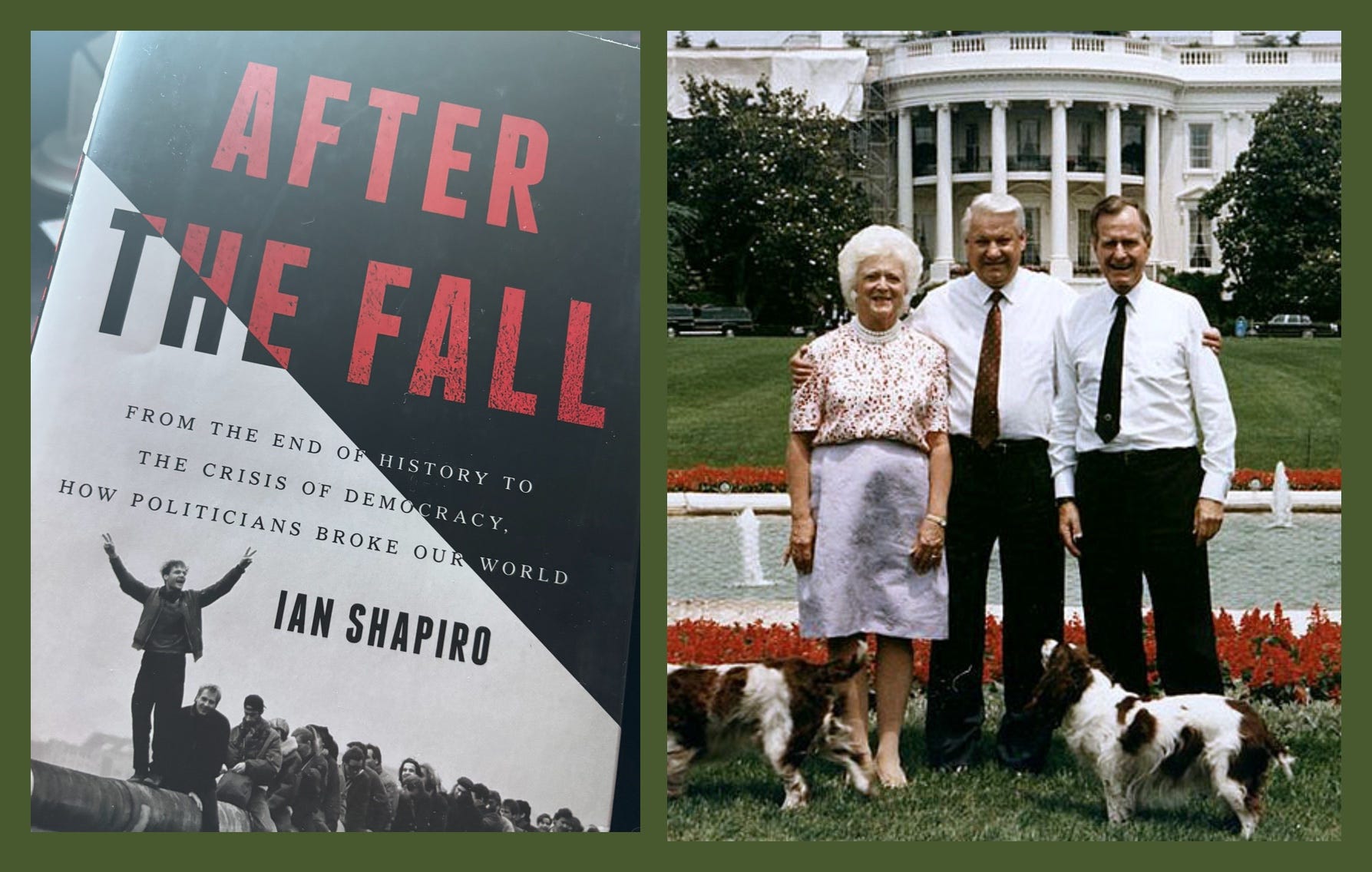
After the Fall: From the End of History to the Crisis of Democracy, How Politicians Broke Our World
Author: Ian Shapiro
Year Published: 2026
320 Pages
Type: A compilation of thirty-five years of geopolitical regrets, like an old man looking back at the job he didn’t take, or the girl he should have married—only the job was the Partnership for Peace and the girl was Russia.5 The old man is proud of a handful of things, like when he didn’t sack Baghdad in 1991.6
-------------------------------
II.
Shapiro also remembers the optimism of the ’90s and the abundance of possibilities. But he thinks we mostly squandered them in an unforgivable manner. His contention is that if we had played our cards right we could have moved to a world of international cooperation. A world unified against interstate violence, with free exchange between nations, and dedicated to liberal values. Instead, at nearly every turn, we treated Russia more harshly than necessary. And when we weren’t being cruel, we were being naïve. If this had been limited to Russia, that would have been one thing, but in our hubris we extended it to other countries as well. (See list of 21st Century US Wars.)
By contrast, Shapiro thinks we should have treated Russia similar to the way we treated Germany and Japan at the end of WWII. In particular, we should have offered them something akin to the Marshall Plan, and beyond that turned Russia from enemy to ally, in a fashion similar to what we did with the defeated Axis Powers.
In spirit, it’s the Marshall Plan part that resonated with me the most, but mostly for what it represented rather than the actual proposal that was floated at the time. (Though to be clear it did get floated as a serious proposal and its biggest advocate was Nixon of all people.) The Marshall Plan was at its core a recognition that Europe had been so thoroughly destroyed that it needed significant help to get back on its feet. Russia was not quite so thoroughly wrecked at the end of the Cold War, but it was a lot more wrecked than people realized at the time. When you’ve built up Russia to be this giant colossus, it’s hard to imagine that it’s actually a shattered nation with a very weak state, particularly if no shots have been fired.
Certainly the West provided some assistance, but it was underwhelming, and to the extent we did intervene, mostly we tried to speed things up or paper over problems. The most egregious example of the former was “shock therapy”. This is when a bunch of economists flew to Moscow, waved a magic wand and declared the economy to be “free market”. Okay, obviously there was more to it than that, but not a lot. The big problem was that Russia was missing so many of the things required for a free market: contract enforcement, functional banking, non-corrupt tax collection, etc. But once you start listing things like that, it becomes apparent that Russia would have needed more than just additional cash. That’s why I say I agree with the spirit of a Marshall Plan, but not a straightforward duplication of it.
As a final point on this subject, shock therapy illustrates the naïveté of the time, but less so the harshness. For that we turn to the issue of debt forgiveness. Shapiro points out that forgiving Soviet debt would have been a pretty low-cost way to help out the nascent Russian state. And yet we didn’t do it. In fact some of the debt wasn’t even Soviet debt. It was debt the Tsars had run up previous to WWI, which had been repudiated by the communists, and that got added back on to the total. Now it wasn’t a lot of debt, but nevertheless Shapiro claims that:
[T]he Bush administration didn’t even try, even though other distressed countries were receiving major debt write-downs at the same time. Yeltsin was obliged not only to keep servicing the Soviet debt, as the US Treasury Department was demanding, but even to assume responsibility for some tsarist-era debt that Lenin had repudiated in 1918—lest he jeopardize US grain shipments on which Russia was critically reliant that winter.
In telling this story I should point out that Yeltsin accepted the foreign Soviet debt in exchange for all of the foreign Soviet assets (embassies, debt owed to them by Cuba, etc.) this was all part of the plan to maintain continuity: keep things like the seat on the Security Council, and to legitimate possession of the Soviet nuclear weapons, but clearly he could have been more clever with all of this because those assets were worth a lot on paper but far, far less in reality.
This illustrates something that Shapiro pays less attention to. A lot of this was coming from the Russians themselves, or at least Yeltsin. He was on board with shock therapy. He papered over his own share of problems. It wasn’t all the US.
III.
What about making Russia into an ally? These days, the idea seems insane, but there was a period from around 1990-1995 when they were exceptionally pliable. In fact, when Bush and Yeltsin met at Camp David, Yeltsin was pushing for Bush to use the word “ally” when describing their new relationship. Other examples include:
Voting with us on numerous Security Council resolutions, including the one authorizing the use of force to get Iraq out of Kuwait.
Inviting us into the country to help dismantle parts of their nuclear arsenal.
Joining the Partnership for Peace, a NATO adjacent organization.
And even as late as 1996 there was an example of a Russian brigade serving under a US general in Bosnia as part of the Implementation Force.
Speaking of Kuwait, Shapiro offers that up as the perfect example of how the post Cold War international order should have worked. Bush Sr. worked through the UN, established a coalition that included many of the countries in the Middle East, and then stopped once he had fulfilled the UN mandate, leaving Saddam in power. This is Shapiro’s ideal, an ideal which was never again achieved.
In later interventions, the US increasingly acted unilaterally (or nearly so) and far more aggressively. Shapiro takes issue with the second Iraq War, the Afghanistan occupation, and the Kosovo bombing, but he is particularly scathing about the Libyan intervention.7
The intervention took place after a decade of stalemated NATO presence in Afghanistan and the Iraq invasion, both of which had taken their toll on Western—and especially American—credibility. Whatever might have been left of that credibility was shattered in Libya once it became obvious that the agenda had been regime change from the start. The final nail in the coffin was Western leaders’ brushing aside of multiple overtures to negotiate a settlement—from Gaddafi and from regional third parties alike—rubbishing any pretense that they were acting as agents of the Security Council, whose arms embargo they were violating in any case. On top of all that, the intervention was a spectacular failure that eliminated any hope of gaining legitimacy from a felicitous outcome.
I mostly wanted to focus on the failure to seize that window in the early ’90s when everything seemed possible, but I had to include Libya, because I remember even at the time thinking that it was peak US hubris, only for all the pessimists to be proven right by the ensuing decade-long fragmentation and war.
Returning to Russia, I haven’t yet mentioned Putin. It’s one thing to say that Yeltsin was open to being a US ally, but he started ceding power to Putin in 1999. It would be easy to say that the window I’ve been talking about was closed by that point, but even Putin started off being friendly.
Putin’s reversion to Cold War attitudes that began in the mid-2000s is all the more notable in view of how he started out. On ascending to the presidency in 2000, he quickly revived the defunct NATO-Russia cooperative process, created a streamlined NATO-Russia Council, launched collaboration on a host of issues from counterterrorism to proliferation to maritime search and rescue, and began lobbying for Russia to join the alliance. Within two weeks of the 9/11 attacks, he promised to share intelligence on al-Qaeda and the Taliban with the US, opened Russian airspace to the US, agreed to give military assistance to the Northern Alliance in Afghanistan, and, most remarkably of all, agreed to have American troops in central Asia—an unprecedented move that went over like a lead balloon with his own military establishment. Nor did he make much fuss, initially, at the first round of NATO enlargement that took place on his watch. Evidently, he was probing for the possibility of a reset.
…Everything Putin did in those years implied that he saw Russian integration into NATO and Europe as feasible and desirable, from openly lobbying for inclusion into Western institutions to working to harmonize Russian and EU economic regulations. As Joe Biden, then chairman of the Senate Foreign Relations Committee, put it, “No Russian leader since Peter the Great has cast his lot as much with the West as Putin has.” [emphasis mine]
He wanted to join NATO! We’ve come a long way since then. Now there is certainly an argument to be made that Putin was a bad apple from the beginning.8 And that he was just being strategic in the early 2000s. Shapiro himself mentions this possibility, but this all goes to illustrate the point I was trying to make about how strange and miraculous things seemed for a while before they all came crashing back to earth.
IV.
Where does this leave us? What lessons should we learn from this period? Is there anything to be done about it now? Is there anything we can do going forward? And perhaps more importantly, are we in a similar period?
I have a lot of thoughts. Thoughts on the book, the period, the mistakes, and the aftermath. But in attempting to peer through the tangle of motivations, the bias of both Shapiro and me, and the fog of hypothetical history, the thing that jumps out at me is the speed. Everything happened so fast. At best you could stretch out the pivotal period into a decade, but in reality it was probably just two or three years when the door was really open, and even then it was less open than people thought. And rather than going in we spent so long standing around being amazed that the door was open, the door we thought would never open, that by the time we really got serious about things it had closed again.
If you’ll allow me to continue with the metaphor, I think we were overly optimistic that the door, once opened, would stay open, but also that the shutters and the windows would open as well. Also, we were so focused on getting the door open that we had no further plan. It was easy to count the opening of the door as the win, without any thought to the people inside. And it wasn’t just the people inside. We had to deal with the neighbors who had been suffering as well.
This is one of the complications of the story that Shapiro wants to tell. Yes, there was more we could have done for Russia, but there were also the numerous former members of the Eastern Bloc/Warsaw Pact who had lived under Soviet domination for decades. We certainly owed them some help as well. And none of them were eager to enter into pacts and agreements with Russia.
But again, one is struck by how fast things happened. That might be the biggest similarity between then and now. It would have been nice to slow things down then, and it would be nice to slow things down now. But how do we do that? Some readers will think I’m talking about the “AI Pause” movement. And that’s in there. Certainly I am weary of trying to keep up with AI, but things are also speeding up everywhere. If we just consider the last three years, we have the beginning of the Iran War, panic over misaligned AI (Hugging Face), the strength of the AfD in Germany, the fall of Nicolás Maduro, and Russia’s signalling on nukes.9 Oh, wait, that’s just this last year. The last three years include the re-election of Trump, October 7th (by a few days), the fall of Assad in Syria, the purging of top Chinese generals (what does this mean for Taiwan?), brief martial law in South Korea, and hundreds of billions on AI infrastructure.
As always looking back it doesn’t seem all that ridiculous, but imagine if you had predicted all of those things in September of 2023… People would have laughed at you.
They would have laughed at you because they were more optimistic. (Does not the line always go up?) And I believe a similar optimism existed in the early ’90s. Would the “shock therapists” have laughed at you if you had predicted the full scope of Putin? Would Bush Jr. have laughed if told the full scope of Iraq, or of the eventual debacle of our withdrawal from Afghanistan (or the length of our stay)? One of the themes of my blog is to urge more pessimism. That certainly would have helped in the early ’90s, and I think it would help now. Certainly it’s possible to have too much pessimism. Also pessimism is more difficult to operationalize, but if you translate it as “patience, carefulness, and skepticism” you’re not far off.
The ’90s were an interesting and pivotal time, one we’ve already forgotten so much about, but it was definitely a time that, in spite of all the positive developments, or even because of them, could have benefited from more pessimism. We should have been more patient with changing countries, more careful with our assistance, and more skeptical of what we could accomplish. Hopefully, in a similar moment of vast possibility we can do better this time around.
-------------------------------
And now a list of all the books I reviewed on Substack Notes this month. With a link to the note for those who are interested:
A Parade of Horribles (Dungeon Crawler Carl, Book 8) By: Matt Dinniman
The John Matherson Series By: William R. Forstchen
Charlemagne By: Johannes Fried
You Can Just Do Things: The High Agency Method for Getting Everything You Want By: Cate Hall
Superconvergence: How the Genetics, Biotech, and AI Revolutions Will Transform Our Lives, Work, and World By: Jamie Metzl
Surfing Uncertainty: Prediction, Action, and the Embodied Mind By: Andy Clark
The Dog Stars By: Peter Heller
The Great Endarkenment: Philosophy for an Age of Hyperspecialization By: Elijah Millgram
Fantastic Four Epic Collection, Vol. 3: The Coming of Galactus By: Stan Lee and Jack Kirby
Ivanhoe: A Romance By: Sir Walter Scott
Sex and the Single Savior: Gender and Sexuality in Biblical Interpretation By: Dale B. Martin
The Great Feminization: Women as Drivers of Modern Social Change By: J. Stone
Ikigai: The Japanese Secret to a Long and Happy Life By: Héctor García and Francesc Miralles
To Say Nothing of the Dog: or, How We Found the Bishop’s Bird Stump at Last By: Connie Willis
Jesus and Divine Christology By: Brant Pitre
The Poisoned Chocolates Case By: Anthony Berkeley
The God Test: Artificial Intelligence and Our Coming Cosmic Reckoning By: Robert Wright
-------------------------------
I didn’t read 17 books in September. I’m still catching up, but lately I’ve been trying to do a book review every day on Substack notes, so in theory I’ll have 27 in October (I don’t roll on shabbos). Once I’m caught up I plan to do short reviews of previous books. I can sense your excitement already. To see these reviews as they emerge, consider following me on Substack, and checking out Notes from time to time, and if you want to drop a like over there that would also be cool.
I think my review of the latter is more interesting, but it’s the opposite with respect to the actual books. In other words read Ivanhoe skip Sex and the Single Savior.
A word of advice, stay away from Notre Dame football. It’s a real roller coaster. Somehow it combines nationalism, religion, sports, history and Sean Astin into one giant explosive mix.
From my perspective at least. I’m sure the Cuban Missile Crisis was worse, but I wasn’t alive for that.
I don’t recall anyone bringing up Martin Luther King Jr.’s “arc of the moral universe” quote, but at the time it definitely felt like a global liberalization was inevitable.
Going forward I’ll be using Russia to cover both Russia proper, but also the Soviet Union right at the end.
Claude came up with a pretty good joke about the book. It said that the book was “conducted entirely in the conditional perfect tense”, which I couldn’t include because of my “AI can help but not replace policy.” But it was still good enough to deserve a footnote.
His #1 misstep is probably NATO enlargement. But I think that particular mistake has already received enough attention.
As an example of this look into the conspiracy theories around the FSB and the 1999 Moscow apartment bombings. (Key word “Ryazan”.)
That article is from this week