

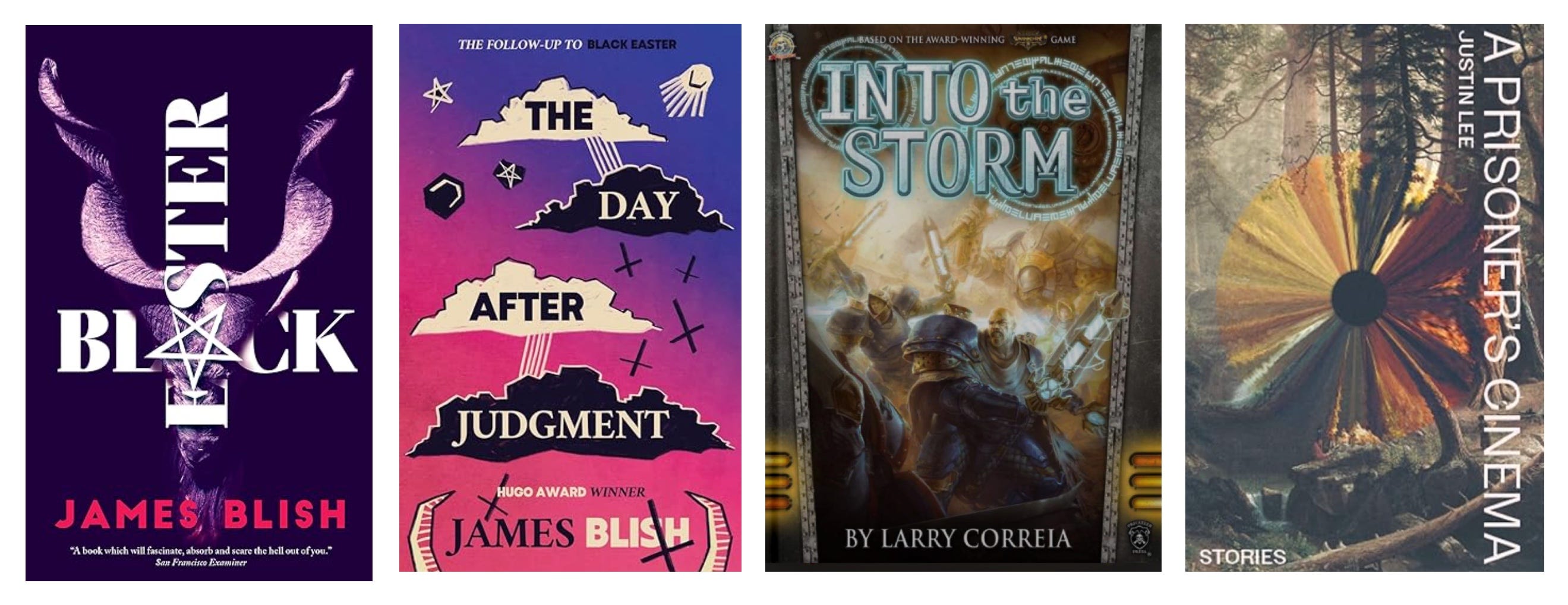
In between some travel, and just being a lazy slug, I’ve fallen behind on my reviews. So it seemed like a good time to conduct an experiment. One of these four reviews is written entirely by an AI. (Though I did chop some bits, AI’s are verbose!) See if you can figure out which one, and bonus points if you can identify the actual AI. I was curious how well it would do and whether it would be easy to detect. But don’t worry this isn’t the first step towards turning things over entirely to AI. I like to (am driven to?) write too much to let it go.
Black Easter
By: James Blish
Published: 1968
176 Pages
Briefly, what is this book about?
A wealthy arms dealer, Baines, teams up with a black magician, Ware, to release all the demons of Hell. Hilarity ensues.
Okay, hilarity definitely does not ensue—what ensues is the release of forty-eight demons of Hell, for a single night of chaos. As you might imagine, it turns out very poorly. Father Domenico, a white magician and Catholic monk, knows it’s going to be bad. He tries to get them to call it off. (Relationships between the two camps rely on a non-interference pact, but are otherwise quite professional.) Predictably, Father Domenico is unsuccessful, which leads to one of the most chilling endings of any book I’ve ever read.
Who should read this book?
This book was written in 1968. They did things differently back then. It’s short, there’s a lot of talking and engineering. (Magic is treated as just another highly skilled profession.) Also there’s very little action until the very end, and even that is mostly “off screen”. Also, Blish doesn’t make anything up. All of the codexes are real books, and all the demonic names are historical. The Christianity is not a useful ingredient, it’s the whole dish. If all of that doesn’t put you off, I think you’ll like this book.
Specific thoughts: Man, that ending…
I’m not going to spoil the ending, but I’m going to get close. Domenico’s worry is that by releasing that many demons Ware and Baines are going to usher in Armageddon. Ware is worried about that as well. (Baines not so much, he just wants to watch the world burn.) But Ware is convinced that he has the situation under control and in any case, the Antichrist is a necessary precondition and he has not yet made an appearance, so Armageddon can’t arrive yet. As you might have guessed he’s wrong, but the reason he’s wrong is the really chilling bit. That’s the bit that made me immediately proceed to the sequel…
The Day After Judgment
By: James Blish
Published: 1971
120 Pages
Briefly, what is this book about?
The aftermath of Armageddon, and the fates of Ware, Baines, Domenico, and indeed of the world itself. Also an examination of the duality of good and evil.
Who should read this book?
If you’ve read and enjoyed Black Easter I would definitely read the sequel. It would be nearly impossible to completely fulfill on the promise made by the ending of the previous book, but this book does as well as anyone could expect in our fallen world. Speaking of which…
Specific thoughts: How fallen is our world?
I will somewhat (say 25%) spoil the ending of this book that’s as old as I am. The demons come to Earth, only to find that humanity is more wicked than they are. In part this is metaphysical. We choose our evil, while the demons are evil out of something akin to a structural compulsion.
The avatar of humanity’s evil is not Ware, the black magician, it’s Baines the arms dealer. And he’s evil because he decides to burn down the world, just to see what it would look like. There is an artistic element to Baines’ obsession, but I think that’s already part of the subtext of “wanting to watch the world burn”.
I’m not sure how common people like Baines are, either then or now. But if we were to generalize Blish’s point, I think it boils down to, you had this amazing reason, this science, and you used it to develop nuclear weapons. And then (in the book) you used them to level the world.
If that was our great crime I wonder what Blish would think about the end of the Cold War 20 years later? (He died in 1975.) Or the fact that we never have used nukes? On the other hand what would he think about Ukraine, and Iran, and the potential war with China? What would he think about culture war issues? Or larger demographic trends like, falling birth rates and polarization? Where would AI fit into things? Would it be in a similar bucket to nukes or an even greater evil?
I find the idea that demons view humanity’s evil as a step beyond their own to be fascinating, and also not entirely without merit.
Into the Storm
By: Larry Correia
Published: 2013
285 Pages
Briefly, what is this book about?
Sir Hugh Madigan, a disgraced Cygnaran knight with a talent for violence, is given command of a platoon of misfits and criminals just in time for a war nobody is prepared for. His second in command is Cleasby, an idealistic young scholar who joined the army because he read too many books about chivalry. The story follows their platoon, “the Malcontents,” through the invasion of the Menite holy city of Sul. Also there are giant steam-powered robots. It’s set in the Iron Kingdoms, the world of the Warmachine tabletop game. Imagine a fantasy setting where someone gave all the knights and wizards access to a steampunk industrial revolution, complete with lightning swords and walking tanks powered by magic brains in jars.
Who should read this book?
This is a tie-in novel for a tabletop game, and that’s working against it. If you bounce off names like “Hierarch Voyle” and “Knights Exemplar” and “Menoth’s Fury” you’re going to have a rough time. But if you’ve already read Grimnoir, Monster Hunter International, and Saga of the Forgotten Warrior and you want more Correia, this will scratch the itch. Just calibrate your expectations accordingly.
Specific thoughts: Correia’s dirty dozen
The template is The Dirty Dozen and Correia knows it. He doesn’t try to reinvent the wheel, he just makes it spin really fast.
Madigan is the best thing in the book — extremely competent, morally grey, carrying a specific wound that gives him more depth than Owen Pitt in the early Monster Hunter books. Cleasby is the heart, going from useless bookworm to competent soldier without losing his idealism. There’s a nice irony in the fact that he joined the army because of romanticized stories about knights, got assigned to the least knightly knight in the kingdom, and ended up writing exactly that kind of story himself — except this time it’s real, and real is uglier than the books ever let on.
The middle bogs down in urban combat that doesn’t have the energy of the opening (Madigan fighting bandits undercover in a tavern) or the climax. But the last fifty pages are legitimately great. Not Correia’s best work, but fun, fast, and occasionally more than that.
A Prisoner’s Cinema
By: Justin Lee
Published: 2025
264 Pages
Briefly, what is this book about?
A collection of spiritually dark short stories with disturbing themes. I’m not generally one to give content warnings, but this goes to some very grim places. Particularly the title story.
Who should read this book?
If the phrase “modern, Christian-inflected, Lovecraft” speaks to you, you’ll probably enjoy this book. The writing is top-notch. The themes are interesting. Though he seems to have trouble sticking the landing.
Specific thoughts:
I’m not one for flowery, purple reviews, but it might be that this collection deserves exactly that sort of review. I did dig up a review by one Stephen Pimentel that went that way. I’ll include the opening paragraph:
Justin Lee’s A Prisoner’s Cinema is a collection of literary horror that declines to soothe. Instead, it uses the genre’s conventions not as a blunt instrument for shock but as a scalpel to dissect the most tormented regions of the human psyche. Here, consciousness itself is the haunted house, a subjective prison from which there is no escape. The stories collectively form a sustained philosophical inquiry into the nature of evil, the instability of the self, and the search for meaning in a world haunted by internal demons and the specter of a sometimes silent God. This is spiritual horror, born from the unlit abysses of memory, guilt, and faith.
Perhaps a book like this deserves a review like that, but when you’re reviewing every book you read (quixotic, I know) summoning that kind of grandiloquence is prohibitive. This all sounds pejorative towards both the review and the book, but it isn’t meant to be. I think Pimentel does nail the core of the book, and I think Lee is a fantastic writer.
The prose in this book is great, and I enjoyed every bit of the writing, though as I said Lee seemed to have trouble crafting a satisfying ending. And oftentimes when you’re talking about the short story form, the ending is 80% of what people remember. It’s a testament to Lee’s writing that I found it to be a memorable book despite some weak endings.
Of course this is just my opinion, you may think the endings were perfect. But I suspect you’ll find some of the endings to be underwhelming, like the ending you’re experiencing right now.
—-----------------------------------------------------------
Are you ready for the answer? The AI-written review was Into the Storm. I don’t feel like it was very hard to guess, but I obviously have an advantage over someone coming in cold. I did try to make it as hard as possible. I figure if anything would be easy for an AI to copy, it would be me reviewing a Larry Correia book. For more, very limited, AI experimentation and Correia reviews, consider subscribing.
I read Blish's Black Easter back in the 1970s when I was a teenager.
The ending was a gut punch.
I also guessed the AI answer! For me, it was two things: (1) the em dash, surrounded by spaces (which it seems like ChatGPT has recently segued to using... it used to be only me who did that, and I was breaking the style guides), and (2) this one line:
>> "If you bounce off names like “Hierarch Voyle” and “Knights Exemplar” and “Menoth’s Fury” you’re going to have a rough time."
It was a funny line — I actually chuckled! — but funny in a shallow way. There's something about the phrase "bounce off" that I both like, and feels empty. Not sure what to do with that.
Thanks for the Easter-morning thinking puzzle.