

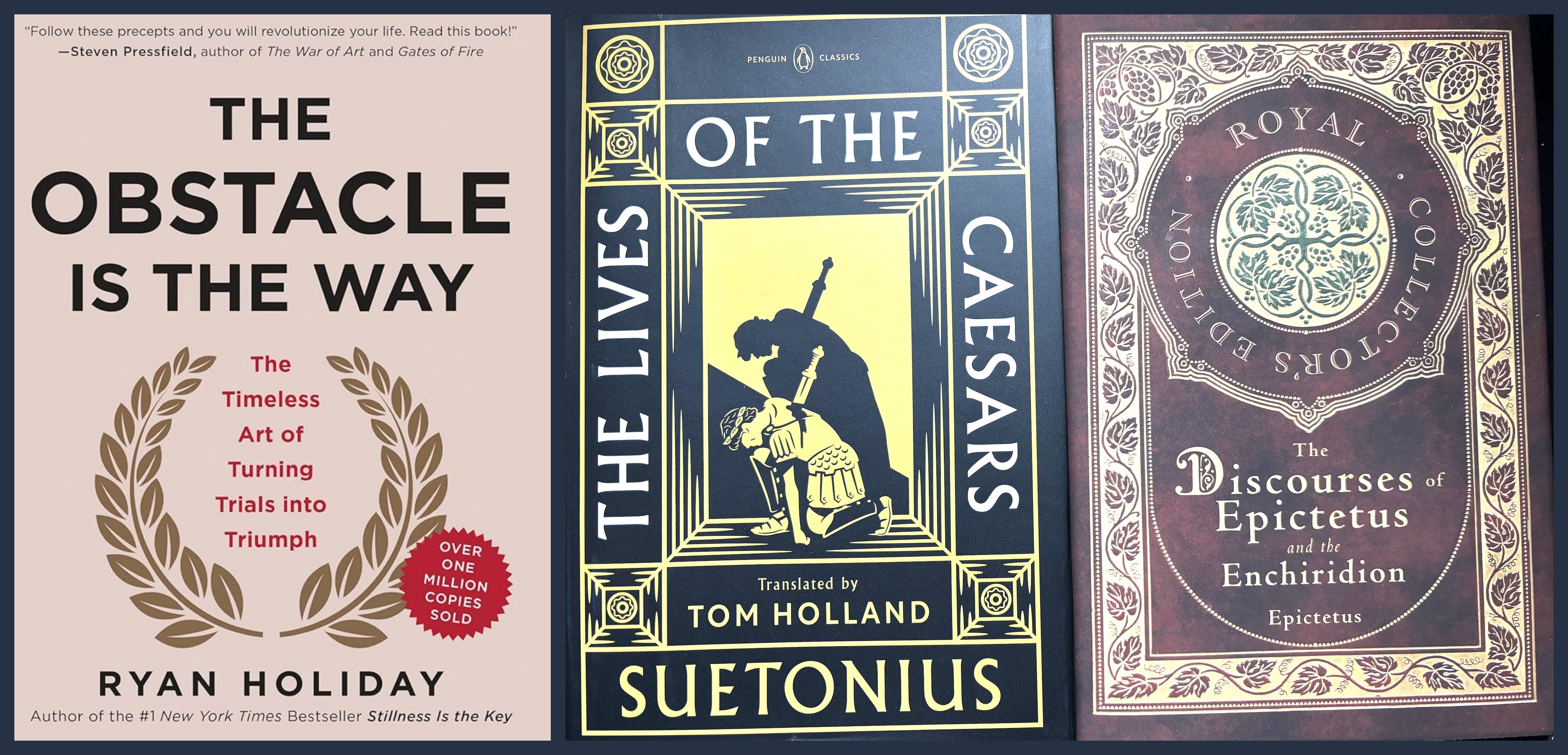
The Obstacle Is the Way Expanded 10th Anniversary Edition: The Timeless Art of Turning Trials into Triumph
By: Ryan Holiday
Published: 2024
224 Pages
Briefly, what is this book about?
A modern distillation of ancient Stoic principles, leavened with recent and historical examples of people overcoming difficulties, and delivered in the style of a motivational speech.
It’s broken into three sections:
Perception: view problems dispassionately. Look for hidden advantages.
Action: do something. Ideally something deliberate and creative. Be persistent.
Will: cultivate the resilience and humility necessary to accept things outside of your control.
What authorial biases should I be aware of?
Holiday is very pro-Stoic, and that’s probably a good thing in this day and age. But this is a book of anecdotes, not data.
Who should read this book?
This book benefits from being short, which widens the number of people I’d expect to benefit from it. It doesn’t take long to read, and I think almost everyone could benefit from a little Stoicism in their life. This is not a bad place to start—though I think I’ve decided that I prefer the OG Stoics. (See below for my review of Epictetus.)
Specific thoughts: The first book I’ve read and reviewed twice
I believe this is the first book I’ve reviewed for a second time. It’s not like I never re-read books, but generally I wait at least a decade for them to fade properly. (I used to re-read the Lord of the Rings every summer, but that was when I was a teenager, many, many, many years ago.) A business group I belong to decided to read this book and since it was short I went ahead.
You can go back and read my first review. I think my big impression is that I’ve gotten better at reviewing books. (One would hope so!) Though I did make an interesting point that most of the principles of Stoicism could be found in self-help books like The Seven Habits of Highly Effective People. Stoicism wasn’t so much forgotten, before the Holiday-led renaissance, as absorbed.
In any case, you can see that the timing was fortuitous. It plugged right into a couple of other books I just happened to be reading. As I already mentioned, I’ve come to prefer the original Stoic texts. Let me try to illustrate why. Consider these two passages (picked somewhat at random):1
First Holiday:
The way life is gives you plenty to work with, plenty to leave your imprint on. Taking people and events as they are is quite enough material already. Follow where the events take you, like water rolling down a hill—it always gets to the bottom eventually, doesn’t it?
Because (a) you’re robust and resilient enough to handle whatever occurs, (b) you can’t do anything about it anyway, and (c) you’re looking at a big-enough picture and long-enough time line that whatever you have to accept is still only a negligible blip on the way to your goal.
Now Epictetus:
What do we admire? External things. What are we anxious about? External things. And yet we are at a loss to know how fears or anxiety assail us! What else can possibly happen when we count impending events as evil? We cannot be free from fear, we cannot be free from anxiety. Yet we say, ‘O Lord God, how am I to be rid of anxiety?’ Fool, have you no hands? Did not God make them for you? Sit still and pray forsooth, that your [snot] may not flow. Nay, wipe your nose rather and do not accuse God.
What moral do I draw? Has not God given you anything in the sphere of conduct? Has He not given you endurance, has He not given you greatness of mind, has He not given you manliness? When you have these strong hands to help you, do you still seek for one to wipe your [snot] away?2
The point of all this is that if I were going to read a book twice, I should have been reading Epictetus, or Marcus Aurelius, not Holiday. But speaking of Epictetus…
The Enchiridion & Discourses
By: Epictetus
Translated by: Thomas W. Higginson
Published: circa 125
416 Pages
Briefly, what is this book about?
Technically, this was all transmitted by Arrian, one of Epictetus’ students. The Enchiridion was his attempt to distill everything down, while the Discourses were just that, a record of Epictetus’ actual lectures.
Differences in formation and composition aside, the collection is attempting to do much the same thing Holiday is trying to do, that is offer advice for living well and overcoming challenges and hardships (of which there were a lot more back then).
What authorial biases should I be aware of?
Epictetus was born into slavery. He was disabled. (It was said that his master deliberately broke his leg during torture.) Later he was banished from Rome. (Banishment was a much bigger deal then than now.) So he doesn’t have time for your petty problems, your small anxieties. He’s mapping out a system for dealing with serious stuff. As such he has a real “The Lord giveth and the Lord taketh away attitude” (though obviously he’s not Christian). For example:
Never say about anything, I have lost it, but say I have restored it. Is your child dead? It has been restored. Is your wife dead? She has been restored. Has your estate been taken from you? Has not then this also been restored? But he who has taken it from me is a bad man. But what is it to you, by whose hands the giver demanded it back? So long as he may allow you, take care of it as a thing which belongs to another, as travellers do with their inn.
This is Stoicism at its most hardcore.
Who should read this book?
The Enchiridion is short enough that really everyone should read it. The Project Gutenberg copy came in at a little over 8000 words. There are blog posts that are longer than that. I’ve never done one that long, but they’re out there. And even if you’re talking about my posts that would only be three or four of them.
Then if you like The Enchiridion you can go on to read the discourses. Which aren’t quite as pithy, but also quite good.
Specific thoughts: I was surprised by how Christian things felt.
Part of the way in which Epictetus is more hardcore is his insistence that everything that happens is what was supposed to happen, and you shouldn’t merely endure it, you should embrace it. Consider this quote:
Remember that thou art an actor in a play, of such a kind as the teacher (author) may choose; if short, of a short one; if long, of a long one: if he wishes you to act the part of a poor man, see that you act the part naturally; if the part of a lame man, of a magistrate, of a private person, (do the same). For this is your duty, to act well the part that is given to you; but to select the part, belongs to another.
Now I understand this isn’t straight down the line Christianity. But it’s certainly similar, and it’s also, as I keep pointing out, far more hardcore than the modern flavor of stoicism. And miles away from anything resembling social justice ideology. Of course what’s weird is that many people think that social justice ideology is rooted in Christianity. And they have a point, but clearly Christianity contains both threads, and the one adjacent to Stoicism has largely been abandoned. Or as Dostoevsky put it, we should be “worthy of our suffering”. If nothing else, that’s a lesson worth taking away from both Epictetus and Holiday.
The Lives of the Caesars
By: Suetonius
Translated by: Tom Holland
Published: circa 121
431 Pages
Briefly, what is this book about?
The lives, loves, acts, attitudes, debaucheries and deaths of the first twelve Roman emperors (including Julius though he technically wasn’t an emperor). It was written around the same time as Epictetus, but this is the “lack thereof” portion of the post.
What authorial biases should I be aware of?
Suetonius is more interested in what we would call the private lives of the Caesars, though privacy had little meaning back then and could be viewed as trying to hide something. Like when Tiberius retreated to the island of Capri. He does have primary sources to draw on, but he passes along a lot of gossip as well.
Who should read this book?
There’s a lot of stuff about Rome out there. I’m particularly familiar with a couple of podcasts, specifically Mike Duncan’s History of Rome and Dan Carlin’s Death Throes of the Republic arc on his Hardcore History podcast. I’m not sure if I would recommend reading this and then listening to the podcasts or, vice versa. I did the podcasts first and it was enlightening to then read one of the primary sources for much of what ended up in them. But, as a general matter, I think Roman History is fascinating enough that you should definitely have some familiarity with it. I suppose the podcasts are an easier way to get a broad view, but I quite enjoyed this book as well. And the Tom Holland translation left all of the sauciness in!
What does the book have to say about the future?
Obviously one of the chief attractions of studying Rome is its transition from a republic to an autocracy. I don’t know if that’s where we’re headed, but it’s certainly one possibility, and I think it’s interesting to know how it happened before.
Specific thoughts: The past is a different country
Suetonius covers twelve different emperors and frequently the book is just called The Twelve Caesars. Some of these emperors were better than others, but the feeling you get from Suetonius is that even the good ones had significant flaws, and the bad ones come across as being comically wicked. Caligula’s reputation is more than earned. And even Augustus, the best of the bunch, gouged out someone’s eyes with his thumbs (according to Suetonius).
This book ends up being pretty salacious from a modern perspective. Even if all the things Clinton and Trump have been accused of by their enemies turned out to be true, they would be considered better than average rulers when set against the excesses of the Twelve Caesars. It’s obviously somewhat strange to see this contrast between the strict morals offered up by Epictetus and the debauchery described by Suetonius. How do we reconcile it?
My sense is that the crimes of the emperors were recognizably Roman, though, particularly in Nero and Caligula’s case, turned up to 11. The Roman sexual mores were different than ours. Adultery was definitely a crime, but within a much more narrow band. Caligula still went way, way beyond what was acceptable, but the distance wasn’t as great as it would have been under modern standards.
On the violence side, there had just been so much violence going back for decades all through the fall of the Republic that, when Augustus had to gouge someone’s eyes out early on, it was part of a whole tapestry of violence. He then did a lot to calm things down, while also clearly demonstrating that the legions were going to be the decisive factor. Later during the year of the four emperors (all four of those emperors being included in this book) the role of the legions became crystal clear.
All of which is to say that the extreme stoicism of Epictetus wasn’t separate from these people and events, it was in response to them. How does one live in a world of chaos disorder and crazy emperors? By being exceptionally stoic…
—-------------------------------------------------------------------------------
In one of Caligula’s more insane moments he connects a bunch of ships together to form a path. He then covers the path with dirt and proceeds to travel back and forth on it for a couple of days, each time taking on a different role. Sometimes writing on Substack feels like a similar parade of self-importance, though less likely to be expressed in Latin. If you want some non-Latin self-importance, consider subscribing.
As in I opened my copy of the book, looked at a few random passages, and grabbed one that seemed to fit.
In a bit of poetic/translational license I changed rheum to snot. I felt like that more accurately gave it the punch it actually has.
I've read one book on stoicism, "A guide to the good life." It seemed, as you say, reasonable and needed, to an extent at least.
Being reminded of Epictetus' life story, one has to wonder if those old Romans might not raise a dubious eyebrow at moderns who teach on suffering...