

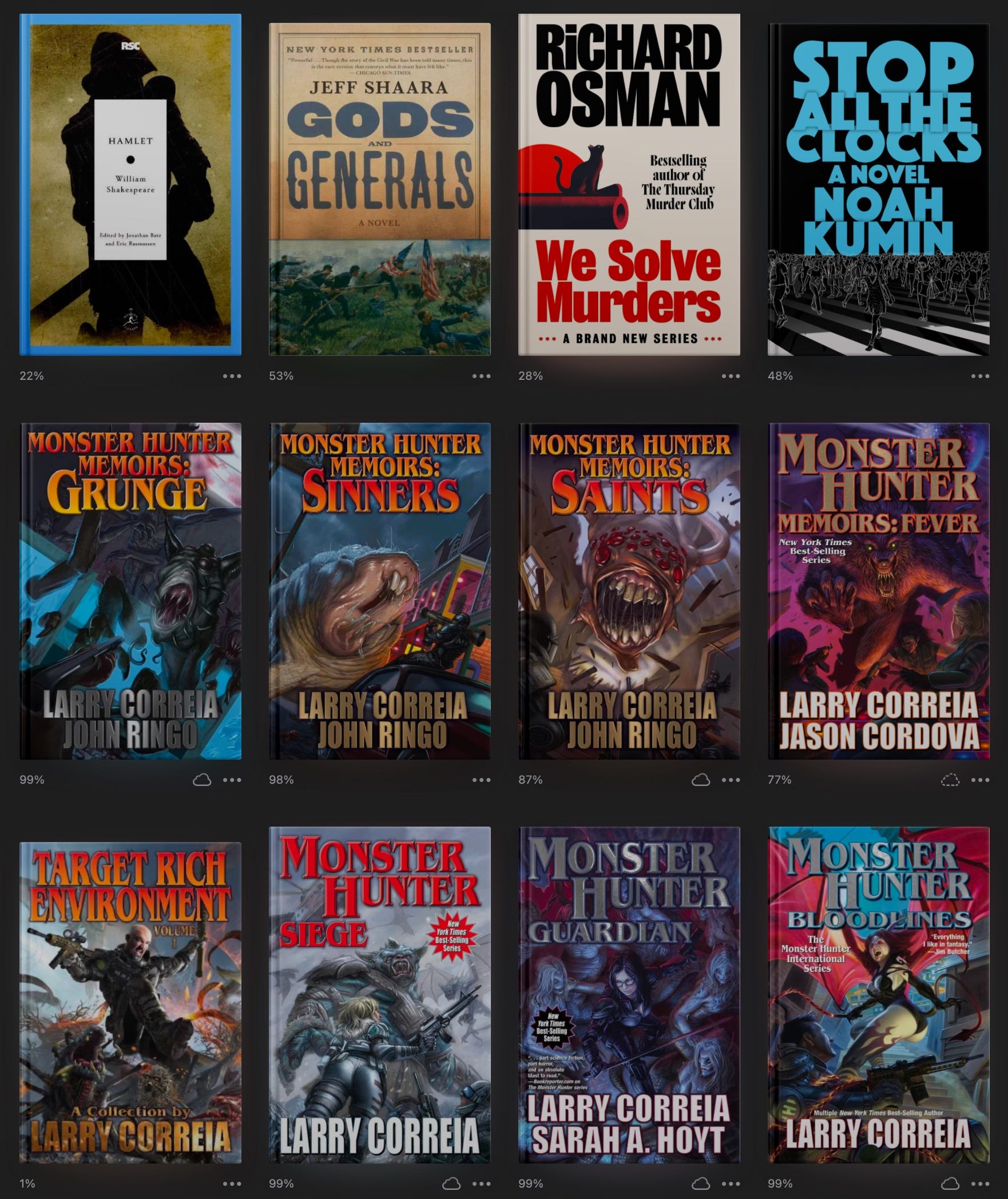
Gods and Generals (The Civil War Trilogy, #1) by: Jeff Shaara
Grunge (Monster Hunter Memoirs, #1) by: John Ringo and Larry Correia
Sinners (Monster Hunter Memoirs, #2) by: John Ringo and Larry Correia
Saints (Monster Hunter Memoirs, #3) by: John Ringo and Larry Correia
Fever (Monster Hunter Memoirs, #4) by: Larry Correia and Jason Córdova
As you may or may not have noticed I fell behind on my review writing. Rather than stop reading until I caught up I switched to reading more fiction, since those books are easier to review. The inevitable result is that I now have a backlog of fifteen fiction reviews. However, ten of them are books authored or co-authored by Larry Correia, so if you don’t like Correia (or if you don’t like him as much as I do, which is apparently a lot) you can skip those last ten reviews.
I suppose you could also skip them if your opinion of Correia, good or bad, is formed and unlikely to be altered by anything I say. If on the other hand you came here strictly to hear me talk more about Correia, then you’ll have to be patient. First I have to get a few lesser authors and their works out of the way, like…
Hamlet
Published: ~1600
169 Pages
Briefly, what is this book about?
Prince Hamlet is approached by the ghost of his father, the former king. The ghost charges him to kill the current king, Hamlet’s uncle and the ghost’s brother. Hamlet spends the remainder of the play agonizing over how to do it, with occasional breaks pretending to be mad and insulting Ophelia, who definitely does not deserve it. There’s a bunch of other subplots, including a blink-and-you-miss-it interlude in which Hamlet is captured by pirates.
Who should read this book?
Everyone should, on some level, be familiar with Hamlet. If you don’t feel like reading it, and after all it was meant to be seen, you should at least watch one of the many movie versions.
Specific thoughts: Shakespeare is the greatest. End of discussion.
Shakespeare is the GOAT. Hamlet (the play, not the person) is fantastic. The language is sublime.
How weary, stale, flat, and unprofitable
Seem to me all the uses of this world!
Fie on ’t, ah fie! ’Tis an unweeded garden
That grows to seed. Things rank and gross in nature
Possess it merely.
Not a whit. We defy augury. There is a
special providence in the fall of a sparrow. If it be
now, ’tis not to come; if it be not to come, it will be
now; if it be not now, yet it will come.
O God, I could be bounded in a nutshell, and count myself a king of infinite space, were it not that I have bad dreams.
Hamlet is clearly a classic of the English language. What more could I possibly say beyond what has already been said?
Well, I will say one thing. When Richard Hanania defended Sam Bankman-Fried’s horrible take on Shakespeare, I knew, despite his previous incisive commentary, that in some areas he was just an idiot. I’m not sure if one can just chalk it up to an “on the spectrum” blindspot. If it demonstrates on some level the difference between intelligence and wisdom (but perhaps I’m repeating myself). Other possibilities include massive arrogance, or he’s just straight trolling. Regardless of the source, it marked the beginning of a small but definite decline.
Gods and Generals (The Civil War Trilogy, #1)
By: Jeff Shaara
Published: 1996
512 Pages
Briefly, what is this book about?
A prequel to Killer Angels (see my review here). That book was written by Michael Shaara. This prequel was written by his son. The POV characters in this book are Robert E. Lee and Thomas J. "Stonewall" Jackson on the Confederate side and Winfield Scott Hancock and Joshua Chamberlain on the Union Side and the book puts forth a semi-fictionalized account of their thoughts and actions between 1858 to 1863.
Who should read this book?
If you liked Killer Angels, or if you like this sort of semi-fictionalized history, particularly of the Civil War, this is a great addition to that world.
Specific thoughts: A great example of empathy for an age where empathy is lacking
This book really makes you feel for all of the characters, even or maybe especially those on the Confederate side. As such I was surprised to not come across any denunciations of this book. Somebody claiming that it minimized slavery or that it sanewashed (or some other neologism) the Confederate generals. Perhaps I wasn’t looking in the right place, or perhaps the book came out long enough ago that no one thinks they’re worth bringing up now. Whatever the case, I’m glad it’s not mired in controversy because I think everyone could benefit from reading books like this. Books that are able to portray both friend and enemy alike as flawed human beings just doing the best they can with the circumstances and time they’ve been granted.
We Solve Murders
By: Richard Osman
Published: 2024
400 Pages
Briefly, what is this book about?
A retired cop and his bad-ass bodyguard daughter-in-law are pulled into a murder mystery involving a shadowy figure and his money laundering empire.
Who should read this book?
If you enjoyed Osman’s first series, Thursday Murder Club (see my reviews here), then you’ll probably enjoy this book as well. It has the same dry wit and the same quirky characters.
Specific thoughts: It’s possible to have strong females without making them cartoonish
I know this point has been done to death, and to be clear I generally enjoyed the book, but stuff like this is so ridiculous that it can seriously contaminate an otherwise very enjoyable book. Before spelling it out explicitly here’s an example of what I mean:
Amy weighs up the odds. Kevin is around six two, must weigh upwards of 260lbs. If she can unbalance him, it’s an easy win for her. But Kevin is an ex-Navy SEAL. And Kevin knows that he is six two, and heavy, so Kevin also knows that if Amy can unbalance him it’s an easy win for her. Kevin is therefore keeping his distance and letting the gun do the work. Amy hears handcuffs. The second Kevin reaches for her wrists, he will be doomed. Once she overpowers him, she can worry about what to do next.
I point this out because in all of the modern examples of amazing, girlboss, female fighters, I can’t remember anything as ridiculous as this. And there has been a lot of ridiculous stuff. I don’t care how well trained Amy is, or if she looks like Brienne of Tarth. She’s not going to automatically win against a 6’2” ex-Navy SEAL, if he but touches her wrists. That’s basically science fiction. In reality her chances of “overpowering” him in a straight up fight are next to zero, to say nothing of a situation where he’s got the drop on her and is holding a gun. “Easy win”? “He will be doomed”? Come on!? I can’t imagine Osman is really that blinkered. I guess it must be a trap to catch out bad people like me. If so, I guess he succeeded.
Stop All the Clocks: A Novel
By: Noah Kumin
Published: 2025
240 Pages
Briefly, what is this book about?
Mona Veigh, the main character, has recently sold her AI/poetry startup to Avram Parr, a tech messiah. Shortly after the sale Parr murders himself, but then weird things start to happen. From there it’s a meditation on language, power, immortality and propaganda.
Who should read this book?
This book was recommended to me by Jesse Singal of Blocked and Reported fame. I was not disappointed, it’s a smart book, that’s not excessively long and reads well. I liked Veigh, and I liked both the murder mystery, but also the philosophical mystery.
Specific thoughts: How seriously should we take Silicon Valley weirdness/ambition?
As you might imagine given that it’s a novel, Silicon Valley ambition ends up being taken very seriously. A novel has to have stakes, but it leads me to wonder how close is fiction to reality in this case? When you look at Musk’s desire to reach Mars, or Bryan Johnson’s desire to live forever, or whatever the heck Zuckerberg thinks he’s doing with AI, how seriously should we take those efforts? How much should the difficulty of space travel, or Johnson’s incoherent ideology, or the abject failure of Zuckerberg’s last big project factor into our assessment? Is it just a matter of time before one of these nascent transhumanists pulls off something truly insane?
What kind of clues can we get from fiction, particularly this fiction? Certainly we can’t reject the possibility of prescience entirely. Science fiction has some surprising hits when it comes to predicting the future, and the tech messiah archetype is a feature of numerous near future books, not just this one. And there’s a tendency when one reads one of those books, to increase the probability of it actually happening. But at the same time as I was reading this book I was getting a real world lesson in the powerlessness of the tech messiah.
I’m speaking, of course, about Musk’s largely inconsequential foray into government. An experiment which was underwhelming on basically every level. The alchemy of the two left me sad. I’m not a big fan of tech messiah’s in general, but as it becomes ever more apparent that their influence is overrated and their powers oversold, the world as a whole becomes a little more narrow, little less fantastic. I guess that’s why we need fiction, and why I enjoyed this book.
Pyrebound
By: Brayton Cole
Published: 2022
620 Pages
Briefly, what is this book about?
A somewhat standard fantasy bildungsroman, with some very interesting world building, which in turn leads to a very strange political situation.
Who should read this book?
There are people who are voracious readers of self-published Royal Road stuff. Who seemingly never have enough to read. (Something I’ll never comprehend. I have far too much I want to read.) If you are one of these people I would say that this book is better than 90% of the stuff on Royal Road.
Specific thoughts:
620 pages is a lot, and while this book went down pretty easy, it was not, as we used to say, a “non-stop thrill ride”. Instead it was a very interesting exercise in world building. I can’t do better than the author’s own description:
A malignant star appears in the east every fourth day, spreading death and decay across Ki. Life survives only around precious fires kindled by dying priests. What happens to a man who loses his place beside the fire?
In a previous review I mentioned that at one point Dungeons and Dragons had the idea of a “points of light” setting—the vast majority of the world is dark and dangerous, but there were a few outposts of civilization within it. This is that idea taken to an extreme, and I very much enjoyed this aspect of Cole’s world building.
Another idea that is taken to its extreme is the conflict between the priests who must maintain these fires, and the powerful people who actually rule. As we’ve seen historically, hereditary aristocracies often outlive their actual influence, but are kept around as a legitimizing facade by those who truly have power. That’s how it works in this setting as well, except there are some complications. The priests actually have considerable power and the fact that they have to die every ten years in order to rekindle the fire makes them psychologically unstable. So the need for an actual “power behind the throne” is both more acute and also harder to maintain once lost.
Cole bravely dives into the tensions thus created, and never shies away from any of the implications, but in the story that emerges ends up being more weird than interesting.
Monster Hunter Memoirs (First Trilogy)
By: John Ringo and Larry Correia
Published: 2016
320 Pages
Published: 2016
304 Pages
Published: 2018
288 Pages
Briefly, what is this series about?
This series features Oliver Chadwick Gardenier who dies in the 1983 marine barracks bombing. St. Peter meets him on the other side and gives him the opportunity to return, telling him there is a work for him to do, if he’s up for it. What is this work? Killing monsters of course. 80% of the series is geared towards giving you more Monster Hunter goodness, and 20% is about creating an 80s period piece. As a child of the 80s I quite enjoyed that part. Your mileage may vary.
Who should read this book?
If you like the main monster hunter series then this series is basically just as good, with one caveat. Gardenier is quite the Don Juan, to the point where it’s actually distracting.
Specific thoughts: Have I become one of “those people”?
My son is a huge Brandon Sanderson fan. (You can read my own thoughts on Sanderson here.) Sanderson is best known for his Stormlight Archive series, which at the moment clocks in at 6,500 pages, and it’s only halfway done. That would be bad enough, but it’s part of a larger shared universe called the Cosmere, and once you include all of those books you’re talking about 15,000 pages. As a gigantic fan, my son has read them all. I will admit I looked down on him for it. Is it really necessary to read another 400 page book just so you can understand a couple of references in the main series? But apparently that’s where I’m at. I’m reading Monster Hunter books that aren’t even written by Correia.1 In the interest of full disclosure I’m probably at 7,500 pages of Larry Correia stuff, so a lot, but less than Sanderson (so far).
Of course to be fair to both me and my son, reading all these additional pages is about more than picking up a couple of connections. I assume he genuinely enjoys the Sanderson stuff, and I genuinely enjoy anything written by, or apparently even near Correia. But I am under no illusions that this preference should apply universally. This is not Shakespeare (of course as I pointed out previously there are apparently some cretins out there who deny the greatness of even Shakespeare) but, for me it is a lot of fun.
I guess I should talk somewhat about the books themself. The first book is set in Seattle, and while Seattle is interesting, its real charm comes from the origin story I mentioned above. The other two are set in New Orleans, and there it’s the location that really shines through. Setting a Monster Hunter book in New Orleans was a great idea. I don’t want to spoil why it’s a great idea, but it puts things on a whole different level.
Monster Hunter Memoirs (Second Trilogy)
By: Larry Correia and Jason Córdova
Published: 2024
384 Pages
Briefly, what is this series about?
Another Monster Hunter period piece. (Is it a period piece if you’re only going back 50 years? It doesn’t feel like it should be I guess it technically is.) Here we’re in 1970s LA with all that entails. The main character this time is Chloe Mendoza, a half-demon created by the gods of Central and South America.
Who should read this book?
Once again if you like the Monster Hunter universe I think you’ll like this book. That said, you might want to wait for me to read the other books in the series (which have not come out yet) before starting it. So far I think this is the weakest of the Monster Hunter properties. Though I still very much enjoyed it.
Specific thoughts: More of the same, but even the same can be pretty good
As I said, while I enjoyed this one, it was still the weakest so far. Mendoza is a pretty good character, but it doesn’t break much new ground. Which is kind of to be expected, there’s not going to be a lot of new ground by the time you reach book 13. The setting is interesting, but while I was alive in the 70s I don’t have nearly the same nostalgia for it as I do for the 80s.
Target Rich Environment Series
By: Larry Correia
Published: 2018
336 Pages
Published: 2019
352 Pages
Briefly, what is this series about?
These books are collections of Correia’s short stories. So there is some Monster Hunter stuff in here, but also short stories related to his other series, as well as stories that are one offs.
Who should read this book?
The short story form used to be something that science fiction and fantasy did really well. I’m not saying that Correia is a master on the level of Ted Chiang or Ray Bradbury, but I think he understands the medium and puts together some great stuff.
Specific thoughts: If you like this sort of thing you’ll find that this is the sort of thing you like.
It was after reading these two collections that I decided that I was going to systematically read everything Correia had ever written, and that maybe I needed to be nicer to Sanderson fans. I would probably only recommend these collections if you are as hardcore as I am, but also there is some really great stuff here.
The first thing I read by Correia was his Grimnoir Series, and I still think it’s his best. I was always a little annoyed that he had so many MHI books, and had only done three Grimnoir books. So annoyed that it took me several years before I tried MHI (and you can see what happened). The point being that there are some Grimnoir shorts in here that I very much enjoyed. There’s also some great Monster Hunter stuff, particularly “Tanya, Princess of the Elves”, which you can actually find online, if you don’t want to have to buy the entire collection.
Outside of stories attached to his series, I really liked “Dead Waits Dreaming” and “Father’s Day” from book 1. From book two I thought “Shooter Ready” and “Episode 22” definitely played to Correia’s strengths.
Monster Hunters International (Series)
By: Larry Correia
Published: 2017
384 Pages
Guardian (with Sarah A. Hoyt)
Published: 2019
352 Pages
Published: 2021
336 Pages
Briefly, what is this series about?
The continuing adventures of Owen Zastava Pitt and his fellow Monster Hunters as they battle the dark forces of evil in preparation for a climatic showdown with a force of unspeakable evil.
Who should read this book?
These are books six, seven, and eight, so if you’re this far into the series you should know what you’re getting. While these books are more of the same, they aren’t as repetitive as some other series I could name. In fact…
Specific thoughts: One of Correia’s gifts is mixing it up.
When it comes to reading long pulpy science fiction and fantasy series, on many metrics I’m a rank amateur. However, I’ve certainly experienced several, and it’s pretty common for them to repeat the same beats, book after book. One of the appeals of Correia is that he’s been really good at mixing things up. Obviously when you’re dealing with the same characters doing similar things some repetition is going to be unavoidable, but I think Correia mixes it up far more than most of these authors.
Another point I’d like to make: I was somehow under the impression that Book 8 was the end of the series. I’m not sure where I got that from, but I was wrong, there are actually two more books which should be released next year or maybe the year after, so if you wanted to wait for the series to be done you wouldn’t have to wait too long. And to be clear I have no doubt they will in fact be released. Correia is not Martin (or Rothfuss for that matter).
The Monster Hunter Files
By: Various
Published: 2017
336 Pages
Briefly, what is this book about?
A collection of short stories set in the Monster Hunter universe by various authors.
Who should read this book?
I liked all of these stories, but as you can obviously tell I’m something of a completist, so if that also describes you then definitely. If you’re on the fence, then maybe.
Specific thoughts:
There are some very solid entries in this collection, including one from Jim Butcher of Dresden Files fame, which might have been my favorite. But at this point we’re at 1500 words of just Monster Hunter stuff, so I assume that you get the idea.
I often question whether I should review every book I read. As you can imagine after covering fifteen books in a single post, this question is particularly acute. And if I’m going to review every book should I also be reviewing every movie and TV show? (There are fewer of these but there are some.) What about podcast series? This leads into a larger point about conforming to “The Algorithm” or striking out on a more eccentric and almost certainly less popular path. I continue to choose the latter. Even so, I think we can all agree that fifteen books is a lot. Of course there’s hundreds more in the archives, and there’s a good chance that hundreds more will follow. If you wish to see them all, consider subscribing.
As I understand it, Ringo did basically all the writing and then Correia came along, made suggestions, vetoed a few things, and added some lore.
A play-by-play of my emotions as I discover that there are seven additional Monster Hunter books: 😃 😂 😅 🥲 😐 🫣 🥹