

I.
While listening to a recent podcast discussing the events of 10/7 I heard something that really stuck with me.1 The guest on the podcast explained how Israel had spent the vast majority of their planning and espionage resources on Hezbollah and Iran. This is why, when the time came, they had the brilliant pager and walkie-talkie attack already prepped. Additionally, they had a clear plan for invading southern Lebanon and for striking Iran.
By contrast, they spent very little of their planning and espionage resources on Hamas. The border was lightly defended, mostly relying on fancy and ultimately fallible electronic warnings. And they further assumed that Hamas had been “bought off”—that they were too addicted to the money coming in to do anything radical. This assumption ran so deeply that they dismissed the Jericho Wall document, which, in retrospect, laid out Hamas’ entire plan. As such, they were completely surprised by 10/7. And even after the smoke cleared they had no real plan for invading Gaza. This led to a few weeks of delays while they come up with one, and even then they were forced to make up a lot of it as they went along.2
This lesson felt like a metaphor for our own approach to large-scale risk. What is our Hezbollah? And what is our Hamas? What risks are getting a lot of attention, and what risks are being ignored?
It’s easy to name our “Hezbollah”. AI is currently completely dominating our discussion of risk, particularly existential risk. Arguably it’s sucking up all the air in the room. In pointing this out, I’m not saying that’s inappropriate. Hezbollah was a genuine risk to Israel, but even so it was Hamas who irrevocably pierced the Israeli psyche. And this brings me to my point. It’s harder to name our “Hamas”, but this identification may be equally important. And I’m willing to wager that when the history of 21st-century disasters is written, just like with Israel, our “Hamas” will end up being more important than our “Hezbollah”.
To be clear, this is my read on the subject. I don’t have a crystal ball. Nevertheless, many people sense that civilization is reaching a point of critical fragility. Let’s say you’re one of them and you think something catastrophic (but not necessarily total extinction) is likely to happen before 2100—say in the next 75 years. Options for what might happen include nuclear war, an intentional pandemic, a gigantic financial crisis, etc. Now imagine that you’re pretty pessimistic (I am) and that you place the chances of something like this happening at greater than 50%. Well then if your AI P(doom) is less than 25% then you should be willing to wager that “when the history of 21st-century disasters is written” something else will end up being more important than AI.3 Obviously these numbers are very crude, but I think you get the point: our doom may come from a direction we should be paying more attention to.
So, what is our “Hamas”? What do we risk being blindsided by while all of our attention is focused on AI?
II.
I think it would be difficult to name a potential disaster that absolutely no one is paying attention to. Obviously if you go to the right corner of the internet you’ll find people panicking about everything from famines caused by fertilizer being blocked in the Strait of Hormuz to the time it takes to replace critical transformers in our electrical grid, with everything in between. So what does it mean to ignore a potential catastrophe? This question leads directly into the larger question of how should we apportion our resources? How much attention should Hamas have gotten as opposed to Hezbollah? Attention and resources are finite. We can’t prepare for everything.
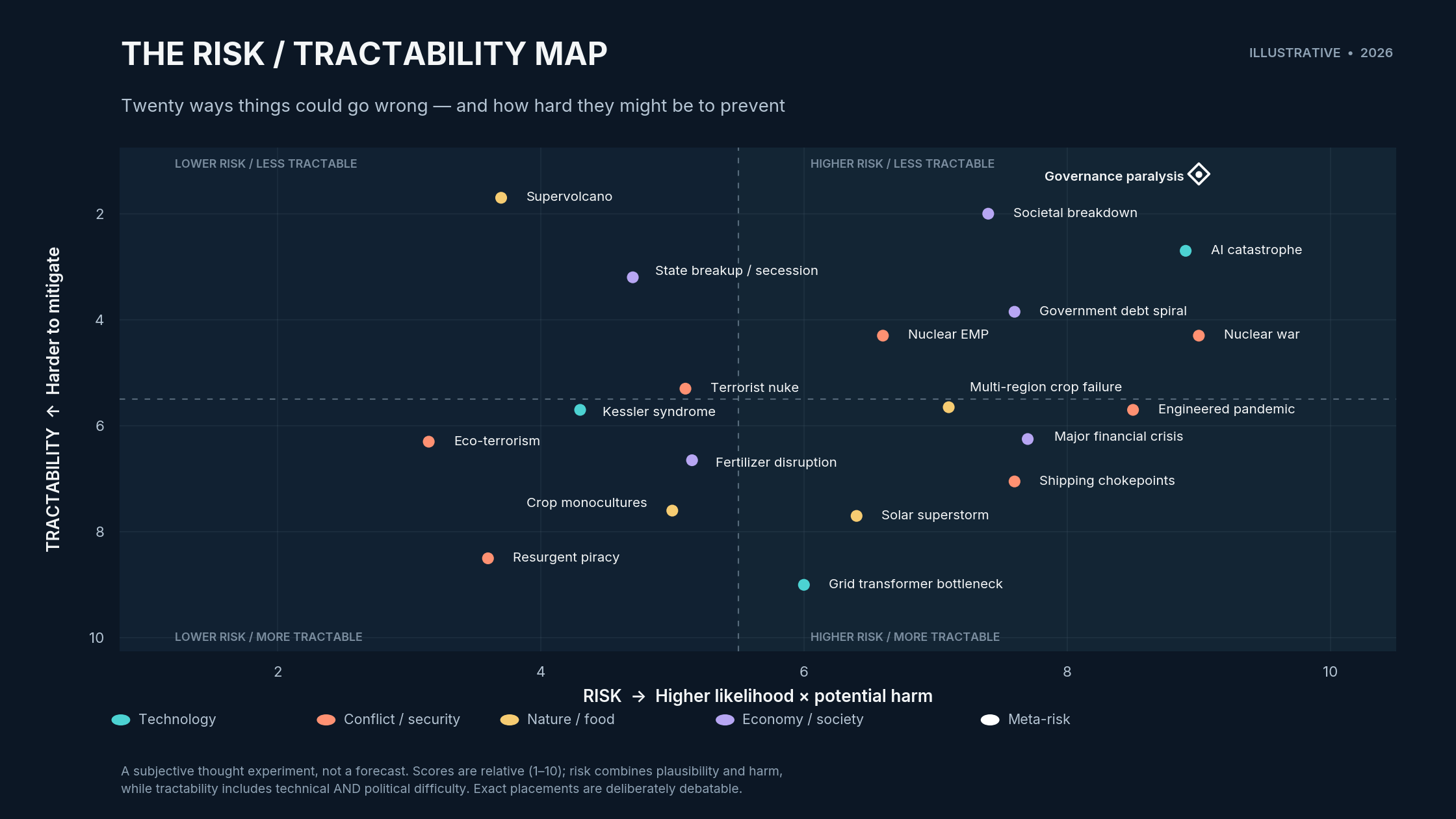
Clearly this is a devilishly difficult problem, but I do think there’s an entry point. We could make a sober assessment of the risk/attention ratio, and identify places where the number is especially high. I understand that such an evaluation is fraught with a large degree of uncertainty, and that everyone is going to have different numbers, but despite this I think it’s a useful exercise and one we should engage in. I’ll start, but should you wish to add anything (or disagree with any of my scenarios) I’d welcome the additions.
EMPs: This touches on several things, including the criticality of transformers mentioned above. There’s of course the nightmare of a huge EMP attack on the continental US (see my recent book review) but there’s also the potential for a massive geomagnetic storm similar to the Carrington event.4 But once you start brainstorming things, you can imagine other scenarios. If Putin ever does decide to cross the nuclear line, does he just open by conducting an EMP over all of Europe? (I don’t know that he could do it in such a way that he doesn’t get any of his own troops, but if he gets to that point does he care?)
Freedom of navigation: This relates to the fertilizer point above, but I think most people generally don’t realize what sea travel was like as recently as 100 years ago. (And I’m not even talking about the period of the two world wars.) Certainly there have been recent issues with Somali piracy, and the Suez Canal was closed between 1967 and 1975, but it could get so much worse. Which is not to say it’s a catastrophe on the order of what we’ve already discussed, but it’s a massive change.
Government debt: This is a good example of something which seemingly snuck up on us. But now that it’s front of mind for many it illustrates some of the difficulties with this exercise. And of course when I say it snuck up on us, it depends on who you’re talking about. From a certain perspective government debt has gotten all sorts of attention—one could point all the way back to the candidacy of Ross Perot. What there has never been is a real plan. The last truly significant attempt to reframe entitlements came in 2005 when Bush proposed to semi-privatize Social Security, and even that plan would have increased the deficit. Since that time there’s been some legislative nibbling often with great fanfare. (For example, sequestration, which has mostly proven to be toothless) but nothing has come close to tackling the root of the problem.
Those are a few of the big ones, and I think most people are on board with them, but as long as we’re on the subject we should mention some others that might be a little more fringe. Actual societal breakdown into anarchy, eco-terrorism (that’s my best guess for an engineered pandemic), national break-up (state secession), terrorist nuke, the weakness of crop monoculture, Kessler syndrome, supervolcanoes, etc.
Each of the things I talked about would require significant effort to mitigate, to say nothing of solving. So what should we do?
III.
I started off by comparing our focus on AI to Israel’s focus on Hezbollah, and I went on to mention what that focus brought: a brilliant pager and walkie-talkie plan. But this is precisely where the analogy breaks down. What similarly brilliant plan has our focus on AI given us? We have lots of potential plans, but, at best, we’re at the designing the explosive pager stage of these plans. We’re nowhere close to attaching those pagers to the belts of our enemies.5
Here we get into the domain of the meta-crisis. It’s not merely that there are numerous issues facing humanity, all of which require our time and attention. It’s that we need to go beyond that into actual action. Several meta-crises have made action nearly impossible. First, there’s a meta-crisis around governance and authority. We’ve become more difficult to govern, and those in positions of power are more horrible caricatures of leaders rather than actual leaders. Deeper still, there’s a meta-crisis around epistemology. We’re having a hard time telling what’s actually even true. It’s not clear that we can competently deal with even one threat, let alone spare attention to consider hidden threats.
To return to government debt, it provides an excellent example of all of these forces.
From the standpoint of governance, it appears that it might never have been possible to significantly modify Social Security and other entitlements, but in the past one could at least imagine trying. Among actual politicians, such efforts are barely even performative—the last dim remnant of a nearly extinct species: a political deficit hawk.6 And if you’re not a politician, they’re nothing but a performance (e.g. DOGE).
From an epistemological standpoint nothing could be more straightforward than the numbers, and yet large portions of the population completely ignore any logic, no matter how ironclad, which threatens the benefits to which they feel entitled. And to be fair, a lot of economists treated the numbers as largely imaginary for the past few decades as well.
Finally there’s the issue of paralysis. One might have hoped that both the epistemological fog and the lack of governance would clear up once interest on the debt really started to bite, as it has recently, but is anyone campaigning for the midterms doing so on a platform of deficit reduction?7 Does anyone think anything significant is going to happen in the next Congress?
IV.
No analogy is perfect, and I’ve wandered away from my initial point, but perhaps there’s a way to bring it back. Nothing is truly going to be a complete surprise. Hamas wasn’t. And whatever disasters befall us over the next few decades won’t be surprises either. When they happen there will be things that we will wish we had done better. There will be warnings we overlooked, precautions we should have taken, and people we should have listened to. Israel had the literal plan for Hamas’ invasion, but it was repeatedly dismissed—a failure of governance. Because they didn’t think Hamas was actually capable of pulling it off—a failure of epistemology. And then even when it was happening, because of the first two, they were far too slow to react—paralysis at the key moment.
We can do better at preparing for the disasters which will inevitably befall us. With luck we might even prevent some of them. Part of that is to consider not just the giant attention-grabbing problem in front of us, but also to consider the disasters that aren’t getting as much attention. But ahead of all of that we should deal with the meta-disaster: getting ourselves into a place where we can act effectively at all. Because more important than identifying the “Hamas attack” that will, one day, change everything, is having the tools in place to actually do something once that identification is made. The terrifying possibility is that we already know what the next great catastrophe is going to be. We have all the necessary warnings. The Jericho Wall document is sitting on someone’s desk right now. And instead of reading it and acting on it, they’re working on crafting the perfect viral one-liner for the next time they’re in front of the cameras.
—----------------------------------------------
As a reminder, I am interested in hearing what your pick is for “catastrophe that’s not getting enough attention”. The one where you’ll be saying “I told you herds of cloned triceratops would spell the death of America, but you all laughed at me! Well who’s laughing now!” Oh, you haven’t heard that one? Well there’s a lot you haven’t heard if you’re not subscribed to this blog! So you’d better get on that.
I think it was the “Inside Israel’s War Room” episode of The Remnant with Jonah Goldberg, but I’m not 100% sure.
This is not the time to get into the vast controversy around the ongoing war, and casualties and everything else. I have touched on that in numerous previous posts. Which you should be able to easily find with your favorite agent.
My sense is that, when pressed, a sober-minded doomer (e.g. Scott Alexander or similar) will offer a P(doom) of between 10 and 20 percent.
Not exactly an EMP, but there are a lot of similarities.
Too dark? Maybe…
How many of you have heard of the Fiscal Commission Act? Anybody?
Two major parties, there’s always a handful of libertarians out there. God bless them!