

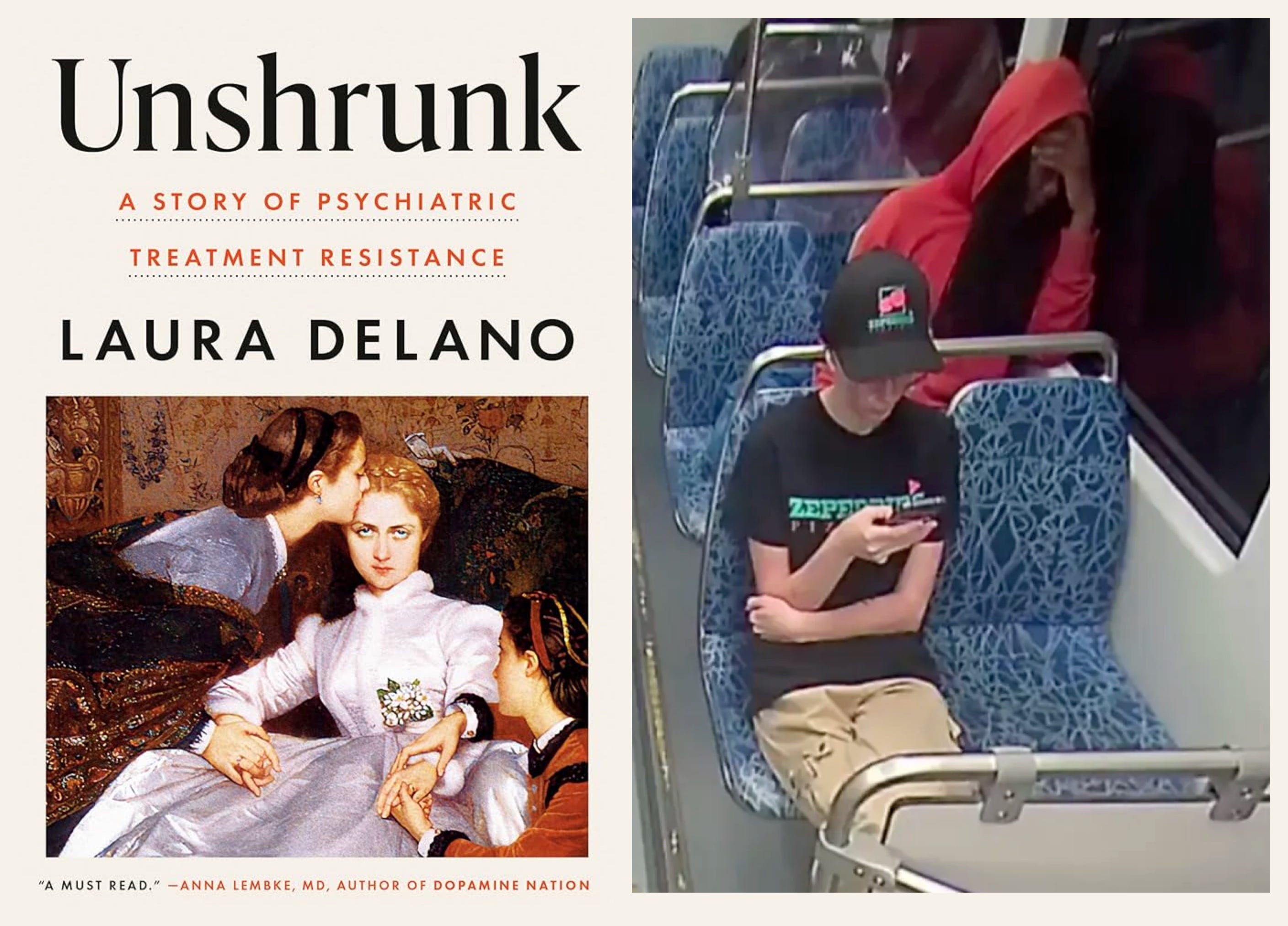
Unshrunk: A Story of Psychiatric Treatment Resistance
By: Laura Delano
Published: 2025
352 Pages
Briefly, what is this book about?
An autobiographical tale of Delano’s experience with the mental health industry starting at the age of thirteen. Among other things, it covers her bipolar diagnosis, eating disorders, cutting, and one, nearly successful, suicide attempt. On the treatment side of the ledger she took at least a dozen drugs, engaged in constant therapy, and was committed to psychiatric hospitals and treatment programs on several occasions. In the end she decided that most of her problems stemmed from the substances she was taking, both those that are recognized as harmful, like cocaine and alcohol, and those that were supposed to help her. A major theme of the book is that the horrible withdrawal symptoms that accompany most psychiatric drugs go a long way towards creating the impression that “the drugs are helping”.
Woven through all of this, Delano provides significant research illustrating the bad incentives, and shoddy testing engaged in by the pharmaceutical industry, along with critiques of the DSM, the paradigm of mental illness as a chemical imbalance, and reliance on drugs as a first line of treatment.
What authorial biases should I be aware of?
Delano includes some extensive research. This is not merely an n=1 anecdote, there are clearly a significant number of people who are taking too many psychiatric drugs, and don’t have the skills to taper off those drugs. Also Delano is explicitly not “antimedication” or “antipsychiatry”. Nevertheless, it is clear that she is not a neutral observer, that she is profoundly distrustful of the pharmaceutical industry, and that she came by this distrust honestly, even if it doesn’t necessarily apply to everyone.
It should also be mentioned that money was never a problem for Delano, which probably meant both that she received too much care, but also that she had a large support network available during every phase of her journey.
Who should read this book?
The debate over how to care for the mentally ill is both fascinating and fraught. It sits at a convoluted nexus that includes healthcare availability, cost, worries over youth, violence, homelessness, anti- and pro- drug narratives, and a weird tangle of culture war issues. Navigating this mess is going to take as much information as we can get and this is a great book describing one of the many angles available for approaching it.
As a more specific matter I would recommend it to psychologists and psychiatrists as something of a counter-narrative/steelman for those who are wary of medications and interventions.
Finally, for those seeking to taper or get off of medication, this book is essential reading, and the idea of hyperbolic tapering may be the single most important bit of knowledge it contains.
If you want a taste of things, I read this as part of the Blocked and Reported book club, and they had an interview with Delano which was quite good.
What does the book have to say about the future?
When new tools are developed it’s tempting to overuse them. You’re on the frontier of science, which is always interesting, plus there’s the hope that the new tool will finally be the thing that fixes the old intractable problem, and finally, while first order effects manifest immediately, second order effects take a lot longer to show up. All of this means that our knowledge is constantly outrunning our wisdom. It’s not clear how to dial it back. Delano mentions a lot of worrying trends, things like the continued increase in antidepressant prescriptions for children, the removal of the bereavement exclusion from the DSM, greater pathologization of childhood restlessness, while at the same time adolescent depression continues to increase, all of which sits in a toxic alchemy with screentime and bad technology incentives.
On the other hand she does see signs of more caution with medication, and better science around how medications work, which medications beat out placebos, and a move away from medication as the first response.
Mostly what I see is a very difficult path to tread, with numerous hazards. Which takes us to…
Specific thoughts: Mental health treatment is crazy complicated
You probably heard about the murder of Iryna Zarutska by Decarlos Brown Jr. on a train in North Carolina. You’ve probably seen the edited version of the video, but if you look hard enough you can see the full video. I would not recommend it. I watched it and it haunts me to this day. The look of terror and helplessness in her eyes after she’s been stabbed, when she knows she’s dying, but in the few seconds before she actually dies… It’s tragic on a scale that we don’t often see outside of actual war.
Brown’s own mother was desperately trying to get him involuntarily committed to a psychiatric hospital, but her efforts proved entirely fruitless. And a judge had released him just months before the attack, despite his history of mental health crises and recent arrests, on nothing more than a written promise to appear. This is one end of the mental health spectrum, desperately ill people who do tragic but preventable things.
On the other end of the spectrum we could probably place Leonard Roy Frank, who was involuntarily committed by his parents after he quit his job, grew a beard and decided to become a vegetarian. Over the seven months he was committed he was subjected to 35 electroshock treatments and 50 insulin comas. We might also offer up the numerous lobotomies performed in the late 40s, early 50s as a similar example of egregious abuse.
Hopefully everyone agrees that, particularly knowing what we do now, Brown should have been committed and Frank should not have been. But in between these two cases making decisions is not straightforward, and a lot depends on someone’s pre-existing biases. Note the judge that decided that Brown should be on the street.
Delano is making the claim that she was on the Frank side of things. That she received treatment she didn’t need for something that was alarming, but not abnormal: that is, adolescent angst and existential dread. And most of all that once she was on the medication treadmill it was really hard to get off of it. All of this is obvious in retrospect, but decisions have to be made prospectively, and that’s tough. And perhaps more importantly, each decision involves a subtle and difficult mix of factors, because each decision involves an individual.
So I think it’s clear that Delano was over-medicated. And I think it’s clear that Brown should have been committed. And I would even go so far as to say that over-medication is a problem, but also that we should be involuntarily committing more people than we are. (Particularly people whose relatives are begging for them to be committed.) But how does this translate into policy? How does this translate into advocacy? Both of these end up being very blunt instruments. I see people advocating “no involuntary commitment” or “no psychiatric medication” on the one hand. And on the other hand I see people arguing that the “deinstitutionalization of the 1960s was a disaster” or that “drugs will eventually fix the problem, and if they don’t we just haven’t found the right drug” (or we need to engage in more extreme measures like electroshock therapy).
It would be nice if we just figure out the single thing we’re doing wrong, fix it and then enjoy our newfound utopia, but that’s not how it works. To put it in terms of the book. I largely agree with Delano, and I think we do have a problem with overusing medication, and being unaware of many of the side effects and particularly withdrawal symptoms. But I’m not sure what to do with this information. Delano says she’s not antimedication, but what does that translate to in terms of whether a given individual should take Prozac? Or at the other extreme, the decision to commit someone lest they murder a girl whose final look of terror will haunt me for the rest of my life?
—---------------------------------------------------
In between the Iryna Zarutska video and the Charlie Kirk videos it feels like we’ve hit a whole new era of awful scenes, and that’s without factoring in AI. I promise you will not see such videos here, and I was a little wary about the description at the beginning of the piece, but it felt important to demonstrate what the stakes are. For more high stakes writing consider subscribing.
A few disparate thoughts...
This was my first time listening rather than reading. It's a nice change of pace, though I have to do more work to keep my focus; not because of anything about your reading, but just that lately my eyes get bored even when my ears are trying to feed my brain information, and that's a problem for concentration.
I like the way you picked two pretty unambiguous test cases that both seem wrongly decided from opposite directions to illustrate the problem occurs at both ends---fatally so, even.
"The look of terror and helplessness in her eyes after she’s been stabbed, when she knows she’s dying, but in the few seconds before she actually dies… It’s tragic on a scale that we don’t often see outside of actual war."
I might suggest cancer wards could hold that sort of terror, just not acute. But maybe that's because I just found out a classmate passed from it this week and its on my mind.
"And most of all that once she was on the medication treadmill it was really hard to get off of it."
Scott Alexander has discussed how a major hurdle to treating schizophrenia is people going off of their meds when they feel better (and dislike the side-effects). But perhaps that's a difference between getting off medication and getting off the treadmill? That is, for people wanting to live an ordinary life, are they constantly nagged by the system to be on something in ways that someone content to live on the margins might not be? Or is it different by locale?
Another issue I thought at first this might address is the abundance of therapy. Also potentially a problem, but a less lethal one to get wrong. But I'm sure you're aware of that debate.
Thanks.