

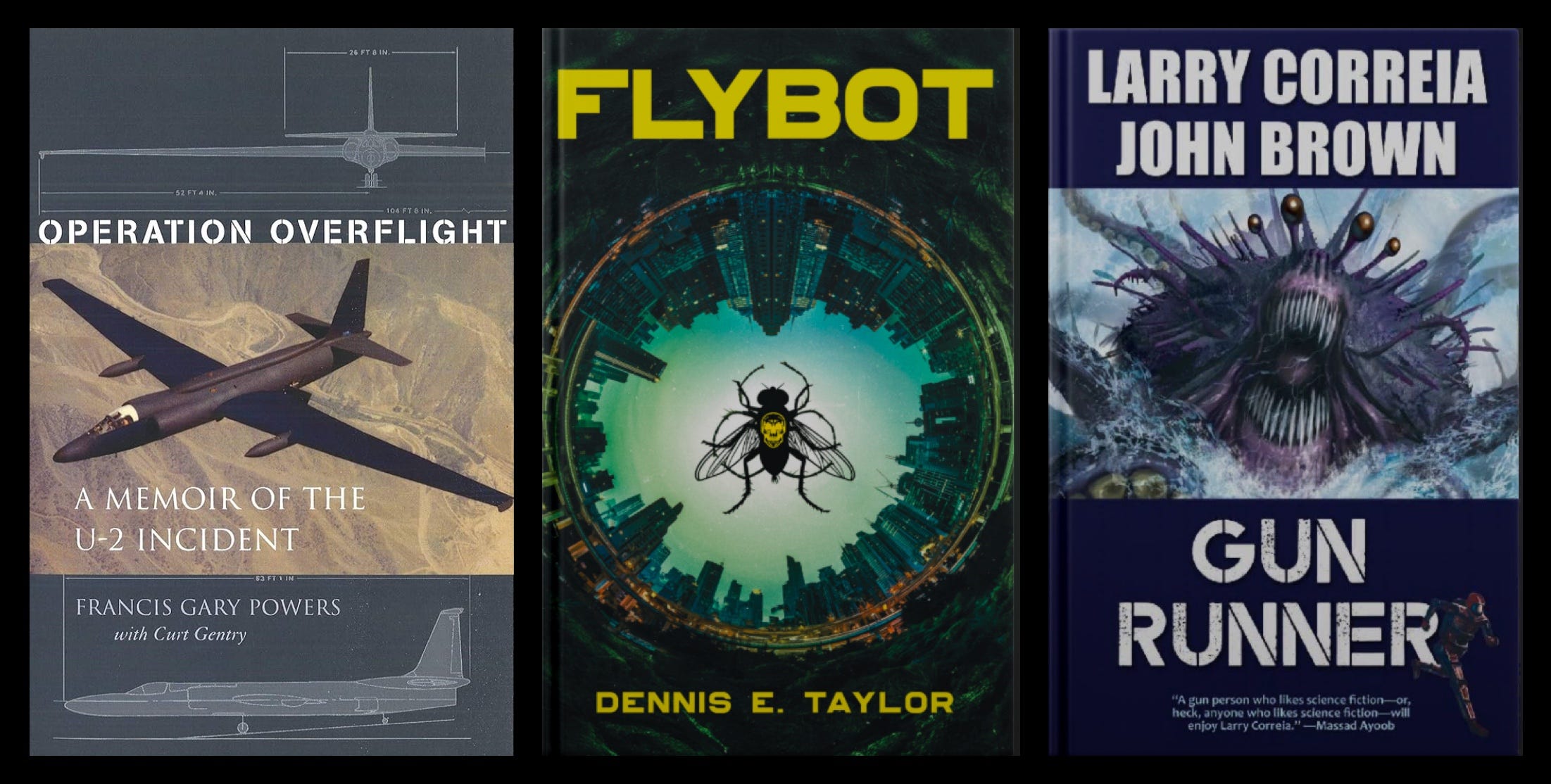
By: Francis Gary Powers and Curt Gentry
Published: 1970
384 Pages
Briefly, what is this book about?
An autobiographical account of Powers’ experiences before, during, after and around his U-2 spy plane being shot down over the Soviet Union, including his 21 months of imprisonment in a Soviet prison and his long campaign to rehabilitate his reputation upon his return to the US.
What authorial biases should I be aware of?
There was, and still is, a lot of dispute about what Powers was actually doing when he was shot down, and how he was brought down.1 It’s clear that a big part of this book is Powers trying to establish that he did everything expected of him, and went above and beyond in some cases. I found his narrative believable, but it’s clearly written from a defensive standpoint.
Who should read this book?
Cold War history buffs will enjoy it. Despite it happening a decade before I was even born, it definitely rekindled that Cold War vibe I remember from my youth. Also it’s a pretty interesting story all by itself.
Specific thoughts: An interesting “Prisoner’s Dilemma”
There’s a lot to like about this book. I found Powers to be an interesting and sympathetic narrator. Of particular interest, and evoking much sympathy, is his dilemma over how much to tell the Soviets once he’s been captured. Obviously interrogations are dramatic and tense situations by default, but Powers’ situation has additional peculiarities on top of that.
You might expect interrogation as a soldier or a spy. But soldiers expect different forms of questioning than spies. For one thing there’s no hiding that you’re a soldier, but people are generally only suspected to be spies. Powers is sort of a soldier (he was in the Air Force). He’s sort of a spy (he ultimately works for the CIA). But at the end of the day he’s technically a civilian. So when it comes to the interrogation, certain things are just obvious. He can’t pretend he’s not an American flying a super advanced spy plane over the Soviet Union. They obviously know that. In this respect he’s kind of a soldier. On the other hand there’s definitely things they don’t know and in many other ways he is acting as a spy. He definitely is in possession of some very sensitive information that the Soviets would very much like to have. Finally he has to play at being a civilian who was hired to fly a plane and push some buttons and he doesn’t know what the buttons do.
Beyond the confusion engendered by his place at the center of several different categories, he’s also handicapped in other ways. Initially he doesn’t know how much of his plane survived, and consequently what they know about the equipment and the photos. He doesn’t know how long they have been tracking U-2 flights, what they know about the overall operation, the other pilots, bases, etc. Where he’s really handicapped is he doesn’t know what the US government is going to say about him or his flight. There is no pre-coordinated cover story for him to follow along with. There’s every possibility that official government statements will contradict what he’s telling his questioners.
This last bit illustrates that the confusion over Powers’ role didn’t start with the interrogation. It’s obvious that the CIA itself never really thought through things either. It’s not that they gave zero thought to the possibility of his capture, it’s that they gave only a bare minimum of attention to that potential. As I already said there was no agreed-upon cover story. There was no discussion of what he should or shouldn’t tell them. Powers makes much of the fact that on the one occasion he did bring up being shot down and captured his CIA handler told him “You may as well tell them everything, because they’re going to get it out of you anyway.” But this was an off-hand remark, not part of some official training. He had access to a modified silver dollar which contained a poison-coated needle, but it was entirely up to him whether he took it on any given flight. This put him in a weird gray zone between hardcore spy and person making a packing list.
Understanding the biases inherent in this account, it appears that Powers did the best he could under these circumstances. He tried to be truthful about things that didn’t matter, or which he figured they already knew, and hide things that might put his fellow pilots in danger. He also tried to engage in subtextual communication with the American Government. One of the big ways he attempted to do this was through using the term “maximum altitude” and claiming that the maximum altitude was 68,000 feet. He hoped to do three things with this claim.
1- He hoped that the information would get back to the American Government who knew the actual maximum altitude was higher than that. 68,000 was wrong, but close enough to the truth that it would seem plausible to the Soviets, while also communicating to the people “back home” that he wasn’t telling them everything.2
2- But by saying he was “shot down at maximum altitude” they would also realize that the Soviets could shoot down U-2s at will and the CIA would not conduct any more overflights, thus keeping his fellow pilots safe.
3- But even if they did conduct more overflights he hoped that the Russians would take the 68,000 feet and “use it as a setting for their missiles” and thereby miss.
In the end it’s the classic story of one man trying to navigate an immense and hostile bureaucracy. Powers expected the Soviet bureaucracy to be hostile, but it’s clear that he hadn’t expected to also experience hostility from his American superiors.
By: Dennis E. Taylor
Published: 2025
430 Pages
Briefly, what is this book about?
Another Taylor book where a few scrappy nerds get thrust into the middle of world altering events. In this case it’s the emergence of an ASI (artificial superintelligence).
Who should read this book?
If you’ve liked Taylor’s other stuff (Bobiverse, Roadkill, Outland ←Links go to my reviews) then you’ll probably like this. I wouldn’t read this as your first Taylor book. I would start with We Are Legion, the first book of the Bobiverse series.
Specific thoughts: Should we expect the characters to be as smart as the readers?
Taylor’s writing is just as engaging as ever and he seems to have pulled back from some of his more extreme global warming scenarios. (See my previous reviews.) He does have a scene where Seattle is struck by a semi-apocalyptic climate event called Poosday. (it’s pretty much what you’d guess.) ChatGPT, Gemini and Claude all agreed that the most extreme consequences of Poosday couldn’t actually happen, but it was still an improvement over his past “scenarios”.
The thing that bugged me this time around was the behavior of the characters. There were a few elements where I figured out things at the same time the characters did, but there were a couple of elements where I was way ahead of the characters. This is not uncommon. If you know more than the characters you should be ahead of them. Or if you’re guessing things based on genre conventions, it’s also to be expected that you might be ahead of them. (You predict the protagonist is probably going to triumph in the end, for example.)
But none of those excuses applied here. The characters live more or less in the same world that I do, and have the same understanding of what an ASI might do that I have. So when they don’t ask the obvious questions, or when they seem blind to things that would be obvious to me (or anyone who’s thought about ASI) it does pull one out of the novel.
This is kind of a minor complaint, but I do feel like it could have been handled better without making the story unmanageable. And if handled well it could have made a good story into a great one.
By: Larry Correia and John D. Brown
Published: 2025
430 Pages
Briefly, what is this book about?
Set in a science fiction future, this is a classic tale of scoundrels with a heart of gold, who may seem like bad guys but once you peel away their gruff exterior. Though actually the story is somewhat reversed. You see the heart of gold right from the beginning, but because they are still scoundrels, some of the scoundrelly things they do end up being bad, and they have to undo the damage they’ve caused.
The story mostly revolves around Jackson Rook, a mech pilot whose piloting implants were once subverted forcing him to cause tremendous harm. This has left him haunted and in search of redemption.
Do I have any biases to declare?
My fondness for Correia is well documented in this space. But I also have a connection to Brown, exactly 36 years ago he taught me to speak Dutch in the LDS Missionary Training Center. Also he’s a friend of a friend.3
Who should read this book?
Anyone looking for a good old fashioned military scifi novel with interesting characters and some surprising twists.
Specific thoughts: An interesting assemblage of a lot of tropes
The story takes place 50 years after the development of gate technology, which allows instantaneous interstellar travel. Given that it’s only been 50 years, things are still kind of in a wild west phase, though in total 30 new planets have been colonized. The story follows the crew of the Tar Heel, the eponymous gun runners. They skirt the law to deliver weapons and contraband to those with the money to pay for them. The captain of the Tar Heel, Nicholas Holloway does have a code: he sells to people fighting the inevitable tyranny, not the tyrants themself. (As this is a Correia novel, there’s a lot of subtext about the righteousness of everyone having the guns necessary for their own defense.)
The body of the novel takes place around the planet of Swindle, a world of horrible extremes. One of those extremes is the presence of gigantic dangerous fauna. Obviously protecting oneself from these “kaiju” requires weapons which the Tar Heel is happy to supply. Unfortunately they’ve been misled by Warlord, the leader of Swindle. While there are dangerous megafauna he’s mostly using the weapons to wipe out and dispossess the original settlers and then steal their claims.
Part of the reason things are so tense is that Swindle is the best source of CX, an organic component critical for gate operation. The three major players of the galaxy (who are kind of just gestured at) currently reside in an uneasy detente. If any of them tried to claim Swindle, it would provoke war with the other two.
Pull all of this together and you have elements of Dune, Godzilla, mech-based anime, Return of the Jedi (rebels on the forest planet), Firefly, and a cyberpunk angle (through one of the secondary characters). It would be easy to screw up a book with this many elements, but I thought they did a great job of integrating them all together. They also set things up for a sequel which I will eagerly read as well.
—----------------------------------------------------------
These reviews went long enough that I considered splitting them up. Maybe I should have, but I’m getting conflicting feedback from my readership. The more I publish the more engagement I get, at least at the level of metrics, but my most vocal readers seem to prefer that reviews have a certain weight, and that otherwise I should combine them. Maybe I should conduct a survey. Or maybe I should just post my writing in whatever way I feel like. I’m leaning towards the latter but like everyone on this platform I secretly crave subscribers. Which is why I’m always telling people to do just that, though in unnecessarily convoluted ways.
Powers has always claimed he was flying at maximum altitude. But the US government thought they had him on radar descending to 30,000 feet at the time he was shot down. It’s thought that maybe they mistook a Soviet plane for Powers’ U-2.
As far as what the maximum altitude was, it depended on how much load the U-2 was carrying, the weight of the remaining fuel and stuff like that. But I get the sense it was closer to 75,000 feet.
This friend of mine describes going to lunch with Brown, Correia and one other person. Early on they discover that between the four of them they are carrying five guns, and Brown didn’t have any.
The poison needle being optional is the detail I can't get past. That's not a serious capture policy, that's a guy making a packing-list decision in the middle of a Cold War operation.
FWIW, three reviews actually DOES seem like a sweet spot! But then, I like your longer stuff, too... (Whatever you do, please just keep the snarky, meta sign-offs.)