

Things Fall Apart (The African Trilogy, #1)
By: Chinua Achebe
Published: 1958
209 Pages
Briefly, what is this book about?
The main character is Okonkwo, and saying that he’s complicated is to put it mildly. He’s desperately afraid of failure, which in his case means following in the footsteps of his father. On top of the complexity of Okonkwo there’s the additional complexity and richness of the Igbo culture: its customs, its gods, its method of delivering justice, etc.
Into this rich and (for me) strange world, the Europeans arrive. Though not till around the 2/3rd mark. The consequences are perhaps not as bad as you might fear, but they’re bad enough.
Who should read this book?
I quite enjoyed the book, and it was certainly different from my normal fare. Also it reads quickly. Finally, it’s widely regarded as a modern classic. I’m not sure I have a good reason why you wouldn’t read this book.
Specific thoughts: The flattening of colonialism
Obviously colonialism is a vast and complex topic and numerous people have spent enormous time dissecting its every nook and cranny. I am not interested in such a dissection, nor am I qualified to carry one out. This is just my take on the moral of the story, as it were.
Africans under colonialism were flattened. In many places they were flattened in the most awful way possible. (e.g. the Congo Free State under King Leopold of Belgium). But this is a book about cultural flattening. There was a marvelous diversity of cultures and traditions before the Europeans arrived. After they arrived, much less so. It’s not as if nothing was left, but certainly all of the most prominent traditions were eliminated. If we imagine culture having a topography, all the peaks were bulldozed, and all the chasms were filled by dump trucks. This book was a record of those peaks and the chasms before the flattening.
It’s not a hagiography. There are moments where you really dislike Okonkwo, but also moments where you profoundly identify with him as well. He’s a complex character, living in a complex society.
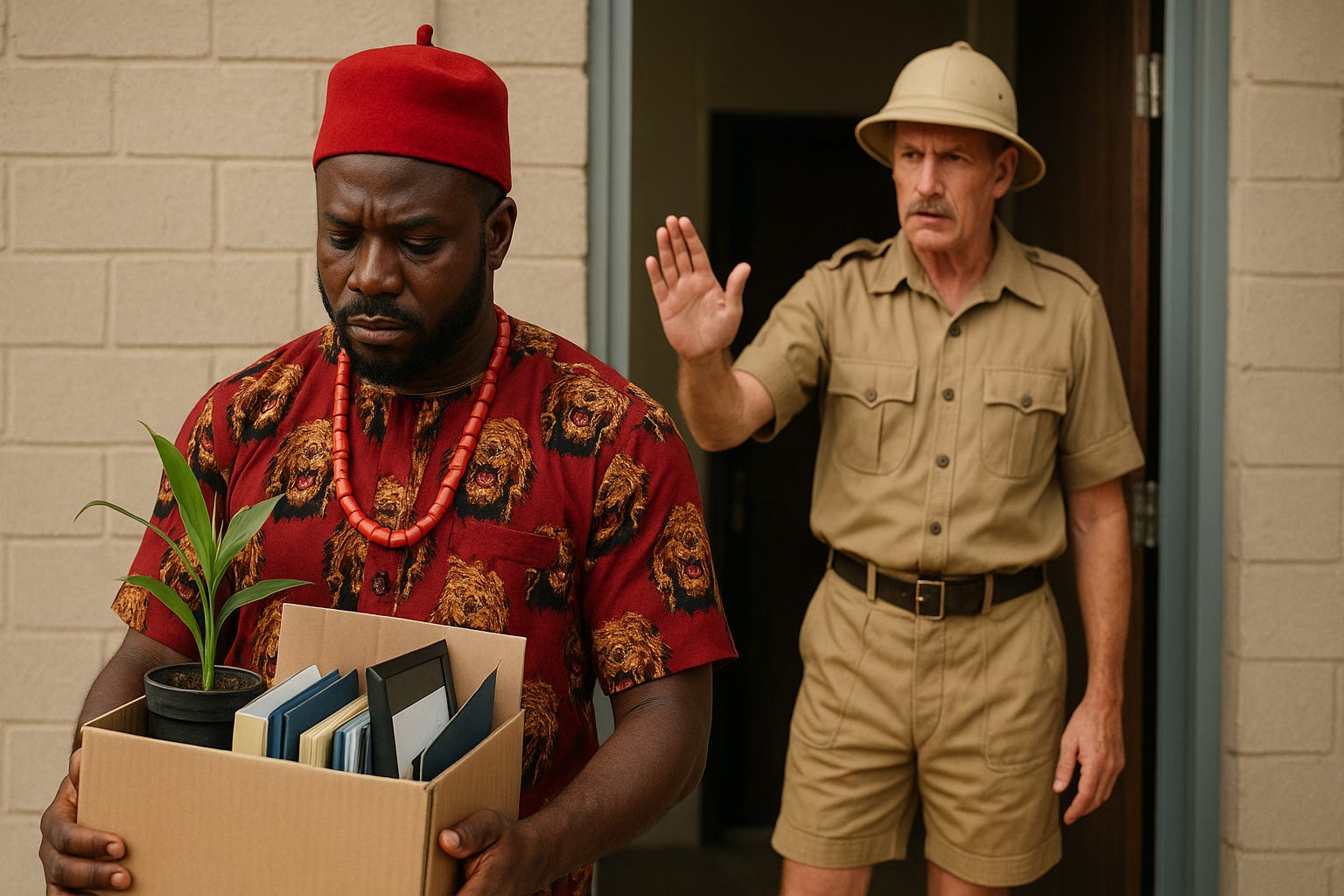
Actually, I’m not sure a bulldozer or a dump truck is the best image here. It feels more like the Igbo were given a storage unit by the Europeans, but it was only 5’ x 5’. They didn’t have to throw everything out. They could put some boxes in there, but you couldn’t store anything big. Your piano and car are not going to fit. Or maybe it’s similar to the stereotypical box people get in movies when they lose their job. You can always see a plant poking out from the top, but the whole scene is pretty pathetic.
Some books or movies are completely ruined by their endings, or entirely perfected. This book falls into the latter category. Consider the last two paragraphs of the book (slightly trimmed to avoid spoilers) and maybe you’ll finally understand what I’m trying to get at.:
The Commissioner went away, taking three or four of the soldiers with him. In the many years in which he had toiled to bring civilization to different parts of Africa he had learned a number of things… In the book which he planned to write he would stress that point. As he walked back to the court he thought about that book. Every day brought him some new material… One could almost write a whole chapter on [Okonkwo]. Perhaps not a whole chapter but a reasonable paragraph, at any rate. There was so much else to include, and one must be firm in cutting out details. He had already chosen the title of the book, after much thought:
The Pacification of the Primitive Tribes of the Lower Niger.
That one phrase… “but a reasonable paragraph, at any rate.” Somehow that encapsulates the entire flattening process. You can just imagine a functionary doing just that. Taking everything I had just read, all the years of Okonkwo’s life, with its struggles, setbacks, and triumphs and reducing it to a “reasonable paragraph”.
I guess over a long enough time horizon, most of us would be lucky to get a “reasonable paragraph”. But we should all hope to feature in a book as interesting as Things Fall Apart.
It’s hard to tell if our own culture is being flattened into a global monoculture. Or if the existence of tiny internet microcultures is creating millions of needle thin peaks, and an equal number of bottomless pits. Either way, one gets the sense that things are, once again, falling apart. Only perhaps on a much larger scale. Colonialism may not be a particular speciality of mine, but things falling apart is. And if that interests you, I think you’ll want to stick around. Maybe even dive into the archives, because things have been falling apart for awhile.
>That one phrase… “but a reasonable paragraph, at any rate.” Somehow that encapsulates the entire flattening process. You can just imagine a functionary doing just that. Taking everything I had just read, all the years of Okonkwo’s life, with its struggles, setbacks, and triumphs and reducing it to a “reasonable paragraph”.
Yeah, I agree this is a good line, that subtlety takes down the imperialist mindset a peg.
I wonder if it was inspiration or convergent evolution when a writer in an entirely different genre reiterated it in farce as "Earth: Mostly Harmless"
> If we imagine culture having a topography, all the peaks were bulldozed, and all the chasms were filled by dump trucks.
> It feels more like the Igbo were given a storage unit by the Europeans, but it was only 5’ x 5’. They didn’t have to throw everything out. They could put some boxes in there, but you couldn’t store anything big.
I really like these analogies.