

By: Bernard Cornwell
Published: 1996
431 Pages
Published: 1998
397 Pages
Published: 1999
436 Pages
Briefly, what is this series about?
The Arthurian Legends turned into historical fiction. All the tales are related retrospectively by Derfel, a Saxon boy raised by Merlin who eventually becomes Arthur’s right hand man.
Who should read this series?
If you’ve read anything by Cornwell, but haven’t read this, you should. Not only is this Cornwell’s personal favorite of his series, it’s only three books, unlike the Sharpe series which is apparently up to 24 books?!? Even if you don’t know who Cornwell is, if you like historical fiction at all this is a great series.
Specific thoughts: A realistic Arthur
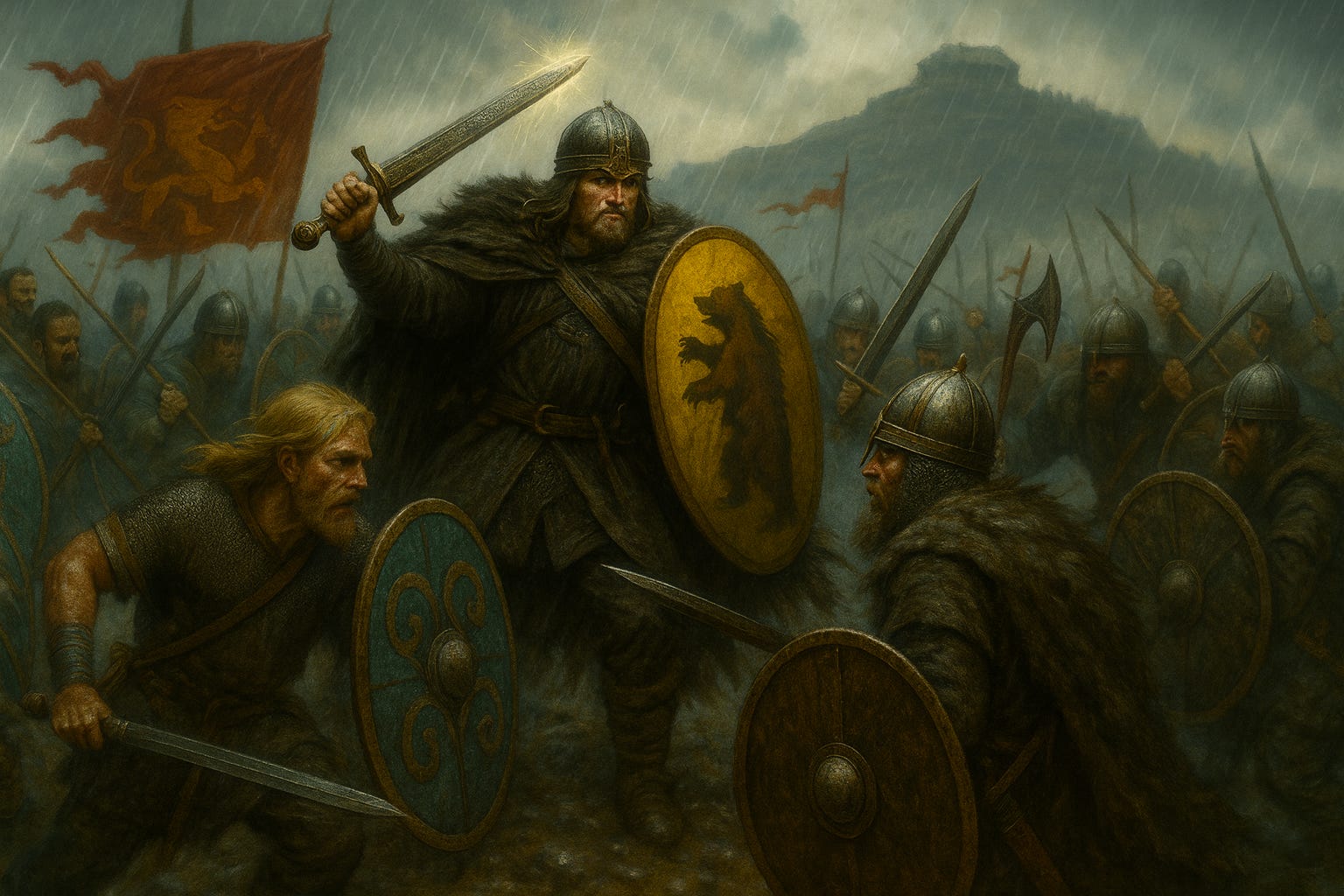
Most stories about King Arthur lean into chivalry and magic—knights in shining armor, fighting other, similarly armored knights while also grappling with sorcery and enchantment. This series is different. To begin with Arthur isn’t even king, he’s a warlord sworn to protect the child-king Modred.
There are a few instances of shining armor in this series, but there’s an awful lot more blood and guts. Nor are there any true castles, or jousting. Instead we have hill forts, ruins left by the Romans, and ancient sites of power.
So yes, magic also makes an appearance in the series, mostly centered around Merlin, but it’s Druidic magic, and it’s not particularly flashy. Certainly Cornwell leaves no doubt that it’s magic, but it’s subtle enough that you entirely understand why some characters in the series doubt the extent of Merlin’s power, or whether he has any power at all.
Chief among the doubters are the various Christian characters in the story, and the conflict between the Christians and the pagans represents a major driver of events. Arthur is not a Christian (in this version) and he has to spend a lot of time negotiating between the two factions. As a matter of fact he has to spend a lot of time negotiating period. Much of the book is taken up by Arthur attempting to get this or that king to join him in confronting the invading Saxons. Even more of the book is taken up with fighting amongst the various British kings, which Arthur has to resolve before he can even think about fighting the Saxons.
It may be that in emphasizing its realism that I have made you less eager to read it. Don’t be. Not only does the realism enhance the story, but it also gives Cornwell great opportunities to demonstrate how something entirely mundane could nevertheless provide the basis for the later, embellished legends.
Beyond all this, I can promise you, if you read these books, you’ll never again feel the same way about Lancelot…
I kind of wish that Cornwell had written a few less Sharpe books and a few more Arthur books. But then again I assume that there are many people who wish I would write a few less of X and a few more of Y. So I probably shouldn’t complain, and yet I continue to do so, day after day, in this very space. So maybe complaining is what you’re here for. If so, consider subscribing, or searching the archives. I think you’ll find significant grumbling regardless of where you look.