

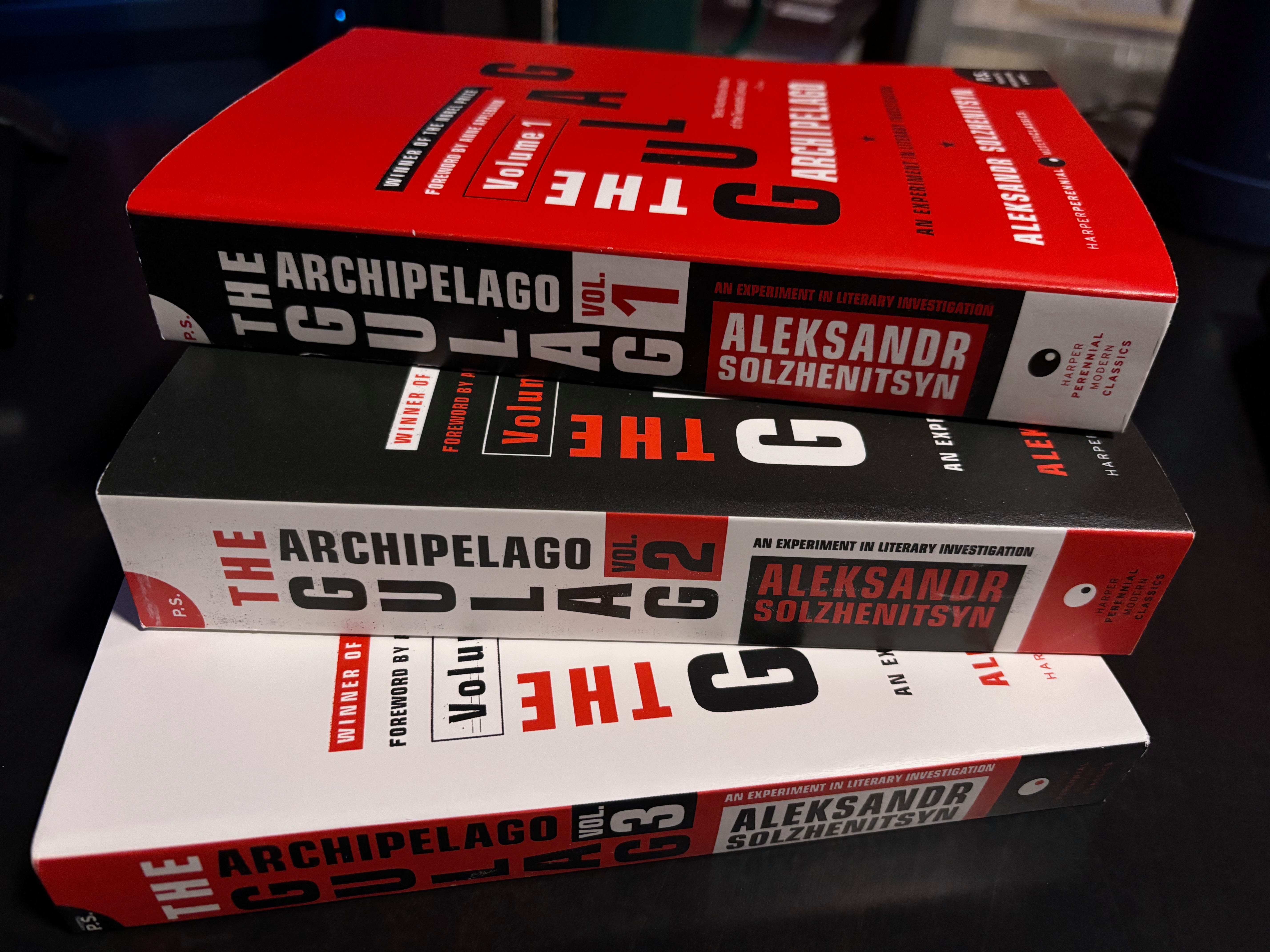
The Gulag Archipelago [Volume 3]: An Experiment in Literary Investigation (1918-1956)
Published: 1973
608 Pages
Briefly, what is this book about?
The final piece of Solzhenitsyn’s amazing, depressing, baffling, chilling, frightening, absurd, terrible, cold, weighty chronicle of the Soviet gulags. This part includes the period after his release which, by itself, could be a fantastic guide to simple contentment.
What's the author's angle?
I found it interesting how much of this book concerned just preserving the notes he’s made and all of the material which will eventually be turned into the book—the angle of making sure the story gets told.
Who should read this book?
I have not talked about the fact that there are actually two versions of the Gulag, this three volume behemoth, and an authorized abridgement. Here, at the end, it’s worth considering whether I would recommend this three volume set, or the abridgement. I haven’t read the abridgement, so I’m not in the ideal position to answer, but given that most people have only read the abridgement, getting the perspective of someone who’s read all three volumes should be a contrast.
I’m glad I read the full three volume set first. Should I go back and read the abridged version (I plan to, but I plan to do a lot of things) it will be interesting to see what was deemed critical, and what was cut. But also there’s a weight to the gulags, a massiveness, an ominous ponderousness which comes through best in the stories, upon stories, upon stories you get in the full set.
Specific thoughts: Cloaking power in ideology
Quite frequently Solzhenitsyn would compare the punishments and conditions of the gulags with the punishments and conditions of Tsarist prisons. Invariably he will conclude that, in this area, the Tsars were kinder than Stalin. Why was that? My reading is that the communists cloaked their power in ideology, which allowed them to deflect guilt and ignore accusations of cruelty. They weren’t doing things just because they were more powerful and therefore could, they were doing things in pursuit of some greater good.
(Which is not to say the Tsars didn’t have any ideology, but communist ideology is far more totalizing.)
This method of cloaking power in a grand ideology continues to be seen even today. It’s not anywhere close to being as bad as the gulags, but it’s still taking place. This brings up a few questions. Questions I don’t have the answer to, but I’ll toss them out here nevertheless.
Is cloaking power with a comprehensive ideology a modern phenomenon? Did it exist before the Enlightenment?
Is Trump a throwback to an earlier era where leaders didn't cloak power with ideology? Or in any case does he do less cloaking than his opponents?
Could this be part of his appeal? Have people just had enough of, “We know you don’t like what we’re doing, but trust us, it’s for your own good…”?
Writing a review of a massively important book like The Gulag Archipelago, and putting that review in essentially the same space as reviews of pulpy fiction (say Dungeon Crawler Carl) is kind of embarrassing. Particularly if the review of the pulpy fiction is longer…