

By: Werner Herzog
Published: 2025
128 Pages
Briefly, what is this book about?
Legendary badass, and sometimes filmmaker Werner Herzog weighs in on the concept of truth, how best to represent truth, and what’s happening to it. Drawing on his own experiences he distinguishes between dry, factual truth, and what he calls ecstatic truth, a deeper kind of truth revealed by art.
Who should read this book?
I don’t think anyone should literally read this book. It’s best consumed as an audiobook with Herzog’s strangely compelling narration carrying you along. With a voice like Herzog’s and clocking in at only 3.5 hours of audio, it almost doesn’t matter what it’s about.
What does the book have to say about the future?
To begin with, a focus on the future is right in the title. And while Herzog is deeply concerned about the numerous ways technology can distort the truth, he’s not a reflexive Luddite. Here’s what he had to say about AI poetry
A few months ago, three young writers, Brent Katz, Josh Morgenthau, and Simon Rich dropped in on me. With help from a computer specialist, they had assigned an early version of ChatGPT, code-davinci-002, the task of writing some poems. The robot had no particular conditions to fulfill, but wrote its poems to please itself. The authors were convinced that with my voice and my peculiar accent I should read their collection, called I Am Code, for the audiobook version. I duly did—in full knowledge of the circumstances of their composition. Some of the poems are better than almost everything I’ve read in terms of poetry in the last twenty or thirty years.
That may be more of a comment on contemporary poetry than the brilliance of AI, but it’s another illustration of how complicated the problem is. Battle lines are hard to draw. Locating the truth has never been easy, nor will it get ea
sier. The book’s closing line alludes to this point.
Truth has no future, but truth has no past either.
But we will not, must not, cannot, give up the search for it.
Specific thoughts: Truth vs. facts
Back in 2020 I did a deep dive into the Anti-Defamation League’s (ADL) reports on right-wing violence. Many people claimed that right-wing violence was more worrisome than left-wing violence, oftentimes on the basis of those ADL numbers. I wanted to understand their numbers better, thus the deep dive. In the end I came to the conclusion that the ADL was involved in some significant cherry picking, but more consequentially the exercise left me in a profound epistemic crisis. Before my investigation I was sure that if I spent the time and dug deep enough I could get “The Answer”. Instead my efforts had revealed to me all of the ways that facts could be distorted, timelines massaged, details twisted, and events cherry picked. I was reminded of that exercise while reading this book. Particularly Herzog’s insistence that facts are not the path to truth.
All my life, my work has been involved with the central issue of truth. I have always vigorously opposed the foolish belief that equates truth with facts. It is for that reason that I took on the representatives of the so-called cinema vérité, who seek to claim for themselves the concept of truth, “vérité,” by means of facts. This school of documentary filmmaking is an antiquated form of cinema that offers no profound insights. Cinema vérité, I have said, offers you the accountant’s truth.
I love the phrase “accountant’s truth”. That’s a fair representation of what I was trying to do with the ADL’s numbers. The whole thing started with a claim about how many police officers had been killed by each “side”. On some level I thought it would be a simple matter of looking at each killing and deciding whether it really belonged in one column or the other. (Or perhaps neither.) I knew in advance that there would be a lot to wade through to get to that point, but I assumed I would reach some sort of foundational truth based on the actual numbers. Instead it eventually became clear that there was no “foundation” to “reach”. Instead, the experience led me to largely give up on the whole idea of doing deep dives except perhaps as a way of deconstructing a narrative.
Narrative construction is always the more important effort, and that’s where we get into Herzog’s idea of “ecstatic truth”. I can’t entirely do justice to the idea in a short review, so instead I offer this example from the book:
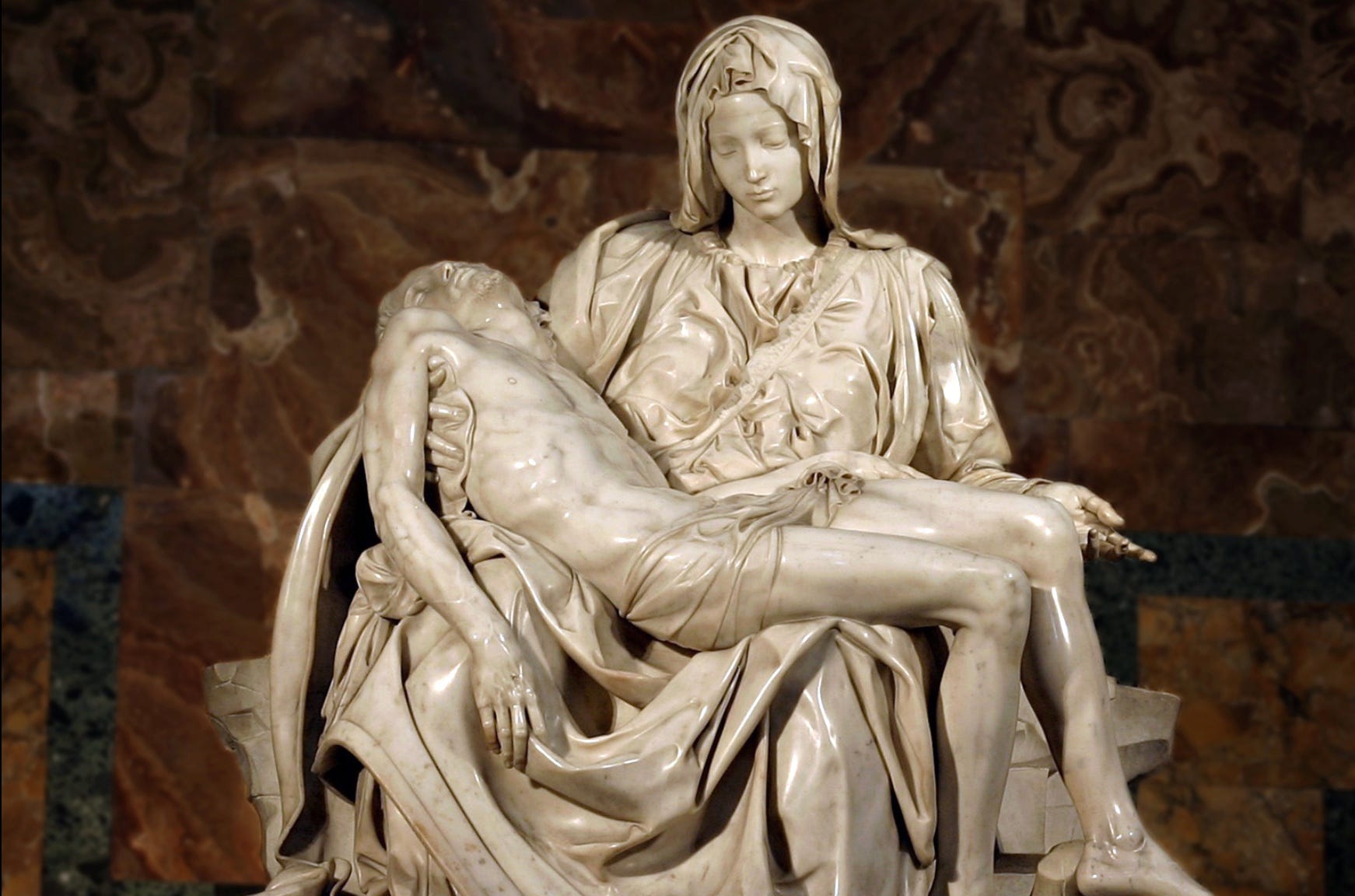
[T]he most instantly comprehensible witness is Michelangelo, in particular his 1499 statue of the Pietà in St. Peter’s in Rome. This Pietà is probably the loveliest there is. But Michelangelo meddled with the facts. He wanted to create an image for the heart, not something realistic… In Michelangelo, the body of Jesus is not proportionate, but that’s more to do with the perspective of the onlooker. But what makes the sculpture so radical is the fact that he depicts Jesus—correctly—as a thirty-three-year-old man, while the Virgin Mary, his mother, to judge by her face is no more than fifteen. I put it to you: Did Michelangelo intend to deceive us, is he offering us fake news, is his sculpture a lie? Of course not. What Michelangelo has done is to show us the essence of the two figures, the man of sorrows just taken down from the cross, and the virgin, his mother.
The Pietà is not a collection of facts, it’s a collection of falsehoods. It could never have happened, and even if it had, the proportions are wrong. And yet for all that it’s unquestionably beautiful. Is it as Keats said? Is beauty truth? Herzog thinks that it is, and that this kind of truth is more important than the truth derived from data, numbers and facts. On this point I’m very much in agreement.
I’m posting this the day before Thanksgiving. I have a lot to be thankful for. It would be customary in this space to thank my readers. And sure, you guys are okay, but are you going to take care of me when I’m old and incontinent? I don’t think so! That’s my children, so I better make sure that I thank them. That’s really where my efforts have to be focused. But until I’m old an incontinent I will continue to post here, and if you continue to read it I’ll be grateful. Not as grateful as I am for my kids, but I don’t think you actually want the responsibility of that level of gratitude.
It's an interesting review and a valuable meditation to begin in this age of fakery, but I'm struck by the tangent on the Pieta.
I don't fault Michelangelo for his artistic choices.
But I wonder if it would really be lesser to depict Mary as a fifty year old woman, as she approximately was?
Men, and heck, women, find youthfulness more beautiful, certainly so in women. Even likely in 1500 AD. But is imaging Mary as the perpetual youth any more honest to her than imaging Christ as the perpetual infant? Is it fair to gloss over the lines age surely etched in her visage?
It seems disordered to not prefer markers of youth and fertility---when selecting a mate. But while the virginal Mary said yes to God, it was the matronly Mary who did the harder thing of living that yes, carrying social shame and infinite responsibility as she searched for a missing adolescent messiah, for example. Is there more truth in forgetting this, for the sake of a smooth marble face?
(and of course, as a middle aged married man, it's not an academic question)