

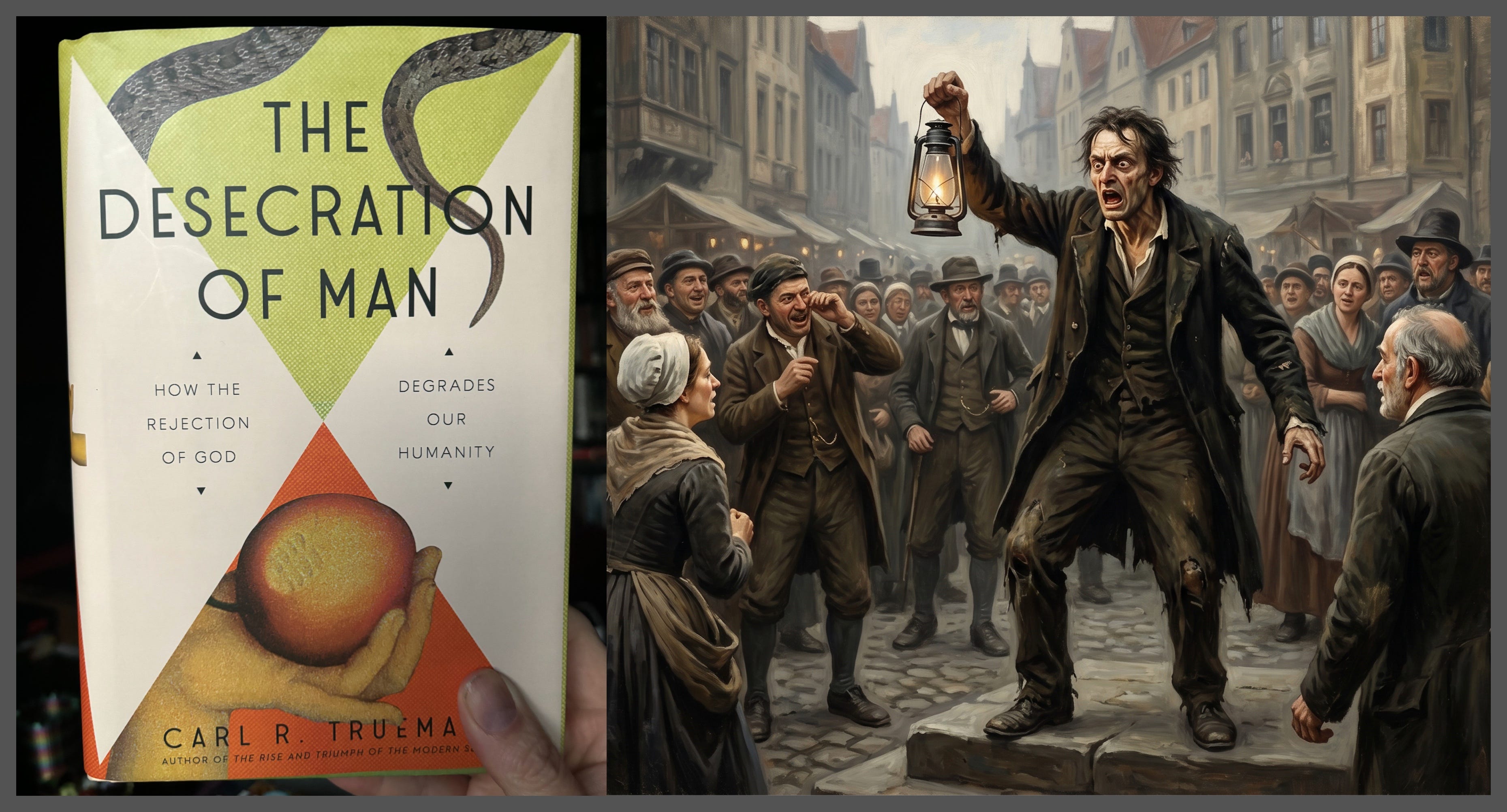
The Desecration of Man: How the Rejection of God Degrades Our Humanity
By: Carl R. Trueman
Published: 2026
256 Pages
Briefly, what is this book about?
In the standard story of the transition from the premodern to the modern, the world has gradually been disenchanted. Depending on who you are, this is either a good thing, a sad thing, or a mixed thing.
Trueman’s contention is that disenchantment has, over the last few decades, transitioned to desecration. In his telling, the modern world hasn’t just outgrown the sacred, it’s rebelled against it. Much like a headstrong teenager might revel in doing the opposite of what his parents expect, society has come to celebrate the transgression of things that were previously deemed to be holy.
These transgressions are not only a source of rebellious pleasure, but more critically, they provide a way to make the person feel superior to the divine. Violating rules and norms allows one to feel above them.
Why is this important? Because (pulling in Nietzsche) having rejected God, men now need to become gods, and this is one way to do it. But these transgressions, rather than elevating men, debase them. We see this debasement in everything from the sexual revolution down through assisted suicide and IVF. In the end Trueman claims one can either accept Christianity root-and-branch or engage in full-on Nietzschean self-creation, but that there is no middle ground, no cultural Christianity, no stable progressive moral creation. It is either one extreme or the other.
What authorial biases should I be aware of?
Trueman is, himself, a root-and-branch Christian, so he definitely favors one side over the other.
Who should read this book?
Like most books, this will appeal to those who already believe what Trueman claims. I would count myself among that group with some fairly significant caveats. (See below.)
I think it could also be a book for people who wonder whether we can eat our cake and have it. Whether we can maintain the morality and culture of Christianity without needing an entire society of true believers.
What does the book have to say about the future?
There has been a widely discussed return to religion. Trueman reads this as hopeful, but insufficient. There have been modern religious revivals before (see the postwar revival), but Trueman argues that the new revival will peter out in the same way as the old one unless it develops far deeper roots—a faith sufficient to abandon the rampant desecration of the current age.
Specific Thoughts: There might be some value in the messy middle
This book is built around one of the greatest passages ever composed by the hand of man, in this case Nietzsche:
God is dead. God remains dead. And we have killed him. How shall we comfort ourselves, the murderers of all murderers? What was holiest and mightiest of all that the world has yet owned has bled to death under our knives: who will wipe this blood off us? What water is there for us to clean ourselves? What festivals of atonement, what sacred games shall we have to invent? Is not the greatness of this deed too great for us? Must we ourselves not become gods simply to appear worthy of it?
This passage is from his book The Gay Science, and is uttered by the Madman to an uncomprehending crowd. Though, when he sees their confusion, the Madman realizes he is too early. It will take a while before the full magnitude of the crime is felt by humanity. Trueman argues that we have finally arrived at that time. And we must either have faith that God is alive, or we must become the gods from the Madman’s rant.
Certain people (Trueman singles out transhumanists) imagine that we can do just that. They’ll take that deal, so to speak. However, there are a couple of problems with this endeavor. First, it comes with no default morality, and in fact the very endeavor implies that a new morality will be created through their efforts. Secondly, the path to godhood is enabled by technology, and in this technological transition, humanity acts more as “raw material” than “virgin forest that should be left alone”. In both cases we end up with a process that looks more like desecration than deification.
I think his description of the overall trend is accurate, and I would even agree that over the long run there really are only two choices, but I think the “long run” is a longer and slower “run” than he imagines. Certainly he agrees that the “Madman was early”, but rather than imagining a long drawn-out process Trueman suggests that once the time arrives it will be relatively sudden and civilizationally devastating. On the other hand, I think it has been gradual and that it will continue to be gradual, though I’ll allow that it might be speeding up. To adapt Adam Smith: “There is a great deal of ruin in humanity.”
Allow me to illustrate my point with two examples:
Trueman is alarmed by a great many things, as am I. But his dichotomous viewpoint means that he tends towards absolutism—there is no safe middle ground. As a result, no quarter can be given with prohibitions against extramarital sex, abortion, or… IVF.
Let’s talk about IVF, because I think it provides the clearest example of overreach. To state the issue succinctly, religion is not a suicide pact. Fertility is a gigantic problem, and that problem is not merely the result of a lack of righteousness. I know many very good people who struggle with fertility issues. The cause of these widespread issues is hotly debated, but, to adopt Trueman’s framing, it appears that they’re the result of societal and environmental desecrations. I assume he would respond, “You don’t solve one desecration with another.” However, I don’t think that’s the right way to frame it. Unless you really do want religion to be a suicide pact, you’re going to have to make uncomfortable trade-offs. In this case you need to trade off the artificiality of IVF versus the profound benefits of children. Trueman’s position on IVF would lead one to believe that he doesn’t think it’s appropriate to bargain in this fashion.
My second example relates to the vast territory between absolute Christianity on the one end, and attempted Nietzschean godhood on the other. I think Trueman cedes this territory too easily. Moreover, it’s worth looking at how we survived for so long in the area between the two extremes. When Nietzsche refers to the death of God, we can substitute “unifying civilizational ideology” for “God” and still end up with essentially the same warning. As in the real crime is not killing a specific conception of deity, but rather murdering the unifying force represented by God.
This unifying force can take many forms, and for a long time, in the United States at least, it took the form of a civic religion of patriotism and American exceptionalism. To be fair, whether you’re talking about an unbending divine morality or American civic religion, they both appear to be fatally wounded. But if the really consequential death was the death of civic religion, then it happened more recently than 1882, when Nietzsche originally penned his warning. I still think he’s correct that anything other than absolute belief in an omniscient lodestar will eventually degrade into self-creation. But if that degradation passes through various semi-stable intermediate stages, that might imply that we have more time than he asserts. Also that it might be easier to maintain the current level (civic religion) than to demand complete religious surrender or total Nietzschean self-creation.
I’ve long maintained that civilizations must cohere around a religion. But I’m not entirely convinced that it has to be exactly as strict as Trueman claims.
—----------------------------------------------------------------
I really need to read more Nietzsche. One would think that with all the pulpy fiction I read that it would be a simple matter to cut that by 20% and fit in some quality books. Obviously part of the issue is the ease of reading one versus the other. Still it’s not like we’re talking about Hegel… I resolve to do better, and if you want to be around to call me, a year from now, when I still haven’t read any Nietzsche, consider subscribing.
Would highly recommend reading Nietzsche chronologically. Seeing where his thought grows and where it declines is important to being able to take what’s good from the man as he is an embodiment of philosophical paradoxes.
God/Religion might be the thing that humanity crystallizes around, but it will not be the cause of the crystallization. It will take an imminent existential trauma before we can ever share a unifying ideology again.