

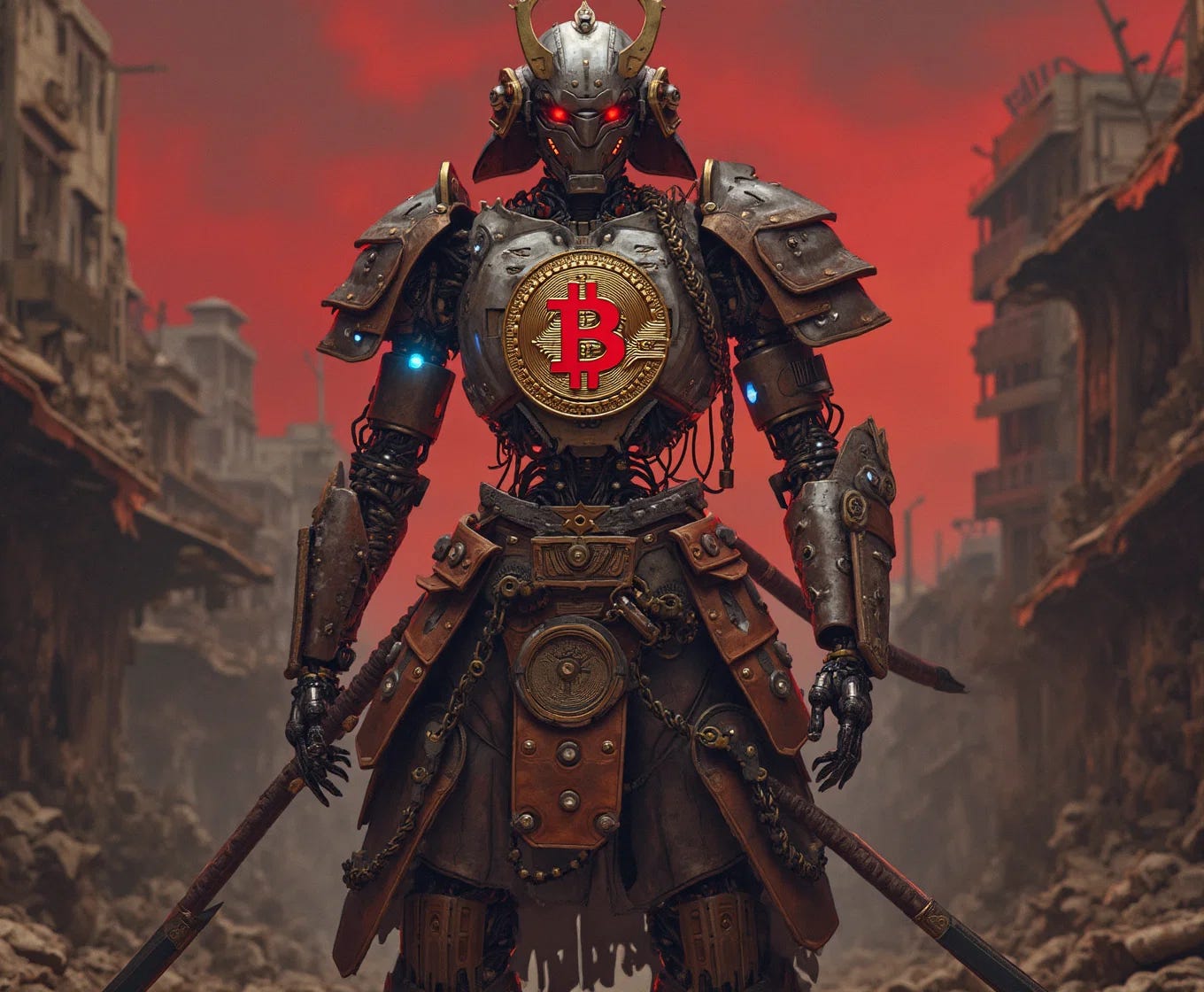
Published: 2024
529 Pages
Briefly, what is this book about?
Bitcoin will be the thing that saves the world from the fiat money created, debt fueled dystopia we’re already descending into. As part of this salvation it will require people to adopt ancient (though also somewhat apocryphal) warrior virtues. Specifically: righteousness, courage, compassion, honor, honesty, responsibility, excellence, respect, duty, and restraint.
What’s the author’s angle?
As you may have already gathered, Svetski is a Bitcoin hyper-maximalist. Bitcoin isn’t just our financial salvation, it’s our spiritual salvation as well.
Who should read this book?
As a “return to virtue” tome it was pretty good, though long-winded, and a retread of books I’d already read. (Like Ryan Holiday’s stoic stuff, if you’re familiar with that.) On top of that it adds quite a bit of culture war stuff, which annoyed many of the reviewers on Goodreads and Amazon. It feels like a book without a natural audience. It’s strident enough that you would already have to be convinced to enjoy it, but if you’re already convinced then you probably know everything Svetski is going to say.
What does the book have to say about the future?
The book lays out two paths, we can double-down on the fiat-future which, at best, leads to dependence, and at worst disaster. Or we can adopt the more muscular, responsible, and sovereign path of Bitcoin. As usual with such books it skips over the messy middle.
Specific thoughts: We need a new civic religion, but I’m not sure this is it
I heard about this book on Substack. Presumably Postcards From Barsoom since the book was edited by John Carter, the author of that newsletter.
I bought it because I thought the title was intriguing. Unfortunately the book did not live up to the promise of the title. I expected something interesting and novel, something that was almost science fiction in its scope. An unexpected alchemy of samurai ethics and blockchain technology. Instead what I got was a fairly middle of the road virtue ethics book with some bitcoin observations tacked on.
Now don’t get me wrong, I’m a fan of virtue ethics. And the book’s biggest failing on that front was not the subject matter, but the length. As an example Svetski spent 15 pages on courage. I think we all pretty much know what courage looks like. It doesn’t need 15 pages of explanation. Which means that when you do spend 15 pages on it, it gets pretty repetitive. Plus it’s all stuff I’ve read elsewhere. On the other hand, I imagined all sorts of things someone might say about Bitcoin which I had never heard. But whereas Svetski spent 15 pages on courage, he only spent two pages on how Bitcoin might increase courage. And it amounted to “Bitcoin is new, therefore it takes courage to buy it.”
This brings us to the central failing of the book. I agree that there is a hole where our civic religion used to be. I agree that something needs to fill that hole. I’m willing to consider that something new might come along and fill that hole. I was skeptical that that something would be Bitcoin, but I was willing to go along for the ride. After reading the book it’s clear that Svetski envisions Bushido and chivalric ethics filling the hole, with Bitcoin as a supporting player. In other words his contention is not that something new will fill the hole, but rather that something old will.
If Svetski was proposing something new then any doubts should be tempered by optimistic imaginations. But if Svetski is proposing returning to something old, “optimistic imagination” should be replaced by historical scholarship. And on that front there’s not as much to “return to” as Svetski suggests. Bushido and chivalric codes are at least 50% myth. And even if you include the myth the actual practical recommendations are pretty light. They are not actual religions, civic or otherwise, but rather separate idealized warrior codes. Which is to say plugging the hole with Christianity is one thing, plugging it with chivalry would be quite another. You may have numerous objections to Christianity, particularly as a basis for a national revival. But you have to admit it’s at least the right size to fill the hole. Chivalry on the other hand would leak, a lot.
I’m probably being too hard on the book. At its core it offered some advice that a lot of people need to hear. And I join it in being terrified at the debt edifice we’ve managed to construct. In the final analysis, I agreed with most of the book’s points, and it presents an interesting take on the relationship between virtue and Bitcoin, but it fell far short of the radical reimagining of the future I had hoped for.
I do own some Bitcoin, though less than I would like. The point at which Bitcoin was cheap, was also the point when I was being sued. I still managed to pick some up, but I don’t recall it granting me any additional Bushido, but perhaps I didn’t buy enough. I suspect the window for that has passed. Certainly blogging is not going to bring it any closer. Perhaps if I stopped blogging and spent all my time as a cryptobro… Nah, I think I’m too far into the blogging thing, plus if I was going to be a cryptobro I’d have to get new clothes, new friends, and grow a mustache.
From the review of this book it sounds like the author is somewhat charmingly childish. He got his first taste of Samurai literature and now wants to relate everything to it and his other hobbyhorse, Bitcoin.
I suspect, however, the author is not very charming either in person or on the page. BTC obsessives have this semi-religious fixation on it but like many their fixation seems antithetical to actual deep thinking.
I must admit I have a hard time reading "Bitcoin" without thinking "scam".
Though i really ought to have bought some when it was 5 cents, lol.