

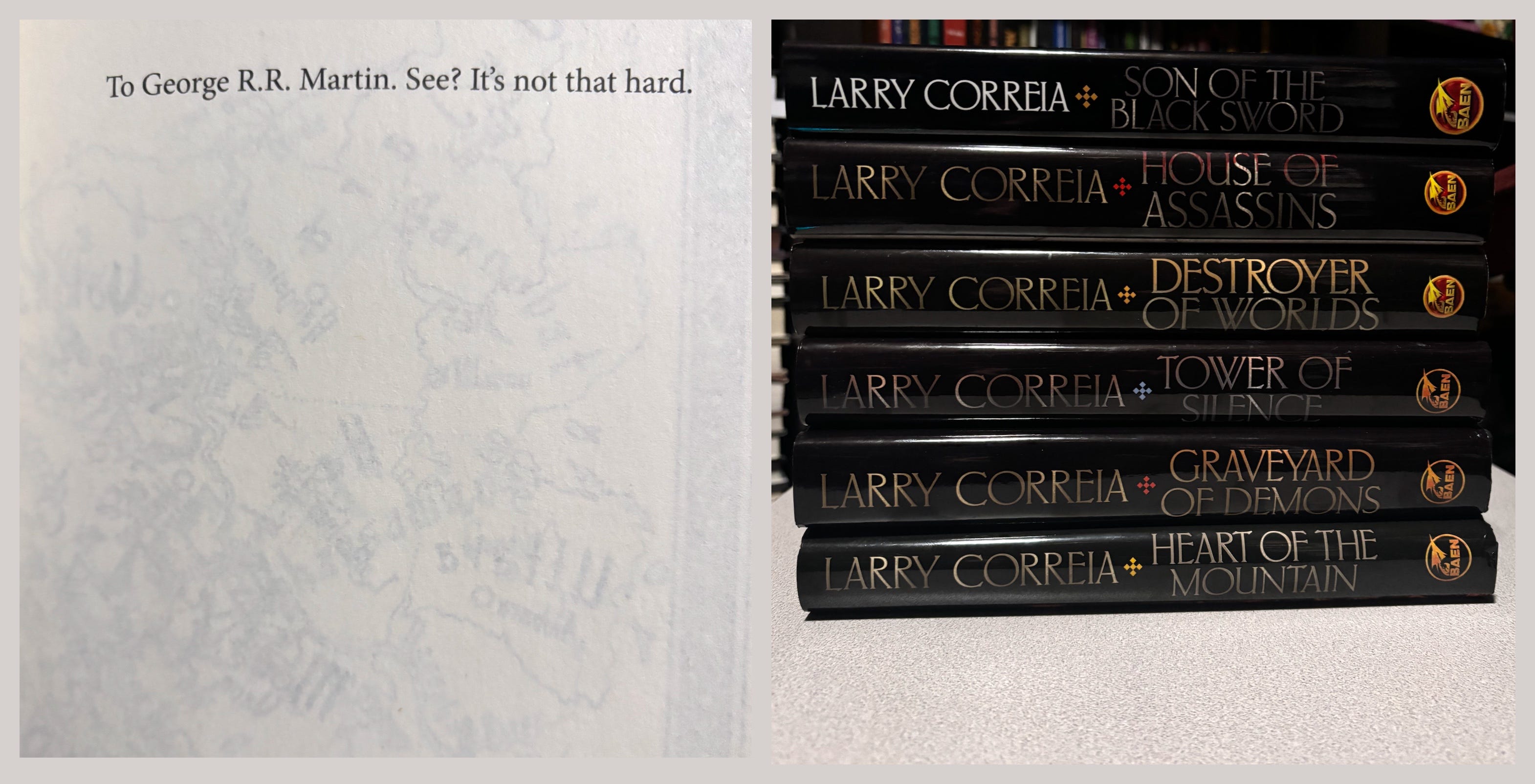
By: Larry Correia
Published: 2015
412 Pages
Published: 2019
408 Pages
Published: 2020
407 Pages
Published: 2023
391 Pages
Published: 2024
406 Pages
Published: 2025
337 Pages
Briefly, what is this series about?
The series is set on the continent of Lok, in a world inspired by feudal India and Southeast Asia, meaning that there are castes, and outside of that, the casteless, who are literal non-people. The story follows Ashok Vadal, a pitiless “Protector of the Law”. The Order of the Protectors is like a branch of elite special forces, called in when the normal constabulary, or even the normal military is insufficient. Even among these elite warriors Ashok stands out as being particularly deadly because he bears one of the world’s twelve sentient magical swords.
Much of the law concerns the status of the first caste and the casteless’ lack of status. But it also forbids religion, illegal magic, and demons leaving the sea. The ocean is full of demons, and they don’t have much regard for the law, so Ashok spends much of his time killing them.
Given that the ocean is the exclusive domain of the demons, all status consists in living far away from it, and all insults reference the ocean in some way. “Saltwater!” Or calling someone a “Fisheater.”
Who should read this series?
Much of my discussion below will concern this very question, but as a tl;dr you should definitely like it if you like Correia’s other stuff. Also if you like fast moving action heavy fantasy series that are done, I would also recommend it.
Specific thoughts: How this fantasy series compares to other fantasy series
As I was working on this review one of my friends sent me a link to the trailer for the latest Jason Statham movie (Shelter). And while I hadn’t made this connection before, as I watched the trailer it suddenly all clicked. This series is the fantasy equivalent of a Jason Statham movie. One of the first lines from the trailer, “Mason isn’t just an assassin, he’s a precision instrument.” Now compare this with a line from early in the first book: “Black-hearted Ashok, the finest killer who has ever lived.” Which is to say if this sort of language is going to annoy you then you probably shouldn’t read this book. On the other hand if it’s exactly the kind of thing you enjoy then have I got a series for you.
Before I go any deeper, if I stop to consider my taste in books, it’s clear that I have an insatiable appetite for Correia books. I will try to separate out an objective appraisal of the book from my unobjective tastes, but I doubt I’ll entirely, or even mostly succeed.
Moving on, as you might have gathered from what I’ve already said. Ashok starts the book as probably the best swordsman in the world. This is not a bildungsroman about the peasant boy gradually becoming a master swordsman, Ashok starts the book as a master swordsman. (There are some flashbacks, so you get glimpses of how he got to be where he is, but it’s not the primary narrative.) For me that sort of thing is a positive. It’s nice to read something where the protagonist is always exceptionally competent, and you just get to revel in that competence.
This is not to say that Ashok doesn’t experience setbacks. He experiences a lot of them. Nor is it meant to imply that there’s no character growth. Ashok has one of the more interesting arcs I’ve encountered. It requires a certain suspension of disbelief, but what doesn’t? And it’s not just Ashok. I thought all of the characters were very well done. In particular I quite enjoyed the villain, he was just the sort of villain you might expect in a Statham movie (or for that matter a Guy Ritchie movie.)
As you probably already saw in the image at the top, Correia dedicated the last book in the series to George R. R. Martin, so it’s obviously fair game to wonder how it compares to A Song of Ice and Fire (ASOIAF). Well as Correia himself points out, it has one big advantage: It’s done! Which is actually kind of a big deal these days. That said it is not as “thick” as Martin’s (uncompleted) series. ASOIAF actually feels like it could be a real world, mostly because of the number of characters and locations. This is not the case with Saga of the Forgotten Warrior. But neither is it the case for nearly any other series I’ve read. Brandon Sanderson has at least a dozen books in his Cosmere series and it still kind of feels like the chronicle of a large high school. (And even Tolkien, may I be forgiven, falls pray to this.) So yes, Martin pulled off an amazing world with lots of characters, but the number of characters is also why he’s never going to finish it.
Speaking of Sanderson, I went off on kind of a rant about his latest book, Wind and Truth earlier in the year. In large part this rant was fueled by the length of the book. It was 63 hours in audio. The Saga of the Forgotten Warrior, in its entirety, is only 95 hours, making the six books only 1.5 times as long as one of Sanderson’s books. I suppose if you just can’t get enough of Sanderson, that this is a good thing. However, I think you can get too much Sanderson, so the idea that I could finish an entire series in half again as much time as a single book was one of the things that convinced me to not read Wind and Truth.
One final note, this series is not Correia’s masterpiece. That title belongs to his Grimnoir Chronicles (which unfortunately I read before I was reviewing everything). But the Saga of the Forgotten Warrior is still a fantastic set of books that does very interesting things. Highly recommended!
Lately I’ve been coming up with a clever title (Larry Correia Without Guns (Mostly)), a clever subtitle (If John Wick and Judge Dredd loved each other very much…). Something clever to say when I post this to Notes (or at least interesting) which means I’m all out of clever things to put here at the end. Perhaps I’ll direct you to clever things in the past, or at least remind you of them, that way you can imagine something clever here at the end.
Should you enjoy this cleverness (such as it is) consider subscribing.
>> "it still kind of feels like the chronicle of a large high school. (And even Tolkien, may I be forgiven, falls pray to this.)"
I was going to puckishly suggest that for comments like this there is no forgiveness... but on reflection, dang it, I think you're right. Luthien knows Morgoth knows Sauron knows Gandalf. Narratively, there's a lot of good that comes from this, but it definitely doesn't strike the effect of a huge world, where it's actually shocking when people know each other.
I know of Correria's reputation solely in the context of gun porn, so I suppose it's good to see he can write without that facet.
But I took the opportunity to click through to you posts on Sanderson and Card; you mentioned not liking the non-Enderverse (or perhaps non-Ender's Game) books of Card, and I wonder if you've ever read his Memory of Earth series? I enjoyed it as a young sci-fi fan, never suspected it was such a close allegory to the Book of Mormon and I'd be curious your take if you've read it.