

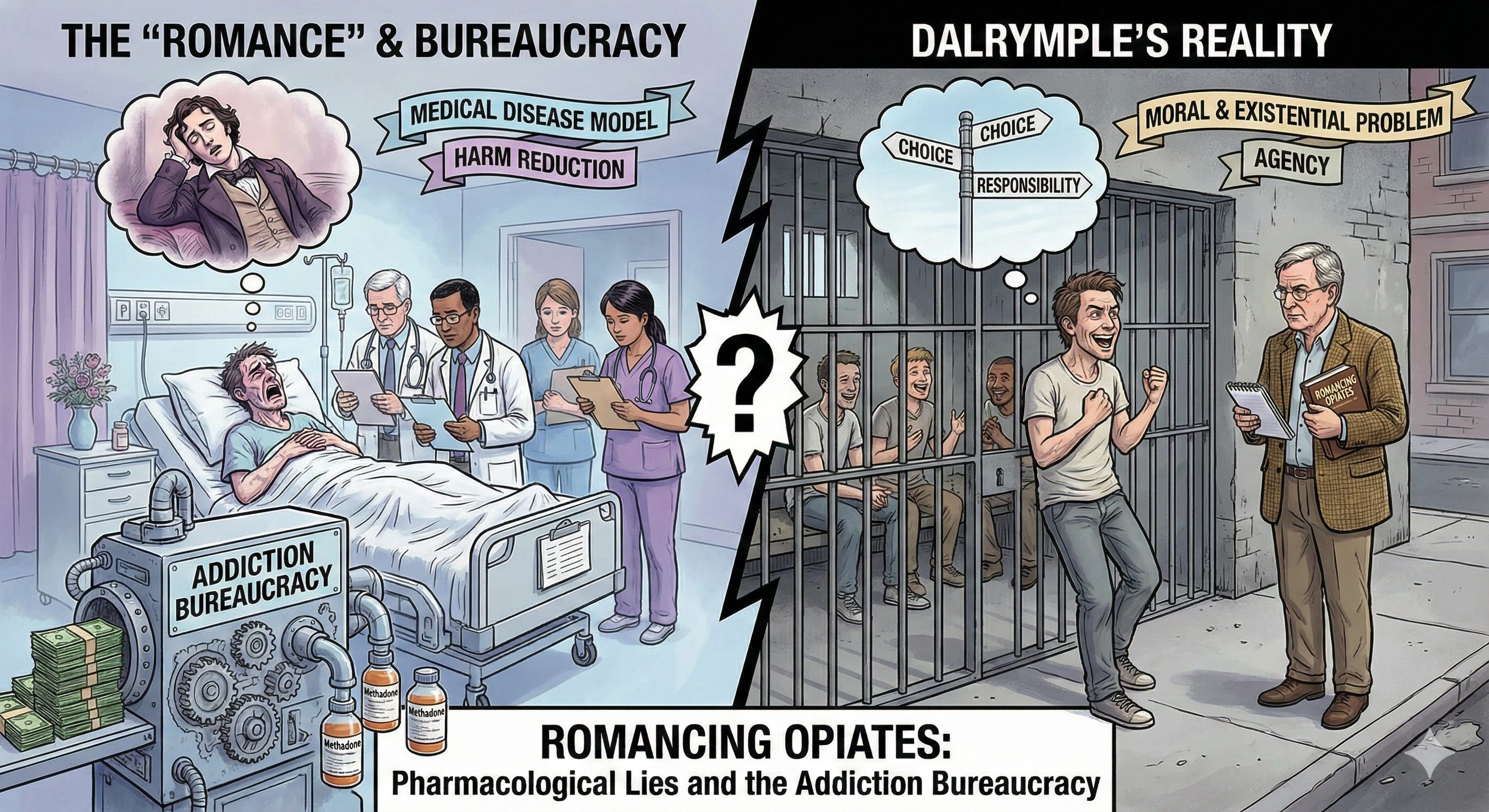
Romancing Opiates: Pharmacological Lies and the Addiction Bureaucracy
Published: 2006
160 Pages
Briefly, what is this book about?
This book aims to shatter some of the myths around opioid addiction. The first part covers the myth that stopping opioids cold turkey is both painful and dangerous. The second part dissects the myths propagated by literature, primarily Coleridge and De Quincey. The final part ties it into an addiction bureaucracy, though that part still references De Quincey an awful lot.
What’s the author’s angle?
Dalrymple worked as a prison doctor and psychiatrist for many years. Accordingly, he has a lot of experience with addicts. But he’s also very culturally conservative. The combination of the two leads him to strongly oppose coddling addicts, arguing instead that they should be stigmatized.
Who should read this book?
I’m a fan of Dalrymple. I’ve enjoyed his columns over the years, and I appreciate his curmudgeonly British insight. I previously enjoyed and reviewed his book Life at the Bottom. I would definitely recommend that book before this book. Actually, I would not recommend this book period, unless, for some reason, you want a really deep dive into Coleridge and De Quincey’s writings about opium.
Specific thoughts: Opioid addiction is not a disease?
The book does have some very interesting data on how bad opiate withdrawal is. The popular view is that withdrawal is both agonizing and dangerous. Dalrymple is well aware of this view and relates how he’s seen dozens of addicts:
…hunch themselves up [and] writhe in histrionic agony. They claim that they have experienced nothing as bad in the whole of their lives, that it is quite unendurable, and they make all kinds of threats if I do not prescribe something (by which they mean an opiate) to alleviate their suffering, threats that range from damaging or setting fire to their cells, to killing themselves, others or even me.
Despite this, he claims, and offers numerous medical sources in support of this claim, that the physical symptoms of withdrawal are no worse than the flu. And indeed probably not as bad, because people die of the flu, and no one dies (directly) from opiate withdrawal. In support of it all being an act, he offers up the following observation:
When, unbeknown to them, I have observed them before they entered my consulting room, and again after they have left it, they display a completely different kind of behavior to that which they exhibit once inside it. Gone is the hunched posture, the woebegone expression of martyrdom, the affecting scene of someone in extremis... they are talking or joking animatedly among themselves, and walk with quite a different step.
His overall point is illustrated by this charade. Dalrymple memorably asserts that the addict pretends to be ill, and the doctors, and the addiction bureaucracy, pretends to cure them. He wants to stop pretending, because it’s not an illness, it’s a moral failing and we should treat it as such. Addiction is not some overpowering condition, which falls upon a person the first time they so much as sample an opiate, rather it takes a long time to manifest. And even once it has taken hold, it’s possible, even straightforward, to shed the addiction. As proof of all of these assertions he offers the example (which you’ve almost certainly encountered before) of the Vietnam vets:
During the Vietnam War, thousands of American soldiers, especially towards the end, addicted themselves to heroin. It is not very difficult to imagine why American soldiers found heroin attractive: their life was, like that of most soldiers during a war, 99 percent boredom and 1 percent terror. The supply found its market soon enough. (It was even said that the Vietnamese communists spread addiction deliberately to weaken the resolve and capacity of American soldiers.)
The Encyclopedia of Drugs and Alcohol (Volume 3, pages 1244 to 1245) described what happened. Forty-three percent of American servicemen had tried heroin, and 20 percent of them qualified as addicts. What happened to them when they went home? Only one in eight of the addicts continued with his addiction after return to the United States, and by two and three years after their return, the addiction rates among those who had served were no higher than among those who qualified for the draft but did not serve in Vietnam. And what help or services did these thousands of addicts receive when they returned home? For all intents and purposes, it varied between very little and none. They simply stopped taking heroin and did not resume.
Dalrymple’s assertion is that the remarkable cessation rates came from treating addiction as a moral failing rather than a disease. On the other hand, if we treat it as a disease then we introduce all kinds of incentives towards exaggeration of symptoms (see above), the perpetuation of a medical bureaucracy, and attempts to solve it through the use of other drugs, particularly methadone.
Dalrymple is not a fan of methadone and he offers up a simple analogy to illustrate his objections:
Let us, then, perform a little thought experiment. Suppose we had a population of burglars, whom we divided into two (admittedly the experiment could not easily be double blind). The first group, when caught, receives $10,000,000.00 the second is given conventional “treatment,” i.e., jail. It would not be very unlikely or difficult to establish that the first group’s rate of recidivism (or relapse, to give crime a medical cast) would be very much lower than the second group’s, at least until the money ran out. Of course, as with methadone treatment, the response would not be 100 percent, because there are no doubt some burglars who do it for the sheer hell, that is to say, the joy of it. But it would also be possible to show a dose-response curve. Five hundred dollars might prevent relapse for a week; $5,000 for a month; and so on and so forth. Moreover, you could fiddle around with the treatment ad infinitum, giving burglars benefits in kind, for example, furniture and groceries, or fast red sports cars and a free subscription to a fuel station. Some treatments would undoubtedly work better than others; some would not work at all. Would this make burglary a disease?
Likewise, progressive amputation of digits and limbs, conducted with all the paraphernalia of modern surgery (and thus with all the appearance of a genuine medical treatment), might suppress burglary in burglars. There would, indeed, be a proper dose-response curve: the more of a burglar you amputated, the more effective amputation would be in reducing his burglary. But all the surgery in the world would not make burglary a medical condition or amputation a treatment for it.
This is an interesting analogy, and one I’m sympathetic to. And I believe a lot of people are becoming more sympathetic to it now that the tide is starting to turn against harm reduction. Nevertheless I have many issues with Dalrymple’s overall approach.
First, as I already mentioned he spends way too much time on the literary basis for the romantic notion of opioids. I don’t really think that Coleridge’s description of his opium trips is doing much to move the needle in the year of our lord 2025, or even in 2006 when the book was written.
Second, he doesn’t spend any time on the role of prescription oxycontin, or more the widespread availability of more powerful opioids like fentanyl. This is perhaps forgivable for a book published in 2006, though even then the prescription opioid crisis was evident from the data. When it was largely about heroin, he may have been correct that criminality largely preceded addiction rather than the reverse, but once oxycontin flooded the scene, it created a lot of addicts, who then turned to criminality.
Finally, we need to return to the very first example. If alcohol withdrawal is so much more dangerous than opioid withdrawal. And if it’s further acknowledged that alcohol is also addictive, then why are opioid addicts so much more “theatrical”? I think it’s widely acknowledged that there are degrees of addiction, and if the physical dependence is actually less with opioids, then the psychological dependence must be significantly greater—thus the theatrics. This consequently makes dealing with drugs an incredibly difficult problem. One which has been made more difficult by things like oxycontin and fentanyl, which, again, Dalrymple neglects to mention.
That said, he did mention some things I didn’t know. And offered a medical perspective I hadn’t considered. But as I have hopefully distilled out both of those insights, there’s no need for you to read this book.
In the past when I was dumping all of my book reviews into a single monthly post I was reluctant to include too many quotes, because those posts were already extremely long. Now that I’m giving each book its own post I feel free to include more lengthy quotes, but do I feel too free? The “Specific Thoughts” section was basically 50% quotes. Am I addicted to quotes now? Quick, someone pay me to stop using quotes! I think Dalrymple’s idea of starting with $10 million will do nicely. I don’t have that as one of the options for my paid subscribers, but if you stay a paid subscriber for long enough we’ll get there!
As for whether addiction, or burglary or other things are "medical", I find this essay interesting: https://www.lesswrong.com/s/NHXY86jBahi968uW4/p/895quRDaK6gR2rM82
My question, then, would not be "is it medical?", but "what outcome are we trying to achieve, and how can we achieve it?"
I would point out that addiction (to lots of things) can be treated with GLP-1 agonists which is kinda medical-y.
I'm nervous some progressive might read the "give burglars money to quit" analogy and take it the wrong way...