

By: Ken Grimwood
Published: 1998
320 Pages
Briefly, what is this book about?
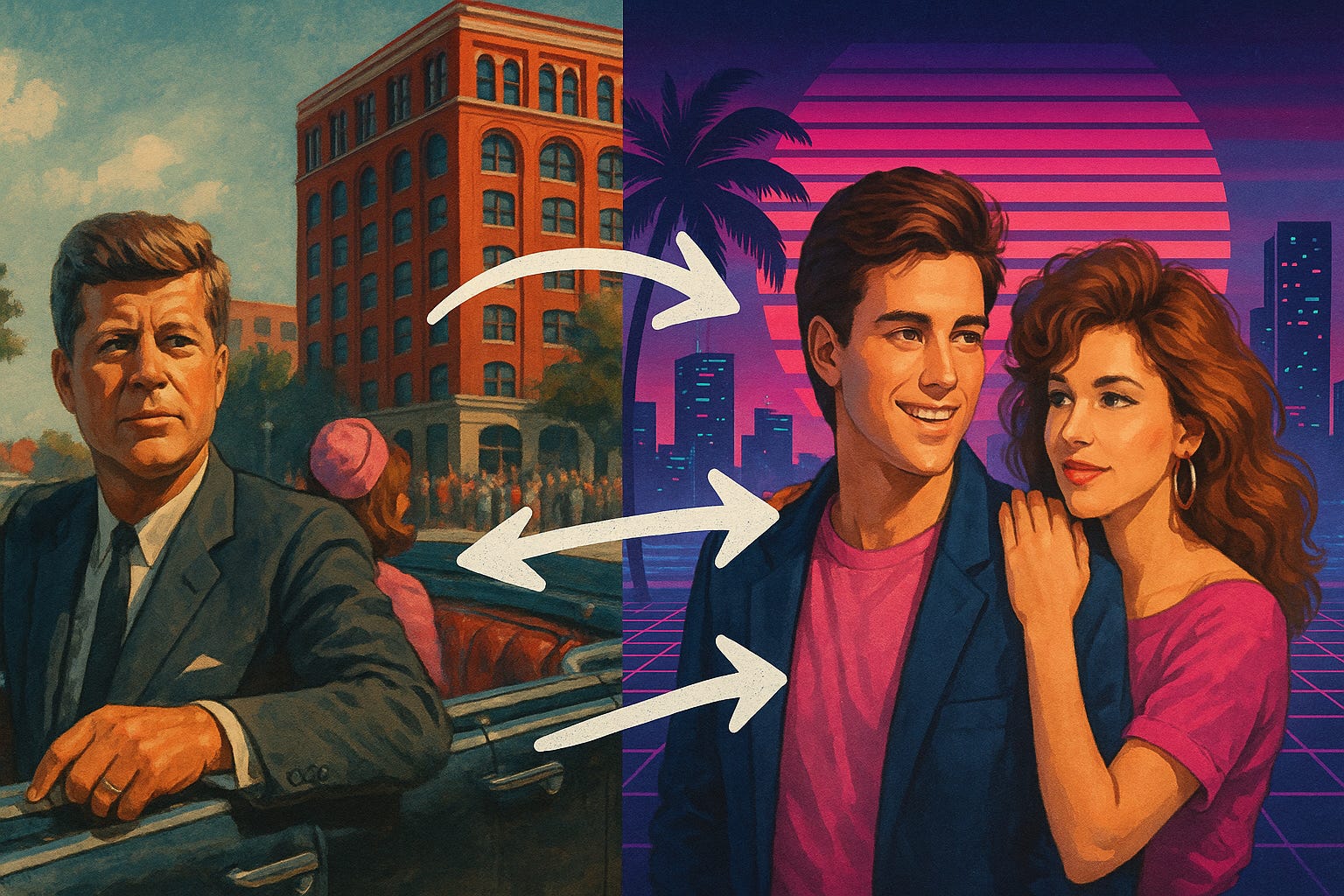
A man dies and is sent back to his 18 year old self to relive his life over, and over, and over. Every time he dies he’s sent back. He dies in 1988, and awakens in 1963, so there’s a lot of discussion of those years (Kennedy Assassination, Moon landing, Iran Hostage crisis, etc.)
Who should read this book?
I came across a recommendation for this book on a Youtube channel that was doing a survey of all the movies that had functionally the same premise as Groundhog Day. And he included the book as sort of an appendix in other things people might want to check out. If you’re a big fan of the Groundhog Day contrivance, then I think you’ll like this book.
Specific thoughts: Great on a personal level, weak on a world-building level.
This review will go from spoiler free to light spoilers to full on spoilers. I will let you know at each transition.
At this point the Groundhog Day format is pretty well known, and what’s interesting about new entries into the canon is how they mix things up. Of course this was published only a few years after the movie, so I should probably cut it some slack, and not compare it against later entries in “the canon”. Nevertheless the canon has given us some common metrics we can apply. What causes things to replay? How much time is replayed? What is the point of the replay? How is it broken? What role do other people play (in the replay)? Those are the questions I can come up with off the top of my head, though I’m sure there are others.
I would say that this book stands out in the area of the role other people play. That it is in fact mostly excellent with this facet. It is also inventive in how long the replays last, and in fact I haven’t seen anyone do quite the same thing. As to the other stuff, I think it’s a little weaker than I would have liked.
Begin Mild Spoilers
Like Groundhog Day itself, the cause of the replay is never explained. But it turns out that other people are replaying, and one would imagine you might gain some clue as to the cause of the replay based on who else it’s happening to. And that looking at the other people involved might also give you some sense as to the ultimate point of the replay. How to break it, and why it’s happening. In some sense it does, and if you kind of just look at the core of the book, it does seem to create an explanation, but he also uses the other people replaying to throw a very strange curveball, one that is never resolved and makes the whole situation kind of weird.
Begin Full Spoilers
The book focuses on Jim. During his second “replay” Jim discovers that Pamela, (who’s four years younger than he is) is also replaying her life. The relationship between Jim and Pamela is great. And Grimwood adds a mechanism the replays whereby the date someone gets sent back to keeps getting later. So they’re not replaying their life forever. They are not, in fact, stuck in a time loop. There’s clearly a clock because while they start the replay later and later, they always die at exactly the same moment. So the duration keeps decreasing.
Also on subsequent repeats, Jim ends up returning earlier in time than Pamela, so there are these very sweet moments where Jim is waiting for “replay Pamela” to show up in the body of normal Pam. Grimwood uses this to provide some shock and humor as well.
Had Grimwood focused on just the two you would have had a situation like Palm Springs. And to the extent that it is focused on them, the novel is great. For quite a while it seems like they’re the only ones replaying their life. But then during one of the replays they decide to see if they can find others like themselves. Initially this seems very interesting, and there are a lot of great places Grimwood could have gone with it.
They could have been entirely unsuccessful, enhancing the specialness of the two of them. There could have been a group of people moving in and out of their lives kind of like Highlanders, or superheroes of a sort. It could have been a secretive group with esoteric knowledge. It was a great opportunity for world-building and I was excited to see what happened.
In the end Grimwood did none of those things. They do find another “replayer”, but just one. And rather than having interesting connections or being the source of more information it turns out he’s a psychotic serial killer who thinks aliens are talking to him. I found this choice to be particularly bizarre.
In another replay Jim decides to stop the Kennedy assassination, and he manages to get Lee Harvey Oswald arrested. But then someone else kills Kennedy, and it seems like we’re meant to assume that history has an inertia and major events can’t be changed, but then in another replay, Jim and Pamela go public with their foreknowledge, and they end up breaking the world and getting Reagen elected early, while turning the US into a fascist state… So which is it can they affect major events or can’t they?
You might assume from the foregoing that I didn’t like the book. That’s not the case, I quite enjoyed it, but certain decisions were unusually baffling. But perhaps that’s the most realistic part of the book. There are, after all, a lot of baffling things about the world.
It was only as I was writing the review that I realized that the two main characters have the same names as two of the main characters from The Office. I don’t think there’s any connection, but it creates the possibility of a whole new way to watch The Office. You’re welcome. For more bizarre suggestions consider subscribing, or checking out the archives.
I ran across this book a decade ago while camped out in a Barnes and Noble in some strange and exotic foreign country (probably Canada; I haven't traveled much since we had kids). And I loved it! I've never heard another person mention it until now — it's surprised me that it never became part of any canon I know of.
Ross, fwiw, "Groundhog's-Day-inspired-books" would be a really interesting review series, perhaps particularly from a spiritual perspective.
Did that video recommend The map of tiny perfect things? I watched that a couple years ago, it's a very sweet entry in the series.