

Radical Markets: Uprooting Capitalism and Democracy for a Just Society
By: Eric A. Posner and Eric Glen Weyl
Published: 2019
384 Pages
Briefly, what is this book about?
A series of radical proposals for restructuring property, voting, immigration, investing, and employment. All of the proposals seek to solve the problem of “monopolized or missing markets” in ways that seem pretty strange. One has to wonder if there’s a good reason those markets didn’t exist in the first place.
What authorial biases should I be aware of?
Posner has his finger in all sorts of things, and has defended everything from post-9/11 government surveillance to increasing foreign aid. I guess the throughline is a belief in technocratic solutions?
Weyl is an economist working for Microsoft who helped popularize the idea of quadratic voting, and had a political awakening while reading Ayn Rand. This feels more like his book than Posner’s but perhaps I’m imagining that.
Who should read this book?
I read this as part of an ACX/SSC book club. Most of the people didn’t like it. They felt that it was too radical. (Though you can’t say we weren’t warned, it’s right there in the title.) But if you want to see what mechanisms Georgist economists come up with when they’re completely unrestrained, this might be the book for you.
What does the book have to say about the future?
Hayek is famous for noting that the big advantage of markets is that they are giant distributed systems for discovering prices and allocating resources effectively. They’re obviously not perfect, and socialists have long dreamt of having a centrally planned economy that would be fairer and work better. Posner and Weyl imagine a future where computing power and machine learning could take over some of the work currently being done by markets, and thereby improve the outcomes.
Specific thoughts: “Six impossible things before breakfast”
Each chapter of this book details a different idea for creating a market where there isn’t one or breaking up a hidden monopoly, and while I wouldn’t say they’re impossible, they’re all radical enough that they might as well be.
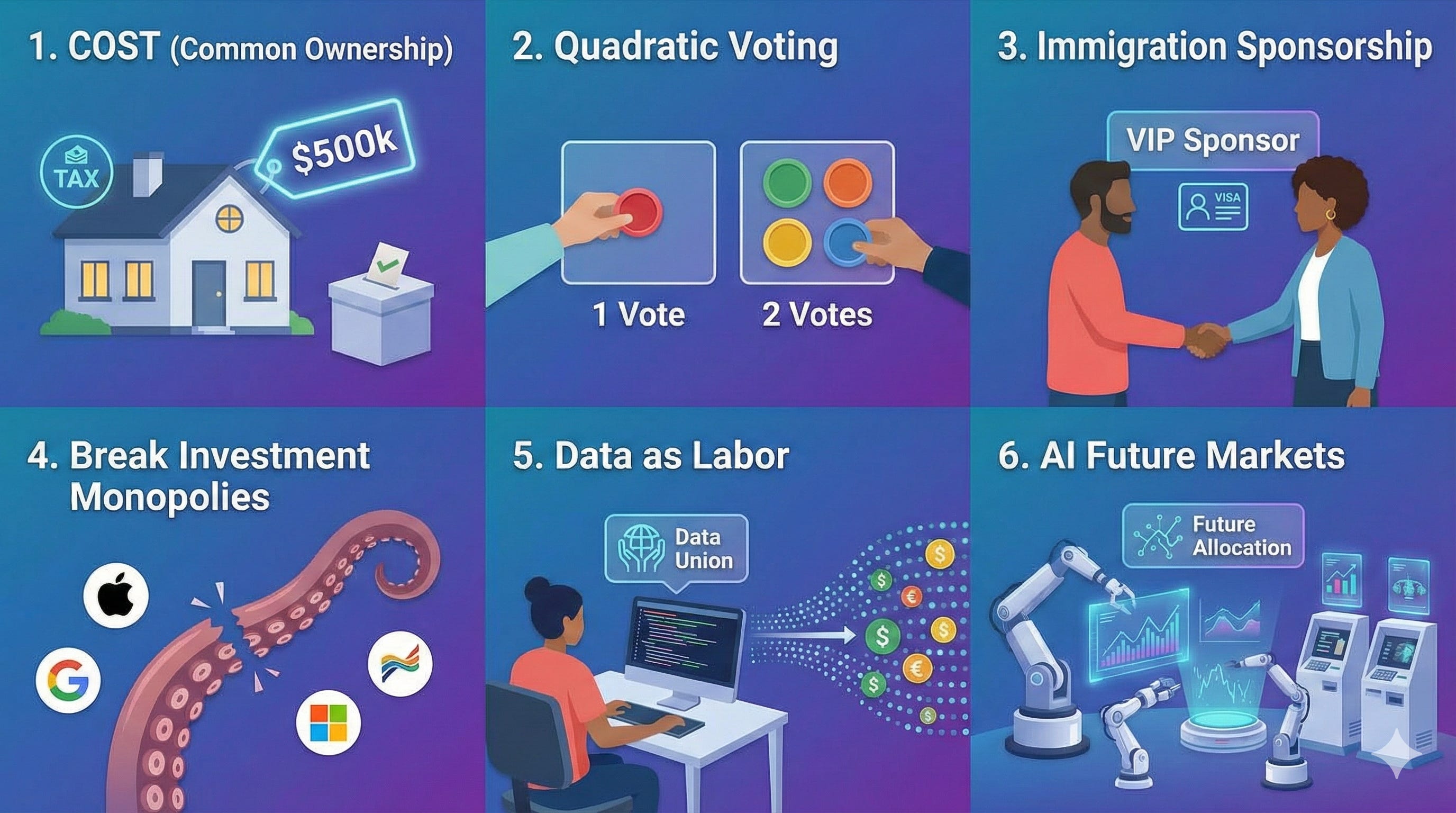
Consider, for example, chapter one, which introduces the COST (common ownership self-assessed tax) proposal. Here they propose that everything anyone owns must be assigned a price by the person owning it. Then, each year, they are taxed a proportion of that price. The obvious solution would be to set the price very low, right? Well only if you want to lose the item, because the price you set is The Price. Anyone who wants to can buy the item for the price you’ve set and there’s nothing you can do about it.
You may have heard of this system with respect to property, but Posner and Weyl eventually want to apply it to everything: your child’s bike, Grandma’s china, each of my thousands of books. All must be priced and taxed. Just the overhead of such a system would be ridiculous, and then you can imagine the outcry that would occur if some grandma lost her house because she had forgotten to reprice it in the midst of a real estate boom. And it’s not merely her house that might be bought out from under her, under their ideal endpoint, someone could purchase everything but the house. Let’s have the estate sale early!
To be fair, Posner and Weyl do offer some modifications which might help prevent such calamities. For certain things—heirlooms, photographs, mementos, etc.—the tax rate would be very low. Meaning that you could make the value so high that no one would want to buy them without affecting your tax bill very much. This still requires you to be aware of anything that’s truly valuable. And one also wonders if the tax is going to be so low, why not exempt certain things from the tax? Obviously this exemption could be abused, but so could the low tax rate.
Another aspect of their system is that you can bundle things. So rather than make me individually set a price on every single book. Presumably I could bundle them all together and set a price for the whole collection. It still seems like a pain, and something you’d have to constantly update.
Should such a system be put in place you could imagine all sorts of secondary institutions springing up. One imagines that pricing guides would become far more common. And there might even be some way of insuring your items. But it’s also possible that the system would quickly reach some weird equilibrium. What’s the limit to bundling? Could a municipality decide to bundle everything in its borders? At that point you would either need to buy the entire municipality for the bundled price or you would have to offer someone within the borders enough money to unbundle their property and sell it to you. In this fashion you would end up being pretty much back to the situation we have now. In any case they did earn the title “Radical”.
One of the people in the book club summed it up thusly:
What if we created a panopticon for private property ownership such that you would live in constant anxiety of having someone outbid you for anything you owned?
I don’t intend to spend as much time on the other chapters, but I will give a brief overview.
Chapter two is the quadratic voting chapter. This system is designed to capture the intensity of preference, rather than just its presence. Everyone would be given a certain number of voting credits. To cast one vote for a candidate or issue would cost one credit, but casting two votes would cost four credits. Three votes would be nine and so forth. Another interesting idea, but given the difficulty people have just understanding ranked choice voting, I’m not sure how easy this would be to implement. And my initial instinct is that it would make polarization even worse.
Chapter three is their solution for the immigration problem. Every immigrant would have to have some kind of sponsor, and they imagine this could go all the way down to the level of the individual. This ends up amounting to a modern version of indentured servitude. It’s not the worst idea in the book, nor the most impractical, but it’s still sufficiently impractical that I can’t imagine any circumstances where it would be implemented.
Chapter four asserts that large investment groups represent hidden monopolies because they end up controlling large chunks of companies in the same industry. This gives them the opportunity to subtly collude in ways that increase the company’s profits but harm consumers. They suggest a rule whereby you have to choose either 1) not vote your shares (so pure passive index funds are okay) 2) keep your percentage below a certain threshold, like 1% or 3%) only invest in one company within a given industry (so you could invest in Coke or PepsiCo but not both).
I can certainly imagine that institutional investors have grown to the point that they can influence companies and markets in ways we haven’t previously encountered. In other words, people in finance are always looking for an angle and I wouldn’t be surprised at all if they had found a new one. So I have some sympathy for this position, but I think at a minimum I’d like to hear more than one person making this argument in order to start taking it seriously.
Chapter five discusses creating a market for data. Obviously arguments around the monetization of personal data by giant social media corporations have been going on for a very long time, and lots of people think that people should get paid for their data. The problem is that the value of any individual’s data is tiny. Despite this book being written in 2019 Posner and Weyl are very savvy about AI, and the way it will need to be trained. They imagine that AIs will have a voracious appetite for training data, and that while old school data won’t be worth very much that training data for AI will actually be valuable enough that it might be a way of mitigating the unemployment brought on by AIs. Still it’s clear that any individual’s data is not particularly valuable, especially if a company already has 10,000 examples. To combat that they imagine data unions whereby people collectively bargain with AIs. Sure this is interesting, but as I said at the beginning, it’s also pretty fringe and strange as well.
Finally they imagine all the new markets that might be opened up by AI and LLMs. A sixth impossible idea to tackle after they’ve successfully implemented COST, passed quadratic voting, reintroduced indentured servitude, broken up institutional investors, and established UBI through data unions. Needless to say I’m not holding my breath.
—--------------------------------------------
I’m never sure what to make of books like this. I mean what’s step one here? Hope that the future AI overlords happen to be particularly convinced by your arguments? I mean that might work until the AI reads this review where I totally EVISCERATE Posner and Weyl.
When you consider how critical I have been of so many books, perhaps that’s my greatest service to the future. I’ll leave the eventual AI overlords so uncertain about the correctness of any path that they won’t have time to Skynet us. Do your part to fight extinction by subscribing.
Some modest market ideas I have:
Streaming a'la'cart: A simple service that charges you a monthly flat fee, say $100. You can watch any show you want from any platform. The service tracks what you watch and divides the fee up in proportion to your viewing on various platforms. This not only would return something like ratings to platforms (shows that get eyeballs get you paid) but I think better align incentives
COST applied to new drugs: I would apply the first idea to pharma companies. They would set a reserve price for their patent monopoly each year and pay a tax on that price. If the gov't wants, it can shorten the monopoly by paying them the price at any time. I'd consider adding a 'buy my own' option. If a price was set at $1B because a drug seemed ho-hum but suddenly it showed unexpected promise for other lines of therapy, the company could pay the gov't their reserve price for the right to reset their price partially thru a year. I'd also allow private groups, charities or insurance companies the right to pay the price to trigger early generics on an expensive drug.