

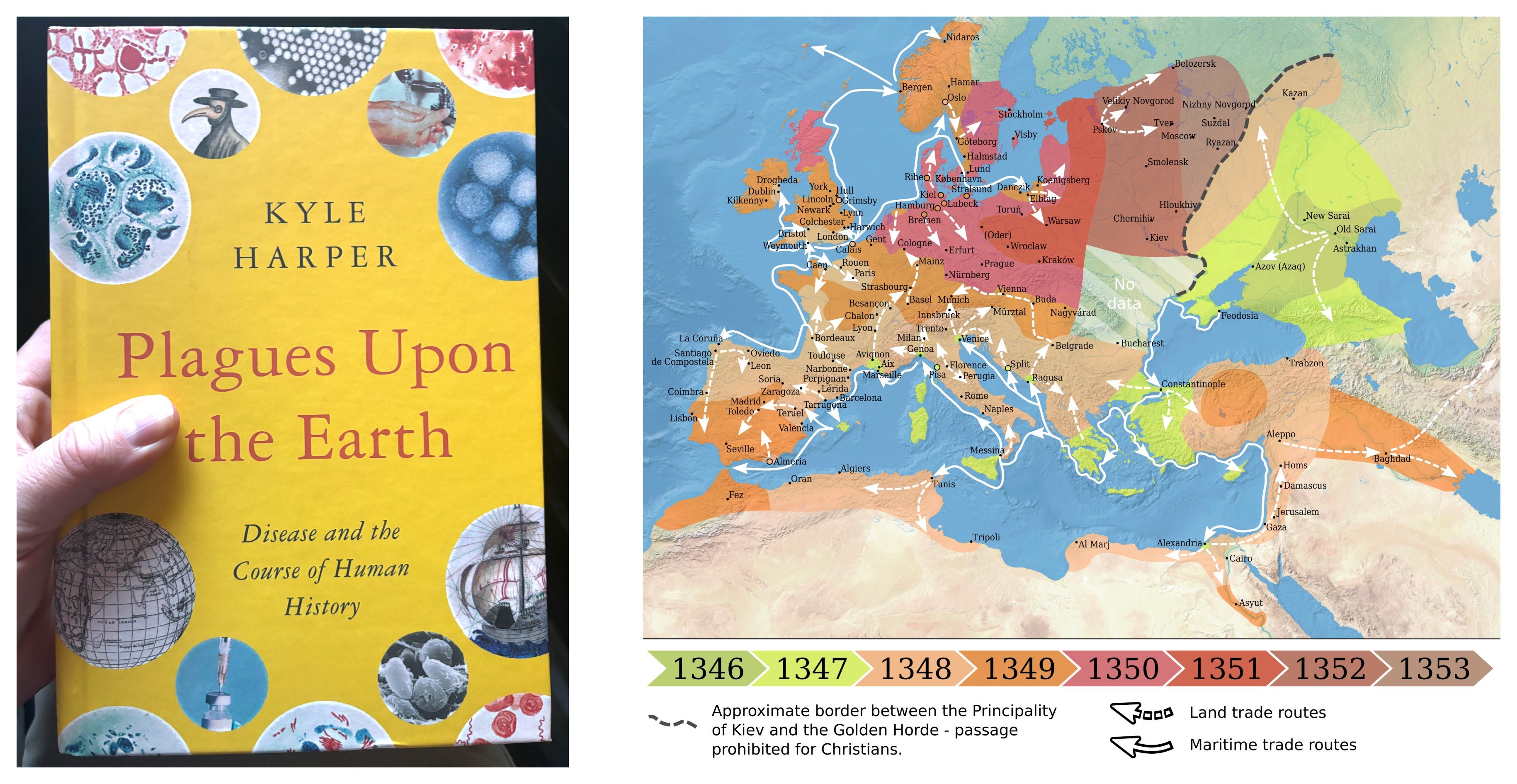
Plagues Upon the Earth: Disease and the Course of Human History
By: Kyle Harper
Published: 2021
704 Pages
Briefly, what is this book about?
A comprehensive historical overview of the never-ending war between humanity and disease. From its earliest days all the way down to the COVID-19 pandemic. With a specific focus on what he calls the “paradox of progress”: every new advance creates new opportunities for diseases. But it’s not just us driving diseases, they’re driving us as well. Efforts to mitigate the negative effects of these pathogens are scattered throughout our history, our civilization and our genes.
What authorial biases should I be aware of?
None that you’d really be surprised by. He explicitly takes a very global view of humanity’s disease burden, knowing that the story of European diseases like smallpox and the plague have already received plenty of attention. (Which is not to say he ignores them. Merely that he locates them as just one among many.)
Who should read this book?
I think everyone should be more aware of the potential dangers of pandemics, and the monstrous impact plagues have had on the development of humanity and civilization, and this book does a fantastic job with the second part, but it has less to offer on future danger than I hoped. Speaking of which:
What does the book have to say about the future?
Harper definitely takes the stand that our long war against diseases is far from over, and there is a lot of great discussion about how pathogens evolve alongside us, changing tactics as we change our environment. But there’s almost no discussion (none that I really remember) of the danger of bioengineered pathogens, which felt like a significant oversight.
Specific thoughts: Two things which continue to baffle me
It can be difficult to remember the before times, what it was like before some major event. Even one that happened fairly recently. I’m speaking, of course, of the time before the COVID-19 pandemic. Back then everyone had heard of the really big diseases. Things like Black Death and smallpox, but surprisingly, very few people had any awareness of the Spanish flu pandemic of 1918–1920. You might have to take my word for that, but trust me, to the extent that people even knew about it (and many didn’t) it was never mentioned. It just wasn’t part of the standard historical narrative. There was World War I and the Great Depression and World War II, and so on, but no one would insert “And the Spanish flu”. Despite the fact that far more people died from that than from the actual war.
This isn’t just a weird quirk of the Spanish flu. It’s clear that diseases, even ones that kill multiple millions of people, just don’t get anywhere near the same attention per death that wars do or even well-known books! This book reinforced this strange asymmetry in attention. Historically there were numerous, gigantic plagues which are almost entirely forgotten, while other things, which occurred around the same time, are widely known. And yes, it could be argued that some things are uniquely memorable, but the other side of that is that plagues seem uniquely forgettable.
Consider these examples:
Antonine Plague vs. Marcus Aurelius: How many people have any idea about the Antonine Plague versus have seen the movie Gladiator? Or who knows who Marcus Aurelius was but doesn’t know that a plague during his reign ended up killing an estimated 10% of the population of the Roman Empire? I think it’s safe to say that Meditations, Aurelius’ book, is far better known than the plague.
Black Death vs. Hundred Years’ War: The Hundred Years’ War lasted from 1337 to 1453. In that time there were probably around 250,000 combat deaths (statistics are obviously tough to compile). In that same time the best guess is that there were at least 25 million deaths from the bubonic plague. (And actually the bulk of the deaths occurred between 1347 and 1353). So at least 100 times as many people, but it certainly doesn’t get 100 times the attention, particularly if you consider the fame of the individuals and events from the Hundred Years’ War (Agincourt, Joan of Arc, Crécy).
Shakespeare’s plays vs. the plagues that were happening at the same time: Everyone knows about Shakespeare’s plays, but how many people know that the theaters were constantly being shut down because of the plague, and that the 1592–1593 London plague probably killed around 10% of the population of London.
Add this on top of the Spanish flu and one starts to detect a trend. Now obviously there are all manner of biases when it comes to what makes it into “the record” and what doesn’t. There are obviously biases within nations and cultures, and biases related to how sympathetic the victims are, and how dramatic the situation. And one could hazard a guess as to which biases are at play here, but it still seems to be a very large asymmetry.
Arguably this was not the case with the COVID-19 pandemic. Many would say that we over-reacted to the deaths caused by it, and went too far. I don’t know what that means for future pandemics, but I hope to not find out. Though there are people who seem determined to make sure I do, which takes us to the second thing which baffles me. The continued efforts, by some, to facilitate the creation of the worst pandemics ever.
Coincidentally just before I started reading this book (it may have prompted me to pick it up, I don’t recall) I listened to an episode of Sam Harris’ podcast called “Privatizing the Apocalypse”. He was talking to Rob Reid, a leading advocate for better biosecurity, about the absolutely crazy DEEP VZN (pronounced deep vision) project. This was a program started in 2021, so after the start of COVID-19 pandemic, to go out, find as many naturally occurring pathogens as possible (go into the, much discussed, bat caves), take them back to a lab, sequence them, and then publish those sequences.
This is insane on so many levels.
It’s a follow up to the PREDICT program, which some people blame for getting the virus to Wuhan which eventually led to COVID. (I know there’s a lot of controversy here.)
Apart from the question of whether COVID was caused by a lab leak, you have to believe that lab leaks are impossible to think dredging up the world’s deadliest pathogens and gathering them in a lab is a good idea.
Despite the enormous risks, it was run out of USAID, not exactly the organization you think of when you think top tier biosecurity.
There are an estimated 30,000 people who might be able to synthesize a pathogen, once the sequences are published. You’re giving all of these people the equivalent of a nuclear weapon. And that number is only going to go up.
I understand the principle of open science, but as they said in the podcast “open science is not a suicide pact”!
Fortunately, someone came to their senses and DEEP VZN was cancelled in 2023, and hopefully that marks the end of these misguided efforts at collecting and cataloging. But one wonders if on some level, we’re once again seeing this strange minimization of plague deaths vs. other deaths. Would the scientists involved in PREDICT or DEEP VZN have been equally willing to work on research for a new form of nerve gas? Probably not, and yet the pathogens they uncovered could have ended up being 100 times worse.
As the title says we do have “plagues upon the Earth”. They’ve been around forever, and they will continue to haunt us, evolving and adapting as we do. Perhaps it’s this longevity, the fact that they have always been with us and will always be with us, that makes us treat them differently, to treat deaths as less severe, and research as less dangerous.
And I guess that’s the final message of this book. Just because they’ve been around forever doesn’t mean we can let our guard down!
—---------------------------------------------------------------
One of the scary scenarios mentioned in the Sam Harris podcast was bioengineering several viruses at the same time and then releasing multiple pandemics all at once. So when you show up at the hospital, the doctors aren’t even sure which disease you might have or how to treat you. For people that are opposed to releasing DNA sequences they seem to have no qualms about offering up evil genius level ideas to the bad guys. And there I go, doing the same thing. For more of this sort of casual hypocrisy consider subscribing.
My friend, you had a chance to use 'decimate' accurately in a Roman context and you forbear. I admire your focus. ;)
I must not have got the memo about the standard historical narrative, because I was aware of the 1918 flu epidemic and that it had killed more people than WW1.