

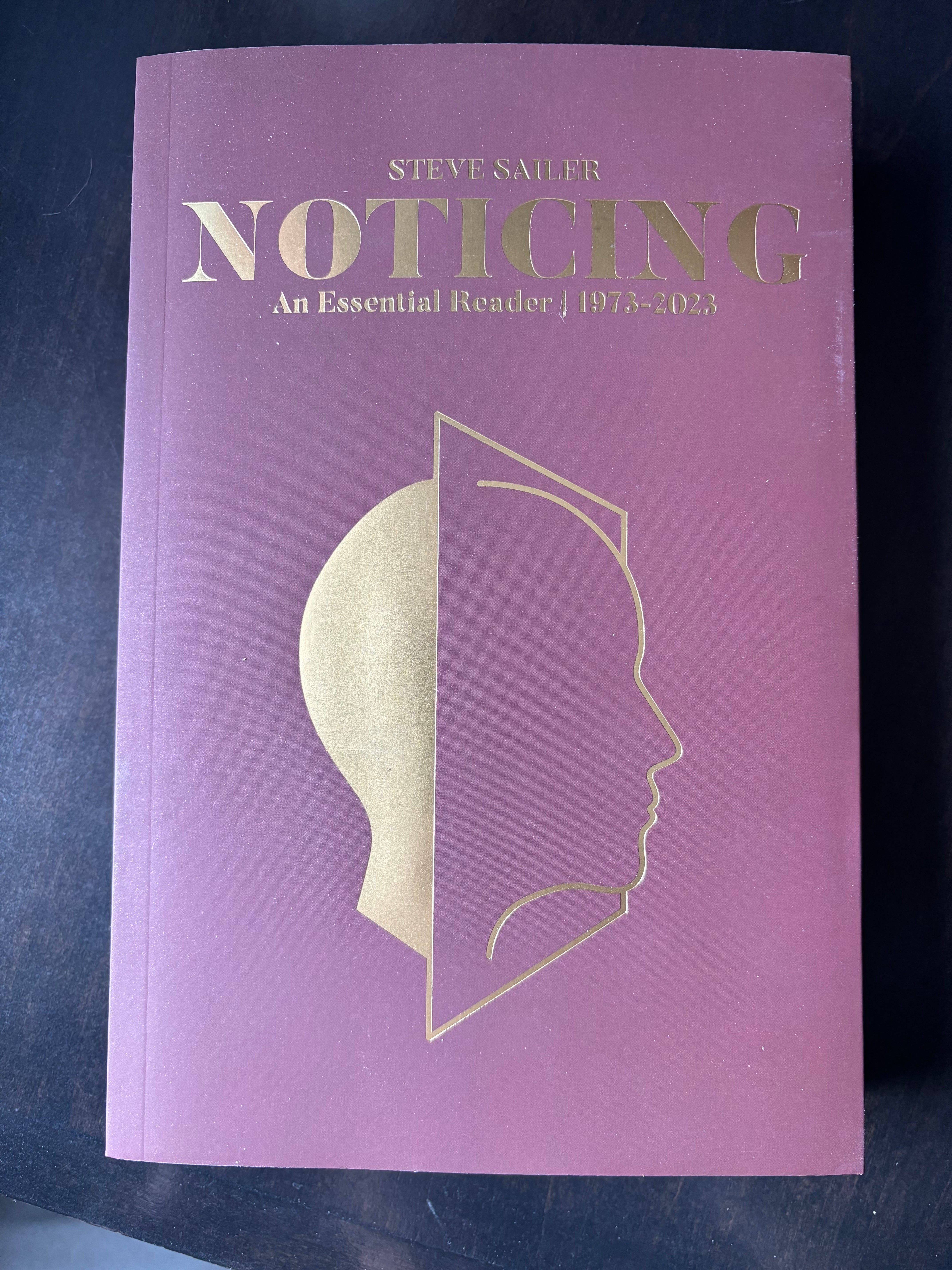
Noticing: An Essential Reader (1973-2023)
By: Steve Sailer
Published: 2024
458 Pages
Briefly, what is this book about?
A collection of essays from Steve Sailer covering immigration, culture war stuff, and human biodiversity.
What's the author's angle?
For some, Sailer is a horrible right-wing racist. For others he’s a data-driven contrarian. I mostly fall in the latter camp. Also whatever you think of his opinions, his tone is exceptionally mild. He’s not a fire-breather.
Who should read this book?
If you’ve been following Sailer forever there’s nothing especially new here. Even if you haven’t previously read all of the included essays (and I believe I was at probably 90%), he’s covering territory which is very well-trod by him in general. On the other hand if you’re only vaguely familiar with Sailer—perhaps you’ve come across his name once or twice, then this is a great summation of his opinions and writings.
Specific thoughts: How important is tone?
Many, many years ago, while I was still young and foolish, I would often assert that the left was nicer and more even-tempered than the right. To the extent that it was not a hasty generalization (and that’s what it mostly was) there might have been some truth to it at the time. It’s certainly not true now.
Regardless of whether one side or the other is nicer at any given point in history (then or now), is it actually important? I think it is. And I think Sailer illustrates that fact.
Some people might retort that there are critical issues which demand speedy and immediate action, and in such cases anger is appropriate. This is generally hindsight bias. Yes, there are some things which would have benefited from swift action, and applying pressure in the form of anger and vitriol to achieve this swift action would have been justified. But generally, particularly with really big questions, that only becomes apparent long after the event has occurred.
Mostly what we’re doing is playing a very long game. And in that case being nice and even-tempered is the right call. Whatever you may think of Sailer’s politics, I think he’s a great illustration of someone who’s been calmly playing the long game his whole career. This has allowed him to continue publishing despite the titanic culture war raging around him. (It also helps that he lives very modestly.) Now he has gained some measure of prominence and people are paying attention to his ideas. I think his ideas are good, but I wonder if it’s actually his methodology that is more worthy of study.
I’m still experimenting with what makes the best image to attach to a book review. So far I’ve done a screenshot of the book’s audible screen, AI, and now a picture of the physical copy. Of course the latter only works if I own the book. And not all books are equally photogenic (for example this one). Should you have a preference please leave a comment. I have a terrible sense of aesthetics.
Per aesthetics, I use book covers a lot in my presentations, and I find that the nicest way to show them is usually to look for a high-res image of the cover. (For whatever reason, this is something that Google Images is much better at than competitors. Lookin' at you, Bing!)
"I think he’s a great illustration of someone who’s been calmly playing the long game his whole career. This has allowed him to continue publishing despite the titanic culture war raging around him."
He has gotten kicked from at least one publication, right? National Review at one point?