

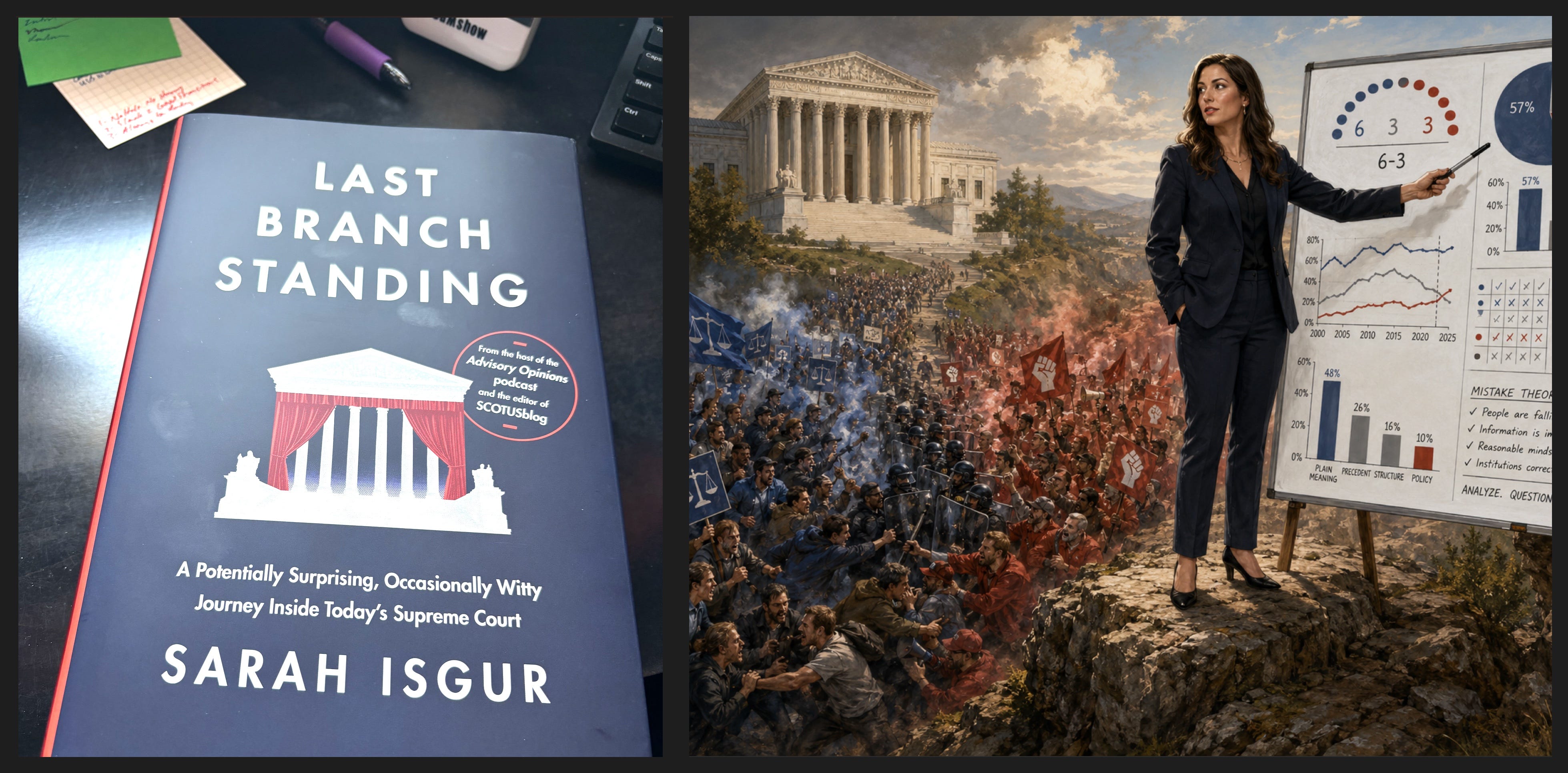
By: Sarah Isgur
Published: 2026
416 Pages
Briefly, what is this book about?
A deep dive into the Roberts Court, with a historical framing of the Court as a whole. Two main themes run through the book.
First, while people want to evaluate the Court on the single axis of liberal vs. conservative, there is a second, perhaps more important axis that tracks the institutionalism of the justices—respect for precedent, maintaining the legitimacy of the Court, congressional deference, etc. Once you consider both axes, rather than a 6–3, Republican vs. Democratic Court, you get a 3–3–3 Court. Composed of (in Isgur’s words):
The Deciders: Roberts, Kavanaugh, Barrett
The Conservative Honey Badgers: Thomas, Alito, and Gorsuch
The Lonely Liberals: Sotomayor, Kagan, Jackson
Second, there’s the idea of the Supreme Court as the Last Branch Standing, by which she means that it’s the only branch of government that would be recognizable to the Founders. Which also means it’s the one branch of government trying to hold a constitutional line. This is not a comment on Originalism or Textualism, this is a comment on the fact that the executive Branch has accumulated an enormous amount of power, while, conversely, the legislative branch does barely any legislation. As a consequence, much of what the Court does is designed as subtle encouragement for Congress to take back some of its power.
What authorial biases should I be aware of?
Isgur is a Never-Trump conservative who divides her time between The Dispatch, Scotusblog, ABC News, and a few other places. All of this places her in the center-right institutionalist bucket. That said, her conservatism should not be understated. (She was a Republican political operative for over two decades.) But for those who are worried, this is not a MAGA polemic. Isgur evinced great admiration for all of the current justices, and even endorsed Kagan’s nomination back in 2010, despite the fact that the Senate Republicans had reached out to her for help with defeating that same nomination.
Isgur gives each justice a ranking on her X and Y axes: how conservative they are, and then how strong of an institutionalist. (Kagan: 3-8, Thomas: 9-2, Roberts: 6-10, etc.) As far as her own biases, I would place Isgur at 7-8 on that scale.
Who should read this book?
I think this book does a great job of straddling the line between readability and information. It’s got the perfect density of facts, not so many that you’re overwhelmed, but enough to feel that you’re getting real insight. Also Isgur’s tone is informal (note the honey badger reference above, click on the link if you don’t get it.) As an example:
The process isn’t just to slow things down and annoy the hell out of everyone. The process is how we ensure the ends are just. Some might argue (me! I argue it!) that the means are the ends in American law. But as I’ve said many times, I’m just a process girl living in an outcomes world.
So, anyone who thinks the Court is important, an important force for good or an important force for destroying the country, should read this book. Also James Carville, who recently delivered an unhinged rant about the Court, should definitely read this book.
What does the book have to say about the future?
Obviously the Supreme Court is going to be important in the future, but how exactly that plays out is unclear. One could imagine a gradual diminution of their influence, until there are no branches standing and everything is hyper-polarized. Heaven help us then.
One could imagine that they hold on to their influence because someone has to ultimately decide. As a result they effectively become autocrats (an argument I made as long ago as 2017.) But we already sort of have this situation. (I often reference a joke from when ObamaCare was going before the court. “Can’t we just ask Anthony Kennedy what he thinks and get this over with?” Kennedy was the swing vote at the time on the Supreme Court.)
One question I’ve long been curious about is would the military side with them. Imagine that some future president refuses to leave office, claiming that they, and not their opponent, actually won the election. (Far-fetched, I know…) But the Supreme Court rules in favor of the opponent. Does the military stop allowing the former president onto Air Force One? Do they switch command and control, including the nuclear launch codes, to the new guy? Do they drag the old president out of the White House kicking and screaming?
Specific thoughts: People (and possibly machines) are wrong about the Supreme Court, but also maybe I’m wrong about the framing
I mentioned James Carville above. He’s definitely not the only one who thinks that the Roberts Court is a rubber stamp for the Republicans, but the actual statistics don’t bear this out. Isgur breaks down the numbers for the 2024–25 term:
…42 percent of the Court’s cases were decided unanimously. In 2013–14, that number got as high as 64 percent, [also the Roberts Court] but it usually hovers in the mid-40s. When you think about the fact that the Court takes only around sixty of the legally trickiest cases a year that have usually divided lower courts around the country, deciding any of them unanimously is surprising, but 42 percent should shock and delight…
If you include the 5–4 and the 6–3 opinions together, all three of the Court’s liberal justices dissented together in 15 percent of the cases. But if you look at the 5–4 and 6–3 cases that had only conservatives in dissent, that’s 15 percent of the cases too. Most of those closely divided cases—70 percent—were a mixed bag of conservatives and liberals on both sides. Cats and dogs living together. Mass hysteria!
In the last twenty years, just over 90 percent of the cases were decided with at least one liberal justice in the majority. Let that sink in!
My excerpt only includes about half of the statistics Isgur rattles off in that section, but her central point is that the Court is far less divided than people think. Those who want to paint a narrative of the Court as being ideologically out of control will cherry-pick something like overturning Roe, or ending Chevron deference. But not only are these cases unrepresentative of the overall jurisprudence of the Roberts Court, there are also generally nuances to even these decisions. (For example, even Ruth Bader Ginsburg was a critic of the reasoning behind Roe. And Chevron deference was originally a win for Reagan because it helped with EPA-centered deregulation.)
Interestingly, Isgur claims that these biases have even infected LLMs:
At the beginning of this book, I mentioned that large language models were notoriously bad at predicting the outcomes of Supreme Court decisions. I fed a popular AI model the briefs from each case in the 2024–25 term. It predicted unanimous outcomes in 21 percent of the cases and 6–3 in 42 percent of them. The reality was almost the opposite: 42 percent of the cases were unanimous and 15 percent were 6–3.
I would be interested in trying to duplicate that experiment, but I don’t have the time. Also, I wonder if, now that the result is in the wild, LLMs will start correcting for it. (Do prediction markets fare any better?)
Of course, this book and my review are both written from the standpoint of mistake theory. And critics, like Carville, are approaching it as conflict theorists.
For those unfamiliar with these ideas, mistake theorists come at things from the standpoint of process. This is Isgur talking about the justices as protectors of an institution that needs to continue working. On the other hand, conflict theorists frame everything in terms of war, and they’re either winning or losing. Here it all comes down to the fact that abortion was once legal everywhere, and now it’s not. That battle was lost.
I am very much a mistake theorist by inclination, and this book is pure mistake theory, cover to cover. But it’s important to be aware of the conflict theorists, because if someone else is fighting a war, you’re probably not going to talk them out of that war by offering up statistics. All of which is to say:
Carville is never going to read this book, and he wouldn’t change his mind even if he did.
—-------------------------------------------
It’s been brought to my attention that some people prefer a book review to come out close to the same time as the book itself. The review can then be used to form an opinion at the same time as everyone else is forming an opinion, bringing them a feeling of togetherness and groupthink—offering advice when it might actually be useful. I thought I would try that. I’m not winning any awards for speed, but at least the review is coming out less than a month after the book. If you appreciate this attempt to connect you to the hivemind consider subscribing.
On the last point, I'm happy for a mix that favors reviewing books a bit later than everyone else; throw a bit of hindsight and context on them.
"I’m just a process girl living in an outcomes world."
This is a great line, and it matches with your description of her as Never-Trumper, since they're essentially the last process-lovers still around. But they're fading, and for good reason.
John Locke was looking for a way out of the European wars of religion. To achieve that, he left questions of ends (morality, outcomes, etc...) out of his "liberal" society. He dethroned God and morality and deified procedure instead. Justice was no longer a "good" outcome but a set of rules to be followed. (Lady Justice statues go blind in the 17th century; the ancient Roman Goddess Justitia features scales but no blindfold.)
Even at the time, Edmund Burke warned him this wouldn't work, that society could only exist within a shared moral framework which Locke's own system was going to destroy. That justice and goodness could never be separated. But no one listened. They were too high on "life, liberty, and property".
It worked fine for a long while. (Well, save that little moral skirmish over slavery -- and it's worth noting that the Lockeans were the Confederates) But it looked like Burke had been up a tree. He figured we'd devolve into a monarchy within a few decades (the French did, so perhaps we just got lucky or got rid of Thomas Paine at the right time.)
Over the centuries, a few people mentioned Burke's insistent contradiction (Tocqueville, Lord Acton, T.S. Eliot, Russell Kirk, MacIntyre, even Dostoevsky), but no one really paid much attention until Patrick Deneen resurrected it a few years ago.
The Left gave up on Locke in the 90's. The Democratic Party is now run by people who don't give a hoot about the process (means) as long as they get the outcome they know it right (ends). It took the Right another few decades, but they've also given up on Locke now. MAGA is entirely outcomes based as well.
2020 was the last hurrah for the procedural institutionalists on both Left and Right. (What, exactly, is Nikki Haley doing now?) It's Nietzschean world. I wish it wasn't. I wish every major political decision wasn't made by 9 unelected, black robes. But that's where we are. I'd prefer a Congress that started legislating again, but absent a shared moral framework, I don't think that can happen, so I guess I'm going to have to settle for effectively electing a king every 4 years who will govern by CR's and EO's.
In case you can't tell, I'm a conflict theorist. And also a civics teacher. :-)
However, thanks for a great book review. Even though I expect to disagree with her, I will put the book on my library checkout list.