

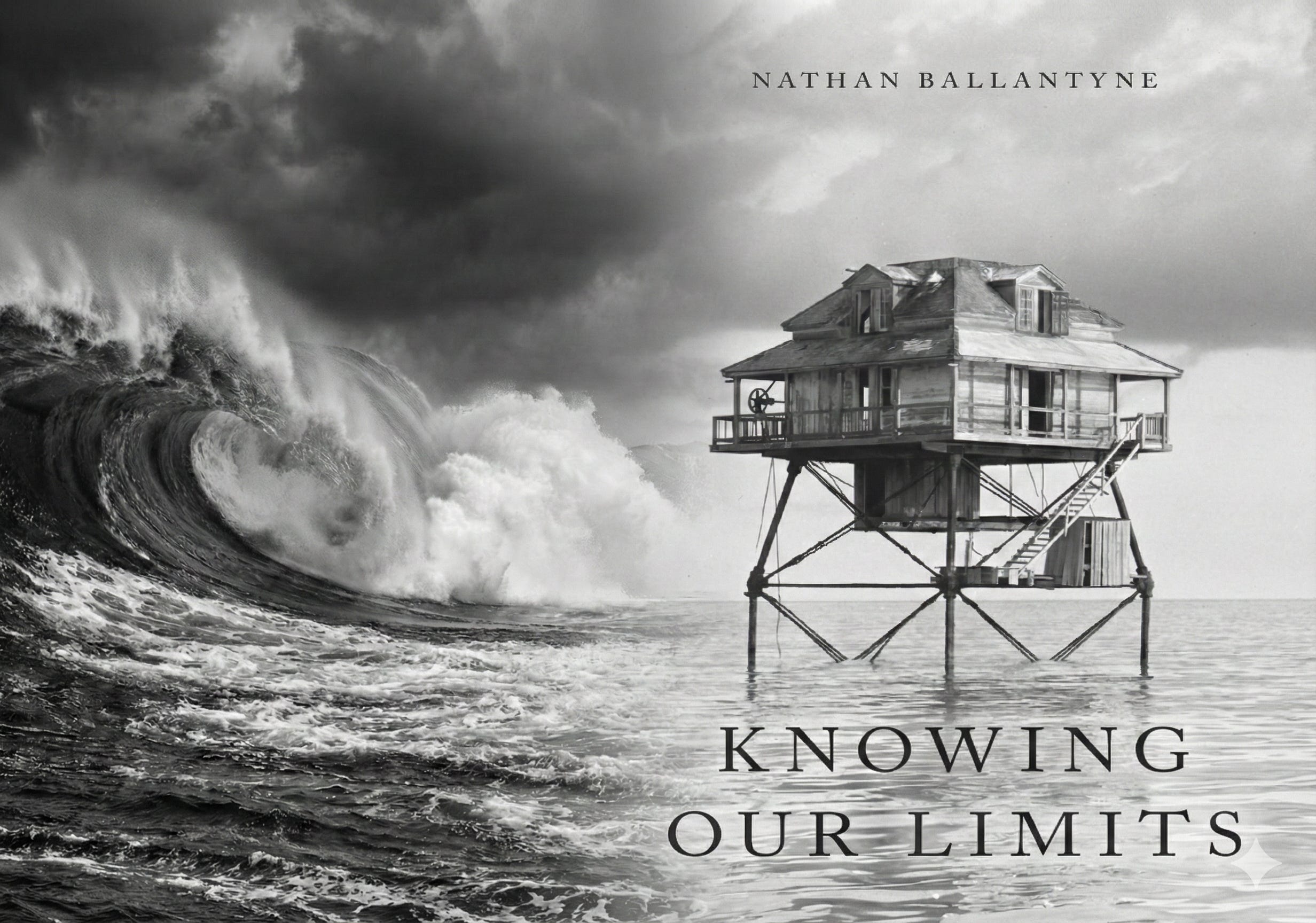
Published: 2019
344 Pages
Briefly, what is this book about?
Regulative epistemology as opposed to descriptive epistemology. Put more simply, this is about how to find truth, as opposed to how to define truth. Though because the author recommends having very high standards, you may come away from the book thinking that there is no truth. That is not Ballantyne’s intent, but most of his guidance revolves around less confidence rather than more confidence.
There is some good stuff about tolerance, and the utility of doubt. And while I take issue with some of what he says on the subject of expertise, he covers the subject exhaustively and thought-provokingly.
What authorial biases should I be aware of?
Ballantyne isn’t just interested in epistemology. He doesn’t dabble in it. He is epistemology, or rather an epistemologist. Accordingly, even though it’s apparent that he’s trying really, really hard to not make the book overly academic, it’s still pretty academic. For example:
If an undefeated defeater for believing p were included in the evidence I don’t have, then I (probably) would have heard of it by now. But I have not heard of it and the “silence” gives me reason to think that the unpossessed defeater is probably defeated.
He’s a big fan of the word defeater, and various constructions involving the word. In the course of a few pages he uses the term “defeater-defeater” seventeen times.
Who should read this book?
Epistemological collapse is the major crisis of our time, so on some level it’s probably useful to read everything you can get your hands on. (Which was my big reason for reading it.) But, as much as I crap on Yudkowsky’s Rationality: From AI to Zombies I’d probably read his chapters on Bayes’ Theorem before reading this.
I heard about the book on Jesse Singal’s substack. He was much more bullish on it. So you might read that if you’re interested or on the fence.
Specific thoughts: Lots of epistemic tools, Ballantyne really only covers one
On the one hand this is a great book about intellectual tolerance, being open to doubt and uncertainty, and refraining from judgement on controversial topics. On the other hand I can’t believe that the word “Bayes” doesn’t appear even once in the book. Allow me to explain.
Ballantyne offers numerous forms of epistemic guidance. This advice includes stuff like: employing metacognition, imagining counterfactual interlocutors, awareness of unpossessed evidence, etc.
Out of all this guidance the two that stuck out to me were:
Be wary of epistemic trespassing: That is making confident proclamations about areas where you lack familiarity with the evidence, and the tools to interpret that evidence. Investigation is fine. High confidence is not.
Seek out collaboration: As many questions sit at the intersection of disciplines, if you are going to trespass, acquire a guide. They should hopefully not only provide competence, but criticism.
You can see where these two points sit very much in the middle of the many questions of expertise that plague current discourse. But at the moment I’d like to focus on the idea that Ballantyne himself should perhaps have trespassed, or collaborated a little more. Because the book he produced was remarkably narrow.
I’m sure that on some level this is an oversimplification, but, basically for Ballantyne things are either true or not. They are defeated, or they are undefeated. On some level he’s clearly right, something is either true or it’s not, but, as he also points out, it is very difficult to establish the truth of something. There may be arguments you haven’t encountered, evidence still to be gathered, or a methodology you don’t possess. This leads him to repeatedly recommend doxastic openness ”a doubtful or unsettled mindset toward a special class of beliefs”. With the special class of beliefs being basically anything controversial. But, if you’ve come across Bayes’ Theorem, you know that there’s another way.
I’m guessing most readers have heard of Bayes’ Theorem, but if you haven’t: it’s a rule for updating the odds for something being true when you come across new evidence about that “something”. You start with an initial probability (what people call your “priors”), consider how likely the evidence would be if the claim were true versus false, and that gives you a new probability. Using this method you’ll never reach 100% certainty (or 0% for that matter) but it’s a great way of dealing with precisely the problem Ballantyne mentions, and he never so much as alludes to it. And when I was reading it I couldn’t understand why there was this glaring hole.
I asked Gemini and it said:
Ballantyne omits Bayes because he is writing a practical guide for limited humans using the language of traditional epistemology (defeaters/justification) rather than writing a formal theory for ideal agents using the language of mathematics.
I’ll be the first to tell you that Bayes is impractical, but I’m not sure telling people to “think that the unpossessed defeater is probably defeated” is any better. I do think that Gemini is right on target to point out that Bayes just isn’t part of Ballantyne’s branch of epistemology, which is illustrative of the whole problem. In the epistemic hellscape we’re currently in, we need all the tools we can get, and restricting your book to a specific branch from one slice of philosophy, which is already a niche subject, seems perverse.
In order to understand the challenge we face, let me offer up a story from the book.
Bethe remarked that convincing them was like “carving a cubic foot out of a lake”. Bethe argued that every energy system has risks; but the risks of nuclear power were manageable, and nuclear power could actually deliver more energy with less environmental risk than the alternatives. One historian recounts a story Bethe told about speaking to an audience in Berkeley, California: “After [Bethe] had presented his position on the need for nuclear power, a woman in the audience stood up, turned her back on him, and shouted, ‘Save the Earth!’ The crowd reacted, he said, with ‘thunderous applause’ ” (Walker 2006, 21). Let’s hear it for the antinuclear novices! Their values prevented them from seriously considering Bethe’s claims. Intoxicated with solidarity and righteousness, they spurned the physicist.
I’m not necessarily saying that using Bayes in this situation would have produced better outcomes than talking about defeaters. Obviously a big part of the problem is that by the time the woman is yelling “Save the Earth!” it’s already too late.
As near as I can tell that incident happened in the mid 70’s, I don’t think things have improved since then. I think we’re going to need all the tools we can get if we’re going to pierce the polarization and the panic.
What tools would I recommend? I already mentioned Bayes, but beyond that there are several others that deserve a brief mention. While Ballantyne doesn’t cover Bayes, he does mention using virtue. This comes as part of his discussion of the origins of modern epistemology. Apparently there were two branches. One focused on rules, and the other focused on virtue. Ballantyne mentions both before declaring that his book will be focused on rules. I understand why he did this, I’m sure virtue fell into the same category as Bayes, something outside his wheelhouse, but at least it got a mention. But when we consider the speech in Berkeley, one can imagine all sorts of virtues that might have helped. Intellectual curiosity, humility, respect for other opinions. Even the attribute Ballantyne prizes the most, “doxastic openness” might be easier to imbue as a virtue than teach as a rule.
My favorite form of epistemology is to pick a course that minimizes Black Swans. You’re less interested in truth than in survival. And I realize it’s a stretch to call it epistemology, but it’s very much a method for making decisions under uncertainty, which is kind of the whole point of having an epistemology. I don’t have the time to get into it here, but if you’re curious you can read about it in my post “Review of Rationality: AI to Zombies”. And I specifically speak to the Bethe/nuclear power situation in my post “Nuclear Power And Winning Through Intolerance”
Epistemic guidance is desperately needed, and this book provided it, I just wish it hadn’t been so narrow.
—-------------------------------------------------------------------------------
I’ve got to start writing shorter reviews. I spent too much time on Bayes, and I’m not even that big of a fan, but the omission seemed very strange. It would also be a strange omission if I didn’t mention subscribing, or liking, or all the other stuff that comes at the end of something like this. So assume that I did, and you were very moved. Perhaps because you were feeling virtuous…
This was great as usual
>"My favorite form of epistemology is to pick a course that minimizes Black Swans. You’re less interested in truth than in survival. And I realize it’s a stretch to call it epistemology, but it’s very much a method for making decisions under uncertainty, which is kind of the whole point of having an epistemology."
Ha, you definitely pre-empted my objection. Perhaps one would say you care about epistemological triage?
Anyhow, thanks for the review. Epistemology is a dry topic, and it doesn't sound like the author moistened it much, but I enjoyed your bite sized overview of his contribution.