

I.
On January 2, 2023, I made a bet with Conrad Barski (@lisperati) that an AI would not solve a Millennium Prize Problem before the end of 2026. I offered this bet to other people afterwards, and no one was willing to take Barski’s side of the bet. Everyone agreed that I was almost certainly going to win, and they were all a little bit baffled at Barski’s optimism.
This summer, while out at the LessOnline conference in Berkeley, I had the honor of meeting Barski in person, and even he confessed that it looked like I was going to win, but that it was going to be close. As presumably all of you now know, I did not win that bet.1
Now, I did put a clause in the bet that it couldn’t be some kind of brute-force solution. It couldn’t be something that could have been done pre-AI if you were just willing to spend unlimited compute time. In this I was thinking of a case like the 1976 proof of the four color theorem.2
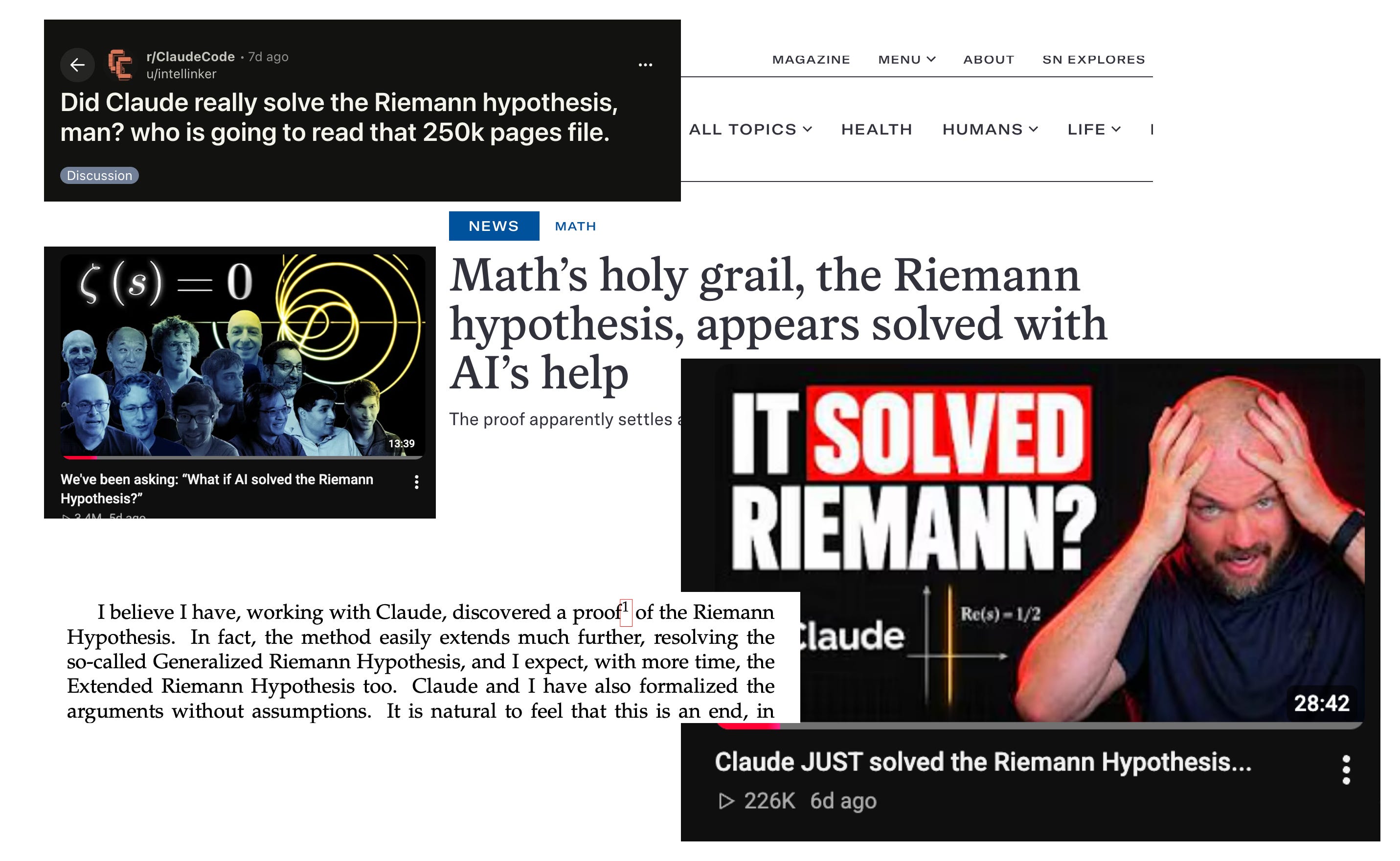
If you’re familiar with the story of the two problems that have (provisionally) been solved—Navier-Stokes and Riemann—neither solution would be called elegant by any stretch of the imagination, and both have elements that gesture in the direction of “brute force”. $10 million was spent on the former and the latter involved a 17-million-line Lean proof. But clearly AI did end up as an essential component, so I have gracefully(?) conceded.3
I made three other formal predictions about AI in this space:
General artificial intelligence, something duplicating all of the abilities of an average human (or better), will never be developed.
A complete functional reconstruction of the brain will turn out to be impossible. For example, slicing and scanning a brain, or constructing an artificial brain.
Artificial consciousness will never be created. (How do we know? Good question…)4
Some people think I’m already wrong about the first prediction, and nearly everyone thinks I will be eventually. I will say both that I should have been more specific on how this prediction could be falsified, and that turning an AI into a proprioceptive entity is still proving to be difficult.
The second prediction is still far away, and unlikely to get much attention as long as LLMs continue to improve.
It’s the third prediction where things get interesting.
II.
My reason for walling off consciousness has as much to do with my religion as with my sense of technological progress. Mentioning the word religion may immediately turn off many of you, but stick with me for a second. Religion, or at least god (small-g), has already entered the room. I’ve talked to several people who are deep in the AI trenches and all of them have mentioned that they’re becoming increasingly convinced we’re in a simulation. As an example of this phenomenon, see Scott Alexander’s recent piece “My AI Opinions” where he gives a 66% probability that we are in a simulation. And once you think there’s a strong possibility we’re in a simulation, the idea of a creator god immediately follows.5
Once you start entertaining the idea that we’re in a simulation, the next natural question is: What’s the simulation for? Nearly every reason I’ve seen offered up for conducting a simulation involves seeing what intelligent entities do in a given circumstance. And quite often what we really care about is whether the entities behave well or poorly. This is the testing we’re already conducting on AI when we attempt to see if it’s “aligned”. And in my opinion this testing works best the more strongly it resembles the real world and the circumstances we encounter as human beings.
This is where my contribution (or delusion) comes into play. If someone believes in simulations, then my assertion would be:
There is a strong resemblance between the kinds of tests/simulations we’re conducting for artificial intelligences and the simulation we’re in.
And I further believe that both simulations are designed to assess the morality of the intelligence under a wide variety of situations.
I understand this is hand-wavy. Back in the day I wrote a whole three-part series about this correlation. I’m not going to recapitulate those three essays here, but I intend to write more about it in the very near future. But to sum up:
If we’re in a simulation and one of the purposes of the simulation is to assess our morality, then our simulation and the simulations we’re creating for AI are basically doing similar things.
III.
Okay, so if you’re willing to entertain the idea that we’re engaged in creating sub-simulations which resemble the simulation we are in, what does that have to do with consciousness? Well, one of the main questions about our own simulation is why does the creator allow conscious entities to suffer? Which means that if we can create conscious entities then we have entered the realm of theodicy. Do the rules of our simulation allow us to create conscious entities that suffer? Many people answer the problem of suffering by imagining an entity capable of crafting a world where suffering exists, but in a way that is ultimately purposeful. But when we imagine such an entity it normally takes the form of an omniscient and omnipotent being. We do not imagine Sam Altman in this role. If the “creator-gods” are powerful enough to create our “simulation” and if they also care about theodicy, then there’s a good chance they recognize that we cannot be trusted with the same responsibility.
Breaking this down we get something like the following:
Our universe/simulation may have been created by morally responsible beings. (If you’re religious you believe it definitely was, but even if you’re not religious you’d assign a decent probability to it. Look at the debates we’re already having about AI consciousness and suffering.)
Creating conscious beings who can experience an inner life of suffering carries enormous moral responsibilities.
We are not equipped to discharge these responsibilities with the same care and capacity as our creators. (See my Sam Altman point above.)
If our creators are moral (see point 1) and powerful enough to create simulations like the one we’re in, they would recognize this problem.
Consequently, they might place limits on our ability to create artificial consciousness, up to and including making it impossible. (And in the latter case my third prediction ends up being true.)
Each step could be objected to on different grounds, and different people would have different objections. The point of this is not to create a logical proof with quod erat demonstrandum at the end. The point is to demonstrate that someone, without reference to God or religion, might plausibly end up reaching the same conclusion I did. My objection to AI consciousness flows from religion, but it doesn’t depend on religion.
Nevertheless, it is worth addressing some common objections.
Clearly, the biggest objection is that we are already allowed to create conscious beings who suffer: children. (Or, depending on your cutoff line for consciousness, there’s also the breeding of livestock.) Religion has obvious answers for this objection, but we can still get here without religion. There are two possibilities for answering it, if we assume this is a simulation.
This simulation has been running for a long time, and evolving “naturally” (evolution works, domestication can happen). And in this area there is likely a long-standing plan to deal with suffering. As such, all of the things mentioned are part of a standard unfolding simulation. But creating a sub-simulations would still be a difference of kind, not of degree, and it’s not unreasonable to imagine that the “creator” would draw a bright line at that point.
The simulation has been created around this moment and our “history” is entirely fictitious (rather than real but simulated). This is the weirder situation, though it’s the one Alexander is toying with. In this case, this moment is the hinge of the simulation, and if it’s designed to model anything, a model testing whether we will create conscious beings without considering the theodicy of the act is as good a candidate as any. And given the great evil we might end up committing should we succeed, the creator would stop things between clear intent, and actual success.6
In other words, I believe the creator (whatever entity that might be) will not allow us to create conscious beings for deep theological reasons. But it seems entirely possible that if one believes we’re in a simulation, we might be prevented for reasons which are entirely secular, albeit very science-fiction-y. Finally I think even secular people need to give serious thought to the idea that while we’re busy testing AI alignment, someone else is busy testing ours.
—-------------------------------------------------------------
I was going for a Robin Hanson-esque “let me explain this deep concept in 300 words” format, but I’m afraid there is only one Robin Hanson, though I wish there were more. If you think I’m even a little bit Hanson-y (and you enjoy him rather than loathe him—I’ve met both types) consider subscribing.
The terms were $100. He graciously said I could add it to my next EA-esque donation. I used it to buy pizza for one of the EA college meetups, though I did not attend the actual meetup on account of my advanced age.
The proof reduced the problem to 1,936 configurations, which were then checked by a computer. Reducing it to 1,936 configurations took a lot of skill, but the actual proof came out of the computational horsepower, which was impractical to check by hand.
You’ll be the judge of my grace after you’ve heard the full argument about how I’m still right on the broader picture.
Full disclosure: the parenthetical on this point has been changed from my original formulation because I’m older and wiser, and it was a parenthetical, not the prediction. I wish there were some easy way to falsify this (a position I share with numerous neuroscientists and philosophers) but I also think this touches on the fundamental mysteries of existence (a position I share with fewer neuroscientists and philosophers).
Yes, I understand that our simulation might be created as part of 10,000 simulations, and that these 10,000 simulations might have been created by one AI agent out of 500 that were created to test one part of some future post-human’s doctoral thesis, but this is still well-covered territory religiously. There is still a prime mover.
Very similar to how we test AI alignment by giving artificial intelligences the apparent opportunity to do things while preventing them from actually doing them. Except we’re bad at it (see Hugging-face) which is kind of my whole point.