

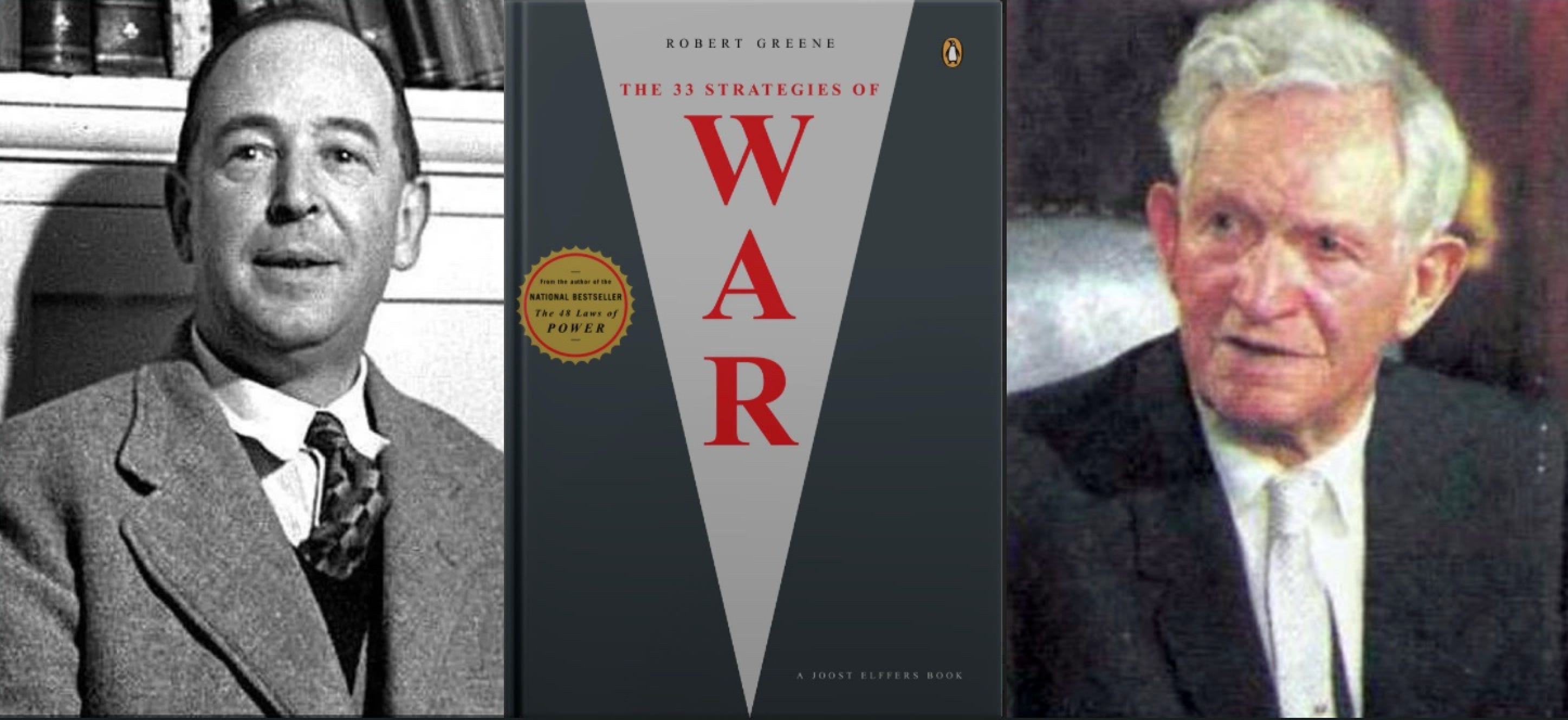
There’s a concept within statecraft known as grand strategy. The “grand” strategy means paying attention to every avenue of conflict, not just the military sphere, but also the diplomatic, the logistical, and the domestic, and everywhere else advantage might be gained or lost. It encompasses soft power, irregular actions, public opinion, etc. But at the same time, it also encompasses prioritization and focus, because, while it’s important to consider every avenue, resources are always limited and need to be spent wisely.
A great example of grand strategy done right is the US in WWII. We supported the Soviets, we developed nukes, we invaded Europe, we came together as a nation, and most of all, we buried the Axis with our industrial capacity.
For an example of grand strategy done poorly consider Vietnam. Our battlefield tactics were great. But at the strategic level we comprehensively failed in almost every domain. There was vast domestic opposition, political goals were unclear, we failed to contain the conflict geographically, and never really understood the resolve of the Vietnamese people.
You might think that the point of grand strategy, if well executed, would be winning. I disagree, I think the point of grand strategy is not losing. (There’s probably an essay to be written about how this applies to Iran, but I think we have enough hot takes on that subject at the moment.) Grand strategy asks you to pay attention to all potential avenues by which disaster may arrive. Disaster in Vietnam did not arrive through the front door, it came from many unexpected directions, but an unexpected disaster is still a disaster, and generally worse than disasters which have been foreseen.
As one considers the various aspects of grand strategy, what would it mean to have a personal grand strategy? And how would that be different from just living a “good life”? As a bridge between these two ideas, consider the life of Napoleon. Something Robert Greene does at great length in his book:
By: Robert Greene
Published: 2006
496 Pages
Briefly, what is this book about?
An overview of 33 different strategies with broad utility in both literal and figurative war. Each strategy gets its own chapter which includes things like: Do not fight the last war, segment your forces, create a threatening presence, expose and attack your opponent’s soft flank, sow uncertainty and panic through acts of terror. The thing I love the most about this book are the stories Greene includes to illustrate the various strategies, and the many fantastic quotes he sprinkles in the margins.
What authorial biases should I be aware of?
It’s difficult to get a read on Greene, is he a modern Machiavelli, recommending that you wage continual war in every aspect of your life? Or does he offer up these ideas in sort of a “break in case of emergency” fashion?
Who should read this book?
I really like this book. I think I’m mostly attracted to the great stories of men pulling off amazing feats of strategic brilliance in the face of overwhelming odds. But I also think that, while I would never recommend going full Machiavellian, most people could be more strategic about how they run their life. Certainly I could.
Specific thoughts: So anyway, you were saying? Something about Napoleon?
Back to Napoleon and the idea of personal grand strategy. Greene loves Napoleon, and, without actually counting, I would say that at least half of his chapters bring in some story about Napoleon. (Maybe it’s not quite half but it’s definitely a lot.) In the beginning these stories are all about his surpassing genius, and the surprising strategies he employed to win at Austerlitz and Jena. But as you get closer to the end of the book Greene includes Napoleon’s disastrous invasion of Russia, and, more interestingly because I wasn’t familiar with it previously, Napoleon being socially outmaneuvered by Metternich.
When I first read this book over a decade ago, this contrast really struck me, the idea that Napoleon could be so cunning in one area, but so naive in another. At the time I was fighting something that felt like a war (it was near the end of my time in the company that would eventually sue me) and the book really spoke to me. But I think the idea of “losing” because of a blindspot is the thing that really stuck with me. You might even say it haunted me.1
Of course I was not engaged in a giant war with other great nations. I was just a guy trying to figure out life. As I said, it wasn’t too long after reading this book that I was sued, and I think this book helped. I did win the lawsuit.2 But mostly what this book did was leave me with high level questions. I didn’t find myself “attacking my opponents soft flank” but I did end up being very interested in what a grand strategy of life might look like. What were my objectives? What were the potential blindspots? How could I make sure I didn’t lose?
These are all interesting questions, but for most people they’re also fairly personal as well. Despite this personal nature I think that these days most people are failing in the same way that Napoleon was. They’ve put an enormous amount of focus on being really good in one or two domains and they end up being brought down in areas they dismissed. They spend a lot of time making sure they have a great career. Or, in a similar vein they really focus on being “fulfilled” or “happy” thinking that life is all about maximizing hedonic output. In either case they end up never getting married and having kids.3 And when the end of their life comes, that career they spent so much time on, or all the time they spent on themselves ends up feeling pretty hollow.
There’s a saying from David O. McKay, one of the LDS prophets, that speaks to this particular failure mode: “No other success can compensate for failure in the home.” Of course McKay was assuming that there was some kind of home, that people were married with kids, and then spending too much time at the office, or something like that, but these days a lot of people don’t even get that far.
This probably all sounds like the typical moralizing of a conservative religious guy, so let me pivot to a completely different example to illustrate what I mean. Perhaps the best known, fictional account of Buddhism in the west is Siddhartha by Herman Hesse. In the book Siddhartha achieves enlightenment. He does the thing that so many people are searching for and yet he can’t figure out how to be a good son or a good father. I realize it’s fictional, but how many people do something very similar? How many people claim to be paragons of enlightenment, but can’t manage to stay married or get married?4
You may think I’m placing too much emphasis on marriage, but this takes me to my last point. In addition to having a personal grand strategy it’s even more important that we have some kind of national, or even civilizational grand strategy. Perhaps we do, but if so it’s failing in the same way Napoleon failed. We have enormous material wealth, luxuries that were undreamed of for 99.99% of human history. And yet despite these great victories, we’re failing in the one area that matters most, we’re not having enough kids. What does it matter if Napoleon wins on the battle fields of Austria, but gets out maneuvered in the court of Austria? What does it matter if the U.S. wins the AI race in the next decade, but collapses demographically in the next century?
As usual other people have said all of this better than me, so to end I’ll turn to one of them. In this case C.S. Lewis:
To be happy at home, said Johnson, is the end of all human endeavour. As long as we are thinking only of natural values we must say that the sun looks down on nothing half so good as a household laughing together over a meal, or two friends talking over a pint of beer, or a man alone reading a book that interests him; and that all economics, politics, laws, armies, and institutions, save in so far as they prolong and multiply such scenes, are a mere ploughing the sand and sowing the ocean, a meaningless vanity and vexation of spirit.
—--------------------------------------------------------
As I prepare to, once again, do the bare minimum of self-promotion I wonder where such an endeavor rests in the universe of personal grand strategy. There certainly seems to be a lot of it these days, but I’m not sure how effective any given instance of it is. Self-promotion feels like something with high variance. Some people achieve quite a bit of success with it, while other people are so interested in success at any cost that they hitch their “self” to angry mobs and partisan prostitution.
Perhaps this is another area where it’s more important to not fail than to dramatically succeed. At least that’s how I excuse my own pathetic efforts on this front.
Speaking of pathetic efforts, be sure to subscribe! And like the post I guess…
Oh, and also any thoughts on this kind of essay/kind of book review format?
This might even explain why, when I read Black Swan and Antifragile a couple of years later, they had such an impact, though I think I was dispositionally attracted to ideas like this before I ever read 33 Strategies.
It didn’t feel like winning, but we ended up spending probably ⅕ of what the other side spent, so as an attritional defensive action I feel pretty good about it.
I know that many people want to get married and have kids and are unable to find someone. I think recent technological innovations have made things far more difficult than they were in the past. So I differentiate between those who avoid marriage because they have other priorities and those who wish to get married and are unable to.
At the moment I’m thinking of two people (though I’m sure the right AI prompt would come up with at least a half a dozen more) Bryan Johnson, who is apparently founding a new religion, and yet turns out to be a gigantic douchebag to his romantic partners. And Simon Sinek who goes on and on about human connection and yet seems to have basically decided that marriage is too hard. (I’m not a big Sinek fan…)
Y'know, it was only on reflection that I realized this was a new combo review/essay format — it felt like a natural extension of what you've already been doing. Which is to say, I like it, and lots!
This is a good format, but it's only a little bit new. That is, the delight in a good book review is when the writer (ie, you) extend and give your own informed take on the concept. This is that, perhaps just a bit moreso?
In any event using a book as a springboard is a good way to have new and relevant content.