

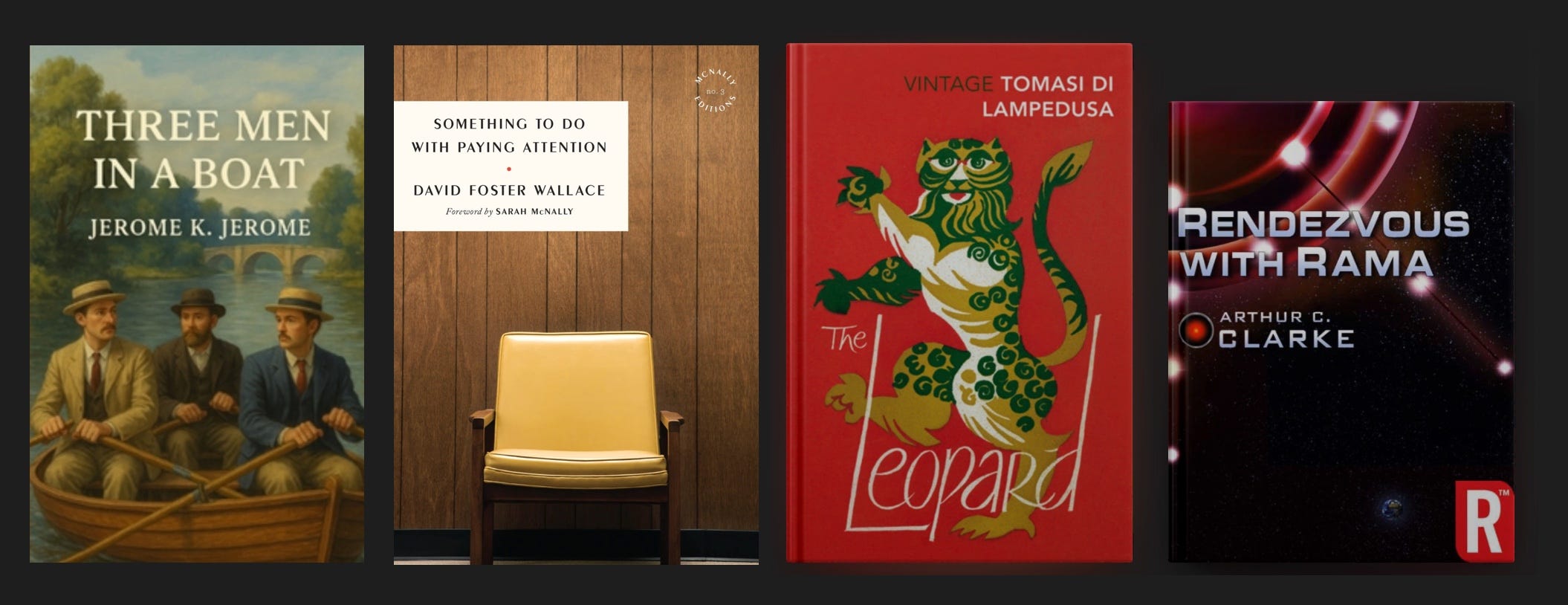
Three Men in a Boat (To Say Nothing of the Dog) by: Jerome K. Jerome
Something to Do with Paying Attention by: David Foster Wallace
Mark Twain remarked once, quoting someone else, that a classic is “something that everybody wants to have read and nobody wants to read.” Well I’m here to make the whole reading process easier with these short, easily digestible classics. Now you’ll be able to claim erudition without having to slog through 800 pages of Dostoevsky. (Though actually Dostoevsky isn’t a slog, he’s great, and I’ll have a review of Demons/Devils in the next month or so. Moby Dick on the other hand…)
Three Men in a Boat (To Say Nothing of the Dog)
By: Jerome K. Jerome
Published: 1889
102 Pages
Briefly, what is this book about?
Three friends and their dog go on a river holiday up the Thames. Victorian-era hilarity ensues. It’s essentially a series of funny anecdotes stitched together.
Who should read this book?
If you like dry, witty British humor and straight faced, but comical exaggeration, you’ll love this book. But you don’t have to guess at whether it’s your sort of thing. It’s in the public domain, just read the first half dozen or so paragraphs, and if you chuckle at any of it, then you ought to read the rest.
Specific thoughts: Comically exaggerated, but surprisingly relatable.
Having traveled with friends, family, and most of all kids, I could really identify with these stories. Something crazy is always happening, and of course later, it grows in the telling. There are a ton of great stories in the book and I would have a hard time picking a favorite. But I think this excerpt will give you a good sense of the book’s style and humor. One of the friends suggests making “Irish stew” which is just an excuse to throw in any leftovers. Things start out normally enough but soon they’re throwing in things with abandon. It’s at this point that the dog, Montmorency, shows up.
I forget the other ingredients, but I know nothing was wasted; and I remember that, towards the end, Montmorency, who had evinced great interest in the proceedings throughout, strolled away with an earnest and thoughtful air, reappearing, a few minutes afterwards, with a dead water-rat in his mouth, which he evidently wished to present as his contribution to the dinner; whether in a sarcastic spirit, or with a genuine desire to assist, I cannot say.
We had a discussion as to whether the rat should go in or not. Harris said that he thought it would be all right, mixed up with the other things, and that every little helped; but George stood up for precedent. He said he had never heard of water-rats in Irish stew, and he would rather be on the safe side, and not try experiments.
Harris said:
“If you never try a new thing, how can you tell what it’s like? It’s men such as you that hamper the world’s progress. Think of the man who first tried German sausage!”
Ah, yes, the Victorian era, when you could always make a joke at the expense of the Germans.
Something to Do with Paying Attention
Published: 2022
136 Pages
Briefly, what is this book about?
When Wallace died, he left behind an unfinished novel, The Pale King. Much of the novel was basically done, and this book represents the longest finished section of the novel. It follows Chris Fogle as he recounts his conversion story from “wastoid” to proud employee of the Internal Revenue Service. And no, Wallace is not being ironic.
Who should read this book?
I’ve read Infinite Jest, so it’s not as if I’m unfamiliar with Wallace, but I hadn’t heard of this book until Ted Gioia mentioned it in his “Where to Start in Reading David Foster Wallace” post. And he was right, this is a great place to start. So if you’ve always wanted to dip your toe into Wallace, I would read this book. And hopefully that will inspire you to ignore the haters and go on to read Infinite Jest. If you have already read that, and enjoyed it, then I’m sure you’ll enjoy this as well.
Specific thoughts: A story about attention, but also about the duty to pay attention to the right thing.
Wallace was very much a student of attention, particularly later in life, and this book is a distillation of some of his most profound thoughts on the subject. (I really wish he was still around so he could comment on the current attentional war of all against all.)
Fogle begins the book very much paying attention to the wrong thing. He’s ostensibly in college, but only because that’s the kind of thing people of his age and class do. To the extent that he has a vocation, it’s to smoke weed and watch daytime soap operas. (He has a great epiphany when he realizes that he is watching As the World Turns both literally and figuratively.)
At around the midpoint of the book he has a conversation with a devout Christian girl one of his friends is dating. She ends up telling him her conversion story, which Fogle is very dismissive of. But later he ends up having a very similar conversion story when he happens to wander into the wrong class: the final session of Advanced Tax. Serendipitously allowing him to hear the closing advice given by the substitute teacher, who may or may not be a Jesuit priest. It’s a brilliant scene and a brilliant speech all about the duty and indeed heroism of paying careful attention to the right things:
Continuing on without pause, he said, ‘Exacting? Prosaic? Banausic to the point of drudgery? Sometimes. Often tedious? Perhaps. But brave? Worthy? Fitting, sweet? Romantic? Chivalric? Heroic?’ When he paused, it wasn’t just for effect—at least not totally. ‘Gentlemen,’ he said, ‘—by which I mean, of course, latter adolescents who aspire to manhood—gentlemen, here is a truth: Enduring tedium over real time in a confined space is what real courage is. Such endurance is, as it happens, the distillate of what is, today, in this world neither I nor you have made, heroism. Heroism.’
…
This may be the first time you’ve heard the truth put plainly, starkly. Effacement. Sacrifice. Service. To give oneself to the care of others’ money—this is effacement, perdurance, sacrifice, honor, doughtiness, valor. Hear this or not, as you will. Learn it now, or later—the world has time. Routine, repetition, tedium, monotony, ephemeracy, inconsequence, abstraction, disorder, boredom, angst, ennui—these are the true hero’s enemies, and make no mistake, they are fearsome indeed. For they are real.
I won’t spoil it any more than that, but I think it ranks up there with some of the best speeches in literature.
On top of everything else, the book also covers the divorce of Fogle’s parents, his father’s horrible death, several humorous asides about accounting, college students, and the culture of the IRS. There is a lot going on in 136 pages. I would urge you to pick it up.
The Leopard
By: Giuseppe Tomasi di Lampedusa
Published: 1958
248 Pages
Briefly, what is this book about?
This is an atmospheric novel about the fading of history, the regrets of an old man, and the melancholy of change. The main character is Don Fabrizio, who belongs in the pantheon of the great figures of literature. He’s a Sicilian prince navigating the Risorgimento, the unification of Italy, with all of its upheaval. Nothing especially bad happens to him, but there’s a tragic beauty to the old ways, and a frenetic ignorance of the new that makes the whole novel gorgeously sad.
Who should read this book?
This is a book you read for the characters and the amazing prose. There’s not much of a plot, but the writing is elegant and enveloping, even in translation.
Specific thoughts: Does this sort of thing ever apply to our own situation?
One is tempted to look for echoes of our current situation in the upheavals of the past. I would say that I am particularly prone to these sorts of readings. Usually, it’s overfitting. The past may rhyme, but it rarely repeats. With these caveats in mind, there were a couple of incidents that I thought were particularly evocative.
Very early in the book Don Fabrizio goes walking in his garden, and he’s reminded of an incident from not long ago.
He remembered the nausea diffused throughout the entire villa by certain sweetish odours before their cause was traced: the corpse of a young soldier of the Fifth Regiment of Sharpshooters who had been wounded in the skirmish with the rebels at San Lorenzo and come up there to die, all alone, under a lemon tree. They had found him lying face downwards in the thick clover, his face covered in blood and vomit, crawling with ants, his nails dug into the soil; a pile of purplish intestines had formed a puddle under his bandoleer. Russo the agent had discovered this object, turned it over, covered its face with his red handkerchief, thrust the guts back into the gaping stomach with some twigs, and then covered the wound with the blue flaps of the cloak; spitting continuously with disgust, meanwhile, not right on, but very near the body. And all this with meticulous care. “Those swine stink even when they’re dead”. It had been the only epitaph to that derelict death.
After bemused fellow-soldiers had taken the body away (and yes, dragged it along by the shoulders to a cart so that the puppet’s stuffing fell out again), a De Profundis for the soul of the unknown youth was added to the evening Rosary; and now that the conscience of the ladies in the house seemed placated, the subject was never mentioned again.
No, the dead man had not been mentioned again; and anyway soldiers presumably become soldiers for exactly that, to die in defence of their king. But the image of that gutted corpse often recurred, as if asking to be given peace in the only possible way the Prince could give it; by justifying that last agony on grounds of general necessity. And then around would rise other even less attractive ghosts. Dying for somebody or for something, that was perfectly normal, of course: but the person dying should know, or at least feel sure, that someone knows for whom or for what he is dying; the disfigured face was asking just that; and that was where the haze began.
My apologies for the long excerpt, but there’s a lot going on, and all of it is intriguing and I think important. It really does strike me as being a metaphor for our own situation. First you have a nobleman’s garden, with all that entails of luxury and wealth. Our own world might be said to be such a garden, but in the garden is a dead soldier, and Lampedusa goes to great lengths describing the horrible condition of his body. It doesn’t seem like too much of a stretch to imagine this represents the Ukraine War, or more recently the situation in Iran.
Then we have the various reactions of the characters. The soldier was fighting on the side of the Royalists, against unification, so he’s a defender of the old order, and by extension on the side of Don Fabrizio. But Russo, the Prince’s agent, is a member of the middle class. He can see which way the wind is blowing (and to be fair, so can the Prince, that’s the whole point of the novel) and so he curses the soldier as a swine. Yet, he’s still happy to work for the Prince. We see similar fracturing inside our own household/nation.
The ladies are initially horrified, but a De Profundis (a prayer for the souls of the dead) is added to their evening prayers and soon they have forgotten all about it. We see something similar in our own time, spurts of outrage on social media about this or that injustice, which are quickly forgotten and never brought up again.
Finally there’s Don Fabrizio, the wisest character in the book. And for him, it brings up existential questions. Is any of the killing necessary? Why did the soldier die? And as he grapples with the questions, “that was where the haze began”.
The other scene I want to highlight, albeit more briefly, occurs at the very end of the book. Don Fabrizio is long dead, but his three spinster daughters remain. Despite the tumult of the Risorgimento (now decades in the past) they have maintained some of the family’s wealth. One of the daughters, Carolina, has a mania for religious relics, and a shady supplier willing to take advantage of this mania. One of the other daughters, Concetta, the one most like the Prince, supplies the money for these relics. She does this not out of belief, but more to placate her sister. At some point the family chapel needs to be “recertified” and the local the cardinal comes by, and his secretary stays behind to inspect all of the relics. A few are considered to be genuine and allowed to remain in the chapel, while the vast majority are declared to be fakes, which means they need to be removed. Including a picture that hung over the altar that was supposedly the “Madonna of the Letter”, but in actuality was just a girl waiting for her lover.
I imagine that we’re doing something similar, collecting hollow luxury beliefs that bring us comfort as the world around us gradually transforms. But at some point there will be an accounting and the beliefs we’ve enshrined will turn out to be hollow and meaningless. Hopefully some of those beliefs remain. Hopefully we will be left alone to live in peace in the crumbling remains of our former palace. But it’s also possible we’ll end up face down next to a lemon tree, with ants eating our body, our intestines in a pile next to us, dead from a battle we neither chose nor understood.
Rendezvous with Rama
By: Arthur C. Clarke
Published: 1973
248 Pages
Briefly, what is this book about?
The year is 2130 and a giant, fifty-kilometer-long, spinning cylindrical object enters the solar system having traveled for hundreds of thousands of years through the depths of interstellar space. It’s given the name Rama, and it’s moving fast enough that only one ship, Endeavour, is in a position to intercept and explore it. The book recounts the crew’s exploration of the object’s hollow interior, including enigmatic cities, an ocean which circles the cylinder like a belt, and six gigantic strips of light which act as an artificial sun, among other things.
It also deals with the reaction of the humans observing from afar, their hopes, fears, and predictions. It’s a classic hard science fiction novel which won both the Hugo and the Nebula.
Who should read this book?
There’s not a lot of character development or even much plot to the book. It’s more of an exploration of ideas. There’s the exploration done by the characters and the exploration done by the author, and both are handled with exceptional competence.
Specific thoughts: What Clarke gets right and what he gets wrong
Clarke gets a number of things “right”. He accurately describes how spin gravity would work. He correctly models how the sea would thaw from the depths, leaving a shell of ice at the top. He accurately models how the atmospheric heating as Rama gets closer to the Sun would cause powerful winds. He creates mysteries for the crew, which end up having logical explanations. The interior sea is reached from a 50-meter cliff on one side and a 500-meter cliff on the other side. This doesn’t seem to make much sense until they realize that the higher cliffs are closest to the engines, and they need to be higher to keep water from sloshing out when the ship is under thrust. It’s all impressively thought through in the way you expect from Golden Age Science Fiction.
On the other hand, most of his predictions for what future human society would be like turned out to be wrong.
He thought overpopulation would continue to be a major problem. (People need permission to have babies.)
He imagined that the tracking of dangerous asteroids would only begin in 2077, and only after a major asteroid strike of the Earth.
He didn’t foresee drones. (They would have made Rama exploration way easier.)
He thought communication would still be expensive and limited, despite the fact that he imagines that humans have spread out across the solar system.
He imagines that humans would be unified under a UN-like structure, the United Planets.
They can genetically engineer intelligent chimps (“Simps”) but broader human gene treatments are surprisingly underdeveloped.
But there are two big things outside of these more understandable misses that I’d like to focus on.
First, Clarke did that thing where there’s a few brilliant scientists who’re smart enough to see all the implications. All of the stuff I mentioned above, the sea thawing, the cliffs being higher on one side than the other, the hurricane force winds? All of those things were intuited by a handful of scientists who were part of the Luna-based Rama Committee. (And most of the heavy lifting was done by just one scientist, Dr. Perera.) In our day and age there would be thousands of scientists working on things, and stuff like the gigantic windstorm would be figured out before the astronauts even entered Rama, conditional on there being gas inside the cylinder. Once it was discovered what kind of gas was in the cylinder, they would just be refining their estimates.
So why does Clarke write it the way he does? Certainly it makes it more exciting. It reads better. But I also wonder, back in 1973, if it was also closer to the truth. Back then you could still point to individual engineers and scientists having genuinely revolutionary insights, and completely changing the landscape. Enrico Fermi, who was the kind of guy who basically did come up with all the ideas, had only been dead for a couple of decades, and Feynman was still around (and would be for a couple decades more) in 1973. So I think Clarke was definitely simplifying things, but I also think he was describing a real difference between how science worked back then, and how it works now. And I wonder if this difference is bigger than we think…
Second, speaking of Fermi, Clarke has no mention of the famous paradox in his book, though Fermi asked his famous question in 1950. (To be fair the Hart paper that really opened things up was in 1975.) The book doesn’t grapple at all with the mystery of why, nearly two centuries into the space age, Rama is the first hint humanity has of actual intelligent life outside of our solar system. This would be a major oversight in any book written in the last ten years, but I suppose it’s forgivable for a book published in 1973. Still it represents a major lacuna in Clarke’s otherwise very thorough treatment of his idea. I guess he was, and still is, coasting on his invention of geosynchronous satellites. I agree that it was pretty impressive.
—-------------------------------------------
Have you checked out the “voiceover” that comes attached to every post? For book reviews it’s an AI clone of my voice. (The occasional essays are actually read by me.) But I do occasionally toss in an extra flare. So for these reviews I used my special Chesterton AI voice for the quote from Three Men. And I created an all new italian nobleman voice for the excerpt from The Leopard. The Wallace excerpt I kept in my own voice, because of the obvious similarities between the two of us. Sure, generating a new voice requires no more than typing a sentence and pressing a couple of buttons, but I’m the kind of guy who will type that extra sentence and press those buttons for my loyal subscribers. If you want to be one of those subscribers, you know what to do.
For a sci-fi related story to one of your books, try Connie Willis' To Say Nothing of the Dog.
https://www.goodreads.com/book/show/77773.To_Say_Nothing_of_the_Dog
You won't understand the reference until late in the book, but much of it is set in Victorian England and it's pretty funny. Like many authors though, her ending isn't particularly stellar.
I find that's one of the differences between the good and the great: strong endings.
> They can genetically engineer intelligent chimps (“Simps”) but broader human gene treatments are surprisingly underdeveloped.
Maybe they have a taboo on genetic engineering on humans?