

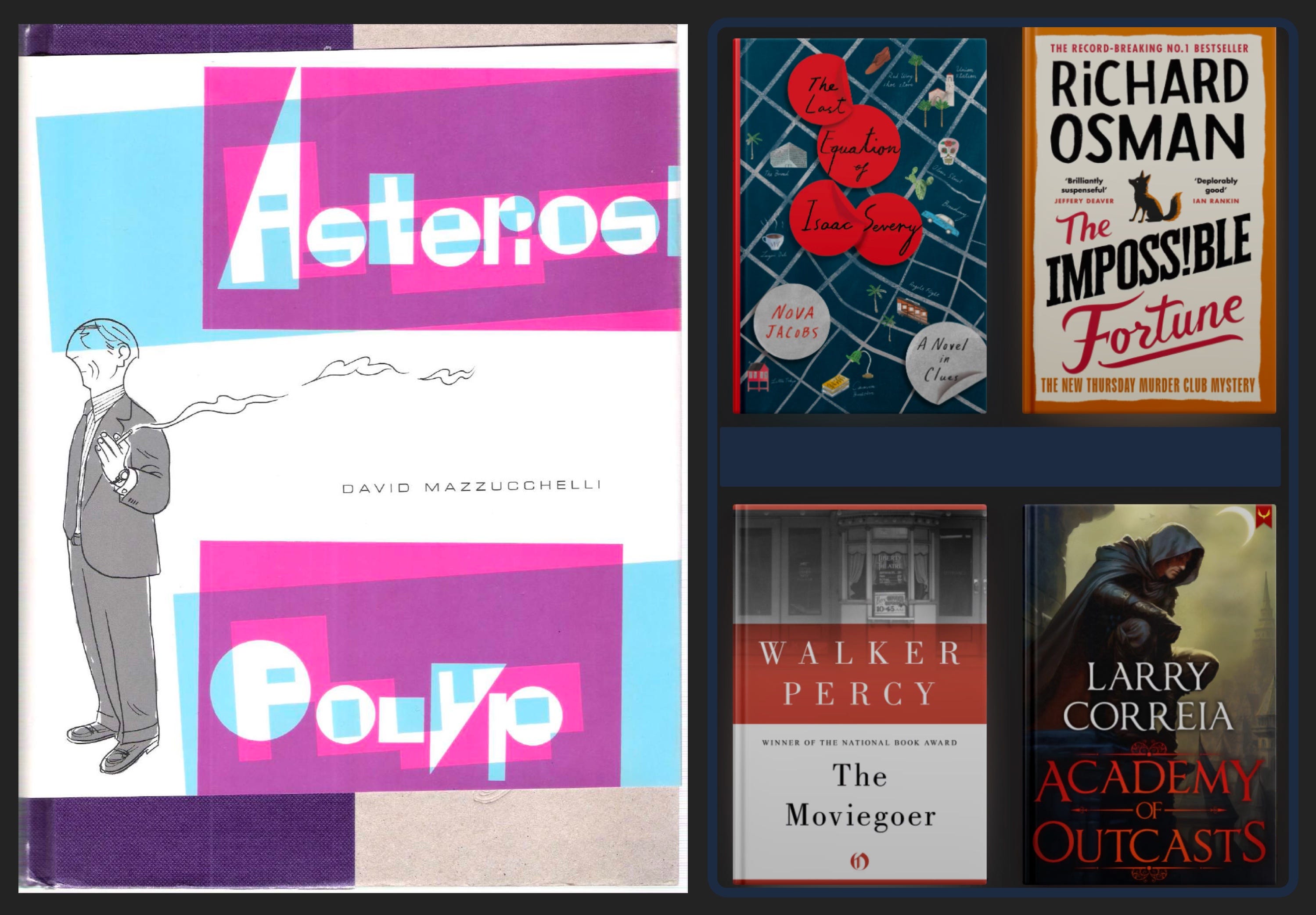
The Last Equation of Isaac Severy: A Novel in Clues by: Nova Jacobs
The Impossible Fortune: A Thursday Murder Club Mystery by: Richard Osman
Asterios Polyp
Published: 2009
344 Pages
Briefly, what is this book about?
A graphic novel chronicling the titular Polyp and his strange life. When it begins he’s living alone after his wife divorced him. On his 50th birthday a lightning strike burns down his Manhattan apartment. In response to this, he takes the last of his cash, buys a bus ticket to the town of Apogee, and gets a job as an auto mechanic. While there he befriends the auto shop owner and his eccentric wife, and reflects back on his life, and particularly his relationship to his ex.
Who should read this book?
If you enjoy the genre of high-brow graphic novels this is right in the sweet spot of that. It should be noted that the book would be rated-R if it were a movie.
Specific thoughts: Very enjoyable, but my enjoyment is hard to pin down
I like Polyp, I even see myself in him a little bit. I too am cerebral, dismissive, and a little bit full of myself. I too have regrets that haunt me. (Nothing as big as Polyp, but it’s surprising how haunted one can be by even small regrets.) But on the other hand his arc, and his specific interests are kind of strange. His trip to Apogee to restart his life is a great plot point, but it also feels like something he wouldn’t have the maturity for. But also you completely overlook that because the situation and the characters are so great.
The graphic novel format is also a fantastic vehicle for the story, but I would have a hard time explaining why it’s so fantastic. Though here’s a snippet to give you an idea:
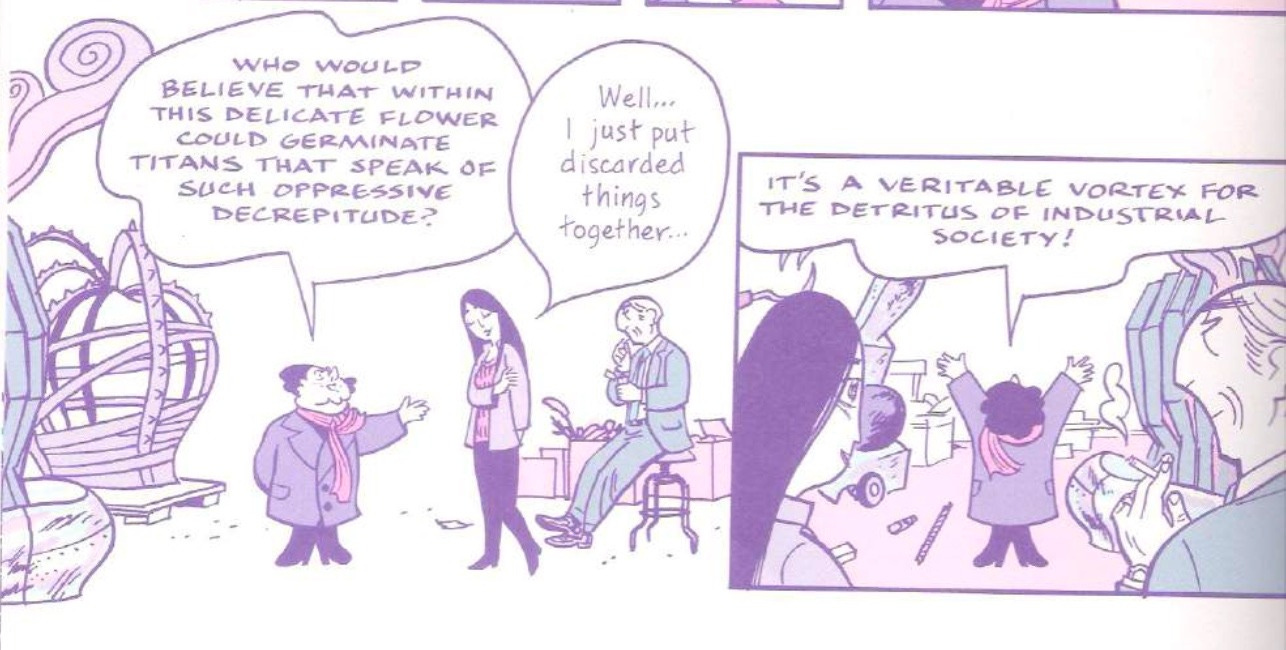
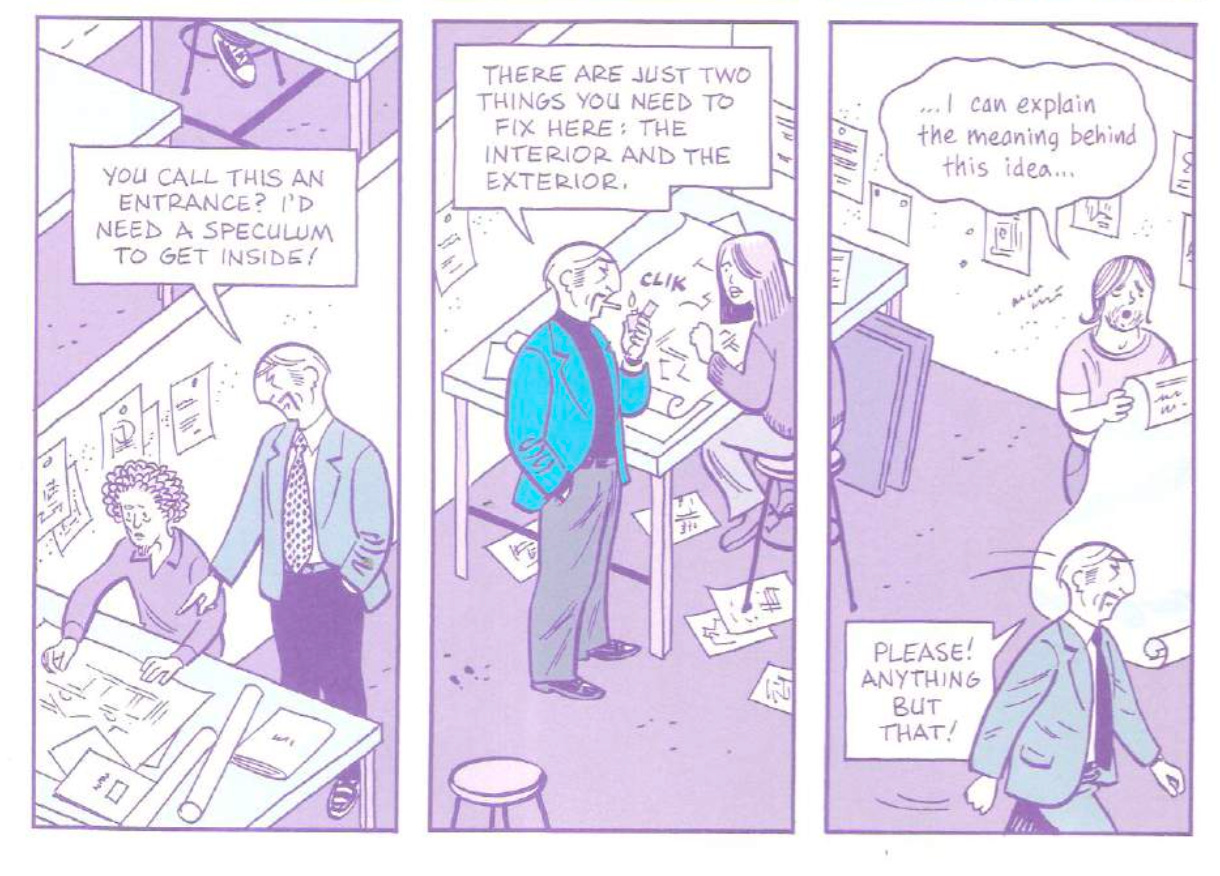
Graphic novels often aspire to be literature, and they succeed more frequently than most people think, but this one is a particularly clear example of actual graphic literature. But as Polyp says, perhaps trying to explain anymore is the last thing I want to do:
The Last Equation of Isaac Severy: A Novel in Clues
By: Nova Jacobs
Published: 2018
352 Pages
Briefly, what is this book about?
The book opens with the death of Isaac Severy, and while his death is somewhat mysterious, the true mystery is his last equation, or rather the math he died for. The main character is his adopted granddaughter Hazel, with the rest of his descendants filling out the list of secondary characters.
Who should read this book?
If you’re looking for a good mystery novel, this one is very enjoyable. (Though the core mathematical idea is obviously impossible…)
Specific thoughts: What’s the deal with Goodreads ratings?
I read a lot of science fiction and fantasy. And it’s not uncommon to see books in that genre with a 4.5 or 4.6 on Goodreads. (Sanderson’s Words of Radiance has a 4.76!) People are a lot harder on mysteries, so when my daughter and I went looking for a good mystery to read as part of our ongoing book club it was hard to find something that was a standout favorite. As far as I can tell there’s only one mystery of any sort that gets a 4.5. Put every Sherlock Holmes story together in a single book and it manages to eke out a 4.51. One of the Thursday Murder Club books also manages to get a 4.4 (I review the latest in that series next) though I would claim a certain degree of recency bias there. Beyond that there’s a couple of 4.3’s but all of the stuff that’s considered a classic basically comes in at 4.2 or lower. And Then There Were None? Agatha Christie’s most famous novel? 4.27! The Hound of the Baskervilles? 4.13!
So what rating did Last Equation end up with? 3.56.. Low enough that despite some good buzz I was nervous. I needn’t have been, it was quite enjoyable. The characters were appealing, the plot was sufficiently intricate. The ending was satisfying. Etc. I mean it didn’t change my life, but as a pleasurable diversion it more than met my expectations. So why the difference in the ratings between the two genres? That’s a good question and one I may explore further, but my initial guess is that the intensity of the fantasy fandom leads to “grade inflation”.
The Impossible Fortune: A Thursday Murder Club Mystery
By: Richard Osman
Published: 2025
368 Pages
Briefly, what is this book about?
The further adventures of the Thursday Murder Club, a group of four English pensioners, who solve old and new murders. This is the fifth book in the series, and in this one they are dealing with bitcoin, because at some point doesn’t everyone? It actually ends up being pretty clever for a story involving crypto. Also Ron, the former labour agitator, gets a nice arc.
Who should read this book?
I definitely wouldn’t start with book five, but I would recommend it to people who’ve read and enjoyed previous books in the series.
Specific thoughts: Does a good job of keeping things fresh
I’m impressed by Osman’s ability to come up with new twists. Obviously I don’t want to give those twists away, but I was definitely surprised by a couple of revelations. Not everything was probably as surprising as Osman hoped, but I’d say he was batting more than 50% which is quite good.
As usual the real appeal of the books is the four main characters. They continue to be charming and develop in interesting ways. And keeping things fresh for five books is no mean feat. We’ll have to see how much longer he can keep it up.
The Moviegoer
By: Walker Percy
Published: 1961
228 Pages
Briefly, what is this book about?
The main character of the novel, John “Binx” Bolling, is a stockbroker who feels that life resembles a meaningless movie. Enjoyable, but also purposeless. He describes being sunk in a “malaise” of “everydayness”.
He comes up with the idea of a “search” which will relieve him from these conditions. On one side is a succession of flings with the attractive secretaries which end mutually, but also miserably. On the other side is his family— particularly his Aunt, a formidable matriarch—who emphasizes a life of duty and contribution. Among other things, she wants him to abandon his current profession and go to medical school.
Who should read this book?
I came across this book on the excellent new podcast Old School from the Free Press. The host, Shilo Brooks, was interviewing Ryan Holiday, who recommended it. Holiday made a compelling case that this book takes direct aim at lives without meaning, and answers some of the deep questions everyone has. I would check out the podcast, and the Holiday episode. It’s titled “Read this book instead of Catcher in the Rye”. I couldn’t agree more.
Specific thoughts: Sometimes one scene can make an entire book.
The prose in this book is great. The description of Binx is psychologically interesting—believable but also strange. That said, there’s not much of a plot. Percy creates more of an atmosphere than a narrative, but near the end his Aunt lays into Binx, and it’s pure gold:
There is nothing to do but go directly in to her and stand at ease until she takes notice of me.
Now she looks over, as erect and handsome as the Black Prince.
“Yes?”
“I am sorry that through a misunderstanding or thoughtlessness on my part you were not told of Kate’s plans to go with me to Chicago. No doubt it was my thoughtlessness. In any case I am sorry and I hope that your anger—”
“Anger? You are mistaken. It was not anger. It was discovery.”
“Discovery of what?”
“Discovery that someone in whom you had placed great hopes was suddenly not there. It is like leaning on what seems to be a good stalwart shoulder and feeling it go all mushy and queer.”
We both gaze down at the letter opener, the soft iron sword she has withdrawn from the grasp of the helmeted figure on the inkstand.
“I am sorry for that.”
“The fact that you are a stranger to me is perhaps my fault. It was stupid of me not to believe it earlier. For now I do believe that you are not capable of caring for anyone, Kate, Jules, or myself“—no more than that Negro man walking down the street—less so, in fact, since I have a hunch he and I would discover some slight tradition in common.” She seems to notice for the first time that the tip of the blade is bent. “I honestly don’t believe it occurred to you to let us know that you and Kate were leaving, even though you knew how desperately sick she was. I truly do not think it ever occurred to you that you were abusing a sacred trust in carrying that poor child off on a fantastic trip like that or that you were betraying the great trust and affection she has for you. Well?” she asks when I do not reply.
I try as best I can to appear as she would have me, as being, if not right, then wrong in a recognizable, a right form of wrongness. But I can think of nothing to say.
The interaction goes on, and gets even better, but I think that last line is an appropriate place to cut. I’m familiar with this longing. I know when I was younger I often wanted to be wrong in the right way. I’m sure this is the curmudgeon in me, but these days people aren’t merely wrong, the wrong in the wrongest of ways.
Academy of Outcasts
By: Larry Correia
Published: 2025
400 Pages
Briefly, what is this book about?
The first book in a new series. It’s basically a D&D campaign. There are seven worlds representing seven different elements, all connected to “Core”. The great city at the center of it all. The main character Oz Carnavon is from the world of fire and he wants to become a mage. That’s a very hard nut to crack, but along the way he manages to collect the other members of his “party”. That process has been compared by some (in other reviews) as being similar to Guardians of the Galaxy.
Who should read this book?
I really enjoy Correia, and if you fall into the same category, then this is a Correia book, and you’ll probably get the same amount of enjoyment as you got out of his other books. Though I will say that with this one I noticed a couple of big plot holes that kind of bugged me. (Will discuss over DM if curious.) Not sure if he’s getting a little bit sloppy, or if I’m getting slightly more critical.
Specific thoughts: Lots of nice hooks, let’s hope they pay off
Evaluating the first book in a series immediately after it’s released is obviously a different discipline than evaluating a completed series. Any book should stand on its own, but the beginning of a series needs to exhibit potential, because potential translates into excitement, and excitement translates into future book sales. So how does this book do on that count? Quite well I would argue.
Without really spoiling anything here are a few hooks that appear to have lots of potential:
Carnavon’s desire for vengeance, and the mystery of his “enemy”.
The complete closure of the portal to the world of time.
The fallen tower of Primopolus.
The various factions which have been introduced.
The potentiality of higher “ranks” of magic.
There are several more I could list if I didn’t care about spoilers. I’m excited to see where it goes. But then I’m always excited by the potential of beginning a new D&D campaign.
—-------------------------------------------------------------------------
If I were to choose a common thread for these reviews I might come up with some BS about meaning or purpose. Or I could be cute and say the common thread is that I read them all. I actually hope that there is no common thread. I want this to be an eclectic mix, which resists categorization. Hopefully that’s a good description of my reading tastes in general. If you want to see more eclectic reviews check out the archives, or if you have a suggestion for an eclectic book feel free to DM me.