

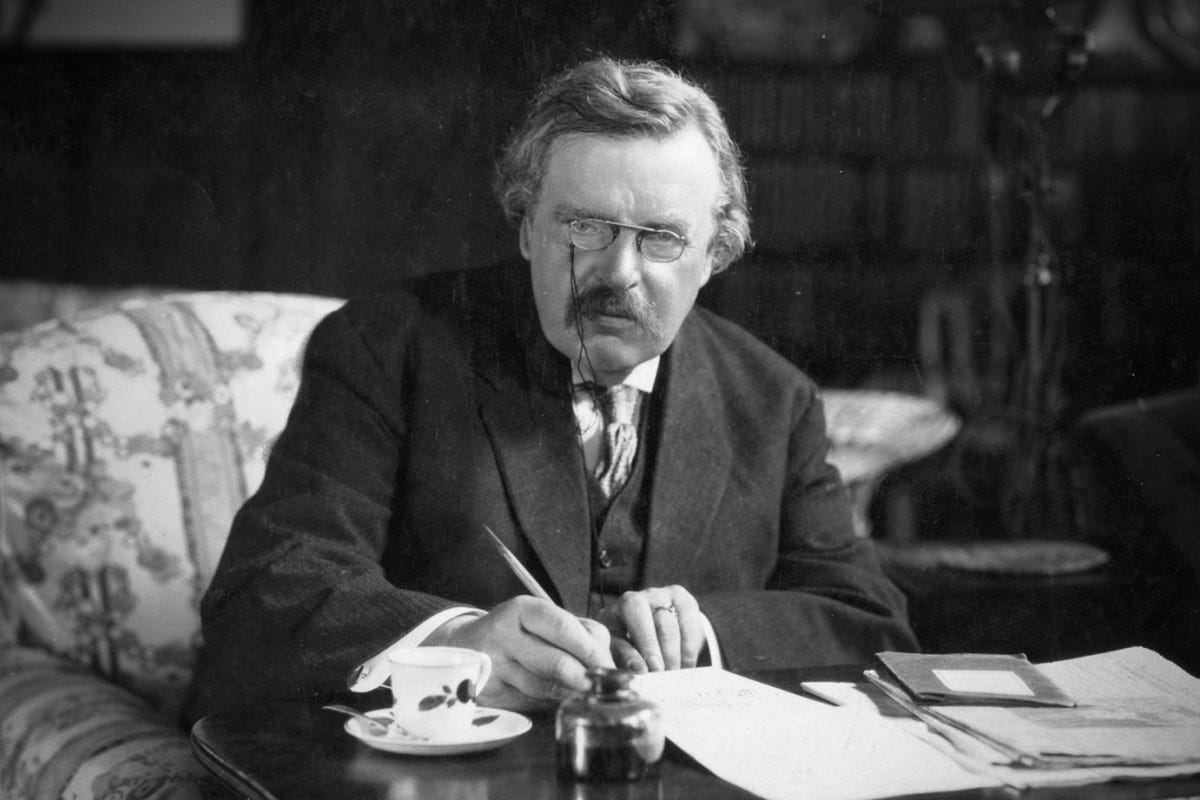
By: G. K. Chesterton
Published: 1922
188 Pages
Briefly, what is this book about?
Once this book entered the public domain, someone (most likely Inkling Books) added a subtitle to their edition: “An Argument Against the Scientifically Organized State”. This is a pretty good description of the book’s thrust, though the book’s major focus is still definitely eugenics.
When the book was written eugenics was a powerful political force, supported by numerous well known individuals. Buck v. Bell, the famous case which approved involuntary sterilization, didn’t arrive until 1927. This is where we get the infamous line from Oliver Wendell Holmes Jr. writing for the majority, “Three generations of imbeciles are enough.” Though it was only when researching this piece that I discovered that the ruling explicitly invoked the precedent already set around compulsory vaccination.
The full context is:
We have seen more than once that the public welfare may call upon the best citizens for their lives. It would be strange if it could not call upon those who already sap the strength of the State for these lesser sacrifices, often not felt to be such by those concerned, in order to prevent our being swamped with incompetence. It is better for all the world if, instead of waiting to execute degenerate offspring for crime or to let them starve for their imbecility, society can prevent those who are manifestly unfit from continuing their kind. The principle that sustains compulsory vaccination is broad enough to cover cutting the Fallopian tubes. Jacobson v. Massachusetts, 197 U. S. 11. Three generations of imbeciles are enough.
What authorial biases should I be aware of?
You’re probably already aware of Chesterton’s biases, though in addition to being very Catholic, and very traditional, he was also a big supporter of the “little guy”. This comes out a lot in this book since eugenics seems primarily aimed at the “unwashed masses”, not the inbred nobility.
Who should read this book?
I have previously mentioned that I am gradually working through an ebook I picked up many years ago collecting Chesterton’s best-known works. This happened to be next on the list. I wouldn’t recommend it as the first Chesterton you read, or even the fifth, but it gives a great insight into a particular time and place, and puts you in the middle of an argument we consider long settled but which was raging at the time.
What does the book have to say about the future?
I think there’s a lot that could be taken from this book and applied to the current debate over MAID (medical aid in dying). It will be interesting to see if that practice ends up following a similar arc.
Specific thoughts: Chesterton’s surprisingly prescient archetypes
Every time I read a Chesterton book I think “I should probably just mostly quote Chesterton”, but then I decide that’s cheating, so I don’t. This time I’m going to ignore the strange pseudo-puritanism that gives rise to that thought and just go for it. There is one section of the book I was particularly struck by, because it seemed like he was precisely describing our present moment. He was explaining the categories of people one encounters on the pro-eugenics side of the debate. I might call them busy-bodies, bureaucrats, pundits, or even self-described experts. He calls them sects. Here are five of them:
The first sect is the Euphemists. Here’s how he describes them:
Short words startle them, while long words soothe them. And they are utterly incapable of translating the one into the other, however obviously they mean the same thing. Say to them “The persuasive and even coercive powers of the citizen should enable him to make sure that the burden of longevity in the previous generation does not become disproportionate and intolerable, especially to the females”; say this to them and they will sway slightly to and fro like babies sent to sleep in cradles. Say to them “Murder your mother,” and they sit up quite suddenly. Yet the two sentences, in cold logic, are exactly the same.
I don’t want to make this all about present day culture wars, but I think you can probably identify where this is happening in our own time.
The second sect is the Casuists. This is Chesterton’s term for people who engage in Motte and Bailey tactics. These are eugenicists who claim that eugenics is just limited to things like making sure people with severe mental disabilities aren’t allowed to reproduce, but whose actual policy proposals involve requiring government approval of each and every marriage.
The third sect is the Autocrats:
They are those who give us generally to understand that every modern reform will “work” all right, because they will be there to [over]see it…Each man promises to be about a thousand policemen. If you ask them how this or that will work, they will answer, “Oh, I would certainly insist on this”; or “I would never go so far as that”; as if they could return to this earth and do what no ghost has ever done quite successfully—force men to forsake their sins. Of these it is enough to say that they do not understand the nature of a law any more than the nature of a dog. If you let loose a law, it will do as a dog does. It will obey its own nature, not yours.
I feel like I see this a lot. Many new policies have been defended by saying that, “well people would never do that.” Or “we would never allow that.” “You’re worried about nothing.” and then of course it proceeds in exactly that fashion. Referring back to MAID, in 2016 Canadians were assured that MAID would only ever be offered to people whose death could be reasonably foreseen. In 2021, just five years later, that requirement was removed. They were also assured that poor people would never be pushed into it, and yet that’s what happened with “Sophie” who resorted to it when she couldn’t find housing.
The fourth sect he calls the Idealists:
…strange people who seem to think that you can consecrate and purify any campaign for ever by repeating the names of the abstract virtues that its better advocates had in mind. These people will say “So far from aiming at slavery, the Eugenists are seeking true liberty; liberty from disease and degeneracy, etc.” Or they will say “We can assure Mr. Chesterton that the Eugenists have no intention of segregating the harmless; justice and mercy are the very motto of——” etc.
“Abolishing the police can’t possibly result in an increase in violence. The police abolition movement is a nonviolent movement entirely dedicated to reducing violence through increased understanding!”
And finally there are the Endeavourers:
The prize specimen of them was another M.P. who defended the same Bill as “an honest attempt” to deal with a great evil: as if one had a right to dragoon and enslave one’s fellow citizens as a kind of chemical experiment; in a state of reverent agnosticism about what would come of it.
I know I’ve heard “Well we have to do something about X!” a lot, and there’s often no regard to whether that something will do anything about the underlying problem, but at least it will be, as Chesterton says, “an honest attempt”.
I understand not everyone shares my fondness for Chesterton. If so, I’ve got bad news for you, because I’m going to include a couple more quotes illustrating Chesterton’s interesting relationship to socialism:
The curious point is that the [letter writer] concludes by saying, “When people have large families and small wages, not only is there a high infantile death-rate, but often those who do live to grow up are stunted and weakened by having had to share the family income for a time with those who died early. There would be less unhappiness if there were no unwanted children.” You will observe that he tacitly takes it for granted that the small wages and the income, desperately shared, are the fixed points, like day and night, the conditions of human life. Compared with them marriage and maternity are luxuries, things to be modified to suit the wage-market. There are unwanted children; but unwanted by whom? This man does not really mean that the parents do not want to have them. He means that the employers do not want to pay them properly.
This is a great example of being economically on the left, but culturally on the right. But Chesterton makes it clear that he’s not a socialist:
It may be said of Socialism, therefore, very briefly, that its friends recommended it as increasing equality, while its foes resisted it as decreasing liberty. On the one hand it was said that the State could provide homes and meals for all; on the other it was answered that this could only be done by State officials who would inspect houses and regulate meals. The compromise eventually made was one of the most interesting and even curious cases in history. It was decided to do everything that had ever been denounced in Socialism, and nothing that had ever been desired in it. Since it was supposed to gain equality at the sacrifice of liberty, we proceeded to prove that it was possible to sacrifice liberty without gaining equality. Indeed, there was not the faintest attempt to gain equality, least of all economic equality. But there was a very spirited and vigorous effort to eliminate liberty, by means of an entirely new crop of crude regulations and interferences. But it was not the Socialist State regulating those whom it fed, like children or even like convicts. It was the Capitalist State raiding those whom it had trampled and deserted in every sort of den, like outlaws or broken men. It occurred to the wiser sociologists that, after all, it would be easy to proceed more promptly to the main business of bullying men, without having gone through the laborious preliminary business of supporting them. After all, it was easy to inspect the house without having helped to build it; it was even possible, with luck, to inspect the house in time to prevent it being built.
Who would have known that Chesterton would turn out to have been the first YIMBY…
—-----------------------------------------------
One final quote:
The Frenchman works until he can play. The American works until he can’t play; and then thanks the devil, his master, that he is donkey enough to die in harness. But the Englishman, as he has since become, works until he can pretend that he never worked at all.
While I would like to be the Frenchman, or even the Englishman, I expect that I am a legitimate American, and I’ll die in harness, i.e. I’ll be writing these reviews till the bitter end. If you’re interested in getting in early on the long downward spiral consider subscribing.
> Short words startle them, while long words soothe them
Orwell makes a very similar point in Politics and the English Language.
I'm not sure MAID is a good analogy for eugenics. Leaving aside eugenics was more focused on breeding than dying. We do in the modern world have a lot of people dabbling with eugenics and human breeding but they are centering themselves on one side of the spectrum. Just hinting.
I think the appeal is a bit like flat earthism but stronger. It has the common sense appeal, don't we like some genes more than others? Don't we do it all the time not only with animals but plants? Are there really no cases of "three generations of imbeciles"?
The argument for it lends itself to a lot of pithy phrases and slogans. It also lends itself to ego heavy characters puffing themselves up as "men (it's always men) who can make the hard call without the emotionalism!". The arguments against it are, well, a book and we seem to be moving out of the age when book level arguments are even considered.
"In 2021, just five years later, that requirement was removed. They were also assured that poor people would never be pushed into it, and yet that’s what happened with “Sophie” who resorted to it when she couldn’t find housing."
Ok but like many of these cases, the claim seems more geared for the sensational story. Nowhere do I find any source that claims she got MAID because she was poor or couldn't find housing? Actually it wasn't that she couldn't find housing but she claimed she had 'multiple chemical sensitivity' making any home unacceptable if there were traces of a host of things like previous smokers, detergent or perfume.
But we don't actually know anything about her or the circumstances of her death. The gov't can't release medical records and even her name is hidden from us because her family insists on not releasing it.
I'd seriously issue these challenges then:
1. Has the age adjusted Canadian death rate increased? If it hasn't that is a sign MAID is getting overly hyped. While that doesn't mean there won't be questionable cases it would indicate that it is being used by people who would not normally have lived much longer.
2. Has the suicide rate dramatically decreased? Obviously if MAID has started being used by people it wasn't really meant for, the most obvious population would be those who would have committed suicide but now have a gov't option to help them provided they say the right things to the right doctors. Wouldn't that show up then in an odd decline in the suicide rate?
This might not be a sure fire proof. I could see a counter argument that many suicides prefer the illegal method they choose or are impulsive so MAID being an available option wouldn't impact the suicide rate much.