

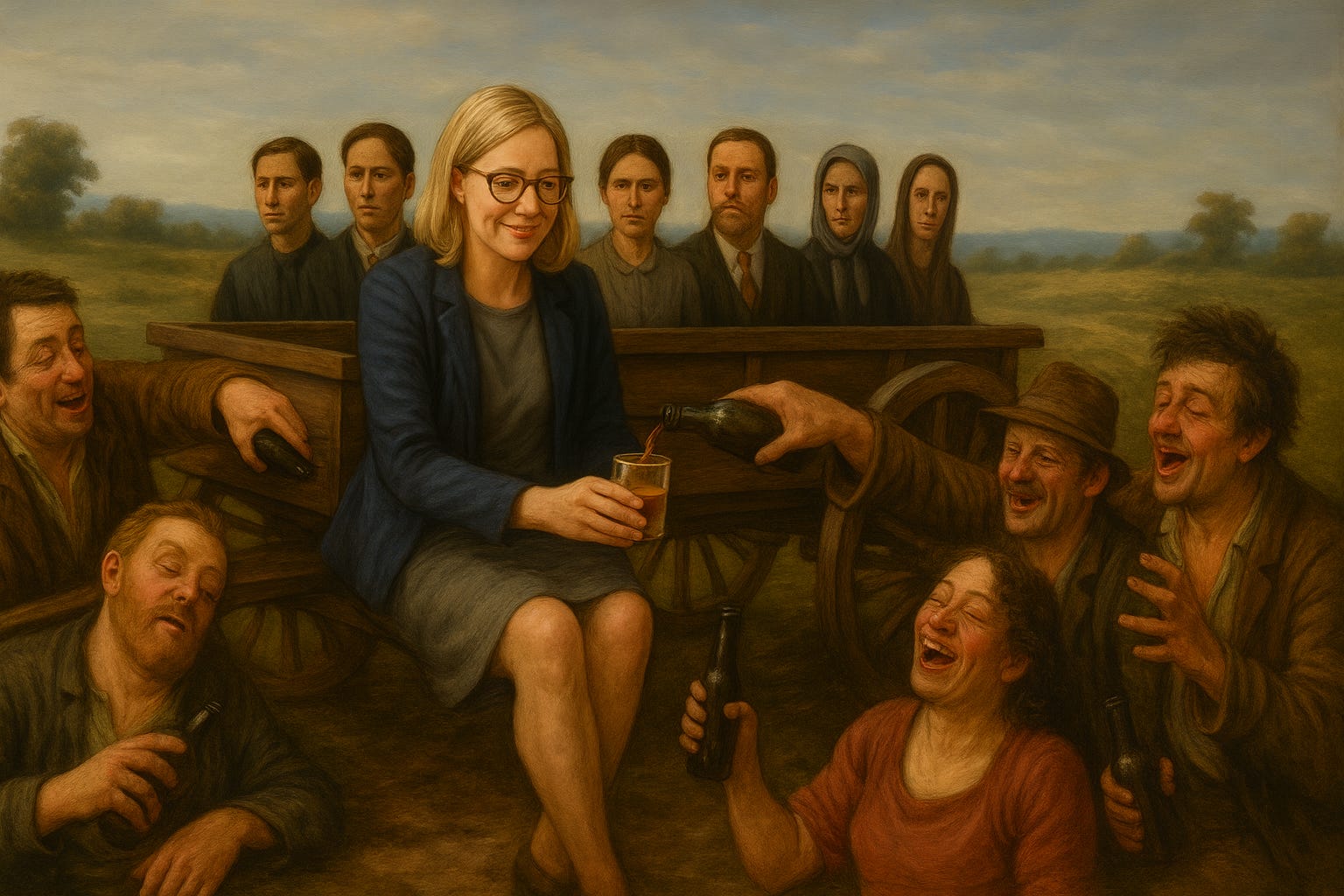
Drink Your Way Sober: The Science-Based Method to Break Free from Alcohol
By: Katie Herzog
Published: 2025
208 Pages
Briefly, what is this book about?
You may be familiar with Katie Herzog from Blocked and Reported, the podcast she hosts with Jesse Singal. Or you might have seen her byline on the Free Press. What I didn’t know (at least before she started promoting this book) is that she’s also a recovering alcoholic. I also didn’t know about the Sinclair Method for “extinguishing” alcohol use disorder (AUD). Finally I didn’t know that we are now calling it alcohol use disorder. So you could say this is a book about a bunch of things I didn’t know.
What’s the author’s angle?
Herzog failed to get her drinking under control using any of the more common methods. Willpower, Alcoholics Anonymous (AA), overwhelming shame, etc. The Sinclair Method was what finally worked for her. This method involves taking naltrexone before you drink. This blocks the reward circuit allowing you to train your body out of alcohol dependence. It’s also something that not a lot of people have heard about, so her angle resembles that of a fiery recent convert, who believes that people trapped in similar despair need to hear the good word.
Who should read this book?
As someone who’s never had a drink, I’m loath to recommend anything in the sobriety space. In the same manner that a fish doesn’t know about water, can I have anything meaningful to say about sobriety? That very large caveat aside, if you have AUD, and nothing else has worked, and you haven’t tried the Sinclair Method (or if you know someone who fits this category) I would definitely recommend this book.
If you’re thinking of reading it just as Herzog memoir, there’s some pretty good stuff in here, but not enough to justify reading the entire book. But if you’re on the fence I would push you towards getting the book.
Specific thoughts: So why isn’t the Sinclair Method better known?
This book belongs to a loose genre of books that we might call “X seems straightforwardly good. It’s amazing that we don’t do more of X. Why is that?” (I’ll have to work on making the title of the category more pithy.)
Oftentimes books in this genre point towards sinister cabals. “Big Timber killed hemp because the paper was so much better!” Or they’ll come up with a name for a broad class of selfish behavior: NIMBYism, puritanical overreach, a moral panic, etc. Or they might direct your attention to a single law with perverse second order effects no one expected: The Jones Act, California Prop 13, employer-sponsored Healthcare tax exclusion, etc.
This book doesn’t do that. Which is to its credit. Sometimes there is a single phenomenon that explains the whole problem, or a single decision that has enormous downstream consequences, but most of the time lots of little things combine to create the world as we see it. None of these things are sufficient all by themselves, but together they can create spots of extreme irrationality. As Herzog examines the reasons behind the relative obscurity of the Sinclair Method, that’s what we find. It’s a combination of:
No profit motive. Naltrexone is old and generic; So no pharma company has any profit incentive to hawk it as the latest thing.
Perverse incentives in the rehab industry. There are lots of residential programs that make a lot of money housing people for weeks at a time. A cheap, generic pill that requires little or no housing doesn’t fit that model.
Drug guidelines are kind of blunt instruments. They’re designed around daily dosing, or responding to symptoms. Take before alcohol is a weird category.
It’s a bad look for doctors to encourage alcoholics to drink.
Most doctors don’t know about it and there’s not much incentive for them to learn about it. (See pharma incentives above.)
Abstinence and AA are the dominant methodologies. Saying “take a pill and then drink” feels like a betrayal.
The last one is probably the biggest, but even then you can’t point to a coordinated effort to kill the Sinclair Method by “Big AA”. It’s just the way things have evolved.
If you could point to one big thing then maybe Herzog would have been better off trying to undo that big thing, but as is so often the case this problem doesn’t have just one weak spot. There’s no law which could be overturned or conversely a law which could be passed that would make everything better. It’s a matter of awareness, and the best way to change awareness is to talk about it. In this case Herzog wrote a book, and I wish her all possible luck in her efforts.
Was writing a book really the best play for Herzog? If you listen to her podcast (which I would definitely recommend) it’s clear that she’s not sure. I wonder the same thing. I still aspire to write a book, but as it turns out (and I keep forgetting this) running a business is hard. Perhaps short essays (which I’m not doing a lot of either) is a better format? Or perhaps I should actually start a Tiktok channel? Actually that would be the sign that I have become an alcoholic. Because I would have to be some form of impaired to ever consider doing that. Until such time as I fall off the wagon I’ll be putting out these reviews and the occasional essays. If you enjoy them consider subscribing or checking out the archive, or leaving a like.
I dodged the addictive impulse despite both parents having a bout with the bottle in their time. I'll have a drink if someone else is buying but lack the impulse to over do it.
I should consider grabbing some Naltrexone before loading up Civilization, though.